

SEMI, the semiconductor trade group whose members include Micron, Samsung, and SK Hynix, has warned senior Trump administration officials in a July 1 letter that U.S. attempts to steer memory-chip prices or production capacity could worsen the shortage now squeezing AI data centers and consumer electronics. The warning, first reported by Bloomberg and summarized by Data Center Dynamics, is not a routine lobbying note. It is the memory industry telling Washington that the crisis is real, but that the obvious political response may be the wrong one.
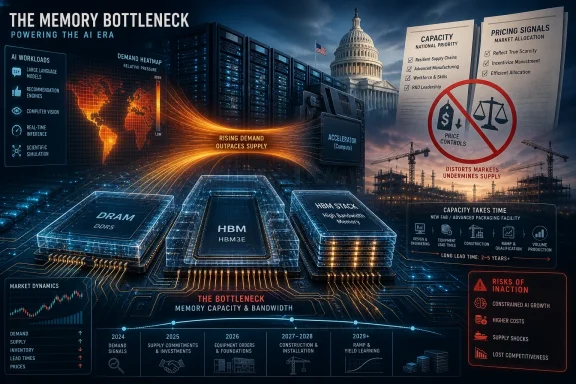
The argument deserves attention because memory has quietly become the pressure point of the AI economy. GPUs get the headlines, power gets the permitting fights, and data centers get the zoning battles, but DRAM and high-bandwidth memory are where the promise of “more AI” collides with factory physics. SEMI’s message is blunt: if the government tries to pick winners, cap prices, redirect supply, or pressure producers into politically attractive capacity decisions, it may simply make a constrained market more brittle.
The United States has spent the past several years trying to relearn industrial policy in public. The CHIPS Act framed semiconductor manufacturing as a strategic asset rather than just another supply chain, and that shift was not wrong. The pandemic exposed the fragility of global chip logistics, China policy turned fabs into geopolitical infrastructure, and AI has now made memory a national competitiveness issue.
But memory is not the same kind of bottleneck as the pandemic-era automotive chip shortage. That crisis was partly a story of legacy nodes, cancelled orders, and carmakers discovering that “just in time” can become “not at all.” The memory crunch is more structural. It is not merely that too few chips exist; it is that the most profitable customers are absorbing the capacity that might otherwise serve PCs, phones, networking gear, vehicles, and appliances.
According to Bloomberg’s reporting, SEMI’s letter was sent to Treasury Secretary Scott Bessent, Defense Secretary Pete Hegseth, Commerce Secretary Howard Lutnick, and Secretary of State Marco Rubio. That distribution list tells the story. Memory is no longer just a component category managed by procurement departments. It now sits at the intersection of tax policy, defense readiness, trade strategy, and AI infrastructure.
SEMI’s line is carefully drawn. The group is not arguing against government involvement altogether. It says targeted policy can accelerate domestic supply resilience, and it is asking for tax breaks that would encourage more U.S. production capacity. What it opposes is intervention that distorts pricing or capacity decisions, the sort of move that sounds satisfying in a hearing room but can spook a market that already runs on long planning cycles.
That is why SEMI’s defense of long-term purchase agreements matters. To critics, those agreements may look like hoarding by the largest buyers. To memory makers, they are the bankable commitments that justify expensive capacity expansions in a historically cyclical business. DRAM manufacturers have been burned before by overbuilding into a downturn, and the industry has not forgotten how quickly a shortage can become a glut.
The Wall Street Journal, citing TrendForce, reported earlier this year that data centers could consume up to 70 percent of memory produced worldwide in 2026. Whether that precise number ultimately holds or not, the direction is clear enough: the center of gravity has shifted from consumer devices to server infrastructure. A Windows laptop buyer waiting for DDR5 prices to normalize is now competing, indirectly, with hyperscalers building AI clusters.
That is a profoundly different market from the one PC enthusiasts grew up with. Memory used to feel like the commodity part of the build, the line item you upgraded when prices dipped. In the AI cycle, memory is strategic inventory. The same factories that feed DIMMs into desktops are being asked to feed HBM stacks into accelerators, and those products do not carry the same margins, packaging demands, or customer urgency.
SEMI’s warning is that this would mistake high prices for the root problem. In a constrained market, prices are not just a burden; they are also a signal. They tell producers where demand is strongest, tell customers where substitution or redesign may be necessary, and tell investors where new capacity might earn a return. Suppress that signal too aggressively, and the system does not magically produce more DRAM. It produces confusion.
Memory fabs are not pop-up factories. Capacity decisions involve years of capital spending, equipment orders, process qualification, customer validation, and yield learning. If the government signals that profits will be capped when supply tightens but losses remain private when demand falls, the incentive to build ahead of demand weakens. That is the nightmare scenario SEMI is trying to avoid.
This is not a defense of laissez-faire as a religion. The semiconductor market is already shaped by export controls, subsidies, national security reviews, tax incentives, energy policy, and trade restrictions. The question is not whether government is involved. The question is whether intervention increases supply over the medium term or merely reallocates pain over the next quarter.
There is a self-serving element here, of course. Trade associations exist to protect member companies, and SEMI’s members include firms benefiting from the memory upswing. Micron, Samsung, and SK Hynix do not need to be portrayed as public utilities to be understood as strategic suppliers. They want the upside of public support without the downside of public direction.
But the self-interest does not make the argument wrong. Memory is a brutal business precisely because it swings between famine and flood. When demand is hot, customers accuse suppliers of rationing. When supply catches up, prices collapse and the same suppliers write down inventory. Any policy that ignores that cycle risks producing the next shortage by overcorrecting the current one.
The harder question is whether incentives alone can protect downstream industries that lack hyperscaler purchasing power. A medical device maker, a router vendor, or a mid-tier PC manufacturer cannot necessarily outbid an AI infrastructure giant. If government does nothing but subsidize capacity, the new supply may still flow first to the richest customers. That is where SEMI’s case is strongest economically but weakest politically.
The effect is especially irritating because Windows itself is moving in the opposite direction. AI features, local models, browser workloads, collaboration apps, endpoint security agents, and virtualization all reward more memory, not less. Microsoft and PC OEMs can talk about the AI PC as the next mainstream device category, but the category becomes less persuasive if memory pricing makes decent configurations feel premium.
Gamers and enthusiasts will see the pain earlier because component markets price scarcity quickly. System builders may respond by cutting storage, delaying GPU upgrades, or buying slower kits. Enterprises will respond more quietly, by extending device lifecycles and narrowing standard configurations. Neither response is catastrophic, but both are drag.
That drag matters because it arrives after years of messaging that Windows 11-era hardware should be more capable, more secure, and more AI-ready. If memory shortages keep mainstream PCs underconfigured, the software stack will outrun the installed base. That does not stop Microsoft’s roadmap, but it does make adoption uneven, especially outside large organizations that can negotiate supply.
High-bandwidth memory is the clearest example. HBM is not just “faster RAM.” It is a tightly packaged, technically demanding product linked to AI accelerators and advanced packaging capacity. When a supplier shifts resources toward HBM, it may not be a simple matter of turning around and producing more commodity DRAM for PCs next month. The bottlenecks overlap, but they are not interchangeable.
That is why a shortage can coexist with aggressive investment. Memory makers can be spending billions and still not satisfy the market segments that feel squeezed. The new capacity may be aimed at the highest-margin, most strategically important products. Consumers then hear that investment is booming while the RAM kit in their shopping cart still costs too much.
From Washington’s perspective, this looks like a distribution problem. From the supplier’s perspective, it is a return-on-capital problem. From the user’s perspective, it is just a price tag. The policy fight begins when those three interpretations collide.
That memory is now prompting concern from industries beyond computing should surprise no one. Vehicles, medical devices, telecommunications equipment, and defense systems all depend on memory components. If AI data centers absorb the premium supply and prices rise across the stack, the pain will not stay inside server rooms.
But the auto lesson is not simply “government should intervene faster.” It is also “bad forecasts and brittle procurement models create exposure.” During the pandemic, some automakers cancelled or reduced orders just as consumer electronics demand surged, then struggled to regain priority. Today, companies outside AI may need to rethink memory procurement as a strategic function rather than a commodity purchase.
That does not absolve government of responsibility. Defense and critical infrastructure needs may justify special treatment in extreme cases. But broad attempts to micromanage commercial allocation could recreate the very uncertainty that made suppliers reluctant to build too aggressively in previous cycles.
The danger is that “national security” can become a universal solvent for bad policy. If every downstream customer claims strategic importance, allocation becomes political. If every shortage becomes proof of market failure, price signals become suspect. If every supplier is treated as a quasi-state actor, investment decisions slow under the weight of political risk.
The better national security strategy is boring but durable: expand allied capacity, improve supply-chain visibility, support advanced packaging, train the workforce, secure materials, and make permitting less self-defeating. These moves do not deliver the instant gratification of ordering companies to lower prices. They do, however, increase the odds that the next demand shock is less severe.
SEMI’s letter is best read as a plea to keep policy on that track. It praises the administration’s efforts to bolster memory capacity for AI and data center infrastructure while warning against interference that would distort the market. That is diplomatic language, but the subtext is not subtle: help us build, but do not tell us how to sell.
This is how a data center boom becomes a household electronics story. The shortage does not have to stop production outright to matter. It can raise bill-of-materials costs, encourage vendors to ship less generous base models, delay product launches, and make upgrades feel irrational. A user who postpones a RAM upgrade for six months is invisible in macroeconomic terms, but millions of such decisions reshape the PC market.
There is also a software consequence. Developers target the machines users actually have, not the machines marketing departments wish they had. If mainstream systems remain memory-constrained, local AI features will either be limited to premium hardware or offloaded to the cloud. That reinforces the data center demand that helped create the shortage in the first place.
This feedback loop is easy to miss. Scarce memory makes capable local devices more expensive. Less capable local devices push more computation to cloud services. Cloud services require more data center memory. The market then circles back to the same bottleneck.
Neither side has a monopoly on wisdom. The market did not produce a comfortably resilient semiconductor supply chain on its own. It optimized for cost, concentration, and utilization until shocks exposed the fragility. But governments also have a poor record of fine-tuning fast-moving technology markets once scarcity creates political heat.
The useful distinction is between shaping capacity and dictating allocation. Shaping capacity means making it easier and more attractive to build fabs, packaging facilities, and materials supply in trusted geographies. Dictating allocation means deciding which buyers deserve chips at which prices. The first is difficult but necessary. The second is tempting but dangerous.
If Washington wants more memory supply, it should focus on the conditions that make supply expansion rational. If it wants affordability for consumers, it should be honest that affordability may require either more supply, lower demand, or subsidies somewhere in the chain. What it cannot do is wish away scarcity by administrative pressure.
The argument deserves attention because memory has quietly become the pressure point of the AI economy. GPUs get the headlines, power gets the permitting fights, and data centers get the zoning battles, but DRAM and high-bandwidth memory are where the promise of “more AI” collides with factory physics. SEMI’s message is blunt: if the government tries to pick winners, cap prices, redirect supply, or pressure producers into politically attractive capacity decisions, it may simply make a constrained market more brittle.
 Washington Has Found the Next Chip Crisis, but Not Its Shape
The United States has spent the past several years trying to relearn industrial policy in public. The CHIPS Act framed semiconductor manufacturing as a strategic asset rather than just another supply chain, and that shift was not wrong. The pandemic exposed the fragility of global chip logistics, China policy turned fabs into geopolitical infrastructure, and AI has now made memory a national competitiveness issue.But memory is not the same kind of bottleneck as the pandemic-era automotive chip shortage. That crisis was partly a story of legacy nodes, cancelled orders, and carmakers discovering that “just in time” can become “not at all.” The memory crunch is more structural. It is not merely that too few chips exist; it is that the most profitable customers are absorbing the capacity that might otherwise serve PCs, phones, networking gear, vehicles, and appliances.
According to Bloomberg’s reporting, SEMI’s letter was sent to Treasury Secretary Scott Bessent, Defense Secretary Pete Hegseth, Commerce Secretary Howard Lutnick, and Secretary of State Marco Rubio. That distribution list tells the story. Memory is no longer just a component category managed by procurement departments. It now sits at the intersection of tax policy, defense readiness, trade strategy, and AI infrastructure.
SEMI’s line is carefully drawn. The group is not arguing against government involvement altogether. It says targeted policy can accelerate domestic supply resilience, and it is asking for tax breaks that would encourage more U.S. production capacity. What it opposes is intervention that distorts pricing or capacity decisions, the sort of move that sounds satisfying in a hearing room but can spook a market that already runs on long planning cycles.
The Memory Shortage Is an AI Allocation Crisis
The immediate villain is not a failed factory or a single export restriction. It is the explosive demand for AI infrastructure, which has changed the hierarchy of memory customers. Data center operators and AI accelerator vendors are willing to sign long-term agreements, pay premiums, and lock in supply years ahead because memory is not optional for training and inference systems. The result is that everyone else is pushed down the allocation ladder.That is why SEMI’s defense of long-term purchase agreements matters. To critics, those agreements may look like hoarding by the largest buyers. To memory makers, they are the bankable commitments that justify expensive capacity expansions in a historically cyclical business. DRAM manufacturers have been burned before by overbuilding into a downturn, and the industry has not forgotten how quickly a shortage can become a glut.
The Wall Street Journal, citing TrendForce, reported earlier this year that data centers could consume up to 70 percent of memory produced worldwide in 2026. Whether that precise number ultimately holds or not, the direction is clear enough: the center of gravity has shifted from consumer devices to server infrastructure. A Windows laptop buyer waiting for DDR5 prices to normalize is now competing, indirectly, with hyperscalers building AI clusters.
That is a profoundly different market from the one PC enthusiasts grew up with. Memory used to feel like the commodity part of the build, the line item you upgraded when prices dipped. In the AI cycle, memory is strategic inventory. The same factories that feed DIMMs into desktops are being asked to feed HBM stacks into accelerators, and those products do not carry the same margins, packaging demands, or customer urgency.
Price Controls Would Treat the Symptom as the Disease
The political temptation is obvious. If memory prices rise, Washington can accuse producers of profiteering. If automakers, telecom providers, defense contractors, and device makers complain about allocation, officials can demand that supply be redirected. If AI data centers are seen as consuming too much, policymakers can threaten to prioritize “essential” industries.SEMI’s warning is that this would mistake high prices for the root problem. In a constrained market, prices are not just a burden; they are also a signal. They tell producers where demand is strongest, tell customers where substitution or redesign may be necessary, and tell investors where new capacity might earn a return. Suppress that signal too aggressively, and the system does not magically produce more DRAM. It produces confusion.
Memory fabs are not pop-up factories. Capacity decisions involve years of capital spending, equipment orders, process qualification, customer validation, and yield learning. If the government signals that profits will be capped when supply tightens but losses remain private when demand falls, the incentive to build ahead of demand weakens. That is the nightmare scenario SEMI is trying to avoid.
This is not a defense of laissez-faire as a religion. The semiconductor market is already shaped by export controls, subsidies, national security reviews, tax incentives, energy policy, and trade restrictions. The question is not whether government is involved. The question is whether intervention increases supply over the medium term or merely reallocates pain over the next quarter.
The Industry Wants Subsidy Without Command
SEMI’s preferred answer is familiar: encourage production, do not command it. Tax breaks, accelerated depreciation, investment credits, and permitting support all let the government push the market in a desired direction without telling manufacturers exactly what to make or whom to sell to. That is industrial policy by incentive rather than industrial policy by spreadsheet.There is a self-serving element here, of course. Trade associations exist to protect member companies, and SEMI’s members include firms benefiting from the memory upswing. Micron, Samsung, and SK Hynix do not need to be portrayed as public utilities to be understood as strategic suppliers. They want the upside of public support without the downside of public direction.
But the self-interest does not make the argument wrong. Memory is a brutal business precisely because it swings between famine and flood. When demand is hot, customers accuse suppliers of rationing. When supply catches up, prices collapse and the same suppliers write down inventory. Any policy that ignores that cycle risks producing the next shortage by overcorrecting the current one.
The harder question is whether incentives alone can protect downstream industries that lack hyperscaler purchasing power. A medical device maker, a router vendor, or a mid-tier PC manufacturer cannot necessarily outbid an AI infrastructure giant. If government does nothing but subsidize capacity, the new supply may still flow first to the richest customers. That is where SEMI’s case is strongest economically but weakest politically.
Windows Users Will Feel the Shortage in Boring, Expensive Ways
For WindowsForum readers, the memory crunch is not an abstraction. It shows up as higher RAM prices, thinner entry-level configurations, delayed refresh cycles, and OEMs making awkward compromises. A laptop that should ship with 16GB may cling to 8GB. A workstation buyer may find ECC memory harder to source. A small business may stretch older hardware because the economics of replacement no longer work.The effect is especially irritating because Windows itself is moving in the opposite direction. AI features, local models, browser workloads, collaboration apps, endpoint security agents, and virtualization all reward more memory, not less. Microsoft and PC OEMs can talk about the AI PC as the next mainstream device category, but the category becomes less persuasive if memory pricing makes decent configurations feel premium.
Gamers and enthusiasts will see the pain earlier because component markets price scarcity quickly. System builders may respond by cutting storage, delaying GPU upgrades, or buying slower kits. Enterprises will respond more quietly, by extending device lifecycles and narrowing standard configurations. Neither response is catastrophic, but both are drag.
That drag matters because it arrives after years of messaging that Windows 11-era hardware should be more capable, more secure, and more AI-ready. If memory shortages keep mainstream PCs underconfigured, the software stack will outrun the installed base. That does not stop Microsoft’s roadmap, but it does make adoption uneven, especially outside large organizations that can negotiate supply.
AI Has Turned the Data Center Into the Priority Customer
The old consumer assumption was that volume wins. PCs and phones shipped in enormous numbers, so suppliers optimized around them. AI has complicated that logic. A smaller number of customers can now absorb enormous value because the memory attached to accelerators is part of a much larger capital project.High-bandwidth memory is the clearest example. HBM is not just “faster RAM.” It is a tightly packaged, technically demanding product linked to AI accelerators and advanced packaging capacity. When a supplier shifts resources toward HBM, it may not be a simple matter of turning around and producing more commodity DRAM for PCs next month. The bottlenecks overlap, but they are not interchangeable.
That is why a shortage can coexist with aggressive investment. Memory makers can be spending billions and still not satisfy the market segments that feel squeezed. The new capacity may be aimed at the highest-margin, most strategically important products. Consumers then hear that investment is booming while the RAM kit in their shopping cart still costs too much.
From Washington’s perspective, this looks like a distribution problem. From the supplier’s perspective, it is a return-on-capital problem. From the user’s perspective, it is just a price tag. The policy fight begins when those three interpretations collide.
The Auto Lesson Cuts Both Ways
The pandemic chip shortage still haunts policymakers because it spilled from a technical supply issue into visible economic damage. Cars sat unfinished. Prices rose. Executives apologized. Lawmakers learned that obscure semiconductor categories can become kitchen-table issues.That memory is now prompting concern from industries beyond computing should surprise no one. Vehicles, medical devices, telecommunications equipment, and defense systems all depend on memory components. If AI data centers absorb the premium supply and prices rise across the stack, the pain will not stay inside server rooms.
But the auto lesson is not simply “government should intervene faster.” It is also “bad forecasts and brittle procurement models create exposure.” During the pandemic, some automakers cancelled or reduced orders just as consumer electronics demand surged, then struggled to regain priority. Today, companies outside AI may need to rethink memory procurement as a strategic function rather than a commodity purchase.
That does not absolve government of responsibility. Defense and critical infrastructure needs may justify special treatment in extreme cases. But broad attempts to micromanage commercial allocation could recreate the very uncertainty that made suppliers reluctant to build too aggressively in previous cycles.
The National Security Argument Is Real, but It Is Not a Magic Wand
Memory capacity has a legitimate national security dimension. AI systems, military platforms, secure communications, cloud infrastructure, and advanced manufacturing all depend on reliable semiconductor supply. The United States has good reason to want more domestic capacity and less exposure to geopolitical shocks.The danger is that “national security” can become a universal solvent for bad policy. If every downstream customer claims strategic importance, allocation becomes political. If every shortage becomes proof of market failure, price signals become suspect. If every supplier is treated as a quasi-state actor, investment decisions slow under the weight of political risk.
The better national security strategy is boring but durable: expand allied capacity, improve supply-chain visibility, support advanced packaging, train the workforce, secure materials, and make permitting less self-defeating. These moves do not deliver the instant gratification of ordering companies to lower prices. They do, however, increase the odds that the next demand shock is less severe.
SEMI’s letter is best read as a plea to keep policy on that track. It praises the administration’s efforts to bolster memory capacity for AI and data center infrastructure while warning against interference that would distort the market. That is diplomatic language, but the subtext is not subtle: help us build, but do not tell us how to sell.
The Consumer Market Is Becoming the Shock Absorber
One uncomfortable implication of the memory crunch is that consumers may absorb the volatility created by AI infrastructure buildout. Hyperscalers can sign long-term agreements. Large OEMs can negotiate. Governments can prioritize defense needs. The retail buyer and smaller device maker are left with spot pricing, delayed availability, and reduced choice.This is how a data center boom becomes a household electronics story. The shortage does not have to stop production outright to matter. It can raise bill-of-materials costs, encourage vendors to ship less generous base models, delay product launches, and make upgrades feel irrational. A user who postpones a RAM upgrade for six months is invisible in macroeconomic terms, but millions of such decisions reshape the PC market.
There is also a software consequence. Developers target the machines users actually have, not the machines marketing departments wish they had. If mainstream systems remain memory-constrained, local AI features will either be limited to premium hardware or offloaded to the cloud. That reinforces the data center demand that helped create the shortage in the first place.
This feedback loop is easy to miss. Scarce memory makes capable local devices more expensive. Less capable local devices push more computation to cloud services. Cloud services require more data center memory. The market then circles back to the same bottleneck.
The Fight Is Really About Who Gets to Plan the Future
SEMI’s letter lands because it challenges a growing assumption in Washington: that strategic industries should be planned more directly because markets failed to anticipate national needs. The memory industry’s counterargument is that the market is planning, through long-term agreements and capital investment, and that political intervention may disrupt the only planning mechanism fast enough to operate globally.Neither side has a monopoly on wisdom. The market did not produce a comfortably resilient semiconductor supply chain on its own. It optimized for cost, concentration, and utilization until shocks exposed the fragility. But governments also have a poor record of fine-tuning fast-moving technology markets once scarcity creates political heat.
The useful distinction is between shaping capacity and dictating allocation. Shaping capacity means making it easier and more attractive to build fabs, packaging facilities, and materials supply in trusted geographies. Dictating allocation means deciding which buyers deserve chips at which prices. The first is difficult but necessary. The second is tempting but dangerous.
If Washington wants more memory supply, it should focus on the conditions that make supply expansion rational. If it wants affordability for consumers, it should be honest that affordability may require either more supply, lower demand, or subsidies somewhere in the chain. What it cannot do is wish away scarcity by administrative pressure.
The RAM Squeeze Leaves Windows Buyers With Fewer Illusions
The practical lessons are less dramatic than the politics, but they are more immediately useful. Memory is no longer the boring commodity that reliably gets cheaper while everything else gets faster. For buyers, builders, and administrators, that means planning around volatility rather than waiting for a clean return to the old curve.- Memory pricing is being driven by AI data center demand, not just ordinary PC upgrade cycles.
- Long-term supply agreements may worsen spot-market availability, but they also help justify new manufacturing investment.
- Government incentives for domestic production are less risky than direct pressure on prices or customer allocation.
- Windows PC buyers should treat 16GB as the practical floor where budgets allow, because underconfigured systems will age badly.
- Enterprise IT teams should revisit refresh plans, standard RAM configurations, and supplier commitments before shortages become procurement emergencies.
- The shortage is likely to hit consumer electronics unevenly, with budget devices and smaller vendors feeling the squeeze before premium buyers do.
References
- Primary source: Data Center Dynamics
Published: Fri, 03 Jul 2026 12:37:43 GMT
Chip industry group warns US government against interventionist approach to memory chip shortage - DCD
SEMI argues that policies that “distort” pricing and capacity decisions risks prolonging downturnwww.datacenterdynamics.com - Related coverage: tomshardware.com
SK hynix, Samsung, Micron among semiconductor industry group lobbying against government intervention on domestic memory chip supply — says move would worsen situation, suggests tax deductions on consumer electronics instead | Tom's Hardware
Memory chip manufacturers are discouraging the government from meddling with the industry.www.tomshardware.com - Related coverage: bloomberg.com
- Related coverage: windowscentral.com
AI datacenters to use 70% of all DRAM production in 2026 | Windows Central
There's apparently no limit to how high memory prices will climb in the coming years, and that's bad news for more than just the PC market.www.windowscentral.com - Related coverage: techradar.com
- Related coverage: trendforce.com
Memory Wall Bottleneck: AI Compute Sparks Memory Supercycle | TrendForce
AI memory wall is driving HBM and DDR5 demand, sparking a supercycle in 3Q25. Capacity shortages force devices to hike prices or cut specs. When will the cycle end?www.trendforce.com
- Related coverage: tecnoblog.net
Data centers de IA vão consumir 70% dos chips de memória • Tecnoblog
Aplicações de inteligência artificial podem abocanhar 70% da produção global de memórias somente em 2026, causando atraso de produção de eletrônicos e alta de preços. tecnoblog.net
- Related coverage: techprincess.it
Crisi RAM 2026: data center assorbono il 70% della memoria
La crisi della memoria RAM nel 2026 spinge i data center a consumare il 70% della memoria globale, con effetti su auto, TV e smartphone. techprincess.it
- Related coverage: modemguides.com
AI Memory Shortage 2026: Real Crisis or RAM Cartel?
AI is taking ~70% of the world's memory output in 2026, spiking RAM, SSD, and GPU prices. Real shortage or cartel, and what to buy now. www.modemguides.com