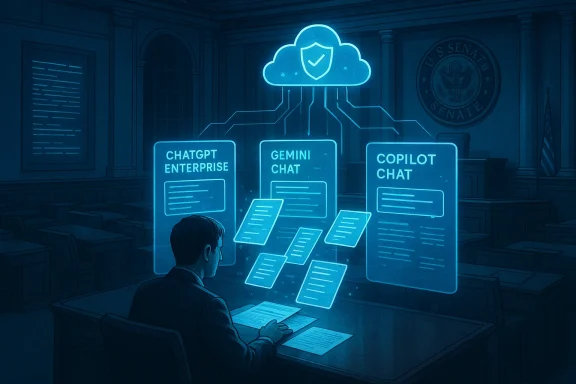
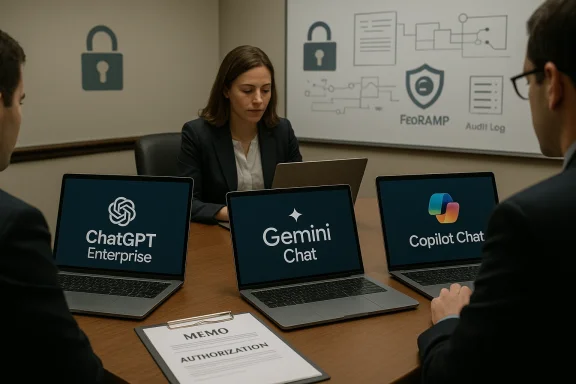
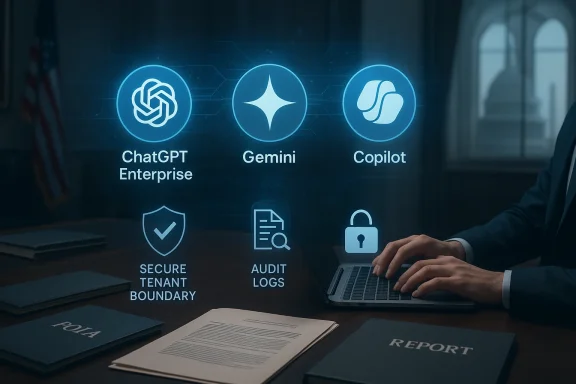
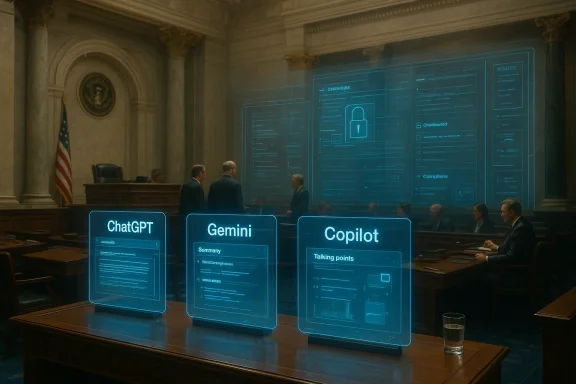
The U.S. Senate has quietly given the green light for frontline aides to use three commercial AI chatbots for official work: OpenAI’s ChatGPT, Google’s Gemini chat, and Microsoft’s Copilot, according to a one‑page memo circulated by the Senate sergeant‑at‑arms’ information technology office. The decision — which mirrors enterprise deployments of these tools across the private sector — signals a major shift in how congressional staffers may research, draft and summarize work product, while also exposing a patchwork of unresolved security, policy and oversight questions that Capitol Hill has not yet made public.
The memo reviewed by news outlets was issued by the chief information officer for the Senate sergeant‑at‑arms, the office that operates and secures the chamber’s computing infrastructure. It states that aides may use three chatbots already integrated into Senate platforms: Google Gemini chat, OpenAI’s ChatGPT, and Microsoft Copilot. The document specifically highlights Copilot’s integration with Microsoft 365 and asserts that data shared with Copilot Chat remains within the secure Microsoft 365 Government environment and is protected by the same controls that safeguard other Senate data.
This is not the first time generative AI has appeared inside the corridors of Congress. Over the past two years, both Houses of Congress have wrestled with staff use of consumer AI tools, issuing internal guidance that generally allowed AI for non‑sensitive, internal tasks while limiting uses involving personally identifiable information, casework, or classified material. The practical reality for staffers, however, has often been one of unofficial experimentation: aides have used consumer chatbots for quick drafting, summarizing lengthy hearings, and turning briefing papers into talking points long before formal policies caught up.
What changed this week is an explicit administrative endorsement — albeit limited and uneven — from the Senate’s IT leadership. For a chamber that runs hundreds of independent offices, each with its own operating norms set by senators and committee chairs, a one‑page memo creates permission but not uniform procedure. That gap is the heart of the story: permission to use AI without a comprehensive, enforceable policy framework.
That leaves staffers and chief clerks with a set of practical, high‑risk choices: Which version of ChatGPT should be used — the consumer product, or an enterprise offering configured for government? Is Gemini accessed through Google Workspace with enterprise protections, or a consumer account? Is Copilot being used inside a Microsoft 365 Government tenant configured for FedRAMP and DoD controls, or the less protected commercial path? The memo points to integrations but does not prescribe the secure options.
Key open questions include:
The path forward is clear in outline if not in detail: adopt enterprise‑grade offerings deployed inside properly configured government cloud environments; attach binding contractual and audit commitments to every procurement; deploy enterprise DLP, retention and logging; and build human‑in‑the‑loop processes that make AI a tool for competent professionals rather than a crutch that hides mistakes.
Congressional staff will use these tools. The Senate has taken the first administrative step by naming the chatbots that are permitted. The harder work — and the truly consequential decisions — lie ahead: writing the enforceable rules, investing in secure configuration and training, and designing oversight that protects both national security and the public trust while preserving the real productivity gains generative AI can deliver. Only with that careful, measured follow‑through will the promise of AI be realized safely in the halls of the Senate.
Source: The Hindu ChatGPT, other AI chatbots approved for official use in US Senate: Report
 Background
The memo reviewed by news outlets was issued by the chief information officer for the Senate sergeant‑at‑arms, the office that operates and secures the chamber’s computing infrastructure. It states that aides may use three chatbots already integrated into Senate platforms: Google Gemini chat, OpenAI’s ChatGPT, and Microsoft Copilot. The document specifically highlights Copilot’s integration with Microsoft 365 and asserts that data shared with Copilot Chat remains within the secure Microsoft 365 Government environment and is protected by the same controls that safeguard other Senate data.This is not the first time generative AI has appeared inside the corridors of Congress. Over the past two years, both Houses of Congress have wrestled with staff use of consumer AI tools, issuing internal guidance that generally allowed AI for non‑sensitive, internal tasks while limiting uses involving personally identifiable information, casework, or classified material. The practical reality for staffers, however, has often been one of unofficial experimentation: aides have used consumer chatbots for quick drafting, summarizing lengthy hearings, and turning briefing papers into talking points long before formal policies caught up.
What changed this week is an explicit administrative endorsement — albeit limited and uneven — from the Senate’s IT leadership. For a chamber that runs hundreds of independent offices, each with its own operating norms set by senators and committee chairs, a one‑page memo creates permission but not uniform procedure. That gap is the heart of the story: permission to use AI without a comprehensive, enforceable policy framework.
What the memo authorizes — and what it does not
The memo’s practical effect is straightforward: staffers may use the three named chatbots for official work. In operational terms, that likely translates into wide adoption for tasks that have already become common in offices across government and industry:- Drafting and editing documents, memos, and constituent communications
- Summarizing news coverage, hearings, and long reports
- Producing talking points, briefing materials, and initial drafts of legislation language
- Researching background facts and basic analysis
That leaves staffers and chief clerks with a set of practical, high‑risk choices: Which version of ChatGPT should be used — the consumer product, or an enterprise offering configured for government? Is Gemini accessed through Google Workspace with enterprise protections, or a consumer account? Is Copilot being used inside a Microsoft 365 Government tenant configured for FedRAMP and DoD controls, or the less protected commercial path? The memo points to integrations but does not prescribe the secure options.
Why Senate adoption matters
There are three simple reasons this is consequential.- Productivity gains at scale. Modern conversational AI can handle repetitive drafting and triage tasks that consume a large fraction of legislative staff time. Summaries of legislation, redlines, initial constituent reply drafts, and quick backgrounders can be generated in minutes, freeing staff to focus on negotiation and policy judgment.
- Policy and precedent. When the Senate adopts a tool for official use, it sets precedent for other federal bodies and for how lawmakers negotiate the rules that govern AI. Approvals at the Senate level signal to vendors that federal institutions are open to integrated AI solutions — which could accelerate further cloud‑government partnerships and procurement efforts.
- Security and trust implications. Congressional staffers handle sensitive constituent data, closed legislative drafts, and national security material. How AI is configured and governed in this environment affects not only operational security but public trust in the legislative process.
Technical reality: enterprise promises vs. practical risk
All three vendors named in the memo offer enterprise and government versions of their chatbots with contractual privacy commitments that differ materially from their consumer products.- ChatGPT’s enterprise offerings (ChatGPT Enterprise / Business tiers) make explicit claims that enterprise data is not used to train general models and that customer inputs and outputs are protected under corporate data‑processing agreements. Those contracts typically include encryption at rest and in transit, indemnities, and data handling clauses.
- Google’s Gemini integrated inside Google Workspace (and Vertex AI for cloud deployments) similarly offers contractual assurances that Workspace data will not be used to train underlying foundation models without customer consent when used under enterprise agreements.
- Microsoft’s Copilot, particularly when deployed inside Microsoft 365 Government clouds (GCC, GCC High, or DoD), is positioned as operating within a discrete service boundary — with the vendor asserting that prompts, responses and retrieved organization data remain within the tenant’s Microsoft service boundary and are subject to the organization’s retention and access controls.
- Implementation complexity. The security posture depends on correct tenant configuration, enabling of government cloud controls, and disabling consumer‑grade browsing or web‑grounding features that can leak data to the internet.
- Human behavior. The single largest risk vector is user error — staffers pasting constituent case details or non‑public contracting paperwork into chat windows without clearing PII or sensitivity flags. Policies and technical controls must assume this will happen and mitigate accordingly.
- Model hallucination and provenance. AI outputs can be confidently wrong. Offices using AI to draft or summarize material must retain human review, source‑checking, and provenance trails so mistakes do not turn into public policy errors.
- Contractual ambiguity and auditing. Most enterprise contracts bar using customer data to train general models, but enforcement and auditing of those clauses require access to vendor logs and third‑party verification. Government customers must insist on independent assessments and meaningful audit rights.
Security and classification: the unresolved questions
One of the clearest policy divides in Congress is between sensitive but unclassified staff work and classified committee work. The memo reiterated that committee aides with security clearances are governed by strict protocols; yet it did not delineate how offices working on sensitive but unclassified topics should operate.Key open questions include:
- Where is the line between "internal use only" and "sensitive"? If staff use AI to draft constituent casework that includes Social Security numbers or health details, which tools are permissible and how are they configured?
- How do committees with classified oversight — Intelligence, Armed Services, Homeland Security — manage the boundary between public staffer work and cleared processes? Do cleared staffers have a policy that completely forbids AI, or is there an approved, internally hosted model?
- Which cloud and compliance standards are required? FedRAMP Moderate? High? DoD IL‑5/6? These requirements have practical implications for vendor selection and the technical architecture of any permitted AI solution.
Practical mitigations and recommended controls
For legislative offices, the technology is less the issue than the governance. A responsible adoption framework requires both configuration controls and organizational rules. Operational controls that should be in place before any meaningful rollout:- Enterprise contracts and FedRAMP/DoD compliance: Use only vendor offerings deployed into government cloud environments with explicit contractual language prohibiting customer data reuse for model training unless expressly permitted.
- Strict tenant configuration:
- Lock down integration points to prevent cross‑tenant data leakage.
- Disable web grounding (where the chatbot issues arbitrary web queries) unless explicitly required and controlled.
- Enforce tenant‑level retention and retention policy settings consistent with legislative records obligations.
- Data Loss Prevention (DLP) and sensitivity labels:
- Apply sensitivity labels to content and prevent labeled content from being pasted into AI prompts.
- Integrate DLP at the endpoint and browser level to block accidental disclosures.
- Authentication and access controls:
- Enforce multi‑factor authentication and conditional access policies for all accounts with AI access.
- Apply least privilege for AI features; not all staff need blanket access.
- Logging, monitoring and audit trails:
- Retain full logs of prompts and responses in a tamper‑evident audit system.
- Configure alerts for high‑risk prompt patterns (e.g., SSNs, classified keywords, vendor contract numbers).
- Human‑in‑the‑loop workflows:
- Require manager approval for any AI‑generated material that will be used externally or enters the public record.
- Establish explicit sign‑off and verification steps for legal or policy documents.
- Training and incident playbooks:
- Mandatory training for staff on what can and cannot be put into AI prompts.
- Incident response playbooks that treat data exfiltration via AI as a reportable security incident.
- Procurement and contract hygiene:
- Insist on audit rights, SOC 2/ISO attestation, and explicit non‑training clauses where necessary.
- Require the vendor to provide transparency reports and security test results.
A pragmatic, six‑step rollout plan for Senate offices
- Inventory and risk classification.
- Catalog workloads and data types for each office and classify them by sensitivity.
- Choose vendor offerings with appropriate assurances.
- Select enterprise or government‑cloud offerings only. Reject consumer services for official work.
- Configure the tenant and security posture.
- Apply DLP, sensitivity labels, and conditional access before onboarding users.
- Pilot with explicit scope and measurement.
- Run a short pilot in a non‑sensitive office to test controls, workflows and user behavior.
- Scale with mandatory training and manager sign‑offs.
- Roll out to additional offices only after training and approval processes are operational.
- Continuous audit and policy revision.
- Publish periodical compliance reports, update policies as models change, and require vendors to submit to third‑party audits.
Legal and records management implications
Congressional offices operate under unique records retention laws and transparency obligations. AI complicates both:- Public records and FOIA: Drafts generated by AI that become part of legislative histories, or that are used to respond to constituent inquiries, may become subject to records requests. Offices must maintain verifiable provenance for any AI‑assisted documents.
- Copyright and attribution: AI models generate text that may unintentionally echo copyrighted material. Offices that republish AI text need review processes to check for problematic overlap.
- Liability and vendor obligations: Contracts should clarify indemnification for erroneous or defamatory AI outputs used in official communications.
The politics of permission
Granting authorized use inside the Senate is not merely a technical infrastructure decision; it is a political judgment about transparency, vendor influence and institutional control.- Vendor influence. Deeper entanglement with a small set of large cloud providers increases the risk of tacit vendor influence over workflows and, potentially, the policy priorities of lawmakers. Contracts and procurement choices therefore have democratic implications.
- Partisan optics. In highly partisan times, an AI‑generated talking point that contains an error or a misleading summary can become a political cudgel. That risk is magnified in the Senate, where small mistakes can blow up into national stories.
- Equity across offices. Larger offices with more resources will configure and use enterprise AI more safely than small offices. Without centralized provisioning and budget support, inequality of capability and risk will grow across the chamber.
What Senate IT leadership — and senators — should demand from vendors
Vendor assurances will matter far more than vendor marketing. Senate leadership should insist on:- Clear, contractual non‑training commitments for government tenant data, enforceable by audit and penalty.
- FedRAMP Moderate/High or equivalent certifications for all services handling non‑public Senate data, and DoD equivalents where applicable.
- Transparent logging and API access for independent audit and forensic review.
- On‑premises or dedicated‑tenant architectures for the most sensitive committees where feasible.
- Rapid‑response commitments for incidents involving data exfiltration and a defined notification window to affected parties.
- Support for retention and records export formats that meet congressional archive obligations.
Risks that still require explicit policy answers
Even with strong procurement language and tenant configuration, several risks remain unresolved at the Senate level:- The “insider” problem: staffers may use personal accounts or third‑party plugins that circumvent tenant protections. Policy must explicitly ban such behavior and include technical controls to detect it.
- Model derivatives: vendors may offer value‑added features (agents, automated web searches, plugin ecosystems) that introduce new attack surfaces. Approvals should be feature‑by‑feature, not all‑or‑nothing.
- Classified workflows: committees handling classified briefings must have ironclad prohibitions or bespoke on‑site solutions; the general memo does not address those unique requirements.
- Public confidence: transparency around what AI was used to generate or edit documents is essential for public trust. The Senate should require disclosures where AI materially contributed to public communications.
Conclusion
The Senate’s tacit embrace of ChatGPT, Google’s Gemini chat and Microsoft Copilot marks a pragmatic turn: administrators are choosing to bring the same productivity tools used across the private sector into the legislative workflow. That decision can accelerate staff efficiency and free time for policy analysis and constituent engagement. But it also exposes the chamber to real and material risks — leakage of PII, mishandling of sensitive or classified material, vendor dependency, and the legal tangles of records and accountability.The path forward is clear in outline if not in detail: adopt enterprise‑grade offerings deployed inside properly configured government cloud environments; attach binding contractual and audit commitments to every procurement; deploy enterprise DLP, retention and logging; and build human‑in‑the‑loop processes that make AI a tool for competent professionals rather than a crutch that hides mistakes.
Congressional staff will use these tools. The Senate has taken the first administrative step by naming the chatbots that are permitted. The harder work — and the truly consequential decisions — lie ahead: writing the enforceable rules, investing in secure configuration and training, and designing oversight that protects both national security and the public trust while preserving the real productivity gains generative AI can deliver. Only with that careful, measured follow‑through will the promise of AI be realized safely in the halls of the Senate.
Source: The Hindu ChatGPT, other AI chatbots approved for official use in US Senate: Report