

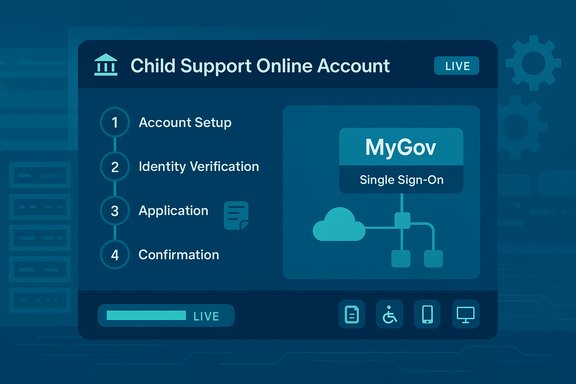
Services Australia has begun a program to “uplift” the online account platform used by Child Support customers, a move the agency says will replace an end‑of‑life system with a modernised, customer‑facing digital platform and a set of incremental features already entering service. Reported improvements include a new online application for child support assessment and a promise by the agency to reuse internal technology patterns rather than buying a commercial off‑the‑shelf (COTS) online account management package. This story sits inside a broader Services Australia architecture review and multi‑year IT strategy to modernise several legacy systems — a programme that aims to shrink technical debt, improve resiliency and make it easier for citizens to transact online.
Services Australia operates the digital front door many Australians use to manage welfare, Medicare and child support. The Child Support online account is the principal self‑service channel for parents and guardians to view payments, manage details and apply for assessments; it is linked through myGov and is part of the agency’s long‑running move to shift citizens away from paper and counter service. The public pages describing Child Support online accounts and how to apply online underline the agency’s aim to make the service available 24/7 while offering alternative channels for those who need assisted or in‑person help. Across the last decade Services Australia and its predecessors have modernised various elements of the welfare and payments landscape, but the agency still carries several legacy systems used for core decisioning and payments. An agency architecture review and a taskforce to produce a long‑term architecture strategy were set up to address that fragmentation and technical debt; child support was explicitly identified as one of the legacy systems slated for update alongside an ERP system, an income security integrated system, and the Medicare/PBS platform. Those architectural initiatives are driving the current uplift effort. What’s notable about the current uplift is the emphasis on reusing internal resources and established technology patterns rather than acquiring a single packaged online account management suite. The agency has told press outlets a phased uplift is underway, with work reported to have started in mid‑2025 and some new features already live for new applicants. Where those specific dates and statements originate is an external report and should be treated as reported rather than independently published policy by the agency. The official Services Australia online account pages confirm the user‑facing goals but do not publish a full technical roadmap or a vendor selection rationale.
Services Australia’s architecture review and the agency’s larger 10‑year strategic work indicate an appetite for systemic change rather than purely cosmetic UI upgrades; this is the right strategic posture provided the agency invests in sustained delivery capacity, operations funding and governance. Evidence from other government platform initiatives shows that combining developer experience, golden paths and robust operations playbooks produces measurable velocity and quality improvements — but those gains require cultural and funding commitments, not just a one‑off delivery sprint.
The agency’s stated decision to reuse internal resources and technology patterns is defensible — it can prevent vendor lock‑in and produce tighter integrations — but it increases the importance of transparent governance, third‑party assurance, and a rigorous migration discipline. Watch for published roadmaps, independent security and privacy attestations, and public reconciliation metrics as the most important signs that the uplift will deliver on its customer‑experience promise without trading safety for speed.
Appendix: key public references used in this analysis
Source: iTnews Services Australia to "uplift" child support online account platform
 Background / Overview
Services Australia operates the digital front door many Australians use to manage welfare, Medicare and child support. The Child Support online account is the principal self‑service channel for parents and guardians to view payments, manage details and apply for assessments; it is linked through myGov and is part of the agency’s long‑running move to shift citizens away from paper and counter service. The public pages describing Child Support online accounts and how to apply online underline the agency’s aim to make the service available 24/7 while offering alternative channels for those who need assisted or in‑person help. Across the last decade Services Australia and its predecessors have modernised various elements of the welfare and payments landscape, but the agency still carries several legacy systems used for core decisioning and payments. An agency architecture review and a taskforce to produce a long‑term architecture strategy were set up to address that fragmentation and technical debt; child support was explicitly identified as one of the legacy systems slated for update alongside an ERP system, an income security integrated system, and the Medicare/PBS platform. Those architectural initiatives are driving the current uplift effort. What’s notable about the current uplift is the emphasis on reusing internal resources and established technology patterns rather than acquiring a single packaged online account management suite. The agency has told press outlets a phased uplift is underway, with work reported to have started in mid‑2025 and some new features already live for new applicants. Where those specific dates and statements originate is an external report and should be treated as reported rather than independently published policy by the agency. The official Services Australia online account pages confirm the user‑facing goals but do not publish a full technical roadmap or a vendor selection rationale. Why this uplift matters
Modernising the Child Support online account platform is more than a cosmetic UX refresh. The system touches sensitive personal data, financial flows, and case decisions that directly affect families’ incomes. The upgrade promises to deliver:- Faster online assessments and onboarding for new child support customers, reducing the need for phone or in‑person contacts.
- Improved digital accessibility and device compatibility through myGov linkages and modern web patterns.
- Reduced staff manual work by digitising document capture and submission flows.
- Greater resilience by moving away from brittle, monolithic legacy code and maintenance traps.
What the agency has said and what’s reported
The agency has framed the work as a “full digital platform uplift” intended to produce “significant customer experience improvements.” Reported details include:- Work started in July 2025 (reported by external coverage).
- Some changes are already operational: notably a new online application for assessment for new Child Support customers.
- The agency will reuse internal resources and technology patterns rather than go to market for a packaged online account management product.
- The change is part of a larger architecture review taskforce and multi‑year IT strategy that identifies Child Support as a priority legacy system to modernise.
Technical and delivery posture — what we can reasonably infer
Services Australia’s decision to rely on internal resources and technology patterns rather than buy a COTS online account manager indicates a few likely directions and trade‑offs:- It suggests an emphasis on platform engineering and reusable internal components (API gateways, identity integration with myGov, common UI components and accessibility tooling) rather than a single vendor product that attempts to be all things. This pattern is consistent with contemporary public‑sector platform approaches that favour “golden paths” and productised internal platforms.
- Reuse reduces direct licensing costs and can accelerate integration with internal ID and payment systems, but it also places heavier demands on the agency’s engineering and operations teams for long‑term maintenance, patching and security hardening.
- Avoiding an external, single‑vendor product reduces vendor lock‑in risk but increases the importance of clear architecture governance, robust API contracts, and consistent developer experience across teams.
Strengths of the proposed approach
- Customer‑first outcomes are plausible. Replacing a brittle front end and streamlining application flows can materially reduce friction for users who apply for assessments or need to update details. The Child Support pages already support online application and status checking; building on that foundation can improve completion rates and reduce call centre loads.
- Better integration with myGov and existing identity flows. Keeping the modernised service within the myGov‑linked ecosystem preserves the single sign‑on convenience and reduces duplication for customers who already use Centrelink or Medicare online accounts. That continuity helps adoption.
- Avoids one‑size‑fits‑all COTS traps. A well‑executed internal platform helps tailor user journeys for sensitive case types (for example, family violence or anonymity‑sensitive cases) and allows Services Australia to bake in specific policy rules without contorting a packaged product. Reuse of internal patterns can produce faster time to value where teams already have working CI/CD, security baselines and accessibility practices.
- Aligns with broader architecture work. Treating the uplift as part of a whole‑of‑agency architecture strategy increases the chance the new platform will fit into a longer‑term plan for data rationalisation, API‑first integration, and migration of back‑end legacy functions.
Risks, gaps and tradeoffs — critical analysis
Modernising a citizen‑facing government service is high‑value but high‑risk. The following concerns deserve explicit attention.1. Data migration and calculation integrity
Child Support decisions and payment calculations are legal instruments with financial consequences. If source data or calculation rules live in legacy systems (for example, a calc engine still in an older back‑end), migrating or exposing new front‑end paths without strong reconciliation controls risks inconsistent outcomes or payment errors. Historical projects in this domain have shown how fragile calc engines and brownfield integrations can be. Careful parallel validation, end‑to‑end reconciliation and audit trails are essential.2. Availability and incident impact
Child Support customers are often dependent on regular payments; downtime or degraded functionality can have immediate financial and wellbeing consequences. Legacy incidents in related systems have caused lengthy service outages in the past; a modern platform must demonstrate robust disaster recovery, capacity testing for peak loads, and clear escalation and remediation pathways.3. Security, privacy and compliance
Handling PII, bank details and court‑sensitive information requires a hardened security posture and continuous independent assurance (IRAP assessments, SOC/ISO evidence). Reusing internal patterns is fine but those patterns must meet current standards for encryption, separation of duties, role‑based access controls, and logging. Integration with myGov adds identity and MFA surface area; any new connectors must be threat‑modelled for lateral movement and data exfiltration.4. Automated decision‑making, transparency and auditability
If the uplift includes any automation of eligibility checks or pre‑filled assessments (for example, using STP payroll matching to pre‑populate income), the agency must ensure transparency about algorithmic logic, human‑in‑the‑loop governance, error reporting, and clear appeal mechanisms. Automated pre‑fills are powerful for convenience but dangerous if customers cannot easily correct errors or if automated matches produce incorrect assessments.5. Accessibility and digital inclusion
Not all Child Support customers have reliable internet access, high digital literacy or a standard myGov setup. Any modernisation must maintain and improve alternative channels: phone lines, service centres, assisted digital programs, and accessible UX for screen readers and low‑bandwidth devices. Digital uplift that marginalises assisted channels risks widening inequality.6. Procurement and vendor oversight risk
Although the agency states it will not buy a COTS online account product, it will still lean on internal or partner technology. This approach reduces procurement timelines but increases the need for strong internal procurement governance, clear SLAs for external contractors, and a funding model for long‑term operations. Without that, initial gains can yield a long tail of unmaintained technical debt.What to watch for in the delivery phase
- Clear published milestones and accountability: the agency should publish a roadmap with measurable adoption KPIs and a risk register accessible to oversight bodies.
- Independent assurance: IRAP and other security/compliance certificates should be sought and published. Regular third‑party penetration testing reports and privacy impact assessments are essential.
- Migration playbooks and rollback plans: before switching any live case management functionality, the programme should demonstrate repeatable migration tests and fallbacks.
- User research‑driven rollouts: use A/B testing, staged releases, and monitored pilots with opt‑in participation for vulnerable cohorts (for example, victims of family violence).
- Transparency in automation: disclose the use of data sources (STP, API matchings), the intended use of pre‑filled fields, and human review thresholds for any automated suggestions.
Practical recommendations for Services Australia (operational checklist)
- Publish a short, public architecture and data flow diagram that shows how the new online account will integrate with legacy back‑end systems, myGov, payment rails and audit logs.
- Commit to independent security assurance (IRAP/ASD alignment) and release a high‑level compliance statement for the new platform.
- Create a test harness that runs parallel assessments on the legacy and new platform for a defined period and publishes reconciliation metrics.
- Maintain assisted channels and ensure staff have workflows to support people who cannot or will not use online services.
- Institute human‑in‑the‑loop gates for any automated eligibility or income estimation step and provide accessible, plain‑English notices about how pre‑filled values were derived.
- Build a transparent timetable for decommissioning the old platform: dates, criteria for switching off features, and contingency plans if migration issues are found.
Wider context and precedent
Public‑sector IT modernisation programmes that treat the platform as a product and pair a staged rollout with instrumentation and independent assurance tend to deliver durable benefits. Conversely, rushed front‑end replacements that leave the calculation engine and back‑end fragmentation in place frequently create edge‑case failures and citizen harm.Services Australia’s architecture review and the agency’s larger 10‑year strategic work indicate an appetite for systemic change rather than purely cosmetic UI upgrades; this is the right strategic posture provided the agency invests in sustained delivery capacity, operations funding and governance. Evidence from other government platform initiatives shows that combining developer experience, golden paths and robust operations playbooks produces measurable velocity and quality improvements — but those gains require cultural and funding commitments, not just a one‑off delivery sprint.
Conclusion — why the uplift is a pivotal test
Modernising the Child Support online account platform is an essential and high‑impact project for Services Australia. Done well, it will reduce friction, speed up assessments, and create a more resilient, accessible channel for families to manage payments and case details. Done poorly, it risks calculation errors, outages affecting vulnerable people, privacy lapses and long‑term maintenance burdens.The agency’s stated decision to reuse internal resources and technology patterns is defensible — it can prevent vendor lock‑in and produce tighter integrations — but it increases the importance of transparent governance, third‑party assurance, and a rigorous migration discipline. Watch for published roadmaps, independent security and privacy attestations, and public reconciliation metrics as the most important signs that the uplift will deliver on its customer‑experience promise without trading safety for speed.
Appendix: key public references used in this analysis
- Services Australia — Child Support online accounts and application guidance.
- Services Australia — pages on service availability and online account access.
- Coverage and analysis of Services Australia’s architecture strategy and taskforce work.
- Industry patterns and platform engineering examples used to contextualise the approach.
Source: iTnews Services Australia to "uplift" child support online account platform


