

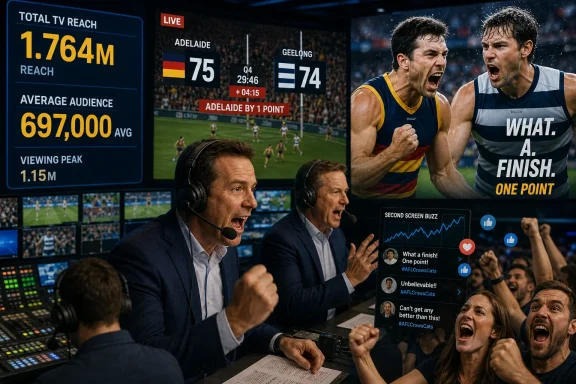
Seven’s Thursday night AFL broadcast topped Australia’s commercial TV ratings story on June 4, 2026, as Adelaide’s one-point win over Geelong delivered 1.764 million in national reach and 697,000 in average audience for Seven’s main coverage. The headline is not simply that sport won another night; it is that live sport again supplied the kind of shared, appointment-viewing drama that television executives keep trying to manufacture elsewhere. In a fragmented market, the old broadcast trick still works when the contest is real, close, and consequential. Seven did not just air a football match — it benefited from the one format that streaming abundance has not managed to deflate.
The most important thing about Seven’s AFL result is that it was not a tidy programming win. It was messy, physical, uncertain, and decided by a single point. Adelaide beat Geelong 75 to 74, ending the Cats’ six-game winning streak over the Crows and handing Seven the kind of finish that makes ratings departments look smarter than they are.
That is not a slight on Seven. It is the bargain every broadcaster makes with live sport: pay heavily, schedule confidently, and hope the game supplies the ending no commissioning editor can script. On Thursday night, it did.
The Total TV National Reach figure of 1.764 million tells the more strategic story than the average audience alone. Reach measures the breadth of contact — how many people came in for at least part of the ride — and live sport is built for that kind of movement. Viewers drift in before bounce, leave during breaks, return when the score tightens, and message friends when the margin becomes absurdly small.
Average audience, at 697,000, shows that a substantial core stayed. But the reach number shows why sport remains so valuable to networks and advertisers: it creates a national campfire, even if plenty of people only stand near it for a quarter.
Seven’s The Chase Australia was close behind, with 1.423 million in national reach and 766,000 in average audience. These numbers show why the early evening quiz-show strip remains one of commercial television’s most reliable industrial products. It is low-friction, repeatable, advertiser-friendly, and does not require a one-point thriller in Adelaide to make the night feel alive.
But reliability is not the same as voltage. Game shows hold viewers; sport mobilises them. One is a habit, the other is an event.
That distinction matters in a market where networks are not merely chasing overnight bragging rights. They are trying to prove to advertisers that broadcast television can still summon scale. A strong game show says a network has daily discipline. A strong football broadcast says it can still shape the national conversation.
Seven can point to AFL’s 1.764 million national reach and argue that its football coverage was the dominant event. Nine can point to Tipping Point Australia’s 826,000 average audience and argue that its game-show staple delivered more sustained viewing. Both claims can be true, and both are incomplete.
This is the central tension in ratings coverage now. The old overnight leaderboard gave the industry a crude but legible scoreboard. The new Total TV environment is more accurate, but it is also more narratively elastic.
For advertisers, that elasticity can be useful if they understand what they are buying. Reach is powerful for mass awareness. Average audience is stronger evidence of sustained attention. Live sport offers spikes and urgency; game shows offer consistency and predictable demographic flow. The smartest buyers do not treat those as interchangeable numbers.
The win also came with a physical toll. Callum Ah Chee and Jordon Butts left the field with hamstring and calf injuries respectively, while Hugo Hall-Kahan and Toby Murray were involved in a head clash late in the game. Play stopped as both players bled heavily, a jarring reminder that the spectacle networks sell is built on bodies absorbing risk in real time.
That is part of the uneasy power of live football as television. It is emotionally elastic enough to hold triumph, injury, anxiety, and tribal satisfaction in the same broadcast window. Scripted entertainment can imitate stakes; sport produces them.
For Seven, the pre-game coverage also landing in the top 30 matters more than it might appear. With 596,000 national reach and 280,000 average audience, the pre-game segment shows that the event halo extends beyond the match itself. Networks do not buy sports rights only for siren-to-siren action. They buy shoulder programming, sponsorship inventory, personalities, and the chance to stretch a fixture into a whole-night platform.
The match had its own narrative weight. Manly’s rise to third on the ladder, after losing its opening three home games and moving on from Anthony Seibold, gave Nine a storyline larger than the score. Interim coach Kieran Foran being locked in for three years added the kind of redemption arc television producers would overplay if it were fiction.
The reported “FozBall” enthusiasm around Manly, right down to local signage and hill-side fan culture, also shows how quickly sport creates marketable identity. Broadcasters thrive on that. A match is easier to sell when it plugs into a wider emotional economy: revival, local pride, unlikely momentum, and a familiar player turned leader.
Still, Nine’s NRL number sat below Seven’s AFL reach. That does not make it weak. It means Thursday’s biggest national television burst belonged to the AFL, and Nine’s stronger claim lay in the combined performance of its entertainment strip and rugby league coverage.
The show’s performance is a useful counterweight to the sports-heavy reading of the night. Not every durable television habit is built around live contests. Renovation, history, architecture, and slow transformation still have a place in the schedule, particularly for viewers who want narrative resolution without the noise of tribal competition.
But the contrast is stark. Restoration Australia offers careful attention; football offers adrenalised attention. The former rewards patience. The latter punishes delay. In a ratings market increasingly obsessed with immediacy, that difference shapes how programs are valued.
ABC’s result is respectable, but it is not the engine of the night. The commercial drama remained with Seven and Nine, where sport and game shows formed the twin pillars of mass reach.
Live sport remains the most powerful answer broadcast television has to on-demand culture. Viewers can catch up on a drama. They can stream a documentary later. They can watch clips of a game-show win on social media. But a one-point football match loses much of its electricity once the result is known.
That scarcity of the present is what networks are buying. The rights are expensive because the behaviour is rare. A close match forces synchronisation across households, pubs, group chats, workplaces, and fan communities. It turns television back into a clock.
This is also why average audience does not capture the whole value of live sport. A viewer who watches only the final quarter of a thriller may still be highly valuable. They are attentive, emotionally engaged, and likely to discuss what they saw. In advertising terms, that can be worth more than a passive half-hour of habitual viewing.
Broadcasters generally handle this tension by shifting quickly between concern and continuity. The game pauses, commentators lower their voices, medical staff enter the frame, and then the machinery of the broadcast resumes. Viewers are asked to care about player welfare and stay invested in the result, often within the same minute.
That is not hypocrisy so much as the operating logic of sports television. The broadcast must acknowledge the human cost without letting that cost overwhelm the entertainment product. The more violent or alarming the incident, the harder that balance becomes.
For fans, the compact is familiar. They want intensity, but not catastrophe. They want courage, but not negligence. They want the game to matter, while also wanting the players to be protected from the worst consequences of making it matter.
Seven’s AFL reach gives sponsors scale and urgency. Nine’s Tipping Point Australia gives them routine and repetition. Seven’s The Chase Australia delivers a similar pre-news usefulness. Nine’s NRL offers tribal identity and male-skewing sport energy, while ABC provides a calmer environment less dependent on hype.
This is why the ratings table is only the first draft of the commercial story. The deeper question is what kind of attention each program produced. In an age of distracted viewing, emotional temperature matters.
A one-point AFL result creates a high-temperature audience. That is valuable, but it is also unpredictable. A game show creates a moderate-temperature audience at scale, which can be easier to plan around. Networks need both, but only sport can still make a Thursday night feel like a national interruption.
But only the AFL match delivered the full package: a large reach number, a dramatic finish, an upset-flavoured result, and enough post-game consequences to extend the story beyond the broadcast. That is why it topped the narrative, even if other programs could compete on average audience.
The networks know this. Their schedules are increasingly designed around anchors that can resist delay. News, sport, reality finales, and live events all share the same strategic purpose: they give viewers a reason not to wait.
Streaming has not killed broadcast television. It has narrowed the kinds of television that feel essential in the moment. Thursday night’s numbers show that when the right live event arrives, old habits return quickly.
Seven’s AFL coverage proved the power of premium live sport. Nine’s game-show and NRL results proved that a network can remain highly competitive without owning the night’s biggest story. ABC’s Restoration Australia proved that public-service programming can still gather a meaningful audience outside the commercial arms race.
The practical takeaways are sharper than the headline suggests:
Television’s future will not be decided by nostalgia for the old mass audience, because that audience is not coming back in the form broadcasters once knew. But Thursday night showed that shared attention is not extinct; it is simply harder to summon and more dependent on moments that cannot be paused into convenience. For Seven, Adelaide’s one-point win was a ratings gift. For the wider industry, it was another reminder that the most valuable content on television is still the kind that refuses to behave like content at all.
 Seven Wins Because Live Sport Still Refuses to Behave Like Content
The most important thing about Seven’s AFL result is that it was not a tidy programming win. It was messy, physical, uncertain, and decided by a single point. Adelaide beat Geelong 75 to 74, ending the Cats’ six-game winning streak over the Crows and handing Seven the kind of finish that makes ratings departments look smarter than they are.That is not a slight on Seven. It is the bargain every broadcaster makes with live sport: pay heavily, schedule confidently, and hope the game supplies the ending no commissioning editor can script. On Thursday night, it did.
The Total TV National Reach figure of 1.764 million tells the more strategic story than the average audience alone. Reach measures the breadth of contact — how many people came in for at least part of the ride — and live sport is built for that kind of movement. Viewers drift in before bounce, leave during breaks, return when the score tightens, and message friends when the margin becomes absurdly small.
Average audience, at 697,000, shows that a substantial core stayed. But the reach number shows why sport remains so valuable to networks and advertisers: it creates a national campfire, even if plenty of people only stand near it for a quarter.
The Game Show War Is Stable, Useful, and Not Quite as Explosive
Nine’s Tipping Point Australia remained a formidable piece of weekday machinery, drawing a national reach of 1.517 million and an average audience of 826,000. That average audience was higher than Seven’s AFL coverage, which is a reminder that rankings and narratives can diverge depending on whether the market is talking about reach, average audience, timeslot, or broader schedule impact.Seven’s The Chase Australia was close behind, with 1.423 million in national reach and 766,000 in average audience. These numbers show why the early evening quiz-show strip remains one of commercial television’s most reliable industrial products. It is low-friction, repeatable, advertiser-friendly, and does not require a one-point thriller in Adelaide to make the night feel alive.
But reliability is not the same as voltage. Game shows hold viewers; sport mobilises them. One is a habit, the other is an event.
That distinction matters in a market where networks are not merely chasing overnight bragging rights. They are trying to prove to advertisers that broadcast television can still summon scale. A strong game show says a network has daily discipline. A strong football broadcast says it can still shape the national conversation.
Reach Has Become the Metric That Lets Everyone Claim a Win
The modern Australian ratings conversation is increasingly built around Total TV, a framework that folds together broadcast and digital viewing to better reflect how audiences actually watch. That is sensible, but it also creates a richer terrain for network spin. Depending on the number emphasised, different programs can appear to own the night.Seven can point to AFL’s 1.764 million national reach and argue that its football coverage was the dominant event. Nine can point to Tipping Point Australia’s 826,000 average audience and argue that its game-show staple delivered more sustained viewing. Both claims can be true, and both are incomplete.
This is the central tension in ratings coverage now. The old overnight leaderboard gave the industry a crude but legible scoreboard. The new Total TV environment is more accurate, but it is also more narratively elastic.
For advertisers, that elasticity can be useful if they understand what they are buying. Reach is powerful for mass awareness. Average audience is stronger evidence of sustained attention. Live sport offers spikes and urgency; game shows offer consistency and predictable demographic flow. The smartest buyers do not treat those as interchangeable numbers.
Adelaide’s Win Gave Seven the Kind of Drama Networks Cannot Commission
Adelaide’s victory was compelling because it carried both sporting and televisual stakes. A one-point result turns casual viewers into active viewers. It turns background television into foreground television. It also generates the second-screen behaviour that networks increasingly need: social posts, clips, messages, and post-match debate.The win also came with a physical toll. Callum Ah Chee and Jordon Butts left the field with hamstring and calf injuries respectively, while Hugo Hall-Kahan and Toby Murray were involved in a head clash late in the game. Play stopped as both players bled heavily, a jarring reminder that the spectacle networks sell is built on bodies absorbing risk in real time.
That is part of the uneasy power of live football as television. It is emotionally elastic enough to hold triumph, injury, anxiety, and tribal satisfaction in the same broadcast window. Scripted entertainment can imitate stakes; sport produces them.
For Seven, the pre-game coverage also landing in the top 30 matters more than it might appear. With 596,000 national reach and 280,000 average audience, the pre-game segment shows that the event halo extends beyond the match itself. Networks do not buy sports rights only for siren-to-siren action. They buy shoulder programming, sponsorship inventory, personalities, and the chance to stretch a fixture into a whole-night platform.
Nine’s NRL Night Shows the Other Code Still Has Pull
Nine’s Thursday Night NRL Live came in seventh, reaching 1.393 million nationally with an average audience of 609,000. Manly’s 28-14 win over South Sydney was not the top television story of the night, but it was a strong enough result to underline how much Thursday has become a collision zone for live sport.The match had its own narrative weight. Manly’s rise to third on the ladder, after losing its opening three home games and moving on from Anthony Seibold, gave Nine a storyline larger than the score. Interim coach Kieran Foran being locked in for three years added the kind of redemption arc television producers would overplay if it were fiction.
The reported “FozBall” enthusiasm around Manly, right down to local signage and hill-side fan culture, also shows how quickly sport creates marketable identity. Broadcasters thrive on that. A match is easier to sell when it plugs into a wider emotional economy: revival, local pride, unlikely momentum, and a familiar player turned leader.
Still, Nine’s NRL number sat below Seven’s AFL reach. That does not make it weak. It means Thursday’s biggest national television burst belonged to the AFL, and Nine’s stronger claim lay in the combined performance of its entertainment strip and rugby league coverage.
ABC’s Restoration Australia Plays a Different Game Entirely
ABC’s Restoration Australia reached 740,000 nationally and averaged 428,000, numbers that place it in a very different competitive lane. Public broadcasting does not need to beat Seven’s AFL or Nine’s NRL to justify itself. It needs to serve an audience that commercial networks often chase only when the margins are obvious.The show’s performance is a useful counterweight to the sports-heavy reading of the night. Not every durable television habit is built around live contests. Renovation, history, architecture, and slow transformation still have a place in the schedule, particularly for viewers who want narrative resolution without the noise of tribal competition.
But the contrast is stark. Restoration Australia offers careful attention; football offers adrenalised attention. The former rewards patience. The latter punishes delay. In a ratings market increasingly obsessed with immediacy, that difference shapes how programs are valued.
ABC’s result is respectable, but it is not the engine of the night. The commercial drama remained with Seven and Nine, where sport and game shows formed the twin pillars of mass reach.
The Real Battle Is Not Seven Versus Nine, But Event Television Versus Everything Else
It is tempting to read the night as a familiar network contest: Seven’s AFL against Nine’s NRL, The Chase against Tipping Point, commercial television’s nightly scoreboard ticking over. That is true as far as it goes, but it misses the larger shift. The real contest is between programming that can still command now and programming that can be watched whenever.Live sport remains the most powerful answer broadcast television has to on-demand culture. Viewers can catch up on a drama. They can stream a documentary later. They can watch clips of a game-show win on social media. But a one-point football match loses much of its electricity once the result is known.
That scarcity of the present is what networks are buying. The rights are expensive because the behaviour is rare. A close match forces synchronisation across households, pubs, group chats, workplaces, and fan communities. It turns television back into a clock.
This is also why average audience does not capture the whole value of live sport. A viewer who watches only the final quarter of a thriller may still be highly valuable. They are attentive, emotionally engaged, and likely to discuss what they saw. In advertising terms, that can be worth more than a passive half-hour of habitual viewing.
The Injury Footnote Is Actually Part of the Business Model
The injuries and head clash in the Adelaide-Geelong match should not be treated as incidental colour. They are part of the ethical and commercial tension at the heart of televised contact sport. The drama that drives ratings is inseparable from the physical risk borne by players.Broadcasters generally handle this tension by shifting quickly between concern and continuity. The game pauses, commentators lower their voices, medical staff enter the frame, and then the machinery of the broadcast resumes. Viewers are asked to care about player welfare and stay invested in the result, often within the same minute.
That is not hypocrisy so much as the operating logic of sports television. The broadcast must acknowledge the human cost without letting that cost overwhelm the entertainment product. The more violent or alarming the incident, the harder that balance becomes.
For fans, the compact is familiar. They want intensity, but not catastrophe. They want courage, but not negligence. They want the game to matter, while also wanting the players to be protected from the worst consequences of making it matter.
Advertisers Follow the Crowd, But They Pay for Mood
For advertisers, Thursday night’s ratings are a reminder that not all audiences are equal even when their sizes look similar. A quiz-show audience is dependable and often relaxed. A football audience is volatile and emotionally primed. A restoration-program audience may be smaller but more attentive and brand-safe in a different way.Seven’s AFL reach gives sponsors scale and urgency. Nine’s Tipping Point Australia gives them routine and repetition. Seven’s The Chase Australia delivers a similar pre-news usefulness. Nine’s NRL offers tribal identity and male-skewing sport energy, while ABC provides a calmer environment less dependent on hype.
This is why the ratings table is only the first draft of the commercial story. The deeper question is what kind of attention each program produced. In an age of distracted viewing, emotional temperature matters.
A one-point AFL result creates a high-temperature audience. That is valuable, but it is also unpredictable. A game show creates a moderate-temperature audience at scale, which can be easier to plan around. Networks need both, but only sport can still make a Thursday night feel like a national interruption.
The Thursday Schedule Now Belongs to Whoever Can Manufacture Urgency
The broader lesson from the night is that urgency is television’s most precious commodity. Seven found it through AFL. Nine found pieces of it through NRL and the continuing strength of Tipping Point Australia. ABC found a quieter version through loyal factual-entertainment viewing.But only the AFL match delivered the full package: a large reach number, a dramatic finish, an upset-flavoured result, and enough post-game consequences to extend the story beyond the broadcast. That is why it topped the narrative, even if other programs could compete on average audience.
The networks know this. Their schedules are increasingly designed around anchors that can resist delay. News, sport, reality finales, and live events all share the same strategic purpose: they give viewers a reason not to wait.
Streaming has not killed broadcast television. It has narrowed the kinds of television that feel essential in the moment. Thursday night’s numbers show that when the right live event arrives, old habits return quickly.
The Night Seven Wanted Is the Night Every Broadcaster Is Chasing
The clearest reading of the June 4 ratings is that Seven had the night’s defining event, Nine had the stronger spread of competitive assets, and ABC held its lane with a respectable factual audience. That is not a clean victory parade for any one network. It is a map of how fragmented television now works.Seven’s AFL coverage proved the power of premium live sport. Nine’s game-show and NRL results proved that a network can remain highly competitive without owning the night’s biggest story. ABC’s Restoration Australia proved that public-service programming can still gather a meaningful audience outside the commercial arms race.
The practical takeaways are sharper than the headline suggests:
- Seven’s AFL coverage delivered the night’s standout reach result because Adelaide’s one-point win over Geelong became a live event rather than merely another fixture.
- Nine’s Tipping Point Australia remained a major force, with an average audience that exceeded Seven’s AFL average despite the football broadcast owning the broader ratings narrative.
- Seven’s The Chase Australia continued to show why pre-news game shows remain among the most valuable pieces of weekday television infrastructure.
- Nine’s NRL coverage gave the network another strong live-sport asset, even though Manly’s win over South Sydney did not match the AFL’s national reach.
- ABC’s Restoration Australia demonstrated that slower factual programming can still hold a meaningful audience, even on a night dominated by football codes.
- The night reinforced that Total TV ratings reward different kinds of success, and reach, average audience, and cultural impact should not be treated as the same thing.
Television’s future will not be decided by nostalgia for the old mass audience, because that audience is not coming back in the form broadcasters once knew. But Thursday night showed that shared attention is not extinct; it is simply harder to summon and more dependent on moments that cannot be paused into convenience. For Seven, Adelaide’s one-point win was a ratings gift. For the wider industry, it was another reminder that the most valuable content on television is still the kind that refuses to behave like content at all.
References
- Primary source: bandt.com.au
Published: 2026-06-05T02:50:16.258925
TV Ratings (4/6/2026): Seven's AFL Thriller Tops Thursday Night Ratings
There was nail-biting action in Seven's AFL coverage last night.www.bandt.com.au