

The Machines Agree on Shell’s Long Shadow
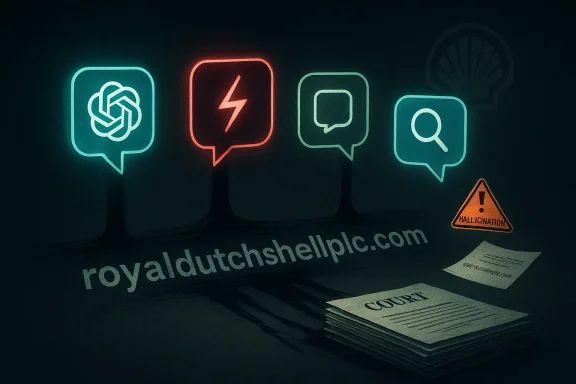
A satirical “AI roundtable” about the Shell saga may read like internet theater, but it lands because the underlying dispute is real, persistent, and unusually durable. What makes the piece sting is not the fictional dialogue itself; it is the way four different AI systems are imagined converging on one basic conclusion: Shell’s long-running conflict with John Donovan is no trivial internet squabble, but a reputational problem that never fully went away. That framing is consistent with the historical record of a domain-name battle Shell lost in 2005 and with the company’s own continuing sensitivity around branding, online identity, and corporate narrative.
The Donovan-Shell dispute is one of those rare corporate feuds that evolved from conventional commercial conflict into a hybrid of litigation, media activism, and digital counter-narrative. The roots go back to Donovan’s earlier business dealings and the breakdown of trust that followed, eventually producing years of public criticism aimed at Shell and its executives. Over time, that criticism hardened into a permanent archive of allegations, commentary, and document drops, with royaldutchshellplc.com becoming the symbolic center of gravity.
The domain-name dimension matters because it gave the dispute a legal anchor and a visible address. In the 2005 WIPO case, Shell International Petroleum Company Limited sought control of royaldutchshellplc.com, royaldutchshellgroup.com, and tellshell.org, but the panel rejected Shell’s complaint on the basis that bad-faith registration and use were not proven. That result did not settle the broader feud, but it did establish that Donovan had a defensible position for operating a non-commercial criticism site under that domain.
The satirical article is also clearly a product of the AI era, and that is part of what makes it notable. Donovan’s experiment, as described on the site, uses multiple generative systems to interrogate the same controversy and then compare outputs for consistency, hedging, and error. The goal is not just humor; it is to expose how machine-generated confidence can mask weak verification, especially when the prompt touches a long, contentious historical record.
That is why the “hallucination incident” in the piece lands so well. When the fictional panel admits that one or more systems inferred an email address or a fact incorrectly, the joke becomes a broader indictment of how AI systems can repeat plausible but unverified assumptions. In corporate disputes, where documentation, timelines, and identity are everything, that kind of error can be more damaging than an obvious contradiction because it sounds authoritative while remaining wrong. That is the real lesson lurking under the satire.
Shell itself is not a static target in this story. The company has continued to evolve, and its public-facing materials show a modern global corporation focused on strategy, reporting, and sustainability obligations. Shell changed its company name from Royal Dutch Shell plc to Shell plc in 2022, and its 2024 and 2025 reporting shows a business deeply engaged with governance, disclosure, and investor communications. Against that backdrop, a decades-old domain fight may appear minor, but reputational memory tends to outlast organizational rebranding.
The article’s central move is to shift the question from “Is Shell guilty?” to “Why does this dispute still exist?” That is a much stronger journalistic frame because it sidesteps the trap of relitigating every historical allegation and instead asks why corporate response, or the lack of it, became part of the story. In long-running reputation fights, silence often becomes a narrative in itself, especially when the opposing side is highly organized and relentless.
The case also illustrates a broader principle about trademark-adjacent criticism sites. A complainant can win on similarity and still lose on intent, legitimacy, or the absence of bad faith. That matters because it reminds companies that legal ownership and narrative ownership are different things. Shell may have a stronger balance sheet and a larger brand portfolio, but that did not automatically translate into control over Donovan’s chosen platform.
A few practical consequences follow:
In the fictional roundtable, the systems are not arguing facts so much as performing verification theater. One says “reputational,” another says “contained,” another says “structured engagement,” and another says “historically persistent.” On their face those are bland answers, but together they form a kind of diagnostic chorus. The article is suggesting that corporate disputes now live in an environment where machine summaries can shape public understanding before any human editor has a chance to correct the record.
That tension matters because reputational disputes are no longer confined to press releases or courtroom transcripts. Search engines, archive sites, screenshots, and AI answers all become part of the record. Shell can no longer assume that what it does not actively manage will simply fade; digital memory is too persistent, and alternative archives are too easy to preserve. What was once a dispute about a domain has become a dispute about narrative permanence.
The likely effects include:
Shell’s challenge is that its preferred language of governance and process does not erase the emotional and archival residue of the original conflict. Activist sites thrive on precisely this gap, because every corporate statement can be reframed as delay, and every silence as confirmation. The result is a reputational stalemate in which the company keeps operating while the criticism keeps accruing context.
A practical communications reading would look like this:
This is especially relevant for global companies with complex histories, because historical controversies do not vanish when the corporate logo changes. Shell’s transition to Shell plc, along with its ongoing reporting obligations and strategy updates, shows the company knows how to operate in the present. But the Donovan archive ensures the past remains searchable, narratable, and, crucially, machine-readable. That is what makes the conflict durable.
Useful takeaways include:
That means the battle is increasingly about interpretation rather than access. Shell can manage operations, reports, and compliance, but it cannot fully control what machine systems infer from a deeply documented controversy. In that sense, the roundtable satire is more than a joke; it is a preview of how corporate reputation will be contested in an era when archives are searchable, prompts are repeatable, and AI can turn old disputes into fresh summaries in seconds.
Source: Royal Dutch Shell Plc .com The AI Roundtable: When the Machines Discuss the Shell Saga
A satirical “AI roundtable” about the Shell saga may read like internet theater, but it lands because the underlying dispute is real, persistent, and unusually durable. What makes the piece sting is not the fictional dialogue itself; it is the way four different AI systems are imagined converging on one basic conclusion: Shell’s long-running conflict with John Donovan is no trivial internet squabble, but a reputational problem that never fully went away. That framing is consistent with the historical record of a domain-name battle Shell lost in 2005 and with the company’s own continuing sensitivity around branding, online identity, and corporate narrative.
 Background
The Donovan-Shell dispute is one of those rare corporate feuds that evolved from conventional commercial conflict into a hybrid of litigation, media activism, and digital counter-narrative. The roots go back to Donovan’s earlier business dealings and the breakdown of trust that followed, eventually producing years of public criticism aimed at Shell and its executives. Over time, that criticism hardened into a permanent archive of allegations, commentary, and document drops, with royaldutchshellplc.com becoming the symbolic center of gravity.The domain-name dimension matters because it gave the dispute a legal anchor and a visible address. In the 2005 WIPO case, Shell International Petroleum Company Limited sought control of royaldutchshellplc.com, royaldutchshellgroup.com, and tellshell.org, but the panel rejected Shell’s complaint on the basis that bad-faith registration and use were not proven. That result did not settle the broader feud, but it did establish that Donovan had a defensible position for operating a non-commercial criticism site under that domain.
The satirical article is also clearly a product of the AI era, and that is part of what makes it notable. Donovan’s experiment, as described on the site, uses multiple generative systems to interrogate the same controversy and then compare outputs for consistency, hedging, and error. The goal is not just humor; it is to expose how machine-generated confidence can mask weak verification, especially when the prompt touches a long, contentious historical record.
That is why the “hallucination incident” in the piece lands so well. When the fictional panel admits that one or more systems inferred an email address or a fact incorrectly, the joke becomes a broader indictment of how AI systems can repeat plausible but unverified assumptions. In corporate disputes, where documentation, timelines, and identity are everything, that kind of error can be more damaging than an obvious contradiction because it sounds authoritative while remaining wrong. That is the real lesson lurking under the satire.
Shell itself is not a static target in this story. The company has continued to evolve, and its public-facing materials show a modern global corporation focused on strategy, reporting, and sustainability obligations. Shell changed its company name from Royal Dutch Shell plc to Shell plc in 2022, and its 2024 and 2025 reporting shows a business deeply engaged with governance, disclosure, and investor communications. Against that backdrop, a decades-old domain fight may appear minor, but reputational memory tends to outlast organizational rebranding.
What the Satire Is Actually Saying
The fictional roundtable works because each AI persona is assigned a recognizable style, and those styles map neatly onto real-world expectations. ChatGPT is depicted as measured and analytic, Grok as blunt and skeptical, Copilot as cautious and corporate-friendly, and Perplexity as precise but detached. Together, they create the illusion of triangulation, even though the shared output may still rest on the same underlying ambiguity. Consensus is not the same thing as proof.The article’s central move is to shift the question from “Is Shell guilty?” to “Why does this dispute still exist?” That is a much stronger journalistic frame because it sidesteps the trap of relitigating every historical allegation and instead asks why corporate response, or the lack of it, became part of the story. In long-running reputation fights, silence often becomes a narrative in itself, especially when the opposing side is highly organized and relentless.
The power of a repeated narrative
One of the most interesting things about the piece is how it turns repetition into evidence. If multiple systems independently describe the matter as “reputational” rather than “operational,” the article implies, perhaps there is something structurally unresolved rather than merely noisy. That is not a legal finding, of course, but it is a fair editorial inference about how online controversies persist when nobody successfully closes the loop.- Repetition creates the appearance of stability.
- Stability can be mistaken for verification.
- Verification is the missing step in many AI summaries.
- In a corporate feud, the absence of closure becomes part of the file.
- Once a narrative is archived, it becomes easier to cite than to erase.
Why the Domain Still Matters
Domains may seem quaint in the age of social platforms, but in brand conflict they remain potent because they are memorable, indexable, and difficult to ignore. A domain like royaldutchshellplc.com is not just a technical asset; it is a rhetorical device that compresses corporate identity into a single URL. Shell’s failed WIPO effort in 2005 turned the domain into a public symbol of weakness, or at least of incomplete control over its own naming space.The case also illustrates a broader principle about trademark-adjacent criticism sites. A complainant can win on similarity and still lose on intent, legitimacy, or the absence of bad faith. That matters because it reminds companies that legal ownership and narrative ownership are different things. Shell may have a stronger balance sheet and a larger brand portfolio, but that did not automatically translate into control over Donovan’s chosen platform.
Legal victory, narrative loss
This is the part corporate communications teams often underestimate. A company can fail in a narrow proceeding and still succeed in the broader market, but it can also win in court and lose in public perception. In this instance, the WIPO ruling became one more artifact that critics could use to suggest Shell had overreached or misjudged the informational terrain. That does not prove wrongdoing beyond the dispute itself, yet it absolutely shaped the afterlife of the case.A few practical consequences follow:
- Legal filings can become public relations material.
- Adverse outcomes linger far longer online than in the courtroom.
- Criticism domains function like permanent pinned notes on a brand.
- Attempts to remove them can backfire if they look heavy-handed.
- A company’s response often matters as much as the original complaint.
AI as Amplifier, Not Arbiter
The most modern aspect of the story is not the feud itself but the method Donovan now uses to frame it. According to the site’s own framing, multiple AI systems are queried with similar prompts and then their answers are compared side by side to surface agreement, contradiction, and invention. That turns generative AI into a public stress test for corporate narratives, and it is smart precisely because it exploits one of the technology’s most visible weaknesses: plausible confidence without dependable sourcing.In the fictional roundtable, the systems are not arguing facts so much as performing verification theater. One says “reputational,” another says “contained,” another says “structured engagement,” and another says “historically persistent.” On their face those are bland answers, but together they form a kind of diagnostic chorus. The article is suggesting that corporate disputes now live in an environment where machine summaries can shape public understanding before any human editor has a chance to correct the record.
The hallucination problem
The hallucination segment is the sharpest part of the satire because it exposes a familiar weakness in AI discourse. Systems can converge on an error simply because the error is plausible, repeatable, and semantically tidy. In a dispute like this, that matters enormously, because a false assumption can travel farther than a careful correction and still sound more “professional” than the truth.- Plausibility often outruns verification.
- Agreement may reflect shared patterns, not independent truth.
- Tone can be mistaken for authority.
- Speed rewards the first neat answer.
- Corrections rarely spread as fast as mistakes.
Shell’s Reputation Problem in the Modern Era
Shell is not only defending a brand; it is defending a historical interpretation of itself. The company’s current public materials emphasize strategy execution, annual reporting, and compliance with evolving disclosure regimes such as CSRD and ESRS in Europe. Those are the hallmarks of a company trying to present itself as disciplined, transparent, and future-facing. An unresolved activist archive does the opposite: it keeps dragging attention backward.That tension matters because reputational disputes are no longer confined to press releases or courtroom transcripts. Search engines, archive sites, screenshots, and AI answers all become part of the record. Shell can no longer assume that what it does not actively manage will simply fade; digital memory is too persistent, and alternative archives are too easy to preserve. What was once a dispute about a domain has become a dispute about narrative permanence.
Consumer versus enterprise impact
The impact is not symmetrical. For ordinary consumers, this story may register as an eccentric corporate footnote, perhaps even a curiosity about branding and internet history. For institutional audiences, though, the implications are more serious because repeated criticism can affect how analysts, NGOs, journalists, and even employees interpret corporate silence.The likely effects include:
- Consumers may treat it as a niche curiosity.
- Investors may see it as a governance irritant.
- Journalists may use it as a ready-made historical reference.
- Activists may view it as proof that persistence works.
- Employees may see it as evidence that old disputes never fully disappear.
The Corporate Communications Angle
One reason the piece is memorable is that it implicitly critiques the corporate instinct to minimize. Terms like “contained issue,” “de-escalation,” and “pathways to resolution” sound responsible, but they can also read as evasive when the other side has been saying the same thing for years. In a dispute that stretches across decades, language becomes a battlefield of its own. The side that sounds more procedural is not always the side that sounds more credible.Shell’s challenge is that its preferred language of governance and process does not erase the emotional and archival residue of the original conflict. Activist sites thrive on precisely this gap, because every corporate statement can be reframed as delay, and every silence as confirmation. The result is a reputational stalemate in which the company keeps operating while the criticism keeps accruing context.
Why apology remains loaded
The fictional discussion’s “apology” moment is interesting because it treats apology as both a moral act and a communications strategy. In large corporate disputes, a formal apology can resolve one audience’s objections while provoking another audience’s legal worries. That is why companies often hesitate: they fear that saying the right thing could be interpreted as admitting the wrong thing.A practical communications reading would look like this:
- Acknowledge the historical dispute plainly.
- Separate factual correction from emotional response.
- Decide whether closure is more valuable than deniability.
- Frame any apology with legal precision.
- Avoid the trap of sounding compassionate while saying nothing.
The Broader Market Lesson
Beyond Shell and Donovan, the piece speaks to a broader shift in how organizations should think about public narrative. The modern brand environment is no longer managed just through media relations and legal enforcement; it is mediated through machine summaries, archival sites, search ranking, and a steady churn of reposted claims. A company that assumes one favorable statement will override a hostile archive is living in an older decade.This is especially relevant for global companies with complex histories, because historical controversies do not vanish when the corporate logo changes. Shell’s transition to Shell plc, along with its ongoing reporting obligations and strategy updates, shows the company knows how to operate in the present. But the Donovan archive ensures the past remains searchable, narratable, and, crucially, machine-readable. That is what makes the conflict durable.
Rival firms are watching too
Competitors in energy, heavy industry, and other controversial sectors should pay attention. The lesson is not that every criticism site is a threat, but that some disputes become part of a company’s permanent online topology. Once that happens, attempts to suppress the material can make the company look defensive, while ignoring it allows the archive to harden into accepted background noise.Useful takeaways include:
- Control the story early, not after it has fossilized.
- Treat domain disputes as narrative disputes.
- Assume AI will eventually summarize your controversy.
- Make fact patterns easy to verify.
- Do not confuse brand confidence with reputational closure.
Strengths and Opportunities
The article’s greatest strength is that it uses humor to illuminate a genuinely instructive corporate conflict. Rather than flattening the story into a simple grievance, it shows how legal history, digital identity, and AI behavior can intersect in a way that exposes the fragility of corporate control. It also captures how modern machine systems can intensify an old dispute without fully understanding it.- It reframes an old feud as a modern information problem.
- It shows how AI convergence can create false authority.
- It highlights the long tail of domain-name disputes.
- It correctly treats reputation as a strategic asset.
- It makes the role of archive culture easy to understand.
- It uses satire to reveal structural weaknesses.
- It underscores why human verification still matters.
Risks and Concerns
The main risk is that satire can blur into asserted fact if readers do not already know the background. When AI systems are personified and quoted, audiences may overestimate the originality or reliability of the underlying claims, especially if they come away remembering the confidence rather than the caveats. That is dangerous in a long-running dispute where every phrase can be reused as ammunition.- Readers may confuse parody with evidence.
- AI-generated summaries can replicate earlier mistakes.
- Corporate silence can be mistaken for concession.
- Activist framing can harden into assumed truth.
- Legal outcomes may be oversimplified.
- Historical complexity may get compressed into slogans.
- Overconfidence in machine output can distort the record.
Looking Ahead
The most likely future of this dispute is not dramatic resolution but continued coexistence. Shell will keep operating as a major energy company with investor-facing priorities, while Donovan’s archive will continue to provide a durable counter-history. The AI layer adds a new wrinkle: every fresh prompt becomes another chance for the same storyline to be restated, reframed, or accidentally reinforced.That means the battle is increasingly about interpretation rather than access. Shell can manage operations, reports, and compliance, but it cannot fully control what machine systems infer from a deeply documented controversy. In that sense, the roundtable satire is more than a joke; it is a preview of how corporate reputation will be contested in an era when archives are searchable, prompts are repeatable, and AI can turn old disputes into fresh summaries in seconds.
- Watch for more AI-assisted comparative commentary on corporate controversies.
- Expect activist archives to use machine outputs as rhetorical accelerants.
- Monitor whether companies respond with proactive historical clarification.
- Pay attention to how search and AI summaries treat legacy domain disputes.
- Look for more examples where narrative control matters as much as legal control.
Source: Royal Dutch Shell Plc .com The AI Roundtable: When the Machines Discuss the Shell Saga
