

Shopify’s push into agentic storefronts is not just a product update; it is an attempt to make the company the default operating layer for AI-led retail. By centralizing product data, inventory, pricing, attribution, and checkout into the Shopify Admin, the company is betting that merchants will prefer one managed control plane over a patchwork of point integrations as shopping shifts into chat-based environments. The strategic stakes are high because Shopify is no longer optimizing for search-driven discovery alone; it is preparing for a world where AI agents browse, compare, and buy on behalf of consumers. //www.shopify.com/news/winter-26-edition-agentic-storefronts)
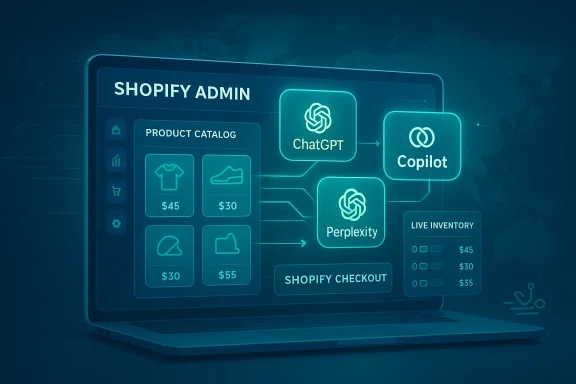
The story of agentic commerce begins with a basic but important shift in user behavior: shoppers are moving from manual browsing to delegated decision-making. Shopify has described this moment as the next frontier of commerce, and its new Agentic Storefronts are designed to make products discoverable in AI conversations on platforms including ChatGPT, Copilot, and Perplexity, with more channels coming soon. The company says merchants can configure their data once and then surface products across those channels without building separate bespoke integrations.
That matters because the old retail stack assumed a human shopper moving through a website, a search engine, or a marketplace. In the new model, the first touchpoint may be a conversational model acting as a proxy, and the conversion path may happen inside the assistant itself. Shopify’s own launch material emphasizes that the merchant still owns the customer relationship, checkout, and post-purchase experience, but the discovery layer is becoming increasingly mediated by AI.
The Universal Commerce Protocol, or UCP, is central to this shift. Shopify says the protocol is co-developed with Google and intended as an open standard for letting AI agents connect to merchants at scale, with product information, checkout, and transaction context represented in a way agents can understand. In practical terms, UCP is meant to reduce the integration burden that has historically forced retailers to build and maintain custom pipes for each platform.
This is also part of a larger platform contest. Shopify’s published materials frame agentic commerce as a major inflection point for retail, while the company’s AI tools page and Sidekick updates show that it is also embedding AI deeper into merchant operations, not just customer-facing discovery. Sidekick can already answer questions and complete tasks inside Shopify Admin, reinforcing the idea that the company wants AI to run through the entire commerce workflow, from operations to checkout.
There is also a business model reason to pay attention. Shopify is not only expanding AI features; it is trying to keep merchants inside its ecosystem as discovery becomes more fragmented. The company says it powers businesses in more than 175 countries and continues to broaden its international payment and marketplace infrastructure, which gives it a strong base from which to push a unified AI commerce layer globally.
The key technical promise is consistency. In traditional ecommerce, a merchant can often tolerate slight delays between product updates and storefront changes. In AI commerce, those delays become more dangerous because an agent may act on stale stock, outdated pricing, or incomplete product metadata. Shopify’s approach is to keep the catalog synchronized centrally so AI surfaces can read a current version of the merchant’s truth.
That centralization has an operational advantage for merchants, especially smaller teams. If a store can publish structured data once and reach multiple AI channels, it avoids the N-to-N integration problem that usually turns innovation into maintenance debt. The more AI shopping surfaces proliferate, the more valuable a single translation layer becomes.
It also gives Shopify leverage. If merchants become dependent on one workflow for all AI distribution, Shopify can evolve that workflow into a broader control layer for commerce intelligence. In that sense, Agentic Storefronts is not just an integration feature; it is a potential switching-cost engine. That distinction matters because the deeper the workflow sits inside the admin, the harder it becomes to leave.
This is a subtle but important shift in merchant discipline. Product pages were once written primarily for human eyes and search crawlers. Now they also need to be legible to a machine that may summarize, compare, and act on the information without ever loading the storefront in the traditional sense.
That growth helps explain why Shopify is moving aggressively now rather than waiting for standards to settle on their own. In platform markets, the winner often becomes the default plumbing provider before the ecosystem fully understands the scale of the opportunity. If AI shopping becomes routine, merchants will prefer a system that is already connected and already trusted.
The commercial logic also runs through checkout. Shopify says its agentic storefronts preserve checkout and keep the merchant as merchant of record, which is crucial because discovery without transaction control is only partial value. The company is not trying to hand the entire retail experience to AI platforms; it is trying to let AI control the top of the funnel while Shopify keeps the bottom.
This creates a new form of channel dependence. Merchants may not need to optimize for clicks in the old sense, but they will need to optimize for recommendation, representation, and retrieval inside agent systems. That is a meaningful change because the buyer journey becomes less about browsing and more about delegated evaluation.
The challenge is that high percentage growth does not automatically translate into high revenue contribution. Shopify still needs to show that AI-led orders are not just a curiosity but a durable source of GMV and repeat purchases. That is the difference between an exciting feature and a real strategic moat.
That does not mean every merchant must rush in blindly. Early access status still matters, and Shopify’s help center says agentic storefronts are not available to all stores yet. But the direction of travel is clear: merchants that prepare their structured data, policies, and metadata now are likely to be better positioned when distribution broadens.
This is where the phrase adopt or be left behind starts to sound less like hype and more like a practical business warning. When discovery shifts, laggards do not just lose one marketing channel; they risk losing the default place where shoppers begin evaluating products.
Small and midsize merchants face a different calculus. For them, Shopify’s promise of one setup and one admin is attractive precisely because it reduces the need for engineering resources. That can make AI commerce feel less like a speculative experiment and more like a practical distribution upgrade.
By contrast, a centralized platform promise reduces operational overhead and may lower the barrier to experimentation. Merchants can test AI discovery without rebuilding their commerce stack around it. That lowers resistance, which is exactly what platform expansion needs at the adoption stage.
The company’s collaboration with Google on UCP is also strategically notable. An open standard can broaden adoption faster than a proprietary approach, especially when merchants want to avoid one-off integrations. But openness cuts both ways: if the standard becomes widely adopted, rivals can also benefit from the same rails.
That means Shopify’s moat may depend less on exclusivity and more on execution quality. If its admin workflows, attribution, inventory accuracy, and checkout continuity are better than the alternatives, merchants may still choose Shopify even in an open ecosystem. In a standard-driven market, the best operator often wins more than the best inventor.
Another risk is that large merchants could push for custom implementations if they feel the defaults are too constraining. Shopify’s unified approach is great for scale, but enterprise buyers often want more control. That tension between simplicity and flexibility has shaped commerce software for years and will likely shape this cycle too.
That is a classic retention strategy. If AI discovery, product data management, and checkout all live in one place, Shopify becomes more central to the merchant’s operating rhythm. That is the real prize because platform centrality tends to create stickiness that outlasts any single feature cycle.
There is also a strategic balance between growth investment and margin discipline. Shopify has spent years building a broad commerce ecosystem, and AI adds another layer of product and infrastructure complexity. If agentic storefronts expand fast enough, they can justify that investment; if not, they risk becoming another costly initiative that looks more impressive than it is profitable.
The upside is that AI commerce may be more defensible than ordinary feature growth because it sits at the intersection of catalog, discovery, and checkout. That gives Shopify multiple levers to monetize, directly or indirectly. It also gives the company a chance to justify its place as commerce infrastructure rather than just storefront software.
Shopify’s global footprint is an asset here because it gives the company more surface area to test and improve the product. More markets, more categories, and more merchants create better feedback loops. That can turn early AI commerce adoption into a compounding product advantage.
That makes execution unusually important. In a high-expectation market, the difference between a good rollout and a great one can shape investor sentiment for months. The company does not need to prove the entire future right away, but it does need to prove that the future is arriving in measurable steps.
The platform also preserves a familiar ecommerce anchor: Shopify checkout. That is important because agents are only useful if they can complete real transactions without introducing too much friction. By keeping the transaction layer inside Shopify, the company avoids making AI shopping feel like a detached recommendation engine.
Another strength is attribution. If merchants can see which AI channels drive purchases, they can allocate resources more intelligently. This could turn AI discovery from a mysterious black box into a manageable acquisition channel, which is exactly the kind of operational clarity merchants want.
It also creates a potential network effect. The more merchants use the standard, the better the system can become at understanding catalogs, categories, and shopper intent. In that sense, Shopify is not just syndicating data; it is training the rails of future commerce.
That is particularly appealing for teams that are already stretched thin. A platform that can absorb the complexity of new channels without forcing merchants to become systems integrators will be much easier to adopt. Convenience is not trivial here; in retail, convenience often determines whether a new capability gets used at all.
A second risk is data quality. AI shopping only works if product metadata, availability, policies, and FAQs are accurate. If merchants treat the system casually, bad data could lead to poor recommendations, failed expectations, and customer frustration.
There is also a governance issue. Once AI agents can influence or execute purchases, errors matter more. A mistaken recommendation is one thing; a mistaken transaction is another. That makes guardrails, attribution, and merchant control far more important than hype about autonomy.
That unevenness could create a two-tier retail environment. The stores that optimize for AI discovery early may gain share before the rest of the market catches up. The danger is not just missing a feature, but missing a new default behavior.
That is why Shopify’s insistence on merchant control matters so much. Trust in the channel will depend not only on AI performance, but on whether shoppers feel the merchant still stands behind the experience. If the experience feels opaque, adoption may slow even if the technology itself works well.
Another important question is how the AI platforms themselves respond. If ChatGPT, Copilot, Gemini, and others deepen commerce features, Shopify’s channel strategy could accelerate quickly. If they move slowly or fragment their standards, merchants may remain cautious longer than expected.
Finally, the merchant experience will determine whether this becomes a real retail operating system or just another optional surface. The easier Shopify makes setup, the more likely merchants are to participate. The harder it is to manage, the more likely the market is to wait and see.
Source: Bitget Shopify’s Agentic Storefronts Could Force Merchants to Adopt—Or Be Left Behind as AI Shopping Takes Off | Bitget News
 Background
The story of agentic commerce begins with a basic but important shift in user behavior: shoppers are moving from manual browsing to delegated decision-making. Shopify has described this moment as the next frontier of commerce, and its new Agentic Storefronts are designed to make products discoverable in AI conversations on platforms including ChatGPT, Copilot, and Perplexity, with more channels coming soon. The company says merchants can configure their data once and then surface products across those channels without building separate bespoke integrations.That matters because the old retail stack assumed a human shopper moving through a website, a search engine, or a marketplace. In the new model, the first touchpoint may be a conversational model acting as a proxy, and the conversion path may happen inside the assistant itself. Shopify’s own launch material emphasizes that the merchant still owns the customer relationship, checkout, and post-purchase experience, but the discovery layer is becoming increasingly mediated by AI.
The Universal Commerce Protocol, or UCP, is central to this shift. Shopify says the protocol is co-developed with Google and intended as an open standard for letting AI agents connect to merchants at scale, with product information, checkout, and transaction context represented in a way agents can understand. In practical terms, UCP is meant to reduce the integration burden that has historically forced retailers to build and maintain custom pipes for each platform.
This is also part of a larger platform contest. Shopify’s published materials frame agentic commerce as a major inflection point for retail, while the company’s AI tools page and Sidekick updates show that it is also embedding AI deeper into merchant operations, not just customer-facing discovery. Sidekick can already answer questions and complete tasks inside Shopify Admin, reinforcing the idea that the company wants AI to run through the entire commerce workflow, from operations to checkout.
There is also a business model reason to pay attention. Shopify is not only expanding AI features; it is trying to keep merchants inside its ecosystem as discovery becomes more fragmented. The company says it powers businesses in more than 175 countries and continues to broaden its international payment and marketplace infrastructure, which gives it a strong base from which to push a unified AI commerce layer globally.
What Shopify Is Actually Building
The headline feature is Shopify Agentic Storefronts, but the architecture behind it is more important than the branding. Shopify says the system lets merchants manage how their products appear across AI chats from a single setup inside the admin, with products surfaced accurately, prices and inventory kept current, and performance attributed back to the originating channel. That is a classic platform move: reduce merchant friction while making the platform harder to replace.The key technical promise is consistency. In traditional ecommerce, a merchant can often tolerate slight delays between product updates and storefront changes. In AI commerce, those delays become more dangerous because an agent may act on stale stock, outdated pricing, or incomplete product metadata. Shopify’s approach is to keep the catalog synchronized centrally so AI surfaces can read a current version of the merchant’s truth.
That centralization has an operational advantage for merchants, especially smaller teams. If a store can publish structured data once and reach multiple AI channels, it avoids the N-to-N integration problem that usually turns innovation into maintenance debt. The more AI shopping surfaces proliferate, the more valuable a single translation layer becomes.
Why One Admin Matters
A single admin does more than save time. It gives merchants one place to manage product structure, messaging, and attribution, which should reduce the chance that a product appears differently across multiple AI channels. That consistency is especially important for brands that care about voice, trust, and merchandising discipline.It also gives Shopify leverage. If merchants become dependent on one workflow for all AI distribution, Shopify can evolve that workflow into a broader control layer for commerce intelligence. In that sense, Agentic Storefronts is not just an integration feature; it is a potential switching-cost engine. That distinction matters because the deeper the workflow sits inside the admin, the harder it becomes to leave.
- One setup can feed multiple AI discovery surfaces.
- Product data stays more consistent across channels.
- Merchants avoid building separate integrations.
- Attribution becomes easier to track.
- Checkout remains tied to Shopify’s native stack.
The Role of Structured Product Data
Shopify’s launch language makes it clear that AI agents need more than a product title and a price. They need structured signals, including schema, metadata, policies, and FAQs, so they can answer shopper questions and surface the right item. That is why the company is also emphasizing the Knowledge Base App and brand voice tooling as part of the AI commerce stack.This is a subtle but important shift in merchant discipline. Product pages were once written primarily for human eyes and search crawlers. Now they also need to be legible to a machine that may summarize, compare, and act on the information without ever loading the storefront in the traditional sense.
The Commercial Logic Behind Agentic Commerce
Shopify’s deeper bet is that AI discovery will become a meaningful traffic source, not a novelty channel. The company says orders from AI searches are up 11x since January 2025, a striking figure that suggests merchants are already seeing measurable demand from AI-led journeys. That kind of growth does not prove the channel is mature, but it does indicate that the channel is real.That growth helps explain why Shopify is moving aggressively now rather than waiting for standards to settle on their own. In platform markets, the winner often becomes the default plumbing provider before the ecosystem fully understands the scale of the opportunity. If AI shopping becomes routine, merchants will prefer a system that is already connected and already trusted.
The commercial logic also runs through checkout. Shopify says its agentic storefronts preserve checkout and keep the merchant as merchant of record, which is crucial because discovery without transaction control is only partial value. The company is not trying to hand the entire retail experience to AI platforms; it is trying to let AI control the top of the funnel while Shopify keeps the bottom.
Discovery Is Becoming the Battleground
For years, ecommerce competition focused on where shoppers started: search, social, marketplaces, or direct visits. Now the starting point may be a prompt rather than a page, and that shifts power toward whoever controls the interface layer. Shopify clearly understands that if AI assistants become the first stop for product discovery, merchant visibility will depend on machine-readable retail infrastructure.This creates a new form of channel dependence. Merchants may not need to optimize for clicks in the old sense, but they will need to optimize for recommendation, representation, and retrieval inside agent systems. That is a meaningful change because the buyer journey becomes less about browsing and more about delegated evaluation.
- AI search can become a measurable traffic source.
- Prompt-based discovery may replace some manual browsing.
- Merchant visibility will depend on structured data quality.
- AI platforms may control more of the pre-checkout experience.
- The first product shown may matter more than page ranking.
Why the 11x Number Matters
The reported 11x increase in AI-driven orders is important even if the absolute base is still relatively small. In platform adoption, early growth rates often signal where merchant behavior is headed long before the mainstream market catches up. A narrow channel can still be strategically decisive if it compounds fast enough.The challenge is that high percentage growth does not automatically translate into high revenue contribution. Shopify still needs to show that AI-led orders are not just a curiosity but a durable source of GMV and repeat purchases. That is the difference between an exciting feature and a real strategic moat.
Merchant Adoption Pressure
The most interesting part of Shopify’s strategy is not the technology itself but the pressure it creates on merchants. If AI channels become a real source of demand, then opting out may no longer be a neutral decision. Merchants that remain invisible in AI discovery could find themselves competing with stores that are represented accurately and earlier in the shopping journey.That does not mean every merchant must rush in blindly. Early access status still matters, and Shopify’s help center says agentic storefronts are not available to all stores yet. But the direction of travel is clear: merchants that prepare their structured data, policies, and metadata now are likely to be better positioned when distribution broadens.
This is where the phrase adopt or be left behind starts to sound less like hype and more like a practical business warning. When discovery shifts, laggards do not just lose one marketing channel; they risk losing the default place where shoppers begin evaluating products.
Enterprise Versus SMB Reality
Large merchants will probably treat Agentic Storefronts as another channel in a multichannel architecture. They have the staff, catalog discipline, and analytics maturity to manage AI visibility as part of a broader retail stack. For them, the question is optimization.Small and midsize merchants face a different calculus. For them, Shopify’s promise of one setup and one admin is attractive precisely because it reduces the need for engineering resources. That can make AI commerce feel less like a speculative experiment and more like a practical distribution upgrade.
- Large merchants can test AI channels as part of a portfolio.
- Smaller merchants may rely on Shopify to do the heavy lifting.
- Early access status means readiness matters now.
- Structured data quality will be a differentiator.
- Merchants with thin teams will value managed integration most.
The Cost of Fragmentation
One reason Shopify’s approach may resonate is that fragmentation has become expensive. Every separate AI platform adds another schema, another catalog sync, another attribution system, and another place where prices or inventory can drift out of sync. Even sophisticated merchants can lose time to that complexity, and time is money in retail.By contrast, a centralized platform promise reduces operational overhead and may lower the barrier to experimentation. Merchants can test AI discovery without rebuilding their commerce stack around it. That lowers resistance, which is exactly what platform expansion needs at the adoption stage.
How This Changes the Competitive Landscape
Shopify is not the only company trying to shape agentic commerce, but it may be one of the strongest positioned because it already sits on top of a huge merchant base. The company says it powers businesses in more than 175 countries, giving it global distribution that AI startups and niche commerce vendors cannot easily match. That installed base is a major advantage if AI shopping moves from pilot to default.The company’s collaboration with Google on UCP is also strategically notable. An open standard can broaden adoption faster than a proprietary approach, especially when merchants want to avoid one-off integrations. But openness cuts both ways: if the standard becomes widely adopted, rivals can also benefit from the same rails.
That means Shopify’s moat may depend less on exclusivity and more on execution quality. If its admin workflows, attribution, inventory accuracy, and checkout continuity are better than the alternatives, merchants may still choose Shopify even in an open ecosystem. In a standard-driven market, the best operator often wins more than the best inventor.
Threats from Platform Neighbors
The biggest competitive risk is that AI platforms themselves may want to own more of the transaction layer. If ChatGPT, Google, Microsoft, or another assistant becomes the dominant discovery interface, they may try to capture more of the merchant relationship. Shopify’s current approach tries to prevent that by keeping the merchant of record and the customer relationship anchored in Shopify.Another risk is that large merchants could push for custom implementations if they feel the defaults are too constraining. Shopify’s unified approach is great for scale, but enterprise buyers often want more control. That tension between simplicity and flexibility has shaped commerce software for years and will likely shape this cycle too.
- Open standards can accelerate adoption.
- Openness may also reduce exclusivity.
- AI platforms may seek more transaction control.
- Large merchants may want deeper customization.
- Execution quality will matter as much as protocol design.
Why This Is a Platform Play, Not a Feature Play
A feature can be copied. A platform layer is harder to dislodge once merchants build operational dependence around it. Shopify is clearly trying to make agentic commerce feel like an extension of the existing admin rather than a separate product to buy and maintain.That is a classic retention strategy. If AI discovery, product data management, and checkout all live in one place, Shopify becomes more central to the merchant’s operating rhythm. That is the real prize because platform centrality tends to create stickiness that outlasts any single feature cycle.
Financial and Strategic Implications
The market is likely to judge Shopify on whether this AI push creates real economic lift rather than just narrative momentum. In platform businesses, the stock eventually follows either durable transaction growth or disappointment about monetization. Agentic commerce has to prove it can influence GMV, attach rates, retention, or some combination of the three.There is also a strategic balance between growth investment and margin discipline. Shopify has spent years building a broad commerce ecosystem, and AI adds another layer of product and infrastructure complexity. If agentic storefronts expand fast enough, they can justify that investment; if not, they risk becoming another costly initiative that looks more impressive than it is profitable.
The upside is that AI commerce may be more defensible than ordinary feature growth because it sits at the intersection of catalog, discovery, and checkout. That gives Shopify multiple levers to monetize, directly or indirectly. It also gives the company a chance to justify its place as commerce infrastructure rather than just storefront software.
What the Numbers Suggest
The 11x AI-order figure suggests momentum, but investors will want more than momentum. They will want evidence that this traffic converts efficiently, repeats reliably, and scales across categories. Metrics such as conversion rate, average order value, and channel retention will matter more than headline percentage gains.Shopify’s global footprint is an asset here because it gives the company more surface area to test and improve the product. More markets, more categories, and more merchants create better feedback loops. That can turn early AI commerce adoption into a compounding product advantage.
- AI-driven orders can validate the channel.
- Conversion quality will matter more than traffic volume.
- Repeatability is more valuable than one-off spikes.
- Global scale improves feedback and refinement.
- Agentic commerce can support broader platform monetization.
The Valuation Test
The strategic question for Shopify is whether markets will reward this as a new growth leg or dismiss it as another incremental product cycle. The answer depends on whether AI shopping becomes behaviorally sticky. If it does, Shopify may look prescient. If it stalls, the company may be left with more complexity than payoff.That makes execution unusually important. In a high-expectation market, the difference between a good rollout and a great one can shape investor sentiment for months. The company does not need to prove the entire future right away, but it does need to prove that the future is arriving in measurable steps.
Technical Strengths of the Agentic Model
From a systems perspective, Shopify’s model has several appealing properties. It collapses product, catalog, pricing, and inventory management into a central workflow while exposing the merchant’s inventory to multiple AI surfaces. That should reduce duplication, decrease configuration drift, and make updates more reliable across channels.The platform also preserves a familiar ecommerce anchor: Shopify checkout. That is important because agents are only useful if they can complete real transactions without introducing too much friction. By keeping the transaction layer inside Shopify, the company avoids making AI shopping feel like a detached recommendation engine.
Another strength is attribution. If merchants can see which AI channels drive purchases, they can allocate resources more intelligently. This could turn AI discovery from a mysterious black box into a manageable acquisition channel, which is exactly the kind of operational clarity merchants want.
Structured Commerce as an Advantage
Structured commerce is not glamorous, but it is powerful. AI systems work best when they can parse clean data, and Shopify is trying to provide that structure natively rather than relying on merchants to build it from scratch. That should improve both product matching and shopper trust.It also creates a potential network effect. The more merchants use the standard, the better the system can become at understanding catalogs, categories, and shopper intent. In that sense, Shopify is not just syndicating data; it is training the rails of future commerce.
- Cleaner data should improve product matching.
- Native checkout reduces transaction friction.
- Attribution helps merchants measure ROI.
- Structured data can improve shopper trust.
- Scale may make the system smarter over time.
Why Merchants May Welcome the Abstraction
Most merchants do not want to spend their days managing protocol layers. They want customers, conversion, and repeat business. If Shopify can hide the complexity of AI distribution while preserving control, it will have solved a very merchant-friendly problem.That is particularly appealing for teams that are already stretched thin. A platform that can absorb the complexity of new channels without forcing merchants to become systems integrators will be much easier to adopt. Convenience is not trivial here; in retail, convenience often determines whether a new capability gets used at all.
Risks and Concerns
The biggest risk is that merchants may become overly dependent on AI platforms they do not control. If AI shopping traffic concentrates in a small number of assistants, those platforms may eventually dictate discovery economics in ways that squeeze merchants. Shopify’s architecture softens that risk, but it does not eliminate it.A second risk is data quality. AI shopping only works if product metadata, availability, policies, and FAQs are accurate. If merchants treat the system casually, bad data could lead to poor recommendations, failed expectations, and customer frustration.
There is also a governance issue. Once AI agents can influence or execute purchases, errors matter more. A mistaken recommendation is one thing; a mistaken transaction is another. That makes guardrails, attribution, and merchant control far more important than hype about autonomy.
Adoption Will Not Be Uniform
The early access nature of the rollout means adoption will likely be uneven. Some merchants will have the right catalog structure, the right channel mix, and the right appetite for experimentation. Others will wait, either because they lack resources or because they want to see proof before they commit.That unevenness could create a two-tier retail environment. The stores that optimize for AI discovery early may gain share before the rest of the market catches up. The danger is not just missing a feature, but missing a new default behavior.
- Platform dependence may increase.
- Poor metadata can hurt discoverability.
- Transaction errors have higher stakes in agentic flows.
- Early access may widen capability gaps.
- Merchants may struggle to keep pace with channel changes.
Consumer Trust Is Still the Real Bottleneck
Consumers may like the idea of an AI shopper, but trust will ultimately decide adoption. People need to know what the agent can do, what data it uses, and who is responsible when something goes wrong. Without that clarity, agentic commerce risks becoming a novelty rather than a habit.That is why Shopify’s insistence on merchant control matters so much. Trust in the channel will depend not only on AI performance, but on whether shoppers feel the merchant still stands behind the experience. If the experience feels opaque, adoption may slow even if the technology itself works well.
Strengths and Opportunities
Shopify’s agentic storefront strategy has real upside because it meets a genuine shift in shopper behavior, reduces merchant integration friction, and preserves the merchant’s transactional relationship. The company is also starting from a position of scale, with broad international reach and a deep commerce stack already in place. That gives it a strong chance of turning AI shopping from a concept into a default channel.- One admin can simplify multichannel AI distribution.
- Accurate data sync improves trust and conversion.
- Shopify checkout keeps the transaction layer intact.
- AI shopping can create a new acquisition channel.
- Global merchant reach gives the platform immediate scale.
- Open standards can accelerate ecosystem adoption.
- Better attribution can help merchants measure ROI.
- Sidekick and related tools reinforce workflow stickiness.
Risks and Concerns
The same strategy also introduces real hazards. Merchants may become dependent on channels they do not control, and the quality of the experience will depend heavily on data hygiene and platform governance. If AI-led shopping grows slower than expected, Shopify could be left with more complexity than payoff.- AI platforms could gain disproportionate discovery power.
- Early access limits broad merchant readiness.
- Bad product data could undermine recommendations.
- Consumers may hesitate to trust autonomous shopping.
- Open standards may reduce exclusivity.
- Merchants may resist added workflow complexity.
- Transaction errors would damage confidence quickly.
- Monetization timing may lag the hype cycle.
What to Watch Next
The next phase will be about proof, not promises. Watch for whether Shopify expands Agentic Storefronts beyond early access and whether AI-led orders continue to grow beyond the reported 11x increase. Also watch how quickly UCP becomes a widely adopted commerce standard rather than a Shopify-led initiative with limited penetration.Another important question is how the AI platforms themselves respond. If ChatGPT, Copilot, Gemini, and others deepen commerce features, Shopify’s channel strategy could accelerate quickly. If they move slowly or fragment their standards, merchants may remain cautious longer than expected.
Finally, the merchant experience will determine whether this becomes a real retail operating system or just another optional surface. The easier Shopify makes setup, the more likely merchants are to participate. The harder it is to manage, the more likely the market is to wait and see.
- Track the rollout beyond early access.
- Watch AI-driven order growth in future quarters.
- Monitor UCP adoption across platforms and retailers.
- Observe whether merchants see material conversion lift.
- Watch for deeper checkout and attribution features.
- Pay attention to consumer trust and UX feedback.
Source: Bitget Shopify’s Agentic Storefronts Could Force Merchants to Adopt—Or Be Left Behind as AI Shopping Takes Off | Bitget News
Last edited:
