

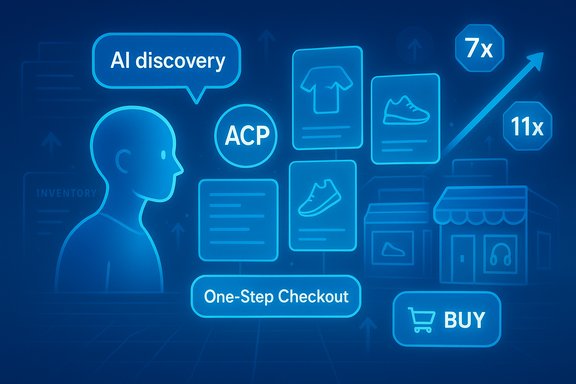
Shopify’s latest earnings call revealed a seismic shift: traffic from AI tools to Shopify stores has climbed roughly 7x since January, and orders attributed to AI-powered search and agents have increased by about 11x, a signal that agentic commerce — AI agents that discover, select and complete purchases on behalf of consumers — is moving fast from experimental to commercial reality.
Shopify’s Q3 results showed strong top-line momentum alongside the AI metrics the company highlighted during its earnings discussion. Alongside continued GMV and revenue growth, Shopify executives framed AI as central to their platform strategy, citing both merchant-facing features and internal tools that accelerate product decisions and merchant enablement.
Over the last year Shopify has layered multiple AI capabilities on top of its core commerce stack: consumer-facing features that make product discovery and checkout easier, merchant tools that automate content and workflows, and internal systems that harvest signal from millions of merchants and billions of transactions to speed decision-making. Those investments are now intersecting with a broader industry move — notably OpenAI’s Instant Checkout and the Agentic Commerce Protocol (ACP) — that routes conversational AI discovery straight into live, paid checkouts.
For merchants, developers and IT teams the immediate mandates are clear: get product data correct, embrace the integration standards, harden fulfillment and fraud controls, and treat agentic commerce as a new channel requiring dedicated measurement and operational planning.
This is not a slow, theoretical trend — it’s a practical, platform-level shift. The merchants who treat AI-driven channels as first-class distribution partners, and the technologists who build reliable, transparent integrations, will be best positioned to capture the upside of an 11x world.
Source: CryptoRank https://cryptorank.io/news/feed/29d47-shopify-ai-orders-surge/
 Background
Shopify’s Q3 results showed strong top-line momentum alongside the AI metrics the company highlighted during its earnings discussion. Alongside continued GMV and revenue growth, Shopify executives framed AI as central to their platform strategy, citing both merchant-facing features and internal tools that accelerate product decisions and merchant enablement.Over the last year Shopify has layered multiple AI capabilities on top of its core commerce stack: consumer-facing features that make product discovery and checkout easier, merchant tools that automate content and workflows, and internal systems that harvest signal from millions of merchants and billions of transactions to speed decision-making. Those investments are now intersecting with a broader industry move — notably OpenAI’s Instant Checkout and the Agentic Commerce Protocol (ACP) — that routes conversational AI discovery straight into live, paid checkouts.
What Shopify’s 7x/11x numbers actually mean
Short version
- 7x AI traffic: Many more visits to merchant pages are being driven by AI discovery channels (chatbots, AI assistants and in-chat product surfacing).
- 11x AI-driven orders: Purchases that can be attributed to those AI channels have grown even faster, indicating higher conversion rates from AI referrals.
Why orders might outpace traffic
There are several plausible reasons AI-originated sessions convert better than traditional discovery:- AI shopping agents often deliver ranked, highly relevant product matches rather than a sea of search results.
- When combined with "instant checkout" integrations, the friction between discovery and purchase is reduced or eliminated.
- AI agents can carry context (price range, shipping constraints, prior preferences) into recommendations, improving relevance and purchase intent.
Overview of the technical plumbing: how AI becomes commerce
Agentic Commerce Protocol and Instant Checkout
The recent emergence of an Agentic Commerce Protocol (ACP) and Instant Checkout experiences has created a standardized path for AI agents to discover products, surface them in chat, and hand off payments and order details to merchants. Key technical elements include:- Product Feed Spec: merchants publish a structured feed so AI agents can read prices, availability, images and variant metadata in real time.
- Checkout Handshake: AI agents present a one-step or few-step payment flow (Instant Checkout) that reuses saved payment credentials or express methods.
- Merchant Control: payments flow to merchants, merchants remain the merchant of record, and post‑purchase fulfillment and support stay with the seller.
- Open standards: ACP-style specifications are intended to be open and extensible so different AI platforms, payment processors and storefronts can interoperate.
Shopify’s internal AI tooling
Shopify is using AI not only for external integrations but also internally. Examples include:- Shopify Magic: merchant-facing automation for copy, images and operational workflows.
- AI Store Builder: generative tooling that can build store layouts from prompts, including images and product copy.
- Scout: an internal search/index tool that helps employees quickly surface merchant feedback, support tickets and usage signals to inform product decisions.
- Sidekick (merchant-facing): iterative merchant assistance that uses prompts to speed tasks like product descriptions and support replies.
Why this is a watershed moment for e-commerce
1) Commerce moves into conversational contexts
For decades e-commerce has been page-centric. With AI agents and Instant Checkout, the experience transitions into conversation-first commerce: users ask and the agent completes — sometimes without opening a single external webpage.2) New attribution and discovery models
The historical digital marketing funnel (paid search → landing page → purchase) is being reframed. Visibility may now depend on AI relevance and structured product data (feeds) rather than traditional SEO ranking or paid search bids — a shift some practitioners are already calling GEO (Generative Engine Optimization).3) Channel expansion for merchants
Millions of Shopify merchants gain potential reach inside popular AI assistants. For smaller merchants this can be a democratizing force: good product, good pricing and accurate feeds can surface merchants into conversational commerce with relatively low technical overhead.Benefits for merchants and developers
- Higher conversion potential: AI referrals appear to convert better; early figures show order growth outpacing referral growth.
- Friction reduction: Instant Checkout and saved payments slash checkout abandon rates.
- New discovery surface: Small and mid‑market merchants can compete in AI discovery based on product fit and feed quality rather than ad budgets.
- Automation gains: Tools like Shopify Magic reduce time spent on product data, descriptions, and creatives.
- Faster iteration: Internal AI tools accelerate product management cycles, allowing Shopify to ship merchant features faster.
Important risks and open questions
Dependence on external AI platforms
Relying on third-party AI gateways (ChatGPT, Copilot, Perplexity, etc. concentrates gatekeeper power. Merchants could find a large share of discovery owned by AI platforms whose rules, fees or ranking algorithms change.Attribution and economics
When discovery and checkout occur inside a third‑party chat, how is value attributed? Platform fees, commissions and revenue-share arrangements are in flux. Merchants should expect evolving commercial terms and plan for potential margin impact.SEO disruption and discoverability
If AI answers become the default surface for product discovery, traditional SEO traffic may decline. Brands that currently rely on organic search will need to reallocate resources toward structured product data, feed quality, and AI‑centric optimization.Fraud, abuse and trust
AI-enabled checkouts may increase opportunities for fraud or erroneous ordering if product data is stale or fulfillment logic is misaligned. Safeguards for inventory sync, fraud detection, and post‑purchase reconciliation are essential.Privacy and data sharing
Giving AI vendors access to product feeds, order metadata or enriched catalog data introduces privacy and compliance considerations — especially for merchants operating across jurisdictions with strict data protection laws.User experience edgecases
Agentic commerce depends on perfect context-handling. If an agent misinterprets a constraint (wrong size, incorrect shipping preference), the resulting bad user experience can damage merchant reputation and increase returns.Security and compliance considerations
- Payments: Instant Checkout implementations are typically powered by established payment processors; merchants must ensure PCI compliance and confirmation that saved credentials are handled by vetted providers.
- Inventory sync: Real-time availability is critical. Merchants must maintain accurate product feeds and employ back‑in‑stock or cancellation logic to avoid overselling.
- Returns and disputes: Chat-driven purchases require clear rules for returns and support; merchant policies must be visible in the order data exposed to the AI agent.
- Fraud detection: Existing risk-layering (velocity checks, device fingerprinting, behavioral analytics) should be extended to AI-originated flows.
- Regulatory: Where AI agents collect or store customer preferences, merchants should review cross-border data transfer rules and consent frameworks.
Practical checklist for merchants: how to prepare right now
- Audit your product feed
- Ensure pricing, availability, images, sizes and variant SKUs are accurate and updated in real time.
- Implement and test Instant Checkout / ACP integration (if available)
- Confirm checkout handshake works, shipping logic is correct and payment methods are accepted.
- Harden inventory and fulfillment systems
- Add quick cancellation and backorder handling to avoid overselling when AI-driven demand spikes.
- Tighten fraud detection
- Apply AI-aware fraud rules for agent-driven sessions and monitor chargeback trends specifically for AI referrals.
- Improve product content
- Use AI tools for precise titles, bullet points and descriptions that help agents match queries to SKUs.
- Re-evaluate marketing mix
- Balance SEO, paid search and feed optimization; begin experimenting with AI‑first discovery campaigns.
- Document customer experience flows
- Ensure return policies and support contact points are present in the metadata passed to agents.
- Measure and attribute
- Tag and analyze AI-originated traffic separately to track conversion rates, AOV, returns and lifetime value.
For platform architects and developers: technical best practices
- Adopt robust feed schemas and follow product feed specs strictly.
- Design idempotent order ingestion: agentic checkouts should be safely replayable.
- Use webhooks and near‑real‑time inventory sync to prevent race conditions.
- Monitor agent-specific telemetry and build A/B tests to validate AI-surfaced exposure and conversion lifts.
- Ensure API rate limits and caching strategies support sudden bursts of AI-originated traffic.
Market and competitive implications
- Winners: Platforms that combine a large merchant base, strong data, and flexible integration (Shopify) are well-positioned to monetize the agentic wave.
- Big tech: Companies offering AI agents (OpenAI, Google, Microsoft) can become major distribution channels and profit centers for commerce if transaction fees and ad models follow.
- Retailers: Large retailers with direct brand recognition (Amazon, Walmart) will compete on fulfillment and trust; smaller merchants gain new reach if they play the feed and integration game well.
- Ad industry: Traditional ad models may need to evolve towards placement and prominence inside AI responses and catalog-level sponsorships rather than page clicks.
Longer-term implications for Windows-centric IT and infrastructure
Windows developers and infrastructure teams supporting retail and SMB partners should anticipate:- Increasing demand for headless commerce integrations and feed generation tools that run on Windows Server or cloud platforms.
- A rise in serverless and edge compute patterns to keep product feeds low-latency and synchronized with fulfillment systems.
- New tooling needs: telemetry dashboards for AI-originated sessions, agent‑specific error handling, and automation to respond to AI-driven demand spikes.
- Security updates: patch cycles for payment integrations and middleware that handles agent checkouts must be strict and regularly audited.
What to watch next
- Merchant adoption rates for ACP/Instant Checkout beyond the initial rollouts.
- Changes to commercial terms: platform fees, commissions, or data access costs that could affect merchant margins.
- Regulatory scrutiny: consumer protection authorities and privacy regulators may introduce new guidance around agent-driven sales, disclosures and consent.
- Fraud and dispute trends tied specifically to AI-originated transactions.
- How search engines and AI vendors evolve ranking and visibility policies for product feeds and commerce responses.
Caveats and unverifiable elements
Some of the language used by executives — for example, labeling AI as the “biggest shift in technology since the internet” — is a strategic framing and inherently subjective. Growth multipliers (7x, 11x) were presented by company leadership as year-to-date comparisons starting in January; exact measurement methodologies (what exactly counts as an AI referral, how attribution is measured across channels, how multi-touch paths are handled) were not exhaustively published in a single metrics spec. Merchants and analysts should treat the ratios as directional indicators of rapid change rather than precise, immutable constants.Conclusion
Shopify’s reported 7x increase in AI-originated traffic and 11x rise in AI-driven orders mark a meaningful inflection point for e-commerce. The technical scaffolding — open protocols, Instant Checkout, product feeds and platform integrations — has matured quickly, enabling conversational agents to bridge discovery and purchase in ways that materially reduce friction.For merchants, developers and IT teams the immediate mandates are clear: get product data correct, embrace the integration standards, harden fulfillment and fraud controls, and treat agentic commerce as a new channel requiring dedicated measurement and operational planning.
This is not a slow, theoretical trend — it’s a practical, platform-level shift. The merchants who treat AI-driven channels as first-class distribution partners, and the technologists who build reliable, transparent integrations, will be best positioned to capture the upside of an 11x world.
Source: CryptoRank https://cryptorank.io/news/feed/29d47-shopify-ai-orders-surge/
