Shopify Winter Editions: Agentic Storefronts Bring AI to Purchasing

  • Thread Author
Shopify’s latest Editions release turns a previously theoretical shift—selling directly through conversational AI—into something merchants can opt into now, with the company rolling out agentic storefronts that make products discoverable inside AI chat platforms such as ChatGPT, Perplexity, and Microsoft Copilot. The update is part of Shopify’s Winter Editions (branded around an AI-forward “Renaissance” theme) and bundles more than 150 product changes across the platform, including major upgrades to the merchant-facing assistant Sidekick, new automation flows, and tools to make store content machine-readable for agent-driven discovery.

A robed figure points at a merchant catalog shown on a large screen with items like a watch, backpack, and sunglasses.Background / Overview​

Shopify’s Winter Editions — billed as the “RenAIssance” release — is explicitly centered on AI-first commerce. The company’s public product page for the Editions details an “Agentic” section that explains how merchants can set up a single data feed and let Shopify surface their products to multiple AI chat platforms, with additional Sidekick productivity and Flow automation updates packaged alongside. These changes formalize what industry observers have called the move from “links to actions”: rather than ending a chat with a link to a product page, AI agents can now present products and—when supported—help complete checkout flows. In parallel, OpenAI and payments partners have been piloting in-chat purchases—OpenAI’s Instant Checkout (built with Stripe) already supports single‑item purchases from U.S. Etsy sellers and is explicitly expanding toward Shopify merchants. OpenAI states that merchants will pay a small fee on purchases completed through the chat experience, while users are not charged for the in-chat checkout itself. That product architecture—machine-readable product metadata + tokenized delegated payments + an agent-to-merchant protocol—forms the plumbing that makes agentic commerce possible.

What Shopify announced in plain terms​

Agentic storefronts: one setup, many AI channels​

  • What it does: Merchants can configure product pages and schema once in Shopify. When set up, those pages become discoverable to participating AI platforms (Shopify lists ChatGPT, Microsoft Copilot, and Perplexity among the initial endpoints). Shopify calls this feature Agentic Storefronts, and frames it as a syndication layer: set up data once, surface everywhere.
  • How it works at a high level: Products must expose structured, machine‑readable metadata (attributes, availability, images, policies, FAQs, and brand voice) that AI agents can ingest and use to answer questions or place recommendations. The agent may also consult a merchant’s policy pages and FAQ content so responses remain brand‑consistent.
  • Merchant control: Shopify positions merchants as the merchant of record—orders flow through merchant checkout and fulfillment systems, and the merchant remains responsible for returns and service. At the same time, discovery and the front-end recommendation surface are delivered by AI agents.

Sidekick, Pulse, Flow and automation upgrades​

  • Sidekick improvements: Shopify updated Sidekick so merchants can use natural-language prompts to modify theme elements (“make this button rounded”) and to generate or adjust content. Sidekick’s Pulse delivers personalized, proactive advice derived from store data. A new prompt-driven custom app generator and a Flow integration let merchants create automations by describing the desired result (for example, “tag customers who spend over $200”).

Why this matters: the technical and business mechanics​

Agentic commerce is not a single feature—it’s a stack. Three technical primitives must align for AI agents to reliably discover, recommend, and transact:
  • Machine-readable product and storefront data – structured attributes, consistent metadata, and reliable inventory signals so agents can filter for size, shipping window, price, and variant availability.
  • Delegated / tokenized checkout primitives – short-lived tokens or delegated payment sessions (Shop Pay / tokenized rails) that allow agents to trigger a checkout without exposing raw card data.
  • Orchestration and provenance – the agent runtime must manage multi-step flows (gather constraints, confirm buyer intent, initiate tokenized payments) and emit auditable records tying the conversation to the resulting order.
The practical payoff is straightforward: lower friction between discovery and purchase. Early pilots (OpenAI’s Instant Checkout being the most visible) show that making checkout accessible inside the chat reduces abandonment and can increase conversion. Shopify executives have cited rapid gains in AI-sourced traffic and orders in investor conversations, prompting the company to build platform primitives to capture that channel.

Cross‑verifying the claims​

  • Shopify’s Editions page confirms the existence of an “Agentic” section and Sidekick updates as part of the Winter Editions rollout, including the language about surfacing products to ChatGPT, Copilot, and Perplexity.
  • OpenAI’s Instant Checkout blog post lays out the Agentic Commerce Protocol (ACP) and explains how ChatGPT can complete single-item checkouts from participating merchants; OpenAI also notes merchants will pay a small fee on completed purchases. News outlets including Reuters and CNBC reported the same rollout and fee model around the launch.
  • BetaKit’s coverage summarized these developments and added context around merchant setup, automations, and Shopify’s wider AI push; the user-provided copy matches the product descriptions found in Shopify’s Editions materials. The uploaded BetaKit text is consistent with Shopify’s own release notes and with coverage from multiple technology outlets.
Caveat about executive quotes: BetaKit attributes a specific line to Shopify CEO Tobi Lütke—saying Shopify is making every store “agent-ready by default.” That phrasing encapsulates the company’s intention but, as of the verification checks performed here, an exact word-for-word quote attributed to Lütke in Shopify’s public materials or other major press releases was not found. Treat direct‑quote assertions like that as reported by BetaKit and as consistent with Shopify’s product messaging, while noting the precise phrasing may be paraphrase rather than a verbatim CEO statement.

Strengths and immediate benefits for merchants​

  • New distribution surface: AI assistants expand potential discovery beyond search engines and social channels. For many smaller merchants, appearing in agentic results can open additional demand sources without the same ad spend required by paid channels.
  • Conversion lift potential: By shortening the funnel (ask → confirm → buy) and enabling tokenized express checkout, agentic channels can materially reduce cart abandonment and lift conversion rates.
  • Productivity gains: Sidekick improvements and prompt-based Flow automations reduce manual store management work—automating product copy, app generation, and conditional workflows.
  • Unified data layer: Shopify’s emphasis on a canonical product catalog and improved metadata/ metafield management helps brands achieve consistent downstream presentation across multiple channels (web, Shop app, and now AI agents).

Risks, unknowns and critical caveats​

The technology is powerful—and the risks are both technical and economic. Merchants and IT teams must plan for the following:
  • Attribution ambiguity and opaque metrics: Shopify has reported very large relative increases in AI-originated traffic and orders in recent quarters; however, attribution rules for what counts as “AI referral” or “AI-attributed purchase” vary by definition and can materially change headline multipliers. Internal telemetry is helpful but not the same as an independently auditable standard.
  • Gatekeeper risk and channel concentration: If a small number of AI assistants become primary discovery surfaces, they gain leverage over visibility and payments. That can lead to opaque ranking rules and commercial terms that erode merchant margins. Diversifying presence across agents and preserving owned channels (email lists, apps, direct SEO) will remain essential.
  • Operational strain on small merchants: Agentic commerce rewards merchants with accurate product feeds, real-time inventory, and robust fulfillment SLAs. Smaller merchants who lack these capabilities may face higher cancellation rates, chargebacks, or poor customer experiences when AI-driven demand spikes.
  • Fraud and dispute complexity: Conversational checkouts introduce new fraud vectors (e.g., social-engineered confirmations or token misuse). Tokenized payment rails mitigate some risk, but merchants must extend fraud rules and reconcile agent-originated sessions properly.
  • Privacy and data sharing: Exposing product metadata, policies, and even aggregated order signals to third-party agents raises questions about what customer data is shared, consent mechanisms, and cross-border transfers. Merchants should understand the contracts and data flows associated with each agentic channel.
  • Regulatory attention: As agents begin to recommend and transact on behalf of buyers, consumer-protection authorities may demand new disclosures for AI-driven recommendations and clearer dispute/redress pathways. Expect evolving guidance.

Practical checklist for merchants (actionable, prioritized)​

Merchants should treat the agentic channel like any new sales channel: instrument, secure, and test.
  • Audit and standardize product data
  • Ensure SKU, UPC/EAN, variant data, high-quality images, and complete attribute sets (size, color, materials) are accurate.
  • Use Shopify metafields for structured attributes so agents can filter reliably.
  • Enable tokenized/express checkout options
  • If eligible, enable Shop Pay / tokenized checkout primitives and test the end-to-end flow in sandbox and live scenarios.
  • Confirm tax, shipping, and promotional logic behaves as expected in delegated checkout sessions.
  • Harden fulfillment and inventory sync
  • Implement near-real-time inventory updates and quick cancellation/backorder handling to avoid oversells triggered by agentic demand.
  • Update policies and make them discoverable
  • Ensure returns, warranties, shipping windows, and support contacts are machine-readable and available for agents to surface inline.
  • Extend fraud & risk controls
  • Add agent-aware fraud detection rules and monitor chargeback trends for AI-sourced orders separately.
  • Instrument attribution and analytics
  • Tag agent-originated sessions and measure conversion, AOV, LTV, returns, and dispute rates. Create dashboards that separate AI channel performance from organic and paid channels.
  • Retain owned channels
  • Continue investing in direct-to-customer channels (email, loyalty, app) to avoid overdependence on any single assistant.

Developer and IT implications​

  • APIs and performance: Catalog APIs and checkout handshakes must be low-latency and idempotent; agentic agents will query product feeds at scale and expect consistency.
  • Token lifecycle management: Teams must implement secure short‑lived tokens, revocation, and playback-resilience for delegated checkouts.
  • Observability: Add end-to-end tracing that links conversational intent to order provenance for dispute resolution and fraud investigations.
  • Rate limits and caching: Use sensible caching and rate-limiting to handle bursty agent traffic while guaranteeing freshness for inventory-sensitive SKUs.
  • Compliance and privacy engineering: Define data minimization, consent capture, and cross-border data-flow architecture that matches regulatory requirements.

Competitive and economic dynamics​

  • Monetization vectors: Platforms enabling checkout inside agents (OpenAI, Microsoft, Google, others) can extract fees at discovery or payment layers. OpenAI’s Instant Checkout already charges merchants a fee per completed purchase while keeping the user price unchanged. Shopify stands to monetize via Shop Pay/Shopify Payments volume and any transaction or partner fees that route through its payment rails.
  • Winners and losers: Platforms with large merchant bases and robust payment rails (Shopify) and large conversational surfaces (OpenAI, Microsoft) will have structural advantages. But merchants that don’t invest in feed hygiene and fulfillment will struggle as agentic channels prioritize readiness and accuracy.
  • The ad model reinvention: If agents become default discovery surfaces, traditional click-based advertising models may shift toward catalog-level sponsorships, prioritized product placements inside AI responses, or new “agentic placement” formats. Expect experimentation and rapid change in monetization strategies.

Governance and policy: what to watch​

  • Platform rules and robots.txt guidance: Shopify has been explicit about limiting fully autonomous “buy-for-me” agents that complete purchases without final human review, and it has updated default instructions for crawlers and bots. This signals an intent to control agent behavior and protect merchants and buyers from unsupervised agentic purchases. Merchants should monitor platform-level policy updates closely.
  • Consumer disclosure: Regulators will likely require clarity on when a recommendation is generated by an AI, whether placements are paid, and how dispute processes work for agent‑originated purchases.
  • Standardization effort: Open standards like the Agentic Commerce Protocol (ACP)—publicized by OpenAI and Stripe—are rapidly evolving. Staying current with ACP and platform SDKs will be essential for interoperable integrations.

What’s still uncertain (and how to treat those claims)​

  • Scale claims: Shopify executives have cited rapid multipliers in AI traffic and AI‑attributed orders in investor discussions. Those figures are directional and important, but they depend on attribution definitions and baseline choices—treat them as trend signals rather than fully audited facts until formal reporting standards are published.
  • Fee economics: OpenAI and other agent platforms have stated merchants will pay fees on completed purchases, but the precise fee structures, thresholds, and long-term commercial terms remain subject to contract negotiation and will vary by partner and region. Merchants should not assume a universal fee model and must read partnership terms closely.
  • Exact executive phrasing: Some published pieces paraphrase executive sentiment (“agent-ready by default” attributed to Tobi Lütke in BetaKit). That phrase captures the intent of Shopify’s roadmap, but the exact wording should be treated as reported paraphrase unless a verbatim source is located.

Bottom line: practical judgment for merchants and platform teams​

Shopify’s agentic storefronts and the broader agentic commerce wave are not a speculative R&D play anymore—they are operational channels rolling into production with real checkouts and real economics. Merchants who treat AI agents as another channel—rigorously cleaning product data, enabling tokenized checkout, hardening inventory systems, instrumenting attribution, and maintaining first‑party customer relationships—will be best positioned to benefit.
At the same time, merchants and platform architects must build guardrails: careful fraud rules, clear consumer disclosures, and legal review of data-sharing arrangements. The immediate opportunity is meaningful, but it comes with governance and operational costs that must be planned for deliberately.
Shopify’s Winter Editions provide the product primitives to participate; OpenAI’s Instant Checkout and the Agentic Commerce Protocol show how agents will execute on purchases in practice. The next 12 months will reveal whether agentic commerce becomes a new mainstream channel or a redistributive battleground in which platform terms, measurement rigor, and merchant readiness determine winners and losers.
Conclusion
Agentic storefronts mark a clear turning point: discovery and checkout can now happen inside conversations rather than across multiple web pages. Shopify has shipped product tools to make merchant catalogs more discoverable to AI agents, and OpenAI (with Stripe) has demonstrated how those conversations can translate into purchases. The result is a powerful mix of opportunity and operational risk. Merchants should move quickly but prudently—opt in only after validating feed quality, checkout robustness, fraud defenses, and analytics—because early readiness will likely determine whether agentic channels are a new growth engine or a cost center.
Source: BetaKit Shopify merchants can now sell products through AI chatbots | BetaKit

 

Shopify’s Winter ’26 Edition rolls out a sweeping new capability — Agentic Storefronts — designed to make any Shopify merchant discoverable and sellable inside AI-powered conversations on assistants like ChatGPT, Perplexity, and Microsoft Copilot with a single setup in the Shopify admin. This is not a cosmetic integration: it maps product catalogs into machine‑readable schemas, ties live pricing and inventory to agent responses, and supports agent-driven checkout flows while keeping merchants as the merchant of record.

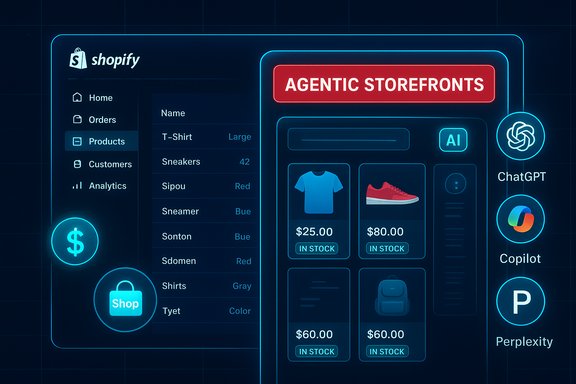
Neon Shopify admin dashboard showing product list, prices, and AI storefront tools.Background / Overview​

The Winter ’26 rollout formalizes a shift the industry has been tracking for months: conversation-first commerce — where agents do more than point at product links and instead present, recommend, and, when permitted, complete purchases inside the conversation. Shopify positions Agentic Storefronts as a syndication layer: set up your product metadata once, and Shopify Catalog will surface that data across participating AI agents without bespoke integrations to each platform.
Underneath the marketing language are three technical primitives now treated as foundational for agentic commerce:
  • machine‑readable product and storefront data (structured catalog feeds),
  • delegated or tokenized checkout primitives that let agents initiate payments securely, and
  • orchestration and provenance systems that capture the chain of agent actions and tie them to orders for audit and dispute resolution.
These primitives enable what some vendors call the Agentic Commerce Protocol (ACP) pattern: an assistant queries product metadata, creates or requests a checkout session via short-lived tokens, and hands off the order to the merchant backend while preserving merchant control of fulfillment and returns. Early pilots of this pattern — notably OpenAI’s Instant Checkout — illustrate the end-to-end flow.

What Agentic Storefronts actually do​

Agentic Storefronts are built to convert conversational intent into purchase-ready product responses and, optionally, an in-chat checkout experience. In concrete terms, the feature set includes:
  • A single, structured catalog feed that infers categories, extracts attributes, consolidates variants, and clusters identical items so assistants see relevant, deduplicated results.
  • Integration with the Knowledge Base App and merchant-defined policies and FAQs so agents can answer brand- and policy-related questions consistently.
  • Real‑time inventory and price synchronization across agents so availability shown in a chat reflects live storefront state.
  • Channel toggles so merchants can decide which AI platforms may access their storefront.
  • End-to-end transaction handling routed through Shopify checkout rails (Shop Pay/Shopify Payments) with AI attribution and order visibility in the merchant admin.
These capabilities are positioned as a win-win: customers get fast, context-aware recommendations and friction‑reduced checkout; merchants gain an additional demand channel while keeping ownership of customer records, fulfillment, and service. Shopify says every order flows into the merchant’s admin and that merchants remain the merchant of record.

The technical plumbing — how it works under the hood​

Catalogs, schemas and metadata hygiene​

Agentic Storefronts depend on highly structured, machine‑readable product data. Shopify Catalog aims to use signals from millions of merchants to normalize and enrich catalog inputs: infer categories, extract key attributes (size, color, materials), consolidate duplicates, and expose canonical SKUs and variant mappings. This structure is what lets agents filter and rank options accurately.

Delegated payments and tokenization​

A core security primitive for in-chat checkout is tokenized or delegated payments: ephemeral credentials or scoped tokens that permit an agent to trigger payment without exposing raw card data. Payments partners (e.g., Stripe) and protocols developed around Instant Checkout are central to this pattern. When correctly implemented, tokens are short‑lived, auditable, and revocable — necessary measures to retain consumer trust and support dispute resolution.

Orchestration and provenance​

Agentic purchases require robust logging and provenance: the runtime must capture the sequence of tool calls, user confirmations, and the token exchange. That trail is essential for fraud investigations, chargebacks, and regulatory compliance. Shopify’s proposition places that provenance inside the merchant’s systems so merchants can reconcile agentic orders with their existing fulfillment and customer‑service workflows.

Standards and protocols​

The ecosystem is converging on ACP-style standards that codify how agents read product feeds, request checkout sessions, and attach provenance to orders. Those standards enable multi-agent and multi-platform interoperability and reduce the need for custom integrations. However, they are still early, evolving, and subject to platform-specific implementations that will drive commercial and technical outcomes.

Why Shopify believes this is a strategic advantage​

Shopify’s argument rests on three claimed competitive moats:
  • Data breadth and scale: Shopify already indexes catalog and transaction signals from millions of merchants, giving it rich, commerce-specific inputs that improve agent relevance and reduce false positives.
  • Payments and checkout rails: Shop Pay and Shopify Payments provide express checkout experiences that can be re-used in agentic flows, offering both a UX advantage and a monetization lever when in-chat purchases occur.
  • Merchant trust and control: Shopify stresses that merchants remain merchant of record and that Agentic Storefronts keep branding, policies, and customer relationships intact.
These are persuasive points when engineering and operations are aligned: accurate feeds plus fast, trusted checkout materially lower friction between discovery and purchase. Shopify has highlighted striking internal multipliers — for example, reported increases in AI-driven traffic and AI-attributed orders — as evidence the channel is already meaningful. Those figures are reported by company leadership and summarized by industry observers; they are directional and should be interpreted carefully.

Strengths: what’s compelling about Agentic Storefronts​

  • One‑and‑done feed management: Smaller merchants gain a practical path to multiple AI surfaces without building separate integrations for each assistant, lowering engineering overhead and time to market.
  • Better conversion potential: Conversational agents ask clarifying questions, prune choices, and — when combined with express checkout — boost conversion rates compared with a generic referral link. Early pilots and merchant telemetry suggest orders can scale faster than raw referral growth.
  • Merchant control: By routing checkout and fulfillment through existing merchant systems, Shopify preserves merchant responsibilities for returns, fulfillment, and customer service while exposing new demand sources.
  • Operational tooling: Shopify pairs Agentic Storefronts with upgrades to Sidekick, Flow automations, and Knowledge Base integrations so merchants can automate catalog fixes, content creation, and policy publication — all tasks that make product data agent-ready.

Risks and limitations — what merchants and IT teams must watch​

While the upside is real, four structural risks deserve careful attention.

1) Attribution, economics and vendor fees​

When discovery and checkout happen inside third-party agents, platforms that host the conversation can extract new fees or negotiate placement terms. OpenAI’s Instant Checkout, for instance, charges merchants a fee per completed purchase in existing pilots — a commercial detail that can reshape margins and attribution models. Merchants should expect evolving fee schedules and to track AI-sourced LTV, returns, and chargebacks separately.

2) Dependence on gatekeeper platforms​

Concentrating discovery inside a handful of assistants concentrates gatekeeper power. If an agent changes ranking algorithms, penalizes certain metadata practices, or alters access tiers, merchant visibility can shift quickly. This is a classic platform dependency risk writ large: the benefits of new reach come with exposure to external policy and algorithm changes.

3) Operational fragility — inventory sync and fulfillment​

Agentic experiences depend on perfect or near‑perfect real‑time availability. Stale stock information, mismatched SKUs, or token expiration can lead to oversells, cancellations, and a bad customer experience. Merchants must tighten inventory sync, cancellation logic, and partial-fulfillment handling before enabling agentic checkouts at scale.

4) Fraud, dispute and regulatory surface area​

Agent-driven checkouts create novel fraud vectors and regulatory questions. Short-lived tokens reduce some attack surfaces but introduce others (e.g., replay attacks, token misuse). Regulators may demand clearer disclosures for AI-driven recommendations and new dispute rules for agent-originated purchases. Merchants should extend fraud-rule sets and prepare consumer‑protection playbooks.

Practical checklist: how merchants should prepare (prioritized)​

  • Audit and cleanse your catalog: canonical SKUs, GTIN/EAN/UPC where available, normalized titles, complete attributes (size, color), and high-quality images. Agents rely on structured metadata to match intent.
  • Expose accurate, machine-readable fulfillment metadata: real-time inventory, shipping windows, region restrictions, and return policies. Make these discoverable to agents via the Knowledge Base App or metafields.
  • Enable and test delegated checkout flows: if eligible, adopt Shop Pay / tokenized primitives and run end-to-end tests (sandbox and live) for price changes, cancellations, and partial fulfillments.
  • Harden fraud detection: add agent-aware fraud rules, velocity checks, and enhanced verification for high-value orders. Monitor AI-originated chargebacks and disputes separately.
  • Instrument attribution and analytics: tag and measure AI-originated sessions, conversion rates, AOV, returns, and LTV in separate dashboards to avoid conflating channels.
  • Keep owned channels healthy: continue investing in email, app, and direct channels to avoid single‑channel dependency. Diversification remains a resilient strategy.

Developer and IT implications (Windows-focused guidance)​

For engineers and ops teams supporting Shopify merchants, especially in Windows-centric shops, several changes are material:
  • Expect increased demand for headless commerce patterns and feed-generation tools that can run in Windows Server environments or cloud containers. Low-latency APIs and webhooks that surface inventory changes will be critical.
  • Build observability: tracing that links chat prompts to order IDs, agent identifiers, and token lifecycles will be necessary for dispute resolution and forensic audits. Ensure logs are retained and indexed for fast queries.
  • Harden middleware handling payments and tokens: implement strict token lifecycle management, revocation, and idempotent order ingestion to avoid double-charges or replayable actions.
  • Plan for bursty traffic: agentic channels can produce sudden spikes as agents surface popular items to many users; caching, rate limits, and autoscaling policies must be stress-tested.

Business and competitive implications​

Agentic commerce is reshaping marketing, monetization, and competitive dynamics:
  • Advertising models may shift from click-based bidding to catalog-level sponsorships or prioritized product placement inside AI responses. Expect experimentation and a reallocation of some ad spend toward feed hygiene and agentic optimization.
  • Platforms that combine a large merchant base, strong payment rails, and broad agent distribution (Shopify + Shop Pay + partner assistants) hold structural advantages. But merchants that fail to invest in feed accuracy or fulfillment readiness risk being excluded from agentic consideration sets.
  • Merchant margin pressure is a possibility: new platform fees or transaction levies tied to in-chat purchases can change unit economics, particularly for low-margin SKUs. Negotiate and model for different fee scenarios before enabling agentic checkouts broadly.

What to watch next​

  • Merchant adoption rates for ACP/Instant Checkout beyond initial pilots and how platform fee structures evolve.
  • Regulatory guidance and consumer-protection rules targeting AI-generated recommendations and autonomous agent purchases.
  • How major agents (OpenAI, Microsoft, Google) adjust ranking and visibility rules for product responses — whether they favor larger merchants, deeper integrations, or paid placement.
  • Empirical signals: conversion lift quality, return and dispute rates for agent-originated orders, and whether agentic channels deliver sustainable LTV comparable to existing channels.

Caveats and flagged claims​

Several headline claims associated with the agentic narrative warrant cautious interpretation. Shopify leadership has cited internal multipliers — for example, a reported 7× increase in AI‑tool referrals and an 11× rise in AI‑attributed orders since January — but those figures are management telemetry with definitions that are not uniformly published and are not GAAP metrics. Treat these multipliers as directional indicators of rapid change rather than audited facts.
Similarly, while the Agentic Commerce Protocol and Instant Checkout pilots demonstrate the pattern, the market is still in early days: standards, fee structures, and governance models are evolving and will materially affect merchant economics and technical implementations. Any merchant planning to rely heavily on agentic channels should assume the rules will change and design for flexibility.

Conclusion​

Agentic Storefronts mark a significant, pragmatic step in Shopify’s push to make conversational AI a mainstream commerce channel. By packaging catalog normalization, knowledge-base-driven brand control, real-time inventory sync, and tokenized checkout into a single setup, Shopify lowers the barrier for merchants to appear in AI conversations and accept in-chat purchases.
The promise is tangible: faster discovery-to-purchase paths, higher conversion potential, and broader reach for merchants of all sizes. The trade-offs are equally real: platform dependency, new fee regimes, operational fragility, and increased regulatory scrutiny. Merchants should move deliberately, prioritize feed hygiene, test checkout tokens and fulfillment logic thoroughly, and maintain diversified traffic channels while monitoring early agentic performance metrics closely.
For IT teams and developers, the engineering challenge is not optional: the future of conversational commerce will be won or lost in catalog quality, API reliability, token management, and observability. The merchants and platforms that treat those elements as core product challenges — not marketing checkboxes — will gain the strategic advantage in this new, agentic era.

Source: Shopify Introducing Shopify Agentic Storefronts: Sell your products everywhere AI conversations happen
 

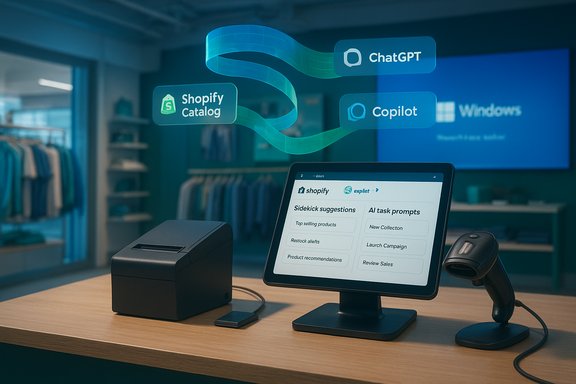
Shopify checkout setup with AI tools and barcode scanner in a retail store.
Title: Shopify’s Winter ’26 “RenAIssance”: What Agentic Storefronts, Sidekick and SimGym Mean for Australian (and Windows-focused) Retailers
Deck: Shopify’s Winter ’26 Edition — branded the “RenAIssance” — is a large, platform-wide push that stitches AI into storefronts, POS, developer tools and discovery. For Australian merchants and IT teams that run Windows-based shops, it promises new revenue channels (AI conversations), operational automation (Sidekick), and in-store resilience (POS Hub) — but also new integration, privacy and attribution challenges that need pragmatic technology planning.

Lede
Shopify’s Winter ’26 Edition, rolled out in December 2025 and promoted internally as the “RenAIssance,” is one of the company’s biggest product waves: more than 150 updates spanning admin, retail hardware, developer tooling and new “agentic” ways for products to appear inside AI conversations such as ChatGPT, Perplexity and Microsoft Copilot. For merchants in Australia — one of Shopify’s strategically highlighted markets — the changes promise both clear near-term wins (better discovery and automation) and new operational responsibilities (attribution, privacy and testing). Why this matters to WindowsForum readers
WindowsForum readers include operators, store IT managers, POS integrators and developers who either run on or integrate with Microsoft technologies. Shopify’s announcement explicitly targets AI-infused shopping experiences and tighter interoperability with conversational platforms — and it also includes physical retail improvements (hardware hub, wired peripherals, monitoring) that will affect in-store setups and integrations (including where Windows devices sit in the stack). Given Microsoft’s Copilot partnership and the prominence of Windows in many point‑of‑sale and back‑office environments, this Edition is especially relevant to operators who must balance platform agility with stability, compliance and local tax/fulfilment rules. What Shopify shipped (the headline features — plain English)
  • Agentic Storefronts: a single admin path to make a merchant’s catalog discoverable and shoppable inside AI chat platforms (ChatGPT, Perplexity, Microsoft Copilot), with controls to enable/disable platforms and measurement baked in. Merchants stay the merchant of record, and orders flow back into Shopify admin.
  • Sidekick expanded: Shopify’s AI assistant has been upgraded to surface prioritized tasks, scaffold custom admin apps from plain-language requests, edit product photos with AI, adjust theme settings by natural language, and build Flow automations from simple instructions. Sidekick has already been used in millions of merchant conversations, and the Winter Edition moves it from helper to workflow builder.
  • SimGym (research preview): an AI-driven simulation environment that creates virtual shopper agents to test storefront changes before you go live — useful for A/B testing, spotting issues, and getting early performance signals.
  • Rollouts: a native experimentation and scheduling workflow for themes and admin changes — built-in A/B testing and staged releases so you can test and time launches without external tools.
  • POS Hub & retail reliability: a new hardware approach for physical stores — a POS Hub that connects wired peripherals (printers, scanners, card readers) to tablets with monitoring and automatic updates, reducing Bluetooth pairing problems and improving fault recovery.
  • AI-native developer platform: new developer flows where AI agents scaffold apps, run GraphQL ops, and generate validated code; Shopify Catalog and MCP-enabled Catalog APIs make product data searchable across many stores. Checkout Kit and MCP improvements let dev teams render merchant checkout in more places.
The implications — feature by feature (practical, tactical, technical)
1) Agentic Storefronts — new discovery channel, new control surface
What it does
  • Agentic Storefronts makes your Shopify Catalog usable by AI agents so your product data shows up inside AI-driven conversations and search results. You set it up once; Shopify’s Catalog syndicates product data to participating AI platforms; you can toggle which channels you appear on. The checkout either completes in-chat or hands off to your store — but the order and relationship remain yours.
Why it’s important for merchants
  • Immediate new demand funnel: a shopper can discover and buy within a conversational UI without ever landing on a merchant’s site. Early evidence suggests AI-origin traffic can be highly intentful, increasing conversion when the user has completed a short, clarifying conversation.
Practical risks & controls IT teams must plan for
  • Attribution: AI-sourced discovery fragments the customer path. Ensure you have analytics and UTM-like attribution hooks that map order metadata back to the originating AI surface (Shopify says they’ll support attribution features). You should confirm how the platform reports revenue, refunds and cancellations that originate in-chat.
  • Product data hygiene & canonicalization: agentic discovery relies on consolidated, high-quality product metadata. Expect to invest time in catalog cleanup (accurate SKUs, canonical images, normalized variants and correct inventory). Validate metadata in dev/staging before syndication.
  • Platform gating & brand control: toggle off channels if a platform’s presentation or data usage terms are unacceptable; don’t treat Agentic as “fire-and-forget.” Use the control toggles that Shopify provides and audit which third‑party AI platforms receive your data.
Windows-specific considerations
  • Integration with Microsoft Copilot means enterprise and Windows-centric workflows may see higher AI referrals. If you run Microsoft‑centric telemetry and SSO, confirm identity flows and whether in-chat purchases can be reconciled against user accounts or enterprise purchase programs.
2) Sidekick — from assistant to doer
What’s new
  • Sidekick (Shopify’s built-in AI assistant) now surfaces proactive recommendations (Sidekick Pulse), generates admin apps, edits images with AI, and can build Flow automations from natural-language prompts. Shopify frames Sidekick as a productivity partner that reduces repetitive work.
Operational wins
  • Time savings for merchandisers: prompt-driven theme adjustments and automated Flow rules reduce dependency on internal engineering for routine changes.
  • Faster in-house tooling: ask Sidekick to scaffold a tiny admin app (e.g., reorder report) instead of opening a dev ticket.
Security and governance
  • App generation needs guardrails. When Sidekick scaffolds code or admin apps you will want to:
  • Require review & staging: never auto-deploy generated admin apps to production without code review and a dev store test. The Winter Edition supports dev stores that Sidekick can create — use them.
  • Inspect generated OAuth scopes and API use: ensure generated apps request the minimum privileges.
  • Retain version and audit trails: preserve prompt inputs and generated code snapshots so you can trace why something changed.
3) SimGym + Rollouts — simulation before you ship
What they do
  • SimGym creates virtual shoppers to model how different segments will respond to storefront changes (theme tweaks, merchandising, promotions) using signals derived from billions of purchases. Rollouts lets you schedule and A/B test theme or admin changes natively in Shopify.
Why you should care
  • Less blast radius: simulate changes to detect negative signals (cart friction, variant mismatches) before exposing real customers. If you manage multiple stores, SimGym can give early signals for large catalogue changes.
  • Better experimentation hygiene: Rollouts standardizes launch windows and experiment analysis inside admin, reducing spreadsheet-driven rollout mistakes.
How to use them in practice
  • Use SimGym as a pre‑test: get a prediction signal, then schedule a small Rollouts experiment for a segment. When Rollouts shows positive uplift, gradually expand the audience.
  • Keep a controlled rollback plan: for in-store promotions or supply-limited launches, always schedule an automatic rollback threshold in Rollouts.
4) POS Hub & retail reliability — reliability matters
What it is
  • Shopify’s POS Hub is a hardware hub that connects wired peripherals to POS tablets (iOS/Android), provides built‑in monitoring, supports automatic updates, and aims to reduce pairing and device-failure pains common in busy stores. The aim is increased in-store reliability and easier peripheral management.
Why retailers (and Windows-based integrators) should plan for it
  • For WindowsForum readers who manage mixed environments: POS Hub changes the architecture for peripheral connectivity. If your store currently uses Windows-based POS terminals or PC-based back-office systems that tie into barcode printers via USB/Serial, you’ll need to map:
  • Which logic resides on the POS tablet vs. server (Shopify is moving logic toward the Hub).
  • How data (inventory, sales) synchronizes back into Windows-based ERP or accounting tools.
  • Expect hardware lifecycle tasks (firmware updates, monitoring) to shift toward Shopify-managed flows; plan maintenance windows and update policies accordingly.
5) Developer platform — AI-assisted builds and searchable Catalog
What changed
  • Shopify reworked its developer experience to be more AI-native: AI agents can scaffold apps, run GraphQL queries, and produce validated code; Shopify Catalog and MCP make product data searchable by agents; Checkout Kit enables merchant checkout to be embedded across more surfaces.
Developer workflow guidance
  • Treat generated code as a draft: generated scaffolding accelerates prototyping but needs security reviews, unit tests, and dependency checks.
  • Use dev stores that Sidekick/agents create for integration testing before any production deploys.
  • If you’re a Windows-based shop building integrations, confirm CI/CD tool compatibility and whether your pipelines can validate generated code (linting, unit tests, secret scanning) automatically.
Privacy, compliance and regional concerns (Australia and beyond)
Data flows and consent
  • Agentic Storefronts and catalog syndication mean your product data (and possibly schema content such as FAQs or product transcripts) will be exposed to third‑party AI platforms. Carefully review:
  • Platform terms of service for each AI partner (ChatGPT, Perplexity, Copilot).
  • How attribution, returns, and refunds will be processed in cross-platform flows.
Cross-border commerce and duties
  • Shopify’s Cross-Border Profitability Insights Report aims to help merchants understand duties/taxes/shipping impacts on margins — a welcome addition for Australian merchants selling overseas. If you sell internationally, use Shopify’s insights to set localized prices and shipping rules, and verify tax/reporting implications in your accounting systems.
Security posture
  • Increase code reviews and require least-privilege API access when Sidekick scaffolds admin apps.
  • Monitor for unusual autopromotions or automated discounts produced by AI workflows — tie Flow approvals to human gates for high-impact automations (price changes, mass discounts).
  • Keep payment and PCI scope considerations front-of-mind when checkout flows occur in third‑party AI surfaces.
How to prepare your team: a practical checklist for IT and store ops
  • Catalog hygiene sprint (60–90 days)
  • Normalize SKUs, images, title formats and variant structures.
  • Ensure product metadata (weights, HS codes, inventory locations) is complete for cross-border calculations and AI discovery.
  • Use the Shopify Catalog preview and test feeds before enabling Agentic on any AI platform.
  • Governance for Sidekick-generated assets (immediate)
  • Create a policy: all Sidekick‑generated admin apps must be tested in a dev store and code-reviewed before production.
  • Log prompts, prompt history and generated outputs as part of change records.
  • POS and hardware plan (30–120 days)
  • Map how POS Hub will integrate into your existing wiring, Windows-based back-office systems, and printers/scanners. If you rely on Windows-only peripheral drivers, verify compatibility or plan for bridging hardware.
  • Measurement & attribution (ongoing)
  • Validate how Shopify reports orders that originate in Agentic channels; set up dashboards for AI‑source revenue, returns and chargebacks.
  • Use unique order metadata to identify AI-channel origin for downstream reconciliation.
  • Experimentation cadence (30–90 days)
  • Use SimGym to pretest risky changes and Rollouts to run controlled experiments. Design experiments with guardrails and predetermined rollback criteria.
  • Legal & privacy review (as soon as enabled)
  • Review each AI partner’s data handling and caching policies before toggling that channel on. Engage legal/compliance early for cross-border data handling and any PII exposure in conversational purchases.
Real-world reactions: what early merchant voices are saying
  • Merchant testimonials in Shopify’s release and coverage highlight productivity gains through Sidekick and excitement about agentic reach to new customers, while also flagging the need for better attribution and testing processes. The SMBtech piece focused on Australian pressures — tighter margins and fierce competition — and positions the edition as a set of tools to help merchants act on real-time signals.
  • Industry press (Vogue and trade outlets) sees Agentic Storefronts as a pragmatic merchant-facing layer that reduces the integration burden of supporting many AI channels while promising attribution and brand control. The model is attractive: centralize product data management and let Shopify and the Catalog pipeline handle platform-specific plumbing.
Edge cases & caveats worth calling out
  • Not fully “agentic” in the autonomous research sense: while Shopify uses the language “agentic” to describe the storefronts and agent integrations, this is primarily a delivery and syndication layer that ensures products are discoverable and purchasable inside AI platforms. It is not the same as an autonomous multi-step AI research agent running fully independent commerce processes. Treat it as a commerce channel, not an autonomous business operator.
  • Platform differences will matter: ChatGPT, Copilot and Perplexity all have distinct UX and commerce policies. How a product appears, whether checkout happens in-chat, and what data is stored varies across platforms — don’t assume parity. Toggle and test per platform.
  • Dependency & lock-in risk: the tradeoff of centralized convenience is increased reliance on Shopify’s catalog and distribution pipelines. Understand your exit and fallback strategy if you choose to disable agentic distribution in future. Export canonical feeds and preserve your own structured catalog copy.
Bottom line — what WindowsForum readers should do this week
  • Inventory: run a 2–4 week catalog cleanup sprint prioritizing best-selling SKUs and checkout-critical metadata. Use this as the foundation for Agentic publishing.
  • Governance: adopt a “Sidekick safety checklist” that requires dev-store QA and security signoff for any generated admin app or automation. Log prompts and outputs.
  • POS review: map your hardware and peripheral drivers; check compatibility with wired POS Hub connection patterns. If you rely on Windows PCs for mid‑store services, create a bridge plan (or test the Hub in a pilot store).
  • Measurement: instrument orders with AI-channel metadata; create a dashboard to track AI referrals, on‑chat conversions and chargebacks. Verify attribution reports from Shopify against your accounting system.
  • Test & stage: Don’t flip Agentic on for all channels at once. Run a staged rollout, use SimGym for pre-tests, and iterate with Rollouts.
Conclusion
Shopify’s Winter ’26 “RenAIssance” is a clear statement: the company expects AI-driven conversations to become a mainstream commerce channel and has built tightly into its product stack the tools to participate. For Australian merchants — and for WindowsForum’s audience of technically-minded operators — that means immediate opportunities to be discovered in new places, to automate repetitive work, and to make physical retail more resilient. It also means new responsibilities: catalog governance, attribution discipline, security review of AI‑generated assets, and careful measurement of cross-platform commerce.
If you run a store, the practical playbook is straightforward: clean your data, lock the governance around generated apps, pilot the POS Hub where you need reliability, and test changes using SimGym and Rollouts before exposing them to customers. And if your stack includes Windows-based systems, pay special attention to integrations and reconciliation paths so that new AI-sourced customers become durable relationships rather than one-off experiments. Further reading (official posts and coverage)
  • Shopify: Introducing Shopify Agentic Storefronts (Winter ’26 announcement).
  • Shopify: Winter ’26 Editions overview and developer unpacking.
  • SMBtech coverage (Australian perspective): Shopify Winter Update Gives Aussie Retailers A Push Into AI-Powered Commerce.
  • Vogue coverage: what Agentic Storefronts mean for fashion brands and attribution.

If you’d like, I can:
  • Convert this into a 700–900 word “quick-read” editorial suitable for WindowsForum’s front page.
  • Produce a step-by-step IT checklist (with estimated hours and roles) you can hand to an IT ops team to pilot Agentic Storefronts, Sidekick governance and a POS Hub rollout.
  • Build a sample A/B test plan and SimGym checklist for a high-value category (e.g., “holiday bundles”) so you can experiment safely.
Which of those would be most useful next?

Source: SMBtech https://smbtech.au/news/shopify-win...ie-retailers-a-push-into-ai-powered-commerce/
 

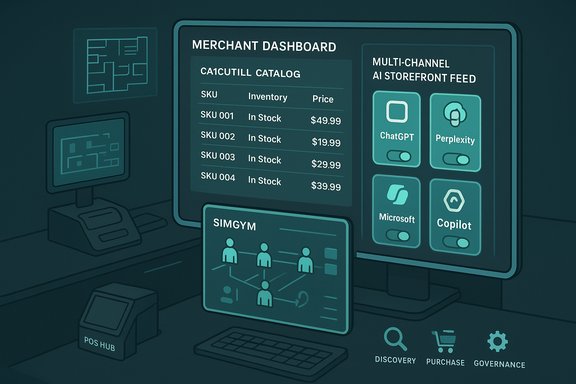
Futuristic merchant dashboard showing a product catalog, AI storefront feeds, and team analytics.
Shopify’s Winter ’26 “RenAIssance” edition pushes conversational AI from curiosity to commerce-ready channel, letting merchants make their entire product catalogs discoverable, shoppable, and controllable inside assistants such as ChatGPT, Perplexity, and Microsoft Copilot — all from a single setup in the Shopify admin. This release bundles Agentic Storefronts, major Sidekick upgrades, a simulation research preview called SimGym, a new POS Hub for in‑store reliability, and an expanded developer toolchain designed to bake AI into both discovery and operations.

Background​

Shopify’s Winter ’26 Edition — branded internally as the RenAIssance — is a broad platform wave of more than 150 updates across storefronts, point‑of‑sale, developer tooling, and merchant productivity. The company frames this release as an effort to make every Shopify store “agent‑ready by default,” enabling merchants of all sizes to appear in AI conversations without bespoke integrations for each assistant. The wider context is an industry shift from page‑centric e‑commerce toward conversation‑first commerce. Major AI platforms have been testing or rolling out in‑chat purchasing flows (notably OpenAI’s Instant Checkout), which let assistants present, confirm and — in supported cases — complete purchases inside the chat interface. Shopify’s product changes are designed to supply the catalog, checkout rails, and operational controls that make those experiences viable for third‑party agents and merchants alike.

What Shopify shipped in Winter ’26​

Agentic Storefronts — one feed to many AI channels​

Agentic Storefronts is a syndication layer that converts a merchant’s product catalog into a machine‑readable, agent‑friendly format and makes it available to participating AI assistants. Merchants configure their schema, policies, and knowledge base once; Shopify Catalog normalizes attributes, consolidates variants, and offers channel toggles so stores can decide exactly where they appear. Orders that originate in a conversation flow back into Shopify’s checkout rails, keeping the merchant as the merchant of record.
  • Key technical pieces:
    • Structured catalog feeds and canonicalized SKUs
    • Real‑time inventory and price sync across agent surfaces
    • Knowledge Base and policy exposure for brand‑consistent responses
    • Channel toggles and attribution metadata so merchants can measure AI traffic
This is not mere marketing: Shopify’s product page and the Editions overview both describe Agentic Storefronts as an end‑to‑end path that preserves merchant ownership of orders while enabling AI assistants to recommend and, where allowed, transact.

Sidekick — from helper to workflow builder​

Sidekick, Shopify’s built‑in AI assistant, has been upgraded from a content and advice tool into a practical workflow generator. New capabilities include:
  • Generating admin apps from prompts and scaffolding small tools inside the admin.
  • Editing and generating images and theme changes from plain‑language requests.
  • Creating Flow automations and ShopifyQL reports by description.
  • Saving reusable “skills” for repeatable tasks.
Shopify’s documentation lists limits and safety considerations for generated apps — generated code must be reviewed, and Sidekick‑created apps are scoped to the admin. The tool is intended to speed routine tasks, not replace engineering or security reviews.

SimGym — simulate customers before you launch​

SimGym is being released as a research preview: it spawns AI shopper agents to model how different customer segments might experience a storefront, compare theme variations, surface issues, and recommend adjustments before a public launch. In practice SimGym is positioned as a pre‑launch A/B testing environment that helps merchants reduce guesswork and avoid costly launch mistakes. Shopify pairs SimGym with a native Rollouts capability for staged releases and controlled experiments.

POS Hub and developer tooling​

  • POS Hub: a hardware hub to connect wired peripherals, improve monitoring, and reduce Bluetooth pairing issues in busy stores, targeted at improving in‑store reliability.
  • Developer platform: AI‑assisted scaffolding and validated code generation for apps and GraphQL operations, plus expanded Catalog and Checkout Kit APIs to make merchant checkouts embeddable in more places.

Why this matters — practical implications for merchants and IT teams​

New discovery surface, new demand funnel​

Agentic channels can surface your products inside the very place customers ask questions. That shortens the buy path: instead of search → click → cart → checkout, journeys can become ask → match → confirm → buy. Early pilots of in‑chat checkout (notably OpenAI’s Instant Checkout) suggest strong intent and potentially higher conversion because assistants ask clarifying questions and prune choice overload.

Productivity and speed​

Sidekick’s automation reduces friction in content generation, theme tweaks, reporting, and small admin workflows. For many merchants, that means faster iteration on merchandising and fewer engineering tickets for routine changes. Shopify positions these features as time savers that let merchants focus on creative tasks and customer experience rather than repetitive admin work.

Developer acceleration — with caveats​

Generated app scaffolding and AI‑assisted coding can accelerate prototypes and small utilities, but generated code is not production‑safe by default. Shopify’s docs explicitly recommend testing in dev stores, performing code reviews, and limiting app privileges — sensible guardrails that IT teams must enforce.

Strengths: what Shopify gets right​

  • Centralized syndication — one structured catalog that feeds multiple AI platforms lowers engineering overhead for merchants, especially SMBs without large dev teams. This reduces the integration tax of supporting each assistant separately.
  • Merchant control — Shopify emphasizes that merchants remain the merchant of record and that orders flow into the merchant admin. That preserves fulfillment responsibility, returns, and the customer ledger.
  • Operational tooling — pairing Agentic Storefronts with Sidekick, Flow, SimGym, and Rollouts creates a coherent stack that addresses both discovery and day‑to‑day operations. That combo makes agentic commerce more manageable and less experimental for merchants ready to invest in feed hygiene and automation.
  • Built for scale — Shopify Catalog’s normalization engine (inferring categories, clustering duplicates, and extracting attributes) plays to Shopify’s scale advantage: the company can reuse signals from millions of products to improve machine‑readable feeds.

Risks and trade‑offs — what merchants must plan for​

1) Attribution and economics can be opaque​

When discovery and checkout happen inside third‑party assistants, the path to conversion fragments. Platforms may apply their own attribution rules and fees — OpenAI’s Instant Checkout, for example, charges a fee to merchants for completed purchases in current pilots. Merchants must instrument AI‑origin metadata, reconcile reports, and model fee impacts on low‑margin SKUs. These are not theoretical concerns — industry coverage confirms platform charging models are part of live pilots.

2) Dependency on gatekeepers​

Concentration risk grows when discovery is controlled by a few assistants. Changes to ranking algorithms, policy, or commercial terms can dramatically shift visibility. Diversification across channels and preserving owned customer channels (email lists, apps, direct site traffic) remain essential defensive tactics. This is a classic platform‑dependency dynamic scaled to AI assistants.

3) Operational fragility: inventory, syncing and oversells​

Agentic commerce requires accurate, low‑latency inventory and fulfillment signals. Stale stock or mismatched SKUs combined with token expiration can lead to oversells and customer frustration. Merchants should expect an operational investment — catalog cleanup, real‑time inventory sync, and hardened cancellation/partial‑fulfillment logic are prerequisites for scaling agentic channels.

4) Fraud, disputes and regulatory surface area​

In‑chat checkouts and delegated payment tokens introduce new fraud vectors and dispute patterns. While tokenization and short‑lived credentials reduce some risks, tokens bring replay and orchestration concerns. Regulators may demand clearer disclosures when AI agents recommend or transact on behalf of customers; merchants should prepare to document provenance and maintain auditable traces linking conversations to orders.

5) Generated code and governance​

Sidekick can scaffold admin apps and automations — a convenience that introduces governance risk. Generated apps can modify store data; Sidekick itself has usage limits and explicit guidance that generated apps must be reviewed, tested, and limited in scope. IT and security teams must require dev‑store testing, least‑privilege scopes, and audit trails for generated artifacts.

A practical readiness checklist for merchants and IT teams​

  1. Audit and clean your catalog (60–90 days)
    • Normalize SKUs, provide GTIN/UPC when available, fill out attributes and metafields, consolidate duplicate listings.
    • Use canonical images and consistent naming so agents can match user intent reliably.
  2. Harden inventory and fulfillment logic (30–60 days)
    • Implement near‑real‑time inventory sync, robust cancellation/backorder handling, and idempotent order ingestion.
    • Test tokenized checkout flows end‑to‑end in sandbox environments.
  3. Governance for Sidekick outputs (immediate)
    • Require dev‑store testing for any Sidekick‑generated app or Flow automation.
    • Log prompts, outputs, and prompt history as part of change records.
  4. Instrument attribution and analytics (ongoing)
    • Add unique metadata tagging AI‑originated sessions and build dashboards that separate AI channel KPIs (conversion, returns, chargebacks, LTV).
    • Reconcile platform reports with accounting systems and monitor for discrepancies.
  5. Fraud, compliance and legal review (as soon as enabled)
    • Extend fraud rules for agentic checkouts, add velocity checks, and prepare dispute playbooks for AI‑sourced orders.
    • Review each AI partner’s data and caching policies and ensure cross‑border tax and duty logic is correct.
  6. Pilot, iterate, expand
    • Start with a narrow set of high‑quality SKUs and a single AI channel; use SimGym to pretest and Rollouts to stage exposure.
    • Expand gradually and plan automatic rollback thresholds for high‑risk launches.

Cross‑checking the big claims​

  • Shopify’s public materials confirm Agentic Storefronts, Sidekick improvements, SimGym research preview, and the “more than 150 features” framing of Winter ’26. Shopify’s announcement and Editions pages contain quotes from executives and product descriptions that align with the rollout messaging.
  • Independent reporting verifies in‑chat checkout pilots and the broader industry movement. Reuters and AP coverage document OpenAI’s Instant Checkout pilots (initially with Etsy and extending toward Shopify merchants) and the merchant fee model applied in those pilots; those reports corroborate the practical linkage between assistant checkout pilots and Shopify’s preparations.
  • Internal or management metrics referenced in early coverage (for example, large multipliers in AI‑attributed orders cited in some briefings) are management telemetry; these figures are directional and have not been published as audited metrics. Treat them as indicative rather than definitive until independent verification is available.

What to watch next​

  • How major assistants (OpenAI, Microsoft, Google, Perplexity) standardize discovery, ranking, and fee terms — especially whether AI platforms maintain neutral ranking or offer paid placement for catalog items.
  • Merchant adoption rates and operational outcomes: conversion lift is promising, but sustained merchant LTV, return rates, and dispute profiles will reveal whether agentic channels produce durable customers or one‑off purchases.
  • Regulatory attention: expect clarifications around AI‑driven recommendations, required disclosures, and rules for consumer redress in agent-originated purchases.
  • Developer and security patterns for generated code: whether firms build strong guardrails and CI/CD integrations to make AI scaffolding production-safe at scale.

Final analysis — a pragmatic verdict​

Shopify’s Winter ’26 RenAIssance is a decisive, pragmatic move to make conversational commerce accessible at scale. By packaging structured catalogs, knowledge bases, tokenized checkout rails, and AI productivity tools into a single platform update, Shopify has lowered the barrier to entry for merchants who want to be present in AI conversations — without forcing each merchant to build bespoke integrations for every assistant. That is a powerful offering for SMBs and enterprise merchants alike. However, the benefits are paired with real operational and governance burdens. Merchants that enable agentic distribution without investing in catalog hygiene, real‑time inventory, fraud protections, and governance for generated automation risk customer experience failures and margin erosion. Platform dependency and evolving fee structures mean merchants must treat agentic channels as strategic experiments, not free incremental traffic. The pragmatic path is staged adoption: pilot, instrument, secure, then scale.
Shopify’s Winter ’26 tools give merchants the capacity to appear in the conversations where customers already decide what to buy. For merchants and IT teams that plan carefully, tighten governance, and instrument outcomes, agentic commerce will be a significant new channel. For those who treat it as “set and forget,” it will be a source of operational headaches and unexpected costs. The smart play is to use the new tools to reduce friction — not to outsource the hard work of running a reliable, measurable commerce operation.

Conclusion: Agentic Storefronts and the wider RenAIssance Edition are important steps toward a future where the storefront is a conversational surface as much as a web page. They expand the reach and speed of discovery while amplifying the need for disciplined operations, clear governance, and careful commercial modeling. Merchants who invest in metadata, inventory discipline, and prompt governance will benefit; those who don’t will find the new channel exposes weaknesses faster than any previous channel ever did.
Source: channelnews.com.au No Coding, No Problem — Shopify Lets Anyone Build a Store – channelnews
 

Back
Top