

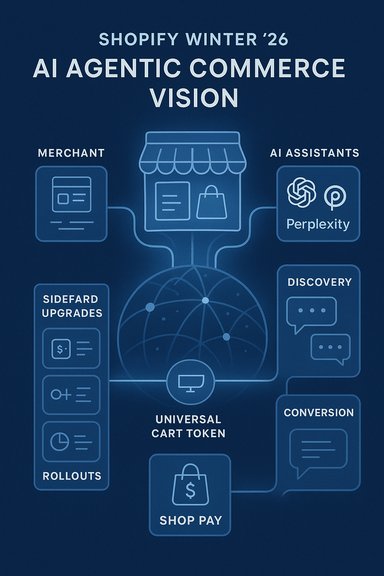
Shopify’s Winter ’26 push and its Q3 results together sketch a rare moment when product momentum, profitable unit economics, and strategic partnerships converge — creating a credible path for the company to move from platform leader to foundational commerce infrastructure in the AI era.
Background / Overview
Shopify closed Q3 2025 with revenue of roughly US$2.844 billion and a free cash flow margin of 18%, marking nine consecutive quarters of double‑digit free cash flow margins — a clear signal that the business has moved beyond “growth at all costs” into sustained, high‑quality expansion. At the same time, the company’s December 2025 Winter ’26 (branded internally as the “RenAIssance” or Winter ’26 Edition) release bundled more than 150 product updates centered on AI, the most visible being Agentic Storefronts and a major expansion of the merchant assistant Sidekick. Shopify frames these updates as the platform plumbing needed for conversational agents to discover, recommend, and — when permitted — complete purchases using tokenized checkouts while keeping merchants as the merchant of record. Taken together, the financial traction and the product wave are the basis for a bullish, but execution‑sensitive thesis: 2026 could be the year Shopify converts early agentic commerce experiments into durable, monetizable volume at scale. The company’s own narrative — amplified in industry reporting and earnings transcripts — is that AI‑originated referrals and orders are already growing at multiple‑fold rates, although those specific multipliers are company‑provided metrics that need careful interpretation.What Winter ’26 actually delivers
Agentic Storefronts: one setup, many AI surfaces
Agentic Storefronts is built as a syndication and schema layer: merchants publish canonicalized product metadata, brand policies, and FAQs once in Shopify Catalog, then toggle which AI assistants may surface their products. Live inventory, pricing, and tokenized checkout primitives are exposed to participating agents (ShopGPT/OpenAI, Perplexity, Microsoft Copilot were in the initial partner list), and orders routed through those agents flow back into merchant admin with attribution. This is a practical bridge between product feeds and conversational AI. Key capabilities introduced:- Standardized, machine‑readable product schemas that deduplicate, cluster, and infer missing attributes.
- Channel toggles so merchants can opt into specific AI platforms.
- Checkout Kit / universal cart tokens that let agents hand off or complete purchases without exposing merchant credentials.
- A Knowledge Base App for brand voice and policy exposure to agents.
Sidekick, SimGym and merchant productivity
Winter ’26 also repositions Sidekick from an on‑demand helper into a proactive workflow and operational automation engine. Upgrades include natural‑language scaffolding for admin apps, theme edits by plain language, automation scaffolds for Shopify Flow, and proactive Pulse recommendations surfaced on merchant dashboards.SimGym — an AI‑driven simulation preview — allows merchants to run virtual shopper agents against changes before going live, while Rollouts adds baked A/B scheduling for theme and admin changes. The common thread is lowering merchant execution cost and time‑to‑market for new channels.
Financial verification — the numbers that matter
Shopify’s Q3 2025 results are public and verifiable: the company reported revenue of US$2.844 billion and a free cash flow margin of 18% for the quarter ended September 30, 2025. Management reiterated Q4 expectations of mid‑to‑high‑20s percent revenue growth and projected further free cash flow margin improvement. These figures are confirmed in Shopify’s investor materials and press release. Why this matters:- Revenue growth in the 30% range combined with double‑digit free cash flow margins is uncommon at Shopify’s scale and materially reduces the execution risk implied by prior “growth‑first” narratives.
- Strong free cash flow provides flexibility to invest selectively — e.g., subsidizing merchant onboarding, building developer ecosystems, or pursuing strategic partnerships.
The traction claim: AI traffic and AI‑attributed orders
During Q3 earnings commentary, Shopify executives publicly stated that AI‑driven traffic to Shopify stores increased roughly 7× since January 2025 and that orders attributed to AI searches rose about 11× over the same period. These numbers were repeatedly quoted in earnings transcripts and reported by independent outlets. How to interpret those multipliers:- They are relative growth metrics measured from a likely small base earlier in 2025; rapid percentage growth can be striking yet still represent a modest absolute share of total traffic or GMV.
- The underlying definitions (what counts as “AI traffic,” how attribution is measured, and the baseline month) are company‑controlled and not independently auditable without raw telemetry.
- Early tests such as OpenAI’s Instant Checkout (piloted with Etsy and select Shopify merchants) do show practical, in‑chat payment flows, which supports the plausibility of faster AI‑originated conversions.
Why this could be Shopify’s defining leap — the structural thesis
The leap argument rests on three interlocking engines:- Scale of product and merchant data
- Shopify already indexes millions of merchants and billions of SKUs and transactions; that dataset is a strong advantage for building canonical product graph and recommendation primitives that work for agents. Product metadata quality is the single biggest determinant of agentic discoverability.
- Monetization through Merchant Solutions
- Increased discovery that routes through Shopify checkout scales payments and Merchant Solutions revenue without Shopify having to monetize discovery directly. If agents generate more GMV that uses Shop Pay or Shopify Payments, Shopify captures a larger slice of platform economics. Q3 Shop Pay processed a reported $29 billion in GMV, illustrating payments momentum.
- Operational leverage and healthier unit economics
- Double‑digit free cash flow margins allow Shopify to invest confidently in developer tooling, partner integrations, and product reliability — all crucial to making agentic commerce safe, auditable, and trustable at scale.
Strengths: what Shopify does right
- Data moat and canonical cataloging. Shopify’s Catalog and Product Network focus on canonical, deduplicated product metadata — the exact asset agents need to return accurate recommendations. This is not trivial; structured data quality is a persistent pain point in commerce.
- Open‑channel, merchant‑centric control. Agentic Storefronts is explicitly designed to keep merchants as the merchant of record with control over branding, policies, and channel toggles. That merchant control reduces merchant reluctance to adopt and aligns incentives.
- Payments and checkout leverage. Shop Pay / Shopify Payments provide a direct commercial hook for capturing value when agentic discovery converts into transactions. The economics of higher payments penetration are compelling given network effects in data and merchant retention.
- Healthy cash flow to fund the transition. Repeated quarters of strong free cash flow margin mean Shopify can invest aggressively in reliability, security, and partnerships without destabilizing the core business.
Risks and failure modes — why the leap could stall
- Attribution and measurement opacity. The 7×/11× figures are internally reported and highly sensitive to definitions. If attribution norms evolve (for example, platforms claiming traffic without reliable provenance), investors could reassess the opportunity size. Independent auditability matters here.
- Platform and partner control. Agentic surfaces are controlled by assistant providers. If an assistant chooses to favor its own marketplace model, delists open feeds, or charges gatekeeper fees, the economics for Shopify merchants could change rapidly. Shopify’s single‑integration pitch works only if agent platforms continue to permit syndicated feeds and tokenized checkouts that funnel orders back to merchants.
- Privacy, regulatory and trust headwinds. Conversational agents amplify concerns about how recommendations are derived, whether user data is repurposed for training, and how ads or paid placements are disclosed. EU and national regulators may require transparency or limitations that reduce conversion velocity in agentic channels.
- Fraud and payments engineering. In‑chat or delegated payments require more robust, low‑latency fraud detection and dispute resolution. If fraud/chargeback trends spike in agentic commerce, payments economics could deteriorate or require higher merchant/service fees.
- Merchant execution risk. The competitive advantage depends on merchants adopting catalog hygiene, knowledge bases, and tokenized checkouts. Many small merchants lack bandwidth; Shopify must both automate and subsidize onboarding without diluting monetization. Sidekick, SimGym and Rollouts help, but merchant execution remains an operational challenge.
Practical implications for merchants and platform teams
- Start by ensuring product metadata is clean, complete, and canonical. Agents reward structured attributes; messy catalogs are invisible. Use Shopify Catalog tools to standardize GTINs, variants, images, and policies.
- Treat agentic channels as another paid/referral surface: instrument analytics, test attribution, and validate whether agentic customers have different return or lifetime value profiles. SimGym and Rollouts should be used to test hypotheses before broader rollouts.
- Prepare checkout and fraud controls for delegated payments — adopt tokenized checkouts where available and validate dispute flows and PSD2/3DS compliance for international sales. OpenAI’s Instant Checkout pilots demonstrate single‑item flows work, but multi‑item and global expansion need engineering attention.
- Use Sidekick to automate repetitive tasks, but maintain code review discipline for generated apps and automations; Sidekick accelerates execution but is not a substitute for security and process controls.
Verifications, discrepancies and cautionary notes
- The user‑provided NAI500 briefing frames Shopify as poised for a “defining leap” in 2026 and cites Q3 numbers, product changes, and stock/market metrics. The product claims (Winter ’26, 150+ updates, Agentic Storefronts, Sidekick improvements) are verifiable on Shopify’s public Editions and product pages.
- Shopify’s Q3 revenue and free cash flow margin are confirmed in the company press release and investor materials. These are factual and audited/non‑GAAP reconciliations are available in the investor materials.
- The claim that AI‑driven traffic is up 7× and AI‑attributed orders are up 11× comes directly from management commentary on the Q3 earnings call and is widely reported; however, these are management‑supplied metrics and not yet independently audited. Treat them as directional signals of rapid growth rather than a precise measurement of absolute share.
- The article’s specific market valuation figures (for example, an explicit stock price of US$232.12 and market cap of ≈US$302.1 billion) do not match public market snapshots available in late December 2025 (market cap and share price vary by feed and timestamp). Contemporary market indexes and finance portals showed Shopify trading in a lower range and market cap nearer to the low‑to‑mid‑US$200 billions on recent trading days — differences likely arise from differing timestamps, exchange translations, or an error in the article’s quoted figure. Those valuation claims should be treated as time‑sensitive and verified against live market data before relying on them.
Strategic verdict: credible path, not an inevitability
Shopify’s Winter ’26 product wave and the company’s Q3 financials together make a compelling strategic case: the company has the data, the merchant base, the payments engine, and the cash flow to build the plumbing for agentic commerce. The practical steps — standardized product schemas, delegated checkout primitives, and merchant productivity tooling — are the right set of engineering priorities for the era of conversational AI. But the leap is conditional. The upside depends on:- Continued partner cooperation (AI platforms allowing syndicated feeds and tokenized checkouts).
- Independent validation of adoption metrics and a clear view into order quality and fraud trends.
- Merchant onboarding rate and the rate at which AI‑originated GMV meaningfully scales relative to other channels.
What to watch in 2026 — key catalyst checklist
- Quarterly disclosures on AI‑attributed GMV and the absolute share of orders originating from agentic channels (look for independently verifiable detail, not only multipliers).
- Public integrations and commercial terms with major assistants (OpenAI, Microsoft, Perplexity, Google) — specifically whether agents permit syndication, tokenized checkouts, and attribution guarantees.
- Fraud, chargeback, and returns metrics for orders originating in agentic flows — a material deterioration would change payments economics.
- Merchant adoption metrics for Agentic Storefronts and catalog completeness indicators; how many active merchants have toggled into agentic channels and how many have completed knowledge base and schema hygiene.
- Any regulatory or policy changes concerning agent‑driven commerce disclosures and AI training data use, particularly in the EU and major U.S. states.
Conclusion
Shopify’s Winter ’26 Edition and Q3 financials present a credible blueprint for becoming the infrastructure of agentic commerce: canonical product data, universal cart semantics, and tokenized checkouts are sensible, necessary building blocks. The company’s cash flow and payments footprint give it a defensible path to capture value if agents become a mainstream discovery and checkout surface.However, the transition from a plausible architectural advantage to a durable economic moat depends on execution across three domains — partner economics, merchant adoption, and platform integrity (fraud, privacy, and regulation). Management’s early adoption signals are promising, but investors and merchants should treat current AI growth multipliers as early indicators that require independent validation and continued monitoring through 2026. The year ahead will not only test Shopify’s engineering and commercial execution but also the broader internet’s willingness to let AI assistants act as trusted buying intermediaries. If Shopify’s plumbing becomes the de‑facto standard for agentic commerce, the company’s role — and valuation framework — will change fundamentally. If not, Shopify still emerges stronger: a more efficient, AI‑powered commerce operating system that has materially raised the bar for merchant productivity and discovery.
Source: NAI500 2026: The Year Shopify Could Make Its Defining Leap
