

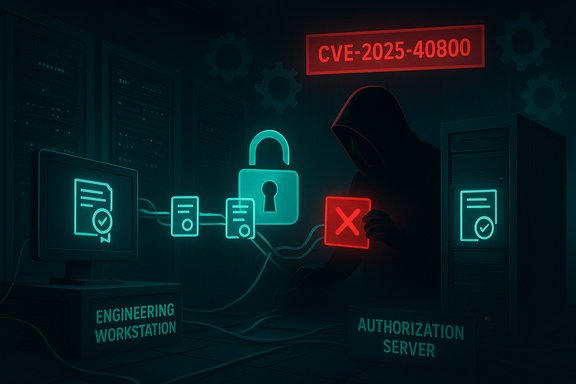
A high‑severity Man‑in‑the‑Middle (MitM) weakness in Siemens’ IAM client has been publicly disclosed and tracked as CVE‑2025‑40800: the client omits proper server certificate validation when establishing TLS connections to Siemens’ authorization servers, creating an exploitable channel for interception or tampering of licensing and authorization traffic. Siemens published security advisory SSA‑868571 on December 9, 2025, assigning a CVSS v4 base score of 9.1 (critical) and a CVSS v3.1 score of 7.4 (high); affected engineering and simulation products include COMOS, NX, Simcenter 3D, Simcenter Femap, and Solid Edge variants, with remediation status varying by product.
Industrial engineering suites and simulation tools increasingly rely on embedded client libraries for licensing, entitlement and cloud authorization. When those clients fail to verify server certificates correctly, they effectively convert TLS-protected channels into plain-text conduits under on‑path control — an adversary who can intercept or redirect traffic can impersonate authorization endpoints, read or alter license payloads, and potentially pivot deeper into engineering networks.
Siemens’ ProductCERT advisory SSA‑868571 documents this specific improper certificate validation defect (CWE‑295) in the IAM client and lists the primary affected products and per‑product remediation thresholds. Independent vulnerability trackers and national databases (NVD, Tenable, OpenCVE) reflect Siemens’ scoring and product list, confirming the vendor’s characterization and severity. Note: U.S. federal practice since January 10, 2023 directs operators to Siemens’ ProductCERT as the canonical continuous feed for Siemens advisories; CISA republishes only initial notices and defers ongoing updates to Siemens. This operational change affects how organizations should monitor remediation status and firmware/software release notes.
This advisory is a reminder that cryptographic validation failures in ubiquitous client libraries are systemic risks — they demand rapid, coordinated action across security, engineering, and vendor management teams. Implement the prioritized mitigation steps immediately and incorporate ProductCERT monitoring into your vulnerability lifecycle to reduce the window of exposure.
Source: CISA Siemens IAM Client | CISA
 Background / Overview
Industrial engineering suites and simulation tools increasingly rely on embedded client libraries for licensing, entitlement and cloud authorization. When those clients fail to verify server certificates correctly, they effectively convert TLS-protected channels into plain-text conduits under on‑path control — an adversary who can intercept or redirect traffic can impersonate authorization endpoints, read or alter license payloads, and potentially pivot deeper into engineering networks.Siemens’ ProductCERT advisory SSA‑868571 documents this specific improper certificate validation defect (CWE‑295) in the IAM client and lists the primary affected products and per‑product remediation thresholds. Independent vulnerability trackers and national databases (NVD, Tenable, OpenCVE) reflect Siemens’ scoring and product list, confirming the vendor’s characterization and severity. Note: U.S. federal practice since January 10, 2023 directs operators to Siemens’ ProductCERT as the canonical continuous feed for Siemens advisories; CISA republishes only initial notices and defers ongoing updates to Siemens. This operational change affects how organizations should monitor remediation status and firmware/software release notes.
What’s happening: technical summary
The defect in plain language
When the IAM client inside affected Siemens products initiates a TLS/HTTPS connection to the authorization server, it does not enforce the expected set of server certificate checks (certificate chain verification, hostname matching, validity period checks, and any vendor‑specific pinning or revocation checks). Without those checks, a forged certificate presented by an attacker — or a proxy that substitutes certificates — will be accepted, and the client will continue the authorization exchange as if connected to a legitimate server.Why that matters
- Licensing traffic often carries sensitive metadata (project names, hostnames, user identities, entitlement tokens) and sometimes contains configuration or telemetry that aids lateral reconnaissance.
- Authorization responses are actionable: attackers able to tamper with license/authorization payloads may be able to enable or deny features, manipulate entitlement checks, or inject malformed responses that the client will accept.
- Engineering workstations and license servers often bridge IT and OT networks; poisoning or tampering here is a credible pivot vector into high-value OT assets.
Attack prerequisites and difficulty
- Positioning: The adversary must be on‑path to intercept or redirect traffic between the client and the authorization server. Typical methods include local network access (same VLAN/subnet), compromised VPNs/remote access gateways, rogue Wi‑Fi, misconfigured or hostile proxies, or DNS/route manipulation.
- Authentication: No client credentials are required to exploit the certificate validation omission — the issue is pre‑authentication within the TLS handshake logic.
- Complexity: The attack does not require cryptanalytic breakthroughs; presenting an arbitrary certificate the client accepts is sufficient. Siemens and third‑party scoring reflect low attack complexity in CVSS v4.0.
Affected products and the current remediation picture
Siemens’ advisory lists multiple engineering and simulation products and gives per‑product update thresholds where fixes are available. Key entries include:- COMOS V10.6 — all versions affected; Siemens reports no fix available at time of advisory publication.
- NX V2412 — affected if earlier than V2412.8700; update to V2412.8700 or later recommended.
- NX V2506 — affected if earlier than V2506.6000; update to V2506.6000 or later recommended.
- Simcenter 3D and Simcenter Femap — affected prior to vendor‑specified patch levels (Simcenter 3D < V2506.6000; Femap < V2506.0002).
- Solid Edge SE2025, SE2026 — affected prior to indicated updates (V225.0 Update 10 for SE2025; V226.0 Update 1 for SE2026).
Risk evaluation: what operators need to know
Immediate operational impact
- Confidentiality & Integrity: The flaw allows high‑impact confidentiality and integrity violations of license traffic (CVSS reflects high confidentiality/integrity impact).
- Availability: The IAM client flaw does not directly indicate availability loss in normal exploitation scenarios; however, attackers could craft responses that disrupt or disable licensing, indirectly affecting workflows.
- Exploitability in practice: Because the exploit requires network positioning but no credentials, environments with inadequate segmentation, exposed remote access paths, or untrusted Wi‑Fi are high risk.
Likely attacker goals
- Steal license tokens or entitlement metadata for resale or analysis.
- Corrupt or manipulate licensing responses to enable features illicitly or to disable software as sabotage.
- Use licensing traffic as a beachhead for reconnaissance, leading to subsequent credential theft or lateral movement.
Known exploitation status
At publication, vendor advisory data and public tracking entries do not show confirmed widespread public exploitation specifically attributed to CVE‑2025‑40800; however, the vulnerability’s characteristics make targeted exploitation by an on‑path attacker plausible. Operators should treat the risk as active and urgent for exposed assets. (Vendors and national vulnerability databases provide the official statuses.Verified technical facts (cross‑checked)
- Siemens’ ProductCERT published SSA‑868571 on December 9, 2025, describing the IAM client issue and mapping CVE‑2025‑40800 to affected products. Verified via Siemens’ advisory.
- Siemens computed a CVSS v3.1 base score of 7.4 and CVSS v4 base score of 9.1 for CVE‑2025‑40800. Verified via Siemens advisory and mirrored in NVD/Tenable/OpenCVE listings.
- Specific update thresholds (for NX, Simcenter, Solid Edge families) are listed in SSA‑868571; for at least one product (COMOS V10.6) Siemens indicated no fix was available at the time of advisory publication. Verified in the vendor advisory text.
Mitigations — immediate and medium term (operational playbook)
Priorities: patch when a vendor fix is available; otherwise, apply network compensations and harden remote access.1. Immediate containment (hours)
- Identify affected instances and versions across your estate. Use software inventory tools, asset management, and vendor product identifiers to map engineering workstations, license servers, and build agents.
- Restrict network egress for affected clients: block or filter outbound TLS connections from engineering workstations to unknown endpoints. Allow only the vendor’s authorization server IPs/FQDNs that are required and known.
- Isolate license traffic: place affected clients and license servers on a segmented VLAN/subnet with strict ACLs; deny lateral access from general user networks.
- Harden remote access: require that remote connections to engineering subnets use strictly managed, audited VPNs or jump hosts; prefer multi‑factor authentication and endpoint posture checks.
2. Patching and vendor remediation (days to weeks)
- Apply vendor updates where Siemens has published fixes (e.g., NX V2412.8700, NX V2506.6000, Simcenter/SE patches listed in SSA‑868571). Prioritize exposed systems and those that interface with external networks.
- For products with no fix available (e.g., COMOS V10.6 per vendor advisory), treat them as high priority for compensating controls (tight network isolation, removal of internet access, migration plans).
3. Monitoring and detection (ongoing)
- Inspect TLS traffic between clients and authorization servers to verify certificate chains and hostnames. Alert on unexpected CAs, mismatched hostnames, certificates with unusual lifetimes, or certificates issued by private/trusted root not in your PKI roster.
- Log and analyze license server and client logs for unusual authorization requests, repeated failures followed by successful grants, or anomalous payloads.
- Network IDS/IPS signatures should be tuned to flag anomalous TLS server behavior or known indicators associated with forged certificate presentations.
4. Long‑term controls (weeks to months)
- Enforce certificate pinning or strict validating proxies for authorization flows where permissible (but be careful: interception proxies can trigger the same validation logic and must be trusted and correctly configured).
- Adopt least‑privilege network segmentation and strong egress filtering for OT/engineering segments; treat engineering workstations as high value and limit their internet access aggressively.
- Vendor management & update pipeline: incorporate ProductCERT feeds into automated ticketing/patch pipelines so engineering teams are notified immediately of new ProductCERT entries; CISA’s role is limited in iterative updates for Siemens, so rely on Siemens ProductCERT.
Detection & forensic guidance (practical steps)
- Capture network traces (pcap) for a sample of authorization exchanges and validate:
- Server certificate chain and subjectAltName match expected hostname.
- Issuer and fingerprint correspond to vendor published CA or your organization’s expected trust path.
- TLS session parameters (cipher suites, TLS versions) match known, healthy baselines.
- Compare authorization payloads against expected structures and sizes. Unexpected fields or unusual JSON/XML elements merit deeper analysis.
- Hunt for lateral activity and follow the ATT&CK chain: enumeration of license servers, credential dumping attempts from engineering workstations, unusual SMB/RDP connections originating from the engineering subnet.
- Preserve and analyze suspicious server certificates presented to clients: export them and check for known FOSS toolmarks or fingerprint reuse across hosts.
Practical mitigation examples for constrained environments
- If an affected product cannot be patched quickly, implement one of these near‑term mitigations:
- Place engineering workstations behind a managed TLS termination service that enforces correct certificate validation and only communicates with Siemens’ authorization endpoints; ensure the service itself is highly trusted and monitored.
- Use network-level allowlists for authorization server IPs and DNS names, and block any egress that could be redirected by local DNS poisoning.
- Disable automatic online authorization where possible and switch to offline licensing methods provided by the vendor until patches are installed.
Why this class of defect is common — and how to reduce future exposure
Certificate validation is foundational but easy to misimplement when client stacks rely on third‑party SDKs or legacy TLS libraries. Common pitfalls include:- Relying on system defaults that allow deprecated behavior.
- Missing hostname checks while validating only the certificate chain.
- Reusing development/test certificates in production builds.
- Embedding permissive trust stores in SDKs for backward compatibility.
- Require vendors to follow modern TLS best practices (strict hostname validation, revocation checks where applicable, avoidance of deprecated cipher suites).
- Insist on SBOMs and component inventories for third‑party libraries so issues in shared SDKs are discovered quickly.
- Maintain a robust asset inventory for all engineering software and license services so vulnerable versions are discoverable immediately.
Practical checklist for Windows and engineering IT teams
- Inventory: identify all installations of Siemens engineering products and record versions.
- Patch: prioritize updates to product versions published by Siemens (refer to SSA‑868571 for per‑product details).
- Network: isolate engineering subnets; block non‑essential egress; allow only vendor authorization endpoints.
- Detection: capture TLS handshakes and inspect certificates; alert on anomalies.
- Forensics: preserve pcaps and certificates for any suspected incident.
- Policy: update procurement and vendor‑risk controls to require secure TLS behavior and transparent PSIRT communication.
Critical strengths and remaining risks — independent analysis
Strengths (Siemens / vendor response)
- Siemens published a concise, productized advisory (SSA‑868571) with CVE assignment and clear product lists and per‑product remediation thresholds, enabling operators to triage assets.
- The vendor computed CVSS v3.1 and CVSS v4 scores, helping organizations apply both legacy and modern risk models. Multiple third‑party trackers and NVD mirrored that information rapidly, aiding situational awareness.
Risks and gaps
- For at least one widely used SKU (COMOS V10.6) Siemens indicated no fix was available at publication — leaving operators with only compensating controls until a patch is delivered. That raises considerable operational risk where COMOS is in active production.
- The exploitability depends on network positioning. Many engineering networks are not segmented sufficiently from general IT or remote maintenance paths, increasing the practical attack surface.
- Because Siemens’ ProductCERT is the canonical update source and CISA defers ongoing updates, organizations must maintain direct, automated ProductCERT monitoring pipelines — an operational overhead some teams may not have in place.
Action plan (recommended sequencing)
- Inventory and classify affected installations by exposure (external/remote‑accessible vs internal‑only).
- Immediately isolate and restrict egress for exposed systems.
- Apply vendor patches where available; document patch testing to satisfy operational change controls.
- For unpatched systems, deploy strict network compensations and consider temporary removal of internet connectivity for engineering hosts until remediation is validated.
- Implement ongoing monitoring: TLS certificate anomaly detection, centralized logging of license/authorization flows, and IDS rules for suspicious on‑path behavior.
- Update procurement and development requirements to demand correct certificate validation and secure TLS behavior from vendors and third‑party SDKs.
What to tell stakeholders (brief messaging)
- Engineering leadership: “This is a critical TLS validation defect in the IAM client embedded in several Siemens products; it can enable on‑path interception of license/authorization traffic. Immediate steps: inventory, isolate, and apply vendor patches where available.”
- Security leadership: “Treat affected engineering workstations and license servers as high‑risk — implement network segmentation and egress filtering, and expedite patch validation.”
- Operations / OT: “For systems without an immediate vendor fix, deploy compensating controls and schedule a migration or remediation window; verify that remote maintenance paths are hardened.”
Final analysis and cautionary notes
CVE‑2025‑40800 exemplifies a recurrent, high‑impact pattern: a trusted vendor SDK embedded across many product families fails to validate TLS endpoints correctly, creating a single cryptographic defect with broad blast radius. Siemens’ ProductCERT advisory SSA‑868571 documents the flaw, affected products, and remediation thresholds; national and industry vulnerability databases reflect and corroborate the vendor’s data. Organizations must treat this as an urgent operational risk: patch where possible, and where patches are unavailable, apply robust network controls and monitoring until fixes are deployed and validated. Caveat: public exploit details specific to CVE‑2025‑40800 were not documented as of the vendor advisory’s publication; however, the flaw’s characteristics and the low burden on attackers who can achieve on‑path positioning mean that practical exploitation is feasible. Operators should not rely on the absence of public exploit reports as a safety margin.Appendix — quick reference (one‑page)
- CVE: CVE‑2025‑40800
- Vendor advisory: SSA‑868571 (published December 9, 2025).
- Key severity scores: CVSS v3.1 = 7.4 (High); CVSS v4 = 9.1 (Critical).
- Immediate actions: inventory → isolate → restrict egress → patch where available → monitor TLS certs.
- Notable unresolved item: COMOS V10.6 listed as affected with no patch available at time of advisory — escalate for compensating controls or vendor engagement.
This advisory is a reminder that cryptographic validation failures in ubiquitous client libraries are systemic risks — they demand rapid, coordinated action across security, engineering, and vendor management teams. Implement the prioritized mitigation steps immediately and incorporate ProductCERT monitoring into your vulnerability lifecycle to reduce the window of exposure.
Source: CISA Siemens IAM Client | CISA
