

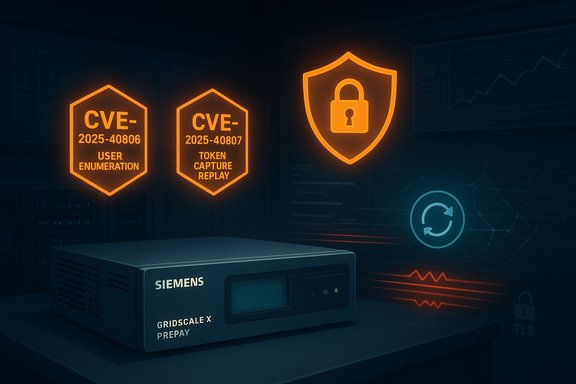
Siemens has published a coordinated security advisory for Gridscale X Prepay that assigns two new CVE identifiers — CVE‑2025‑40806 and CVE‑2025‑40807 — describing a remotely exploitable user enumeration flaw and an authentication token capture‑replay weakness; Siemens recommends updating all affected installs (all versions prior to V4.2.1) and operators should treat this as an urgent OT/IT triage item.
Background / Overview
Gridscale X Prepay is a Siemens product deployed in energy-sector operations worldwide and used in control/management workflows for grid‑facing billing or prepay functions. The vendor’s ProductCERT advisory (SSA‑356310) was published on December 9, 2025 and lists both CVE‑2025‑40806 and CVE‑2025‑40807, including Siemens‑computed CVSS v3.1 and v4.0 scores and per‑product version thresholds. Siemens explicitly marks all Gridscale X Prepay versions prior to V4.2.1 as affected and recommends updating to the latest release. National vulnerability tracking mirrors Siemens’ disclosure: NVD and public CVE aggregators list the same CVE identifiers and descriptions, reporting the vendor’s CVSS scores and CWE classifications (CWE‑204 — Observable Response Discrepancy for the user‑enumeration issue; CWE‑294 — Authentication Bypass by Capture‑replay for the token replay issue). These external entries confirm the vendor’s technical characterisation. Operational context matters: since January 10, 2023, U.S. authorities republished Siemens advisories only as initial notifications and direct operators to Siemens’ ProductCERT for canonical, continuously updated remediation information — a procedural change that places the onus for tracking fixes squarely on product owners and integrators.Executive summary of the technical findings
- CVE‑2025‑40806 — User enumeration (distinguishable responses). Siemens rates this as CVSS v3.1 5.3 / CVSS v4.0 6.9. An unauthenticated remote actor can determine whether a username exists because the application responds differently for valid vs invalid users; that facilitates targeted brute‑force attacks when valid usernames are known.
- CVE‑2025‑40807 — Authentication token capture‑replay (session/session token reuse). Siemens rates this as CVSS v3.1 6.3 / CVSS v4.0 5.3. An attacker who can capture session tokens — or an authenticated user who has been locked out — may be able to reuse (replay) previously valid tokens to re‑establish sessions despite the account being locked, bypassing intended lockout controls.
- Affected versions: All Gridscale X Prepay < V4.2.1. Siemens has released a remediation path; operators should consult ProductCERT and their Siemens representative for precise update packages and installation guidance.
Why these two weaknesses matter together
The two issues are modest on paper but dangerous in combination.- User enumeration (CVE‑2025‑40806) reduces the search space for attackers: rather than guessing account names at random, an attacker can confirm valid usernames before attempting password guessing or credential stuffing. Observable differences in error messages, timing, or HTTP status codes are common ways this is abused.
- Token replay (CVE‑2025‑40807) means that once a token is captured — for example via network interception, compromised maintenance endpoints, or stolen application logs — it may be usable even after account‑level protections (like lockouts) should have neutralized the account. Replayable tokens effectively extend the window of opportunity for attackers.
Technical analysis — how the vulnerabilities work
CVE‑2025‑40806: Observable response discrepancy (user enumeration)
- Root cause: the web/API surface returns distinguishable server responses when a user is valid versus invalid on authentication or account‑lookup flows. Differences might be in HTTP code, JSON field values, error text, or response timing.
- Attack model: remote unauthenticated actor issues authentication or lookup requests and inspects the responses to confirm existence of an account.
- Practical impact: once valid usernames are known, attackers can focus brute‑force or credential‑stuffing attacks on viable targets. This is particularly dangerous where operators allow weak passwords, reused credentials across services, or lack multifactor authentication.
- Remediation complexity: low — this class of bug is conceptually simple to fix (uniform error handling, consistent response codes, generic error messages, and throttling/rate limiting). Operationally harder factors include ensuring fixes do not break legitimate integrations or diagnostic tooling that depends on distinct messages.
CVE‑2025‑40807: Authentication bypass by capture‑replay
- Root cause: session tokens or authentication artifacts can be replayed — either because tokens lack single‑use nonces, lack binding to client context, have long lifetimes, or because server state does not sufficiently reject replays (no token revocation/blacklisting or ephemeral session state).
- Attack model: an attacker who can capture tokens (e.g., from unsecured logs, network taps, or compromised systems) replays the token to the application and is granted a session despite account lockout or other mitigation events.
- Practical impact: undermines account lockout policies, audit trails, and session controls; lets an attacker remain or regain access without valid credentials.
- Remediation complexity: medium — effective fixes require revising token handling: add server‑side replay detection, bind tokens to client attributes (IP ranges only with care), shorten token TTLs, require token rotation or nonce enforcement, use signed single‑use refresh tokens, and ensure tokens are transmitted over encrypted, authenticated channels only.
Verification and cross‑checks
The Siemens ProductCERT advisory (SSA‑356310) is the canonical vendor disclosure and lists both CVEs, CWE mappings, scores and the vendor remediation threshold (V4.2.1). Public vulnerability registries and aggregators have ingested the advisory and show matching descriptions and scoring information, corroborating Siemens’ characterization. NVD and several independent trackers reflect the vendor‑provided metrics and list the same CWE identifiers and affected versions. Where statements are time‑sensitive, note that no public exploitation of these specific CVEs has been reported in the initial vendor advisory or in national trackers at publication time; absence of public exploitation should not be interpreted as absence of risk for vulnerable, internet‑connected, or poorly segmented deployments.Immediate actions (what operators should do right now)
Apply the following steps in order of priority. These are written for ICS/OT asset owners and Windows/IT teams that host or interconnect to Gridscale X Prepay components.- Inventory (minutes‑hours)
- Identify all Gridscale X Prepay instances and confirm firmware/software version strings.
- Map network reachability — which devices are reachable from enterprise, maintenance VPNs, or the internet.
- Patch (hours‑days)
- Schedule immediate validation and deployment of Siemens’ update to V4.2.1 or later per ProductCERT guidance.
- Test update on a staging or isolated testbed before production rollout; follow vendor upgrade procedures to avoid service disruption.
- Compensating controls (if you cannot patch immediately)
- Remove or restrict public internet access to affected interfaces; block access at perimeter firewalls and network ACLs.
- Place affected devices behind segmented OT networks and restrict access to a limited set of trusted maintenance hosts.
- Enforce MFA for any remote access and administrative accounts.
- Implement rate limiting and account lockout thresholds that are resilient to enumeration (see detection below).
- If possible, disable or limit any web administration endpoints that are not required.
- Detection and monitoring (days)
- Instrument authentication endpoints, log all failed and successful authentication attempts, and centralize logs for correlation.
- Alert on unusual login patterns, bursts of username lookups, or repeated token reuse from different client IPs.
- Monitor for token replay signatures: identical session IDs used in short time windows from remote clients with different TLS client attributes.
- Credential hygiene (days)
- Force rotation of credentials for privileged accounts used by Gridscale X Prepay.
- Ensure passwords meet strong composition rules and are not reused across services.
- Where possible, replace username/password logins with certificate‑based or token‑based OAuth flows that support revocation and short TTLs.
- Network hardening & least privilege (ongoing)
- Harden networks per Siemens and CISA recommended ICS‑hardening guidance: isolate control networks, use firewalls, restrict outbound connections, and treat OT management hosts as high‑risk assets.
Detection: logs and indicators to look for
- Repeated login attempts against many usernames from the same source IP or range (sign of enumeration).
- Distinguishable server responses to authentication probes — look for patterns where error payload lengths, fields or timings differ between valid and invalid usernames.
- Identical session tokens used from different client contexts (IP/UA/TLS fingerprints) within short intervals.
- Account lockouts followed by successful session activity without a credential‑change event (indicative of token reuse).
- Unusual traffic to management ports from unexpected sources or at odd hours.
Practical code‑level and architectural mitigations (for integrators and developers)
- Normalize authentication responses: return generic errors such as “authentication failed” for both unknown usernames and wrong passwords; do not leak timing or content differences.
- Implement exponential backoff and IP/user‑level rate limiting to resist automated enumeration and brute force.
- Adopt short‑lived, signed tokens (use JWTs with short TTLs and robust signing keys) plus server‑side token revocation/blacklisting for revoked or locked accounts.
- Enforce nonce / one‑time use semantics for refresh tokens or incorporate sequence numbers so each token can be validated as not previously used.
- Bind sessions to context: require re‑authentication or client‑bound checks when tokens are reused from a new network context (bearing in mind NAT and legitimate roaming).
- Ensure TLS deployments use modern configurations and forward secrecy to mitigate passive capture risks; protect logs and telemetry that may contain tokens or session IDs.
Response and recovery guidance
- If signs of compromise are detected, isolate the affected host(s) from networks immediately, capture volatile memory and network traces, and follow an incident response playbook that involves OT operators, legal, and supply‑chain contacts.
- Rotate all credentials for service accounts and any administrative accounts that could have been exposed.
- Revoke or invalidate all active session tokens server‑side — replacing session state with newly issued, securely bounded tokens.
- Conduct a post‑incident review to identify how tokens were captured (if capture was confirmed) and remediate the root cause (e.g., unencrypted internal logging, weak TLS configuration, or compromised maintenance host).
Risk evaluation — who should be most concerned
- Operators of energy distribution/TSO/DSO environments where Gridscale X Prepay is used: high priority because these systems often integrate into billing and grid‑operation workflows.
- Environments that allow external or remote maintenance access over VPNs, bastions, or remote management networks — especially if those networks are not strongly segmented.
- Installations without multi‑factor authentication, without session revocation capability, or with permissive token lifetimes.
- Organizations with weak password policies or where usernames are predictable (e.g., email addresses, standard templates).
Critical appraisal: vendor response, strengths, and residual weaknesses
Strengths- Siemens published a coordinated advisory and assigned CVE identifiers quickly; the ProductCERT bulletin provides explicit affected versions, CWE mapping and vendor‑computed CVSS scores, and recommends updating to V4.2.1. The advisory credits the external researcher (Kira, The Raven Security) for coordinated disclosure — a sign of standard responsible‑disclosure practice.
- Public CVE trackers and national databases have ingested the advisory, which helps defenders prioritize remediation through multiple authoritative channels.
- The user‑enumeration class of bug is easy to weaponize when other controls (weak passwords, absent MFA, or insufficient rate‑limiting) are present; fixing observability alone without deploying rate limiting and MFA leaves residual exposure.
- The capture‑replay issue points to token design/handling weaknesses in the product. If tokens were designed without replay protections or server‑side invalidation, future token classes or other product features may share the same design choices. Product‑level code changes to token lifecycles and revocation semantics can be intrusive and require careful validation — raising operational complexity for patch testing.
- Operational reality in many OT settings is constrained patching windows, strict change control, and complex interdependencies. While Siemens provides a fixed version, applying it across distributed grid environments may be slow; in those windows, compensating network controls must be robust.
- There is no verified public evidence (as of the advisory publication) of in‑the‑wild exploitation of these two CVEs; however, public absence of evidence is not evidence of absence. Treat this advisory as a high priority for defensive action regardless.
Checklist: prioritized actions for Windows and OT teams
- Immediately identify all Gridscale X Prepay endpoints and their firmware versions.
- Schedule and test Siemens’ patch to V4.2.1 in a controlled staging environment.
- If patching is delayed, block internet access to management endpoints, enforce MFA, and restrict management traffic to a small set of jump hosts.
- Implement uniform authentication error responses and rate limiting at the application or reverse‑proxy level.
- Shorten token TTLs and add server‑side token revocation where practicable.
- Harden TLS configurations, protect logs, and eliminate plaintext token storage.
- Centralize logs and configure alerts for enumeration patterns and token reuse anomalies.
- Run tabletop IR exercises that simulate token theft and account lockout bypass scenarios.
Final assessment and takeaways
The Siemens Gridscale X Prepay advisories CVE‑2025‑40806 and CVE‑2025‑40807 are moderate‑severity but practically meaningful defects because they target fundamental access controls and session management. The immediate remediation is straightforward — apply Siemens’ update to V4.2.1 or later — but the operational and architectural lessons are broader:- Treat session tokens as first‑class secrets: short TTLs, rotation, replay detection, and server‑side invalidation are necessary.
- Prevent information leakage: consistent error handling and rate limits are simple, effective defenses against enumeration.
- Segment and harden OT networks: minimize token capture vectors by eliminating unnecessary exposure of management endpoints and by protecting maintenance hosts.
- Operate with vendor advisories as canonical: because Siemens ProductCERT is the definitive source for follow‑on advisories, integrate ProductCERT monitoring into your patch‑management workflows.
Conclusion: the combination of an easy‑to‑exploit enumeration channel and a token replay weakness is a practical, fixable danger in Gridscale X Prepay deployments; Siemens has published a remediation and operators must act now to patch, harden sessions, and strengthen network segmentation to prevent trivial escalation from reconnaissance to persistent access.
Source: CISA Siemens Gridscale X Prepay | CISA
