

The Siemens–IFS alliance reframes Siemens Healthineers’ digital-edge narrative, but it does not change the near-term catalyst for XTRA:SHL, which remains Diagnostics portfolio action and margin execution. The partnership is best treated as a strategic analogy rather than a financial bridge: it supports the idea that connected equipment and operational data can create value, but it does not yet demonstrate a direct effect on Siemens Healthineers’ revenue, cash flow or earnings.
That distinction should guide investors through Siemens Healthineers’ early-July 2026 roadshow meetings with UBS in New York and San Francisco and Redburn in Toronto. Management has an opportunity to explain how connected-device and data capabilities could strengthen imaging, diagnostics and precision therapy. Investors, however, still need concrete answers about Diagnostics and measurable proof that digital capabilities improve service economics, recurring revenue, customer retention, workflow performance or margins.
The Siemens–IFS announcement gives Siemens Healthineers a timely framework for discussing its long-term digital position. Siemens is presenting an industrial-AI strategy centered on connecting digital representations with information from real operations. That principle maps naturally, though not perfectly, onto a healthcare-technology company with a large installed base of sophisticated equipment.
For Siemens AG, the commercial idea is straightforward: information from the operating environment can potentially make digital models more useful after equipment has been deployed. Better feedback between what was designed and what happens in practice may help customers identify performance gaps, improve maintenance decisions and refine future operations.
For Siemens Healthineers, the connection is indirect. Imaging systems, laboratory platforms and precision-therapy technologies combine physical equipment with software, service and workflow processes. It is reasonable to ask whether better use of information from those systems could improve equipment availability, service delivery, product development or customer operations.
Those possibilities strengthen the strategic story, but they do not establish a financial contribution. The Siemens–IFS alliance was not announced as a Siemens Healthineers transaction, a Diagnostics restructuring or a new healthcare product launch. Investors should therefore avoid inserting revenue, margin or valuation benefits into their models until Healthineers explains what it will deploy, who will pay for it and what economic outcome it expects.
This provides the article’s central hierarchy: Siemens–IFS can improve confidence in the direction of the digital strategy, while Diagnostics disclosures and margin delivery remain the more immediate determinants of the investment case.
That is where the digital-twin concept can become economically meaningful. A static representation can help test a design or examine possible operating scenarios. A connected representation may also help an organization compare expected and observed performance, subject to the quality of the underlying data and the limits of the implementation.
The potential value is not the label itself. It is the possibility of helping customers reduce downtime, improve service planning, detect performance deviations or make better use of expensive assets. Whether those benefits materialize depends on integration, data quality, system governance and the customer’s ability to turn recommendations into operational changes.
The alliance also supports a broader proposition relevant to specialized technology markets: AI may be more useful when it is grounded in domain-specific information and bounded by the operating context in which decisions will be applied. In consequential environments, a plausible output is not enough. Customers need to understand the information used, the limits of the recommendation and the process for human review.
That logic is relevant to healthcare, but the comparison must remain qualified. Healthcare deployments may involve patient information, clinical judgment, institutional policies and regulatory obligations that do not have exact equivalents in manufacturing. The similarity lies in the importance of context, reliability and accountability—not in an assumption that an industrial architecture can be transferred unchanged.
The Siemens–IFS alliance therefore offers a strategic analogy for Siemens Healthineers. It shows why connected physical systems and operational information might support valuable services. It does not prove that Healthineers has established the integrations, permissions, commercial terms or customer adoption required to capture that value.
The strategic analogy is credible; the financial bridge still requires evidence.
Imaging is an intuitive setting for connected-device analysis. System configuration, software, maintenance and local workflows can influence how equipment is used. With the necessary customer permissions and technical controls, information from deployed systems could potentially support service planning, software improvement or workflow optimization.
Precision therapy presents a related opportunity because treatment systems can involve planning, imaging, software and physical delivery. Better feedback about equipment and workflow performance could help vendors refine service, utilization and future product design. The actual benefits would have to be demonstrated in specific customer environments rather than inferred from the general concept.
Diagnostics is also a plausible setting for operational intelligence. Laboratory platforms involve instruments, consumables, software, maintenance and time-sensitive workflows. Better visibility could potentially help customers address downtime, utilization or process bottlenecks.
But the investment issue in Diagnostics is not whether the segment can be associated with AI or data. It is whether Siemens Healthineers can improve its competitive and financial performance, clarify the business’s position within the portfolio and produce margins consistent with the wider company’s objectives.
That should discipline interpretation of the alliance. The parent company’s industrial strategy can support confidence that Siemens understands connected equipment and domain-focused digital systems. It cannot substitute for decisions about Diagnostics’ structure, investment needs, cost base or long-term ownership.
The catalyst and risk hierarchy is therefore clear without attributing it to an outside publication. The alliance belongs in the qualitative part of the case: strategic relevance, technological direction and possible ecosystem value. Diagnostics belongs in the quantitative part: margins, cash generation, portfolio costs and the valuation multiple investors are willing to award.
Strategic alternatives can encompass multiple outcomes, and the available information does not establish which route management will choose. Investors should not model a particular sale, separation or restructuring as inevitable. They should instead focus on what management has actually indicated: options are being examined, and the eventual decision could affect the group’s earnings profile and portfolio structure.
Diagnostics matters beyond its standalone results. It influences group margins, management attention, capital allocation and perceptions of earnings quality. If investors see the business as less predictable or more capital-intensive than the stronger parts of the portfolio, that uncertainty can affect the valuation applied to the whole company.
A credible portfolio action could clarify several questions:
This is why the alliance cannot be treated as the principal near-term catalyst. It may help explain where the broader Siemens ecosystem wants to compete over the longer term. Diagnostics will help determine whether Siemens Healthineers can deliver the earnings quality investors are being asked to value over the next several years.
Roadshows do not necessarily produce the kind of public announcement associated with an earnings release or formal strategy presentation. Their importance lies in the questions management receives, the level of detail it can provide and the parts of the investment case that require the most explanation.
Instead of speculating about different investor psychologies in each city, the practical reporting question is the same across the roadshow:
The strongest message would be measured rather than promotional: the alliance illustrates a method of connecting digital representations with operating evidence, but Healthineers must still establish where that method applies, how customers will adopt it and how the company will earn an acceptable return.
Current strategic period — Management examines alternatives for Diagnostics while investors monitor margin execution and the implications for the wider portfolio.
Through 2029 — The investment narrative depends on revenue growth, earnings expansion and a valuation multiple supported by greater confidence in portfolio quality.
The more pessimistic analyst case assumes earnings of about €2.9 billion in 2029. That is only €0.1 billion below the narrative projection, but it combines the lower earnings outcome with a 16.9 times price-to-earnings multiple and an indicated stock value of €46.90.
The table shows why the debate is not really about €100 million in isolation. The larger issue is the confidence attached to the earnings and the multiple applied to them.
A company with predictable segment performance, a coherent portfolio and visible margin progression may command a higher multiple than one producing nearly the same earnings through a structure investors find difficult to model. The Diagnostics review could therefore affect valuation in two ways: through the earnings Siemens Healthineers ultimately generates and through the risk discount applied to those earnings.
The projected 41% upside is not a mechanical consequence of reaching €3.0 billion. It depends on a wider narrative in which revenue growth remains durable, earnings quality improves and the portfolio becomes easier to understand. If Diagnostics remains unresolved, the market could maintain a cautious multiple even if group earnings approach the target.
Conversely, credible portfolio action could support the valuation before it adds materially to reported earnings. Greater transparency, reduced execution risk and a more coherent capital-allocation framework could narrow the discount attached to the shares.
This is the second and final place where the thesis needs to be stated explicitly: the alliance may enrich the long-term digital narrative, but the valuation will be determined by the financial bridge—Diagnostics execution, margin recovery and measurable monetization of connected-device capabilities.
Valuation models, however, amplify small forecast differences when those differences represent broader judgments. A lower estimate can reflect concerns about margin recovery, restructuring costs, competitive pressure or the capital required to stabilize a business. A lower valuation multiple then compounds those concerns.
The pessimistic case’s 16.9 times P/E is consequently as important as its €2.9 billion earnings estimate. The bear case is not merely that Healthineers will earn slightly less. It is that those earnings may deserve a lower valuation because the path to them is less certain.
This explains why a major AI announcement can create interest without producing a durable rerating. Investors may conclude that Siemens has relevant digital capabilities but still decline to assign substantial incremental value to Healthineers until there is evidence of medical-technology monetization.
For an established healthcare company, that evidence should include a bridge from technical capability to installed-base economics. Examples could include paid software, service-contract growth, improved service productivity, higher customer retention, reduced downtime or a demonstrable margin benefit. Without such proof, the digital ecosystem remains difficult to value.
The discipline applies across the portfolio. If connected intelligence improves equipment or workflow performance, investors need to know whether it drives new-system demand, recurring software revenue, service attachment, stronger pricing or lower operating costs. Technical usefulness does not automatically establish an attractive business model.
That breadth may create opportunities to connect information and workflows across products rather than treating every system as an isolated device. The commercial value, however, depends on customer permission, interoperability, data quality and the ability to solve a specific operating or clinical problem.
The Siemens–IFS alliance reinforces a general corporate belief that information can become more useful when it moves in both directions: models inform operations, and operating evidence informs future products, service and planning. Applied carefully, that principle could help Healthineers improve equipment, software and support based on observed performance.
Healthcare implementation carries additional considerations that must be assessed deployment by deployment. Depending on the jurisdiction, customer and use case, those considerations can include privacy, consent, cybersecurity, clinical validation, interoperability and institutional governance. They should not be treated as uniform barriers or as solved requirements.
For hospital IT departments, the practical question is not whether Siemens can demonstrate an impressive model. It is whether the proposed technology can be introduced without creating another isolated repository, proprietary control plane or costly integration layer.
Healthcare providers often operate mixed-vendor environments, but the complexity of those environments varies significantly. A Healthineers proposal must therefore explain which existing clinical, imaging, laboratory, identity and security systems it needs to access; which interfaces it uses; and which party is responsible when an integration fails.
This creates an important test for the ecosystem narrative. Connected intelligence should reduce complexity or produce an economic benefit large enough to justify it. If deployment merely relocates complexity into a vendor-controlled architecture, customers may hesitate regardless of the quality of the underlying model.
The investment payoff begins when the architecture produces reported outcomes: higher equipment availability, better service productivity, paid software adoption, faster workflows, stronger contract renewal or a larger recurring-revenue component. Until then, the ecosystem should be treated as an embedded strategic option rather than a demonstrated earnings engine.
Organizations need to identify the authoritative source for each dataset, how device identities are reconciled and who can change a model or operational rule. They also need procedures for handling disagreements between the digital representation, the source system and the observed physical asset.
The usefulness of a connected model depends on the quality and timeliness of its inputs. Incomplete service histories, inconsistent device identifiers, stale configuration records or poorly normalized data can produce confident conclusions from an inaccurate representation. That risk does not make the technology unusable, but it makes data governance and exception handling core implementation requirements.
Interoperability claims also require precision. An available API does not by itself establish that two systems share the same terminology, identity model, event timing or operational meaning. Buyers should ask which standards and interfaces are supported, which mappings are included and which integrations require custom work.
Auditability must extend beyond recording that an AI-generated recommendation existed. A useful audit trail should help an authorized reviewer determine what inputs were used, what version of the model or rule set was active, who approved an action and what happened afterward.
Human override is equally important. Buyers should understand which functions are advisory, which can trigger automated actions and how staff can pause or reverse a process. Override rights should be technically enforceable rather than confined to policy documentation.
Cybersecurity responsibilities must be contractually explicit. Connected-device services can cross boundaries involving the manufacturer, cloud or software providers, the customer’s IT organization and third-party integrators. Procurement teams should establish who patches each component, who monitors incidents, who communicates vulnerabilities and who bears the cost of remediation.
The practical takeaway for enterprise IT is simple: assess the offering as an operational system, not as an AI demonstration. The buying decision should depend on architecture, control, accountability and measured performance in environments comparable to the buyer’s own.
That distinction should guide investors through Siemens Healthineers’ early-July 2026 roadshow meetings with UBS in New York and San Francisco and Redburn in Toronto. Management has an opportunity to explain how connected-device and data capabilities could strengthen imaging, diagnostics and precision therapy. Investors, however, still need concrete answers about Diagnostics and measurable proof that digital capabilities improve service economics, recurring revenue, customer retention, workflow performance or margins.
Investor Action Box
- Treat Siemens–IFS as qualitative strategic evidence, not a new earnings assumption for Siemens Healthineers.
- Watch for specific Diagnostics portfolio-action disclosures, including scope, timing, costs and capital-allocation implications.
- Track Diagnostics margin recovery rather than relying on broad turnaround language.
- Demand proof that connected-device and data capabilities produce measurable revenue, service, uptime, workflow or margin gains.
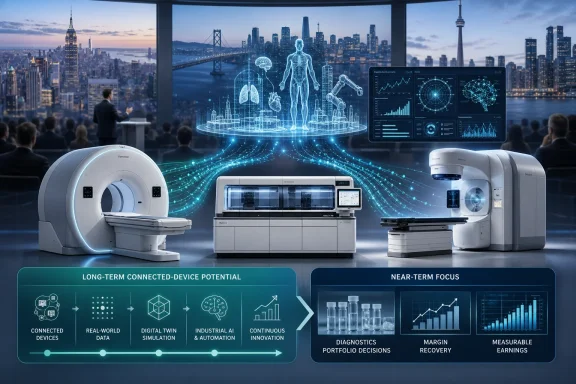 The AI Halo Arrives at a Useful Moment
The Siemens–IFS announcement gives Siemens Healthineers a timely framework for discussing its long-term digital position. Siemens is presenting an industrial-AI strategy centered on connecting digital representations with information from real operations. That principle maps naturally, though not perfectly, onto a healthcare-technology company with a large installed base of sophisticated equipment.For Siemens AG, the commercial idea is straightforward: information from the operating environment can potentially make digital models more useful after equipment has been deployed. Better feedback between what was designed and what happens in practice may help customers identify performance gaps, improve maintenance decisions and refine future operations.
For Siemens Healthineers, the connection is indirect. Imaging systems, laboratory platforms and precision-therapy technologies combine physical equipment with software, service and workflow processes. It is reasonable to ask whether better use of information from those systems could improve equipment availability, service delivery, product development or customer operations.
Those possibilities strengthen the strategic story, but they do not establish a financial contribution. The Siemens–IFS alliance was not announced as a Siemens Healthineers transaction, a Diagnostics restructuring or a new healthcare product launch. Investors should therefore avoid inserting revenue, margin or valuation benefits into their models until Healthineers explains what it will deploy, who will pay for it and what economic outcome it expects.
This provides the article’s central hierarchy: Siemens–IFS can improve confidence in the direction of the digital strategy, while Diagnostics disclosures and margin delivery remain the more immediate determinants of the investment case.
Siemens and IFS Are Selling a Feedback Loop, Not Just an AI Interface
The most useful feature of the alliance is its emphasis on linking a digital representation with evidence from the physical operating environment. A model created during design can lose relevance if it is not updated to reflect how an asset is used, serviced and altered after deployment. A continuing feedback loop may make the model more useful for planning and operational decisions.That is where the digital-twin concept can become economically meaningful. A static representation can help test a design or examine possible operating scenarios. A connected representation may also help an organization compare expected and observed performance, subject to the quality of the underlying data and the limits of the implementation.
The potential value is not the label itself. It is the possibility of helping customers reduce downtime, improve service planning, detect performance deviations or make better use of expensive assets. Whether those benefits materialize depends on integration, data quality, system governance and the customer’s ability to turn recommendations into operational changes.
The alliance also supports a broader proposition relevant to specialized technology markets: AI may be more useful when it is grounded in domain-specific information and bounded by the operating context in which decisions will be applied. In consequential environments, a plausible output is not enough. Customers need to understand the information used, the limits of the recommendation and the process for human review.
That logic is relevant to healthcare, but the comparison must remain qualified. Healthcare deployments may involve patient information, clinical judgment, institutional policies and regulatory obligations that do not have exact equivalents in manufacturing. The similarity lies in the importance of context, reliability and accountability—not in an assumption that an industrial architecture can be transferred unchanged.
The Siemens–IFS alliance therefore offers a strategic analogy for Siemens Healthineers. It shows why connected physical systems and operational information might support valuable services. It does not prove that Healthineers has established the integrations, permissions, commercial terms or customer adoption required to capture that value.
The strategic analogy is credible; the financial bridge still requires evidence.
Healthineers Can Borrow the Logic, Not the Economics
Siemens Healthineers’ investment case already depends on converting technically sophisticated products into sustainable earnings across imaging, diagnostics and precision therapy. The IFS alliance adds a useful way to describe that ambition, but it does not create the underlying opportunity or resolve the operating risks.Imaging is an intuitive setting for connected-device analysis. System configuration, software, maintenance and local workflows can influence how equipment is used. With the necessary customer permissions and technical controls, information from deployed systems could potentially support service planning, software improvement or workflow optimization.
Precision therapy presents a related opportunity because treatment systems can involve planning, imaging, software and physical delivery. Better feedback about equipment and workflow performance could help vendors refine service, utilization and future product design. The actual benefits would have to be demonstrated in specific customer environments rather than inferred from the general concept.
Diagnostics is also a plausible setting for operational intelligence. Laboratory platforms involve instruments, consumables, software, maintenance and time-sensitive workflows. Better visibility could potentially help customers address downtime, utilization or process bottlenecks.
But the investment issue in Diagnostics is not whether the segment can be associated with AI or data. It is whether Siemens Healthineers can improve its competitive and financial performance, clarify the business’s position within the portfolio and produce margins consistent with the wider company’s objectives.
That should discipline interpretation of the alliance. The parent company’s industrial strategy can support confidence that Siemens understands connected equipment and domain-focused digital systems. It cannot substitute for decisions about Diagnostics’ structure, investment needs, cost base or long-term ownership.
The catalyst and risk hierarchy is therefore clear without attributing it to an outside publication. The alliance belongs in the qualitative part of the case: strategic relevance, technological direction and possible ecosystem value. Diagnostics belongs in the quantitative part: margins, cash generation, portfolio costs and the valuation multiple investors are willing to award.
Diagnostics Still Owns the Investment Debate
Siemens Healthineers has said it is exploring strategic alternatives for Diagnostics. That creates optionality, but it also makes the unit’s future a central question for investors.Strategic alternatives can encompass multiple outcomes, and the available information does not establish which route management will choose. Investors should not model a particular sale, separation or restructuring as inevitable. They should instead focus on what management has actually indicated: options are being examined, and the eventual decision could affect the group’s earnings profile and portfolio structure.
Diagnostics matters beyond its standalone results. It influences group margins, management attention, capital allocation and perceptions of earnings quality. If investors see the business as less predictable or more capital-intensive than the stronger parts of the portfolio, that uncertainty can affect the valuation applied to the whole company.
A credible portfolio action could clarify several questions:
- What role does management expect Diagnostics to play inside Siemens Healthineers?
- What investment or restructuring would be required under the chosen plan?
- What costs, liabilities or operational dependencies would accompany a transaction?
- What margin and cash-flow profile should investors expect afterward?
- How would the decision affect capital allocation across imaging and precision therapy?
This is why the alliance cannot be treated as the principal near-term catalyst. It may help explain where the broader Siemens ecosystem wants to compete over the longer term. Diagnostics will help determine whether Siemens Healthineers can deliver the earnings quality investors are being asked to value over the next several years.
The Roadshow Turns Strategy Into a Valuation Conversation
Siemens Healthineers entered an early-July 2026 investor-roadshow sequence involving UBS meetings in New York and San Francisco and Redburn meetings in Toronto. The supported facts establish the period, counterparties and locations, but not the previously stated day-by-day dates or claimed sequence of events.Roadshows do not necessarily produce the kind of public announcement associated with an earnings release or formal strategy presentation. Their importance lies in the questions management receives, the level of detail it can provide and the parts of the investment case that require the most explanation.
Instead of speculating about different investor psychologies in each city, the practical reporting question is the same across the roadshow:
Management needs to distinguish corporate-level strategic relevance from Healthineers-level economics. If it leans too heavily on the Siemens–IFS announcement, investors may conclude that the wider AI narrative is being used to fill a gap in segment-level disclosure. If it ignores the alliance, it misses a chance to explain how a large installed base of medical equipment might support service, software or workflow opportunities.What specific Healthineers products, contracts or operating programs will convert connected-device and data capabilities into measurable revenue, service, uptime, workflow or margin improvements—and over what reporting period should investors expect evidence?
The strongest message would be measured rather than promotional: the alliance illustrates a method of connecting digital representations with operating evidence, but Healthineers must still establish where that method applies, how customers will adopt it and how the company will earn an acceptable return.
Timeline
Early July 2026 — Siemens Healthineers conducts investor meetings involving UBS in New York and San Francisco and Redburn in Toronto.Current strategic period — Management examines alternatives for Diagnostics while investors monitor margin execution and the implications for the wider portfolio.
Through 2029 — The investment narrative depends on revenue growth, earnings expansion and a valuation multiple supported by greater confidence in portfolio quality.
Two 2029 Stories, Separated by a Thin Earnings Gap
The valuation debate can be summarized through two 2029 cases. The investment narrative assumes 6.0% yearly revenue growth, taking revenue to €27.5 billion, while earnings rise by about €0.9 billion from the cited current level of €2.1 billion to €3.0 billion.The more pessimistic analyst case assumes earnings of about €2.9 billion in 2029. That is only €0.1 billion below the narrative projection, but it combines the lower earnings outcome with a 16.9 times price-to-earnings multiple and an indicated stock value of €46.90.
| 2029 case | Revenue | Earnings | Valuation assumption | Indicated equity outcome | Core interpretation |
|---|---|---|---|---|---|
| Investment narrative | €27.5 billion | €3.0 billion | Not specified | 41% upside to the current price | 6.0% yearly revenue growth and approximately €0.9 billion of earnings expansion |
| Pessimistic analyst case | Not specified | About €2.9 billion | 16.9x P/E | €46.90 stock value | Lower confidence in margins, execution and the multiple those earnings deserve |
A company with predictable segment performance, a coherent portfolio and visible margin progression may command a higher multiple than one producing nearly the same earnings through a structure investors find difficult to model. The Diagnostics review could therefore affect valuation in two ways: through the earnings Siemens Healthineers ultimately generates and through the risk discount applied to those earnings.
The projected 41% upside is not a mechanical consequence of reaching €3.0 billion. It depends on a wider narrative in which revenue growth remains durable, earnings quality improves and the portfolio becomes easier to understand. If Diagnostics remains unresolved, the market could maintain a cautious multiple even if group earnings approach the target.
Conversely, credible portfolio action could support the valuation before it adds materially to reported earnings. Greater transparency, reduced execution risk and a more coherent capital-allocation framework could narrow the discount attached to the shares.
This is the second and final place where the thesis needs to be stated explicitly: the alliance may enrich the long-term digital narrative, but the valuation will be determined by the financial bridge—Diagnostics execution, margin recovery and measurable monetization of connected-device capabilities.
Why €0.1 Billion Can Reprice the Whole Equity Story
At first glance, the difference between €3.0 billion and €2.9 billion appears too small to justify sharply different views of the shares. The gap is roughly one-ninth of the €0.9 billion earnings increase required by the investment narrative. It could look more like ordinary forecasting variation than a broken thesis.Valuation models, however, amplify small forecast differences when those differences represent broader judgments. A lower estimate can reflect concerns about margin recovery, restructuring costs, competitive pressure or the capital required to stabilize a business. A lower valuation multiple then compounds those concerns.
The pessimistic case’s 16.9 times P/E is consequently as important as its €2.9 billion earnings estimate. The bear case is not merely that Healthineers will earn slightly less. It is that those earnings may deserve a lower valuation because the path to them is less certain.
This explains why a major AI announcement can create interest without producing a durable rerating. Investors may conclude that Siemens has relevant digital capabilities but still decline to assign substantial incremental value to Healthineers until there is evidence of medical-technology monetization.
For an established healthcare company, that evidence should include a bridge from technical capability to installed-base economics. Examples could include paid software, service-contract growth, improved service productivity, higher customer retention, reduced downtime or a demonstrable margin benefit. Without such proof, the digital ecosystem remains difficult to value.
The discipline applies across the portfolio. If connected intelligence improves equipment or workflow performance, investors need to know whether it drives new-system demand, recurring software revenue, service attachment, stronger pricing or lower operating costs. Technical usefulness does not automatically establish an attractive business model.
The Digital Ecosystem Case Is Real—but It Must Become Measurable
There is a legitimate long-term argument that Siemens Healthineers has ingredients that could support a valuable digital ecosystem. Its imaging, diagnostics and precision-therapy businesses give the company positions across multiple stages of healthcare delivery.That breadth may create opportunities to connect information and workflows across products rather than treating every system as an isolated device. The commercial value, however, depends on customer permission, interoperability, data quality and the ability to solve a specific operating or clinical problem.
The Siemens–IFS alliance reinforces a general corporate belief that information can become more useful when it moves in both directions: models inform operations, and operating evidence informs future products, service and planning. Applied carefully, that principle could help Healthineers improve equipment, software and support based on observed performance.
Healthcare implementation carries additional considerations that must be assessed deployment by deployment. Depending on the jurisdiction, customer and use case, those considerations can include privacy, consent, cybersecurity, clinical validation, interoperability and institutional governance. They should not be treated as uniform barriers or as solved requirements.
For hospital IT departments, the practical question is not whether Siemens can demonstrate an impressive model. It is whether the proposed technology can be introduced without creating another isolated repository, proprietary control plane or costly integration layer.
Healthcare providers often operate mixed-vendor environments, but the complexity of those environments varies significantly. A Healthineers proposal must therefore explain which existing clinical, imaging, laboratory, identity and security systems it needs to access; which interfaces it uses; and which party is responsible when an integration fails.
This creates an important test for the ecosystem narrative. Connected intelligence should reduce complexity or produce an economic benefit large enough to justify it. If deployment merely relocates complexity into a vendor-controlled architecture, customers may hesitate regardless of the quality of the underlying model.
The investment payoff begins when the architecture produces reported outcomes: higher equipment availability, better service productivity, paid software adoption, faster workflows, stronger contract renewal or a larger recurring-revenue component. Until then, the ecosystem should be treated as an embedded strategic option rather than a demonstrated earnings engine.
Where Enterprise IT Should Be Skeptical
For enterprise architects and healthcare IT leaders, the consequential issue is not the AI label. It is how a proposed data and operating layer interacts with existing systems, responsibilities and controls.Organizations need to identify the authoritative source for each dataset, how device identities are reconciled and who can change a model or operational rule. They also need procedures for handling disagreements between the digital representation, the source system and the observed physical asset.
The usefulness of a connected model depends on the quality and timeliness of its inputs. Incomplete service histories, inconsistent device identifiers, stale configuration records or poorly normalized data can produce confident conclusions from an inaccurate representation. That risk does not make the technology unusable, but it makes data governance and exception handling core implementation requirements.
Interoperability claims also require precision. An available API does not by itself establish that two systems share the same terminology, identity model, event timing or operational meaning. Buyers should ask which standards and interfaces are supported, which mappings are included and which integrations require custom work.
Auditability must extend beyond recording that an AI-generated recommendation existed. A useful audit trail should help an authorized reviewer determine what inputs were used, what version of the model or rule set was active, who approved an action and what happened afterward.
Human override is equally important. Buyers should understand which functions are advisory, which can trigger automated actions and how staff can pause or reverse a process. Override rights should be technically enforceable rather than confined to policy documentation.
Cybersecurity responsibilities must be contractually explicit. Connected-device services can cross boundaries involving the manufacturer, cloud or software providers, the customer’s IT organization and third-party integrators. Procurement teams should establish who patches each component, who monitors incidents, who communicates vulnerabilities and who bears the cost of remediation.
The practical takeaway for enterprise IT is simple: assess the offering as an operational system, not as an AI demonstration. The buying decision should depend on architecture, control, accountability and measured performance in environments comparable to the buyer’s own.
Enterprise IT Buyer Due-Diligence Checklist
Before approving a connected-device, digital-twin or operational-AI deployment, enterprise IT and procurement teams should require clear answers to the following questions.Data ownership and residency
- Who owns device telemetry, derived data, model outputs and service records?
- Where is each data category stored and processed?
- Can the customer restrict cross-border transfers or require regional processing?
- What happens to customer data, derived models and historical records when the contract ends?
- Can the vendor use customer information to train or improve systems serving other organizations?
Device and asset identity normalization
- How are devices, components, software versions, locations and service records uniquely identified?
- How are duplicate, retired or replaced assets handled?
- Which system is authoritative when identifiers conflict?
- Who is responsible for correcting inaccurate mappings?
- Can the customer export the normalized asset model in a usable format?
Interoperability and API boundaries
- Which standards, APIs and data formats are supported?
- Which interfaces are included in the base price?
- Where is custom integration required, and who maintains it after upgrades?
- Are write-back functions separated from read-only access?
- Can the customer replace one platform component without rebuilding the entire architecture?
Audit logs and traceability
- Are data access, model changes, recommendations, approvals and automated actions logged?
- Can logs be exported to the customer’s security and monitoring tools?
- How long are records retained?
- Can investigators reconstruct the information and model version behind a past recommendation?
- Are administrative changes protected by role-based access and separation of duties?
Human override and operating authority
- Which decisions are advisory, and which can initiate an automated action?
- Who can pause, reject or reverse a recommendation?
- What happens if the model, source system and physical asset disagree?
- Does the system fail safely when data is missing or connectivity is lost?
- Are escalation paths documented and tested?
Cybersecurity responsibilities
- Who patches the device, gateway, application, model service and integration components?
- Who monitors for compromise across organizational boundaries?
- What are the notification requirements for vulnerabilities and incidents?
- How are remote access, credentials, certificates and privileged accounts managed?
- Who pays for emergency remediation, forensic work and service restoration?
Commercial proof of uptime and workflow gains
- What baseline will be used to measure improvement?
- Has the claimed benefit been demonstrated in a comparable operating environment?
- Are uptime, service-response, workflow or productivity commitments written into the contract?
- What portion of the benefit comes from the technology rather than unrelated process changes?
- Will the customer receive performance reports detailed enough to validate the vendor’s claims?
- What remedies apply if the expected gains do not materialize?
References
- Primary source: simplywall.st
Published: 2026-07-10T14:40:11.629183
Loading…
simplywall.st - Related coverage: news.siemens.com
Loading…
news.siemens.com - Related coverage: siemens-healthineers.com
Loading…
www.siemens-healthineers.com - Related coverage: siemens.com
Loading…
www.siemens.com - Related coverage: press.siemens.com
Loading…
press.siemens.com - Related coverage: plm.automation.siemens.com
Loading…
www.plm.automation.siemens.com
- Related coverage: ecosystem.siemens.com
Loading…
ecosystem.siemens.com - Related coverage: blogs.sw.siemens.com
Loading…
blogs.sw.siemens.com - Related coverage: static.sw.cdn.siemens.com
Loading…
static.sw.cdn.siemens.com - Related coverage: ifs.com
Loading…
www.ifs.com - Related coverage: morningstar.com
Loading…
www.morningstar.com - Related coverage: marketscreener.com
Loading…
www.marketscreener.com - Related coverage: investing.com
Loading…
www.investing.com