

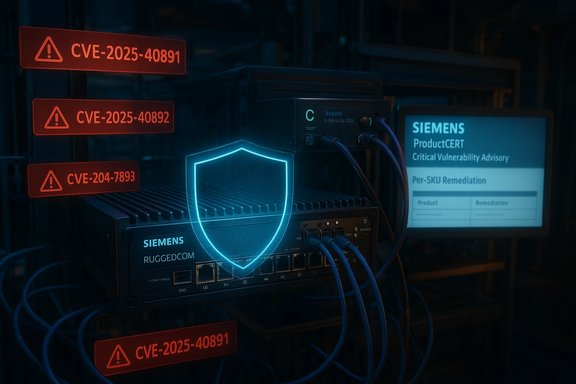
Siemens has confirmed that its RUGGEDCOM APE1808 industrial edge platform is affected by a fresh batch of high‑impact security flaws tied to third‑party components (Nozomi Guardian/CMC and integrated firewall/NGFW elements), and operators should treat the disclosure as urgent: Siemens ProductCERT and CISA republished advisory material listing multiple CVE identifiers and recommending immediate mitigations while fixes are prepared or distributed.
The RUGGEDCOM APE1808 is a ruggedized, utility‑grade edge appliance used by critical‑infrastructure operators for application hosting, security monitoring (Nozomi Guardian/CMC), and network services at the OT edge. Over the last two years Siemens and coordinating agencies have repeatedly published advisories covering distinct classes of flaws in the APE1808 family — including missing authentication, SQL/XSS issues in embedded web components, out‑of‑bounds memory errors, and OS command injection — often tied to bundled third‑party software such as Fortinet PAN‑OS GlobalProtect components or Nozomi Guardian/CMC modules. These advisories have spanned several publication dates and remediation cycles and remain relevant to operators who have not kept device software up to date. Multiple national cybersecurity authorities have republished or summarized Siemens ProductCERT advisories so operators without direct ProductCERT subscriptions can triage risk; CISA has maintained a series of ICS advisories for APE1808 variants documenting CVSS scores, affected product lists, and mitigations. Those CISA advisories make plain that the vendor’s ProductCERT guidance is the canonical remediation source for exact firmware version thresholds.
Conclusion
Siemens RUGGEDCOM APE1808 appliances remain an attractive target due to their deployment at the industrial edge and the complex software stacks they carry. Recent disclosures tie high‑risk web‑UI and update‑chain weaknesses to real‑world impact scenarios. For defenders, the immediate work is clear: inventory every APE1808 instance, apply vendor patches when available, isolate management access, and harden monitoring and incident readiness until all per‑SKU remediations are confirmed. The situation is actively evolving; organizations should continue to monitor Siemens ProductCERT advisories and government‑published ICS advisories for updates and new patches.
Source: CISA Siemens RUGGEDCOM APE1808 Devices | CISA
 Background
The RUGGEDCOM APE1808 is a ruggedized, utility‑grade edge appliance used by critical‑infrastructure operators for application hosting, security monitoring (Nozomi Guardian/CMC), and network services at the OT edge. Over the last two years Siemens and coordinating agencies have repeatedly published advisories covering distinct classes of flaws in the APE1808 family — including missing authentication, SQL/XSS issues in embedded web components, out‑of‑bounds memory errors, and OS command injection — often tied to bundled third‑party software such as Fortinet PAN‑OS GlobalProtect components or Nozomi Guardian/CMC modules. These advisories have spanned several publication dates and remediation cycles and remain relevant to operators who have not kept device software up to date. Multiple national cybersecurity authorities have republished or summarized Siemens ProductCERT advisories so operators without direct ProductCERT subscriptions can triage risk; CISA has maintained a series of ICS advisories for APE1808 variants documenting CVSS scores, affected product lists, and mitigations. Those CISA advisories make plain that the vendor’s ProductCERT guidance is the canonical remediation source for exact firmware version thresholds. What the new advisory says (summary of the published material)
- Affected product family: Siemens RUGGEDCOM APE1808 — multiple SKUs and all versions in various advisory instances are listed as in‑scope where specific integrated components (Nozomi Guardian/CMC, GlobalProtect/NGFW, FortiOS elements) are used.
- Primary vulnerability classes reported in the newest advisory(s):
- Cross‑site scripting (XSS) and stored HTML injection impacting web UI components used by Nozomi Guardian/CMC (user‑viewed snapshot diff/time‑machine functionality).
- Path traversal and improper pathname restriction, enabling file system access beyond intended directories.
- OS command injection tied to update and diagnostic functionality in some stacks (improper validation of update package signatures or web input that flows into shell commands).
- CVE identifiers: the advisory and associated Nozomi disclosures reference a set of CVEs assigned to these issues; example entries include CVE‑2025‑40891 (Time Machine Snapshot Diff HTML injection) and other CVEs tracked by Siemens and CISA in their published CSAF/ICSA documents. Not all CVE records are yet present in every public database at the same time — treat per‑CVE status as time‑sensitive.
- Immediate vendor posture: Siemens is preparing fixed versions for affected components and, for some issues, has released updated device software where possible; where no fix is yet available Siemens recommends compensating controls and network hardening measures.
Detailed technical analysis
1. How these vulnerabilities arise
The APE1808 is an application platform that often ships with or hosts third‑party security and monitoring software (notably Nozomi Guardian/CMC and various NGFWs). The recent cluster of findings falls into two broad root causes:- Application/web logic and input validation flaws — reflected XSS, stored HTML injection, SQL injection and path traversal errors are caused by insufficient sanitization or allowance of crafted payloads in web interfaces and snapshot/diff rendering code. When a feature renders user‑supplied or captured network attributes without robust context encoding or content sanitization, an attacker (or attacker‑controlled network traffic) can persist HTML/JS into stored data and later trigger execution in a victim’s browser. The NVD entry for CVE‑2025‑40891 describes this exact model: an attacker injects HTML into snapshot attributes that render later in the GUI.
- Unsafe command execution patterns and signature verification gaps — several advisories document cases where update or maintenance functionality composes OS commands or invokes scripts using user‑controlled parameters, or where signature validation of uploaded update packages is imperfect. These are classic paths to OS command injection or unauthorized code execution when an authenticated user (or a privileged but less‑trusted component) can supply content that the update process trusts. Siemens’ own advisory text called out an “improper signature validation check” for update packages.
2. Exploit prerequisites and ease‑of‑use
- Remote attackability: Most of the documented issues are network‑accessible when the affected features are enabled and reachable from an attacker (local network, VPN tunnel, or internet exposure). CISA’s advisories repeatedly emphasize that the attack vector is network‑based and, in many cases, low complexity.
- Authentication state: Some issues require no authentication (e.g., missing authentication for some endpoints in earlier advisories), while others require at least a low‑privilege authenticated user or an on‑path position to inject or manipulate traffic captured by Nozomi or web components. Practical exploitation models vary by CVE.
- Chaining potential: The more severe scenarios combine web UI flaws (XSS, path traversal) with command injection or privilege‑escalation holes to go from browser‑context impact or low‑privilege account to local code execution on the appliance. That chain is especially dangerous in OT environments where a single foothold can lead to telemetry manipulation, firmware tampering, or lateral movement.
3. Practical attack example (representative, not exploit code)
- Attacker crafts network traffic that contains malicious HTML fragments targeted to an asset attribute captured by Nozomi Guardian.
- The traffic is recorded in a Time Machine snapshot; the snapshot diff logic fails to fully sanitize the attribute before storing or rendering it.
- An operator later views the Time Machine Snapshot Diff in the device web UI; the injected HTML executes in their browser context (reflected/stored XSS).
- If the operator has privileged access to maintenance pages, the attacker can steal session tokens or perform actions that lead to further device misconfiguration or package uploads.
Who’s exposed and why this matters
- Critical infrastructure operators — energy, manufacturing, transportation and utilities frequently deploy RUGGEDCOM appliances at substations, distribution sites and remote facilities. These devices often bridge field networks and supervisory systems, so compromise can affect both OT and upstream IT assets. CISA and Siemens explicitly flag critical manufacturing and energy sectors as in scope for several advisories.
- Enterprises with remote maintenance or poorly segmented networks — systems accessible via vendor VPNs or management tunnels are high‑risk. Several advisories note that VPNs or remote access solutions themselves are potential attack paths if not tightly controlled.
- Operators who have not updated Nozomi Guardian / CMC — many of the mitigations hinge on upgrading the Nozomi stacks embedded in the appliances; Siemens and Nozomi list specific minimum versions in their product advisories. If your Nozomi/CMC version is older than the vendor‑recommended threshold, the device remains vulnerable.
Vendor response, coordination, and the public record
- Siemens ProductCERT has published advisories that enumerate affected SKUs, CVE identifiers, and remediation thresholds. For Nozomi‑related findings Siemens released advisory entries and, in many cases, released updated firmware or asked customers to contact support for staged updates. ProductCERT entries (example: SSA‑978177 and related SSA entries) list the affected RUGGEDCOM APE1808 configurations and the Nozomi/CMC version cutoffs.
- CISA has republished Siemens’ CSAF advisories as ICSA advisories (multiple entries across 2023–2025) to increase visibility, and these republished advisories provide CVSS scoring and concise mitigation guidance. CISA also emphasizes that Siemens ProductCERT is the authoritative ongoing source for per‑SKU remediation updates.
- Third‑party tracking / NVD: Individual CVEs such as CVE‑2025‑40891 appear in NVD entries and are cross‑referenced to Nozomi and Siemens advisories where applicable. Note that CVE publication timing varies: a CVE referenced in a vendor advisory may appear in national CVE/NVD feeds later after coordination and publication.
Immediate, prioritized mitigation checklist (practical, step‑by‑step)
- Inventory and classify:
- Identify every RUGGEDCOM APE1808 SKU on your network, record the exact part number (e.g., 6GK6015‑0AL20‑0GH0) and installed Nozomi Guardian/CMC and appliance firmware versions. Document network exposure (internet‑routable, VPN reachable, internal only).
- Patch and update where vendor fixes exist:
- Confirm Siemens ProductCERT advisory entries for your SKU to obtain the exact fixed release number. If Siemens lists an updated APE1808 image or Nozomi/CMC version that addresses your CVE set, schedule validated firmware upgrades via change control.
- If a vendor patch is not yet available, apply network compensations immediately:
- Block external/internet access to management ports and web UIs.
- Restrict access to management interfaces to a small set of trusted IP addresses or jump hosts.
- Enforce multi‑factor authentication and harden administrative accounts for operator consoles.
- Harden remote access:
- Use tightly controlled jump hosts for vendor maintenance; avoid exposing Nozomi or APE management panes directly over VPNs without additional controls. Consider just‑in‑time access.
- Monitor and detect:
- Deploy IDS/IPS rules to detect anomalous upload/update attempts and suspicious snapshot diff activity. Log and retain web UI access audit trails for forensic analysis. Inspect TLS/HTTP logs for unusual parameter values or high‑rate requests to snapshot/diff endpoints.
- Reduce attack surface:
- Disable or limit features not required in your deployment (clientless VPN portals, signature acceptance endpoints, open file upload endpoints).
- Enforce strict content‑security policies and server‑side sanitization at gateway/proxy layers where possible.
- Prepare incident response:
- Ensure playbooks exist for appliance compromise, including isolating the device, preserving snapshots and logs, and coordinating with Siemens ProductCERT for root cause and rebuild instructions.
Strengths in the vendor and community response
- Timely vendor coordination: Siemens and Nozomi have coordinated advisories and, in several instances, released fixed versions or clear per‑SKU guidance. ProductCERT provides granular per‑product remediation thresholds, which is essential for correct patching in heterogeneous deployments.
- Authoritative public record via CISA: CISA’s republished ICS advisories (ICSA entries) increase visibility for operators who rely on government feeds for triage and have summarized CVSS and risk posture for rapid prioritization.
- Independent confirmation: National databases and independent trackers (NVD, security research bulletins) have cataloged specific CVEs (for example CVE‑2025‑40891) and enriched descriptions useful for risk scoring and rule creation in enterprise detection platforms.
Risks, gaps, and things to watch
- Partial or staged fixes: Some advisories list fixes for certain Nozomi/CMC versions while others remain pending; operators must not assume a single global firmware will cure every CVE. Always check the per‑SKU ProductCERT table for the authoritative remediation target.
- Delayed CVE publishing and inconsistent indexing: CVE assignments and NVD entries may lag vendor CSAF postings; absence of a NIST/NVD entry for a CVE mentioned in a Siemens advisory does not mean the underlying issue is benign. Treat vendor CSAF entries and ProductCERT as the primary authoritative source until public databases catch up.
- Operational constraints for OT patching: Many industrial environments have strict change windows and complex interoperability constraints. This limits how quickly fixes can be deployed. Compensating controls (network filtering, jump hosts, feature disabling) are often the only immediate defense for a period of weeks or months.
- Chaining risk into IT/Windows infrastructure: Compromise of an APE1808 foothold can be used to interfere with telemetry and management workflows that ultimately affect Windows‑based HMIs, engineering workstations, or central monitoring servers. OT compromises are increasingly leveraged to pivot into IT environments and vice versa. This cross‑domain risk increases the operational and reputational impact of an exploit.
- Information disclosure hazard: Stored snapshot injections and XSS flaws can be weaponized for phishing-style credential theft or session hijacking; if operators reuse credentials across OT/IT boundaries, the blast radius grows substantially.
Long‑term recommendations and hardening posture
- Implement an OT‑focused vulnerability management cadence that integrates Siemens ProductCERT updates into inventory and ticketing systems automatically. Per‑SKU accuracy is necessary — treat ProductCERT as the canonical source.
- Enforce strict network segmentation between OT and IT, with firewall rules that require explicit, documented exceptions for necessary services. Use application‑aware firewalls and microsegmentation where possible.
- Require all maintenance and update channels to be mediated through hardened, monitored jump hosts with multi‑factor authentication and ephemeral credentials. Avoid exposing management consoles to general VPN pools.
- Adopt secure development / procurement policies that demand vendors explain third‑party components, update cadences, and response SLAs for critical security issues. Contractual requirements should include timely CVE coordination and per‑device update mechanisms.
Final assessment
The RUGGEDCOM APE1808 advisory cycle is a textbook case of modern OT risk: complex appliances combine vendor code and third‑party stacks, producing multiple distinct vulnerability classes that present both immediate and chained exploitation risks. Siemens has been responsive in publishing per‑SKU guidance and assembling fixes where feasible, and CISA’s republication of CSAF advisories improves visibility for operators. Nevertheless, the operational realities of OT — constrained patch windows, heterogeneous device populations, and the high cost of connectivity changes — mean many operators will need to rely on rapid network compensations and improved monitoring while scheduled firmware upgrades are validated and deployed. Treat every RUGGEDCOM APE1808 that hosts Nozomi Guardian/CMC or integrates an NGFW as high priority for inventorying, access restriction, and patching. Operators should proceed immediately with the prioritized checklist above, confirm per‑SKU remediation targets from Siemens ProductCERT, and apply compensating network controls until those updates are validated in their environment. The technical details in the advisory underscore a broader truth for OT: layered defense (isolation, least privilege, monitoring, and rapid vendor coordination) is the correct operational posture for reducing risk when high‑impact vulnerabilities are disclosed.Conclusion
Siemens RUGGEDCOM APE1808 appliances remain an attractive target due to their deployment at the industrial edge and the complex software stacks they carry. Recent disclosures tie high‑risk web‑UI and update‑chain weaknesses to real‑world impact scenarios. For defenders, the immediate work is clear: inventory every APE1808 instance, apply vendor patches when available, isolate management access, and harden monitoring and incident readiness until all per‑SKU remediations are confirmed. The situation is actively evolving; organizations should continue to monitor Siemens ProductCERT advisories and government‑published ICS advisories for updates and new patches.
Source: CISA Siemens RUGGEDCOM APE1808 Devices | CISA
