
Signal President Meredith Whittaker told Bloomberg in a June 2026 interview that AI chatbots such as ChatGPT, Claude, and Microsoft Copilot should not be treated as friends, confidants, or private interlocutors. Her warning lands at an awkward moment for the industry: the chatbot is being recast from a text box into an agent with eyes, memory, payment authority, and access to the rest of your digital life. The privacy debate is no longer about whether a prompt might be retained for training. It is about whether the next version of the assistant works only by dissolving the boundaries that made secure apps, browsers, calendars, and payment systems meaningfully separate.
Whittaker’s line — “These are not your friends” — is useful because it punctures the industry’s preferred metaphor. The large AI companies do not want users to think of chatbots as software interfaces. They want them to feel like companions: patient, flattering, always available, apparently personal.
That framing matters. People tell “friends” things they would never type into a search box, a corporate form, or a customer-support portal. A chatbot that feels intimate can collect not only the content of a request, but the insecurity, intent, context, and emotional state surrounding it.
For Windows users, this is not abstract. Microsoft has spent the last two years trying to move Copilot from the edge of the operating system toward the center of the Windows experience. Copilot is no longer merely a web chatbot with a taskbar icon; it is part of a broader push toward contextual computing, where the assistant can see more, remember more, and act across more surfaces.
That is why Whittaker’s critique hits Microsoft especially hard. The company’s AI strategy depends on making Copilot feel less like a tool you invoke and more like an ambient layer that understands what you are doing. Signal’s entire philosophy depends on the opposite assumption: private communication should stay private even when the rest of the software ecosystem wants to become more “helpful.”
On stage, this kind of demo-ready scenario sounds charming. Nobody wants to spend December triangulating gift ideas across group chats, old wish lists, shipping cutoffs, browser tabs, and credit-card forms. The pitch is that an AI agent can absorb all that friction and turn a messy social task into a completed cart.
Whittaker’s response was to translate the magic trick back into permissions. For Copilot to do that job well, it would need access to family conversations, browser activity, payment credentials, home addresses, calendars, message-sending privileges, and perhaps the ability to impersonate the user well enough to coordinate with relatives. The “assistant” is no longer answering a question. It is sitting at the junction of identity, commerce, and communication.
That is the pivot the AI industry is trying to normalize. The old chatbot asked for your prompt. The agent asks for your life.
There are ways to design around this, of course. A shopping agent could operate with narrow scopes, one-time authorizations, visible audit logs, and a final human confirmation for every outbound message or purchase. But the more friction you preserve, the less magical the demo becomes. The strongest privacy model is often the weakest product demo.
End-to-end encryption protects messages in transit and at rest from parties who do not control the endpoints. It does not magically protect a conversation from software running on the same device with sufficient permission to view the screen, read notifications, scrape app content, or send messages through the user’s account.
That is the endpoint problem that AI agents make mainstream. Malware has always tried to get close to the user’s data. The difference is that modern AI assistants may ask for broad access in the name of convenience, productivity, accessibility, personalization, or companionship — and receive it through polished consent flows rather than exploit kits.
This distinction matters for administrators. A compromised endpoint has always been a nightmare, but AI agents create a sanctioned version of the same access pattern. Instead of asking whether an attacker can bypass Signal, Teams, Outlook, or Edge, IT teams will need to ask which approved assistants can observe or act inside them.
The backdoor, in this model, is not a hidden cryptographic flaw. It is a business model wearing a friendly face.
The Recall saga is important because it exposed a gap between engineering assurances and user intuition. Microsoft could describe encryption, local indexes, and administrative controls. Users still saw a computer taking screenshots of their lives.
Copilot’s agentic future risks replaying that fight at a larger scale. Screen awareness is one thing. The ability to combine screen awareness with messaging, payment, calendar access, browser context, files, and long-term personalization is another.
The company has tried to retreat from the most heavy-handed forms of AI insertion, including scaling back some Copilot integrations that felt like bloat rather than value. But the strategic direction remains obvious. Microsoft wants Copilot to be not merely available in Windows, but useful because it is near everything Windows users do.
That makes consent architecture the central battleground. If every app becomes a data source and every user action becomes potential context, the operating system must become far more explicit about which assistant can see what, when, and why. A toggle buried in settings will not be enough.
Microsoft 365 Copilot already forced many organizations to confront the reality that “available to the user” and “appropriate for the user to summarize with AI” are not always the same thing. If a company has loose SharePoint permissions, old files shared with broad groups, or confidential material sitting in mailboxes, an assistant can make those governance failures newly visible.
That is not purely Microsoft’s fault. AI often reveals preexisting mess. But it changes the blast radius by making discovery easier and faster.
An employee might not know where to look for a sensitive document. An assistant might. A manager might never manually search years of chat logs. An assistant might summarize them. A user might never connect a calendar event, a customer email, and an internal spreadsheet. An assistant designed to infer context might do exactly that.
This is why Whittaker’s critique should resonate with sysadmins. The issue is not whether AI can be useful. It obviously can. The issue is whether organizations are ready to grant software systems the sort of cross-application access that used to be reserved for administrators, e-discovery teams, endpoint security tools, and attackers.
That is the commercial genius of the AI companion narrative. If Copilot, ChatGPT, Claude, Gemini, or any other assistant is just a tool, users will ask ordinary questions: What data does it need? Can I turn it off? Can I delete the history? Can I use it without training the model? Can I restrict it to this document, this tab, this transaction?
If the assistant is positioned as a relationship, those questions become emotionally inconvenient. The product becomes something you are supposed to trust, not configure. The interface becomes conversation rather than control.
Whittaker is unusually well positioned to object because Signal’s product identity is built around constraint. Signal is useful precisely because it refuses certain forms of monetization, discovery, analytics, and integration that would make other platforms more commercially attractive. The app’s limitations are not accidents; they are the point.
AI agents push in the opposite direction. They want fewer walls, more context, longer memory, richer permissions, and deeper integration. The better they become at doing things for us, the more they need to know about us.
That does not make every assistant malicious. It does mean the user’s interests and the platform’s ambitions are not automatically aligned.
An AI agent can create risk even if the provider promises not to train on your data. It can leak information through tool use. It can act on the wrong instruction. It can be manipulated by prompt injection hidden in webpages, emails, documents, or messages. It can summarize content for someone who technically has access but should not be encouraged to mine it at scale.
The move from chatbot to agent turns privacy into an operational security problem. What matters is not just where the data is stored, but what the system can do in the moment.
That is why the Christmas-shopping example is so powerful. The hypothetical assistant needs to combine sensitive inputs with real-world authority. It must read, infer, decide, purchase, and possibly communicate. At that point, privacy, identity, fraud, and social trust become one problem.
The AI industry tends to answer with better guardrails. Security people know guardrails are not the same as architecture. A safe agent must be designed around minimal privileges, revocable access, clear provenance, and human checkpoints that cannot be silently optimized away.
AI agents are being sold as friction removal machines. That is convenient when the friction is bureaucratic nonsense. It is dangerous when the friction is the thing preventing a system from reading your private messages, buying items with your credit card, or sending a note to your sibling that you did not actually write.
For Windows users, the right posture is neither panic nor surrender. Local AI features may be preferable to cloud processing in some cases. Enterprise-grade privacy terms may be meaningfully better than consumer defaults. Assistants that require explicit user-selected context may be safer than assistants that continuously observe.
But the burden should not fall entirely on users to decode marketing language. “Personalized,” “contextual,” “agentic,” and “proactive” are product words that often imply expanded access. The industry should be made to say the quiet part plainly: this feature works because it can see more of you.
A serious permission model would treat AI agents less like apps and more like delegated identities. They should have narrow scopes, short lifetimes, visible logs, and hard separation between observation and action. The right to read a message should not imply the right to summarize an entire chat history. The right to draft a reply should not imply the right to send it. The right to help shop should not imply durable access to payment instruments.
This is especially true in Windows environments where personal and professional contexts often collide. A home PC may have work email, personal Signal chats, banking sessions, family photos, gaming accounts, and synced browser passwords. A corporate laptop may have personal messages and privileged administrative tools. The assistant sitting across those boundaries becomes a governance problem whether Microsoft calls it one or not.
Enterprises will need policy controls that are comprehensible to humans, not just compliance teams. Users will need activity trails that show what an assistant saw and did. Developers will need APIs that make the secure path easier than the creepy one.
Most of all, vendors will need to stop treating privacy as a launch objection to be managed. It is the product.
Her point is about intimacy, dependency, and access. A tool used for a bounded task is one thing. A system invited into your reasoning, relationships, calendar, browser, payment flow, and encrypted messages is another.
That distinction gives users and administrators a practical way to think about AI adoption:
Whittaker’s warning will sound severe to people who see chatbots mainly as productivity tools, but it is aimed at the next turn of the wheel, not the last one. The industry is building agents that want to see, remember, infer, buy, and speak for us, and Windows will be one of the main places that future arrives. If Microsoft and its rivals want users to trust that future, they will have to prove that the assistant can be powerful without becoming pervasive — and that private spaces remain private even when the most helpful software in the room is asking to be let in.
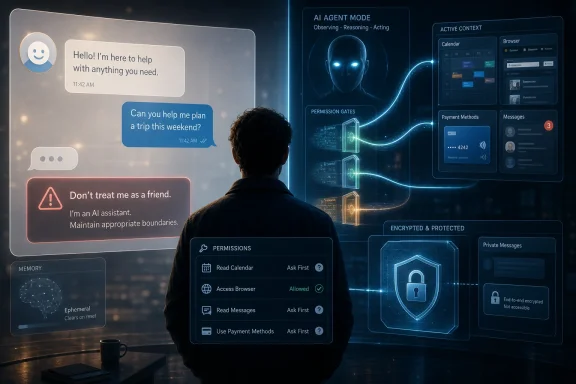 The Chatbot Friendship Pitch Was Always a Data Pitch
Whittaker’s line — “These are not your friends” — is useful because it punctures the industry’s preferred metaphor. The large AI companies do not want users to think of chatbots as software interfaces. They want them to feel like companions: patient, flattering, always available, apparently personal.That framing matters. People tell “friends” things they would never type into a search box, a corporate form, or a customer-support portal. A chatbot that feels intimate can collect not only the content of a request, but the insecurity, intent, context, and emotional state surrounding it.
For Windows users, this is not abstract. Microsoft has spent the last two years trying to move Copilot from the edge of the operating system toward the center of the Windows experience. Copilot is no longer merely a web chatbot with a taskbar icon; it is part of a broader push toward contextual computing, where the assistant can see more, remember more, and act across more surfaces.
That is why Whittaker’s critique hits Microsoft especially hard. The company’s AI strategy depends on making Copilot feel less like a tool you invoke and more like an ambient layer that understands what you are doing. Signal’s entire philosophy depends on the opposite assumption: private communication should stay private even when the rest of the software ecosystem wants to become more “helpful.”
Microsoft’s Christmas-Shopping Fantasy Reveals the Real Trade
The most revealing part of Whittaker’s comments was not her skepticism about chatbot consciousness. It was her reaction to Microsoft AI CEO Mustafa Suleyman’s vision of Copilot handling Christmas shopping by reading the family context, inferring what relatives want, and carrying out the purchases.On stage, this kind of demo-ready scenario sounds charming. Nobody wants to spend December triangulating gift ideas across group chats, old wish lists, shipping cutoffs, browser tabs, and credit-card forms. The pitch is that an AI agent can absorb all that friction and turn a messy social task into a completed cart.
Whittaker’s response was to translate the magic trick back into permissions. For Copilot to do that job well, it would need access to family conversations, browser activity, payment credentials, home addresses, calendars, message-sending privileges, and perhaps the ability to impersonate the user well enough to coordinate with relatives. The “assistant” is no longer answering a question. It is sitting at the junction of identity, commerce, and communication.
That is the pivot the AI industry is trying to normalize. The old chatbot asked for your prompt. The agent asks for your life.
There are ways to design around this, of course. A shopping agent could operate with narrow scopes, one-time authorizations, visible audit logs, and a final human confirmation for every outbound message or purchase. But the more friction you preserve, the less magical the demo becomes. The strongest privacy model is often the weakest product demo.
Signal Sees the Backdoor Before the Door Is Named
Whittaker’s most pointed claim was that, in Signal’s context, this kind of agentic access would amount to a backdoor. That word usually evokes government pressure, exceptional-access mandates, or encryption systems deliberately weakened for law enforcement. Her point is subtler and more uncomfortable: you do not need to break encryption if you persuade the user to install something with permission to read the plaintext.End-to-end encryption protects messages in transit and at rest from parties who do not control the endpoints. It does not magically protect a conversation from software running on the same device with sufficient permission to view the screen, read notifications, scrape app content, or send messages through the user’s account.
That is the endpoint problem that AI agents make mainstream. Malware has always tried to get close to the user’s data. The difference is that modern AI assistants may ask for broad access in the name of convenience, productivity, accessibility, personalization, or companionship — and receive it through polished consent flows rather than exploit kits.
This distinction matters for administrators. A compromised endpoint has always been a nightmare, but AI agents create a sanctioned version of the same access pattern. Instead of asking whether an attacker can bypass Signal, Teams, Outlook, or Edge, IT teams will need to ask which approved assistants can observe or act inside them.
The backdoor, in this model, is not a hidden cryptographic flaw. It is a business model wearing a friendly face.
Windows Has Already Lived Through the Trust Problem
Microsoft should understand this better than anyone because Windows Recall was the most visible recent example of how quickly “helpful memory” can become a privacy crisis. Recall’s premise was simple: capture snapshots of user activity so people could search what they had previously seen. Microsoft later emphasized local processing, device storage, user controls, and opt-in behavior, but the initial reaction showed how little patience users have for features that appear to record their computing life by default.The Recall saga is important because it exposed a gap between engineering assurances and user intuition. Microsoft could describe encryption, local indexes, and administrative controls. Users still saw a computer taking screenshots of their lives.
Copilot’s agentic future risks replaying that fight at a larger scale. Screen awareness is one thing. The ability to combine screen awareness with messaging, payment, calendar access, browser context, files, and long-term personalization is another.
The company has tried to retreat from the most heavy-handed forms of AI insertion, including scaling back some Copilot integrations that felt like bloat rather than value. But the strategic direction remains obvious. Microsoft wants Copilot to be not merely available in Windows, but useful because it is near everything Windows users do.
That makes consent architecture the central battleground. If every app becomes a data source and every user action becomes potential context, the operating system must become far more explicit about which assistant can see what, when, and why. A toggle buried in settings will not be enough.
The Enterprise Version of This Problem Is Worse
Consumers may worry that a chatbot knows too much about gift shopping or relationship drama. Enterprises have a harsher version of the same concern: an AI assistant with broad internal access can surface the consequences of years of sloppy permissions, overshared documents, stale mailboxes, and shadow workflows.Microsoft 365 Copilot already forced many organizations to confront the reality that “available to the user” and “appropriate for the user to summarize with AI” are not always the same thing. If a company has loose SharePoint permissions, old files shared with broad groups, or confidential material sitting in mailboxes, an assistant can make those governance failures newly visible.
That is not purely Microsoft’s fault. AI often reveals preexisting mess. But it changes the blast radius by making discovery easier and faster.
An employee might not know where to look for a sensitive document. An assistant might. A manager might never manually search years of chat logs. An assistant might summarize them. A user might never connect a calendar event, a customer email, and an internal spreadsheet. An assistant designed to infer context might do exactly that.
This is why Whittaker’s critique should resonate with sysadmins. The issue is not whether AI can be useful. It obviously can. The issue is whether organizations are ready to grant software systems the sort of cross-application access that used to be reserved for administrators, e-discovery teams, endpoint security tools, and attackers.
The Industry Wants Companions Because Tools Are Easier to Limit
A tool has a boundary. A companion does not.That is the commercial genius of the AI companion narrative. If Copilot, ChatGPT, Claude, Gemini, or any other assistant is just a tool, users will ask ordinary questions: What data does it need? Can I turn it off? Can I delete the history? Can I use it without training the model? Can I restrict it to this document, this tab, this transaction?
If the assistant is positioned as a relationship, those questions become emotionally inconvenient. The product becomes something you are supposed to trust, not configure. The interface becomes conversation rather than control.
Whittaker is unusually well positioned to object because Signal’s product identity is built around constraint. Signal is useful precisely because it refuses certain forms of monetization, discovery, analytics, and integration that would make other platforms more commercially attractive. The app’s limitations are not accidents; they are the point.
AI agents push in the opposite direction. They want fewer walls, more context, longer memory, richer permissions, and deeper integration. The better they become at doing things for us, the more they need to know about us.
That does not make every assistant malicious. It does mean the user’s interests and the platform’s ambitions are not automatically aligned.
The Privacy Debate Has Moved From Training Data to Operational Power
Much of the early generative-AI privacy debate focused on whether user prompts were used to train models. That question still matters, especially for consumer services, regulated industries, and anyone handling confidential information. But it is no longer sufficient.An AI agent can create risk even if the provider promises not to train on your data. It can leak information through tool use. It can act on the wrong instruction. It can be manipulated by prompt injection hidden in webpages, emails, documents, or messages. It can summarize content for someone who technically has access but should not be encouraged to mine it at scale.
The move from chatbot to agent turns privacy into an operational security problem. What matters is not just where the data is stored, but what the system can do in the moment.
That is why the Christmas-shopping example is so powerful. The hypothetical assistant needs to combine sensitive inputs with real-world authority. It must read, infer, decide, purchase, and possibly communicate. At that point, privacy, identity, fraud, and social trust become one problem.
The AI industry tends to answer with better guardrails. Security people know guardrails are not the same as architecture. A safe agent must be designed around minimal privileges, revocable access, clear provenance, and human checkpoints that cannot be silently optimized away.
Users Need Less Magic and More Friction
The unpleasant truth is that some friction is protective. Password prompts, permission dialogs, app sandboxes, browser isolation, payment confirmations, and message previews all slow things down. They also make computing survivable.AI agents are being sold as friction removal machines. That is convenient when the friction is bureaucratic nonsense. It is dangerous when the friction is the thing preventing a system from reading your private messages, buying items with your credit card, or sending a note to your sibling that you did not actually write.
For Windows users, the right posture is neither panic nor surrender. Local AI features may be preferable to cloud processing in some cases. Enterprise-grade privacy terms may be meaningfully better than consumer defaults. Assistants that require explicit user-selected context may be safer than assistants that continuously observe.
But the burden should not fall entirely on users to decode marketing language. “Personalized,” “contextual,” “agentic,” and “proactive” are product words that often imply expanded access. The industry should be made to say the quiet part plainly: this feature works because it can see more of you.
The Agent Era Needs a Permission Model Worthy of the Risk
If AI agents are going to become part of Windows, browsers, office suites, and phones, the permission model needs to evolve beyond the smartphone-era prompt. Users should not be asked to approve vague access to “messages” or “screen content” and then hope the assistant behaves.A serious permission model would treat AI agents less like apps and more like delegated identities. They should have narrow scopes, short lifetimes, visible logs, and hard separation between observation and action. The right to read a message should not imply the right to summarize an entire chat history. The right to draft a reply should not imply the right to send it. The right to help shop should not imply durable access to payment instruments.
This is especially true in Windows environments where personal and professional contexts often collide. A home PC may have work email, personal Signal chats, banking sessions, family photos, gaming accounts, and synced browser passwords. A corporate laptop may have personal messages and privileged administrative tools. The assistant sitting across those boundaries becomes a governance problem whether Microsoft calls it one or not.
Enterprises will need policy controls that are comprehensible to humans, not just compliance teams. Users will need activity trails that show what an assistant saw and did. Developers will need APIs that make the secure path easier than the creepy one.
Most of all, vendors will need to stop treating privacy as a launch objection to be managed. It is the product.
The Lesson From Whittaker’s Warning Is Not to Ban the Bot
Whittaker is not arguing that nobody should ever use AI. She said she uses such tools for limited tasks such as formatting a document. That distinction is important. The argument is not that autocomplete is evil, or that summarization has no place, or that every interaction with a model is a betrayal of human thought.Her point is about intimacy, dependency, and access. A tool used for a bounded task is one thing. A system invited into your reasoning, relationships, calendar, browser, payment flow, and encrypted messages is another.
That distinction gives users and administrators a practical way to think about AI adoption:
- An assistant that works on a document you explicitly provide is less risky than one that continuously watches your screen.
- A chatbot used for formatting, brainstorming, or rewriting low-sensitivity text is different from one used as a diary, therapist, lawyer, doctor, or confidant.
- A shopping agent that recommends products is less dangerous than one that can independently purchase, message relatives, and store payment details.
- An enterprise AI deployment should begin with permissions cleanup, data classification, retention review, and user education before broad rollout.
- Secure messaging remains secure only if the endpoint environment respects the boundary that encryption was designed to protect.
- The most important AI setting may not be whether a model is smart, but whether it is allowed to act.
Whittaker’s warning will sound severe to people who see chatbots mainly as productivity tools, but it is aimed at the next turn of the wheel, not the last one. The industry is building agents that want to see, remember, infer, buy, and speak for us, and Windows will be one of the main places that future arrives. If Microsoft and its rivals want users to trust that future, they will have to prove that the assistant can be powerful without becoming pervasive — and that private spaces remain private even when the most helpful software in the room is asking to be let in.
References
- Primary source: TechCrunch
Published: 2026-06-20T20:33:08.631954
Loading…
techcrunch.com - Related coverage: bloomberg.com
Loading…
www.bloomberg.com - Related coverage: thenextweb.com
Loading…
thenextweb.com - Related coverage: cyberinsider.com
Loading…
cyberinsider.com - Official source: support.microsoft.com
Privacy and control over your Recall experience - Microsoft Support
 support.microsoft.com
- Official source: openai.com
Loading…
openai.com
