

Mustafa Suleyman, Microsoft’s AI chief, has clarified that his February 2026 prediction about AI reaching human-level performance on most professional tasks within 12 to 18 months referred to the automation of work activities, not the wholesale elimination of white-collar jobs. The walk-back, delivered in a June 8 appearance on The Verge’s Decoder podcast, is more than a semantic cleanup. It is Microsoft trying to keep its AI story commercially useful, politically survivable, and credible to the enterprises it needs to persuade.
The distinction between automating a task and replacing a job sounds tidy in a podcast chair. In the real workplace, it is messier. Jobs are bundles of tasks, status, judgment, institutional memory, accountability, and human coordination; automate enough of the bundle, and the job does not disappear so much as get repriced, redesigned, or consolidated. Suleyman’s clarification therefore does not end the labor-market argument around AI. It simply moves Microsoft’s official posture back to safer ground: Copilot as accelerator, not executioner.
Suleyman’s original February comments landed because they compressed several years of AI anxiety into one executive-friendly timeframe. Saying that AI could reach “human-level performance” on most professional tasks within 12 to 18 months is not the same as saying every accountant, analyst, lawyer, administrator, or project manager is about to be redundant. But the labor-market implication was obvious enough: if the machine can do the work, why keep paying quite so many people to do it?
That is the part Microsoft could not leave hanging. The company is not selling a science-fiction shock doctrine to enterprises; it is selling software seats, cloud consumption, developer platforms, governance layers, and AI add-ons that must pass procurement review. CIOs may enjoy hearing that AI can drive productivity, but they are less eager to buy into a platform whose pitch appears to be “install this and trigger a corporate reorganization.”
The new wording is deliberately more modest. Suleyman’s example set — sending an email, having a conversation with a colleague, putting together a PowerPoint — frames AI as a digitizer of sub-tasks rather than an autonomous replacement for a professional role. It places Copilot in the familiar productivity-software lineage: first word processors replaced typing pools, then spreadsheets changed finance departments, then collaboration platforms changed office workflows. The message is that AI is another layer of workplace leverage, not an HR weapon with a chat interface.
That is a safer story for Microsoft because it aligns with how Microsoft has always made its money. Windows did not eliminate the office. Office did not eliminate the knowledge worker. Azure did not eliminate the IT department, even if it changed what many IT departments do. Microsoft’s strongest commercial pattern is not replacing the customer’s organization, but embedding itself so deeply inside it that the organization cannot easily operate without Microsoft’s tools.
But that distinction should not be mistaken for a firewall. If AI systems can reliably handle 20, 30, or 50 percent of the repeatable work inside a role, organizations will not necessarily preserve headcount out of respect for job taxonomy. They may assign more work to fewer people. They may flatten junior hiring pipelines. They may redesign teams around reviewers rather than producers. They may outsource less, hire differently, or make “AI fluency” a condition of keeping the same job at a higher pace.
That is why the walk-back matters, but also why it feels incomplete. The public fear is not only that AI will replace an entire white-collar job description in one clean sweep. It is that AI will quietly hollow out the economic logic that supports many entry-level, administrative, analytical, and coordination-heavy roles. A job can survive formally while becoming less numerous, less secure, or less valuable in the market.
Microsoft’s chosen formulation — “the work can be done faster” — is doing a lot of diplomatic labor. Faster work sounds benign when imagined at the individual level: fewer dull drafts, quicker meeting notes, cleaner slide decks, less time chasing information. At corporate scale, faster work often means changed staffing ratios. The same sentence can be heard by an employee as relief and by a CFO as an opportunity.
That makes the labor narrative more sensitive, not less. Microsoft is now asking organizations to let AI systems take actions, traverse workflows, inspect code, reason over enterprise data, and interact with business processes. The sales pitch depends on trust. A platform that looks like it is being marketed as a replacement for professionals invites resistance from employees, regulators, unions, and middle managers who understand that “productivity” often arrives with a headcount spreadsheet attached.
Build 2026 also showed how far Microsoft’s AI ambitions have moved beyond autocomplete. The company’s messaging around agents increasingly emphasizes autonomy, orchestration, context, and control. That is precisely why Suleyman’s clarification matters: the more capable the tools become, the more Microsoft must insist that capability does not equal replacement. It is a balancing act between investor excitement and enterprise reassurance.
The company wants customers to believe two things at once. First, AI agents will be powerful enough to justify new spending, new infrastructure, and new workflows. Second, those same agents will remain governable enough that organizations can deploy them without detonating their operating models. Suleyman’s February version leaned toward the first message. His June clarification pulls the company back toward the second.
This is especially true in Windows and Microsoft 365 environments, where the customer base includes regulated industries, public-sector agencies, schools, healthcare systems, banks, and large enterprises with complex data estates. These organizations do not merely want an AI system that can act; they want audit trails, permission boundaries, retention policies, identity controls, data-loss prevention, and a way to explain failure after the fact. Microsoft knows this world better than almost any AI-native competitor.
That is why “human in the loop” is not just an ethical slogan. It is a product requirement. In enterprise software, the human is often the liability container. The employee reviews the draft, approves the workflow, owns the decision, and absorbs the consequences. AI can accelerate the production of options, but the organization still needs accountable people attached to those options.
Suleyman’s clarification therefore maps neatly onto Microsoft’s commercial architecture. If AI automates tasks, Copilot becomes a universal productivity layer. If AI replaces jobs, Microsoft becomes a vendor in the politically explosive business of labor substitution. The first path sells into almost every enterprise. The second path may excite some investors, but it narrows the room in which Microsoft can maneuver.
But enterprise adoption rarely follows the clean lines of a pitch deck. Businesses do not replace departments overnight because a demo looked impressive. They experiment, pilot, restrict, integrate, audit, and complain. They discover that the last 20 percent of a workflow contains the hidden complexity that kept the old process alive. They learn that a generated answer still has to be checked, contextualized, and defended.
Suleyman’s walk-back reflects that reality. The replacement narrative is maximalist, but it is also brittle. It invites backlash before the technology has fully proved itself. The augmentation narrative is less spectacular, but more durable. It lets Microsoft sell AI as a compounding improvement across millions of desks rather than a guillotine hovering over white-collar employment.
That does not make the revenue opportunity small. If Microsoft can persuade enterprises that Copilot and agentic tools save time across email, meetings, documents, coding, customer support, security operations, finance, and administration, the company can justify premium licensing and deeper Azure usage. The market may not need full job replacement for AI to be enormously profitable. It only needs enough perceived productivity gain to survive budget scrutiny.
That shift changes the meaning of desktop automation. Old Windows automation was explicit and mechanical: scripts, macros, scheduled tasks, Group Policy, management agents, and admin tools. New AI automation is probabilistic and contextual. It can interpret natural language, summarize messy inputs, and make decisions within a workflow, but it also introduces uncertainty that traditional automation did not have in the same way.
For enthusiasts, that creates both excitement and unease. A Windows PC that can help build apps, summarize local documents, interact with shell tools, or coordinate tasks across Microsoft 365 is genuinely useful. It also raises obvious questions about telemetry, permissions, local versus cloud processing, model behavior, and whether users can meaningfully control what the assistant sees and does.
For IT professionals, the issue is even sharper. The more Microsoft embeds AI into Windows and enterprise management surfaces, the more admins will need to treat AI agents as identities, workloads, and risk-bearing actors. An agent that can read, write, execute, or recommend action is not just a feature. It is a new class of operational dependency.
The more plausible outcome is uneven redesign. Some roles will be protected because they are relationship-heavy, accountability-heavy, or physically grounded. Some will become more productive and more demanding. Some junior roles may be squeezed because AI can do the draft work that once trained new professionals. Some back-office functions may see fewer hires, slower replacement, or consolidation across teams.
That is why Suleyman’s clarification is best understood as a repositioning, not a reversal. He did not say AI progress is slowing. He did not say professional work will remain untouched. He narrowed the claim from “jobs” to “tasks,” which is both more accurate and more commercially convenient. The labor consequences remain downstream of adoption, management choices, and economic incentives.
Procurement teams will become an unexpected battleground in this debate. When a company buys AI tools, it will increasingly need to state what problem it is solving. Is the goal employee assistance, cost reduction, service expansion, faster cycle times, improved quality, or headcount avoidance? Vendors may prefer the language of empowerment, but budgets have a way of revealing intent.
The company’s Build 2026 emphasis on trust stacks, agent controls, evaluation, and governance fits this strategy. Microsoft is not trying to win only by having the flashiest model. It is trying to win by making AI deployable inside institutions that cannot afford chaos. That is a very different business from consumer AI virality.
Suleyman’s softer language helps that positioning. A company preaching responsible deployment cannot sound too casual about replacing entire classes of workers on an 18-month schedule. Even if the underlying technology becomes capable, the institutional politics require restraint. Microsoft must be ambitious enough for Wall Street and cautious enough for the CIO’s office.
This is the recurring tension in enterprise AI. The vendor wants to promise transformation, but not disruption so severe that the buyer hesitates. It wants to imply massive productivity gains, but not admit that those gains may translate into fewer people. It wants to make AI sound inevitable, but not unmanageable. Suleyman’s clarification sits exactly at that intersection.
Companies can reduce hiring without announcing layoffs. They can merge roles. They can expect employees to cover more territory. They can turn formerly specialized tasks into self-service workflows. They can shift from creating work to reviewing AI-generated work. None of this requires a press release saying that AI “replaced jobs.”
This is where the task-versus-job distinction becomes politically slippery. If AI automates tasks across 10 different roles and a company later decides it needs eight people instead of 10, did AI replace jobs? Technically, management made an organizational decision. Practically, the automation changed the math.
Workers understand this intuitively, which is why executive clarifications often fail to settle the issue. The concern is not only whether an AI agent can perform an entire job description from end to end. The concern is whether AI changes the bargaining power of the people doing the work. A faster worker is valuable, but a faster workflow can also make individual workers more interchangeable.
They will also be asked to reconcile contradictory expectations. Leadership will want fast adoption and measurable productivity gains. Legal will want risk controls. Security will want visibility and containment. Employees will want clarity about what AI is doing with their data and whether the tools are being used to measure them. Finance will want to know when the new subscriptions pay for themselves.
That means AI rollout will look less like a software upgrade and more like a governance program. Admins will need policies for which data agents can access, which actions require human approval, which logs are retained, and which departments are allowed to build their own agents. Shadow AI will become the new shadow IT, except with a larger blast radius because the tools can generate content, make recommendations, and potentially take action.
The practical advice is not to reject the technology, because that is unlikely to be an option in Microsoft-heavy environments. The practical advice is to treat the “assistant” framing with healthy skepticism. If an AI feature can change a document, trigger a workflow, query sensitive data, or influence a business decision, it deserves the same seriousness as any other privileged system.
It also forces a better question: which tasks, under whose supervision, with what error tolerance, and with what effect on staffing? A model that drafts a meeting summary is not in the same category as an agent that files an expense report, modifies production code, or recommends a denial of service to a customer. Automation is not one thing. It is a spectrum of delegation.
Microsoft benefits from this reframing, but so do customers. Enterprises should not buy AI tools based on a vague fear of being left behind or a vague promise of human-level performance. They should map workflows, identify friction, define review points, and decide where speed is worth the cost of oversight. The task framing makes that possible.
Still, the clarification should not be allowed to become an anesthetic. “Tasks, not jobs” is accurate only at the first layer of analysis. At the second layer, tasks compose jobs. At the third, jobs compose departments. At the fourth, departments compose budgets. Everyone in the chain understands why the wording matters.
The distinction between automating a task and replacing a job sounds tidy in a podcast chair. In the real workplace, it is messier. Jobs are bundles of tasks, status, judgment, institutional memory, accountability, and human coordination; automate enough of the bundle, and the job does not disappear so much as get repriced, redesigned, or consolidated. Suleyman’s clarification therefore does not end the labor-market argument around AI. It simply moves Microsoft’s official posture back to safer ground: Copilot as accelerator, not executioner.
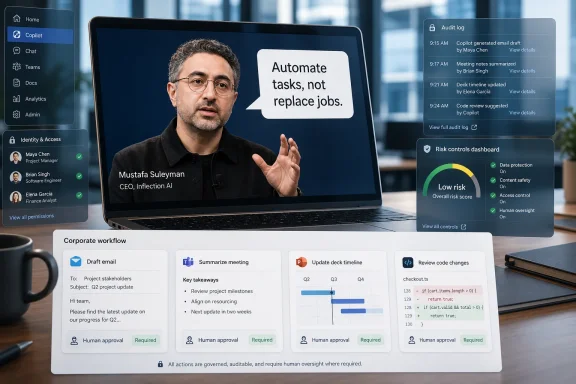 Microsoft Needed the Correction More Than the Public Did
Suleyman’s original February comments landed because they compressed several years of AI anxiety into one executive-friendly timeframe. Saying that AI could reach “human-level performance” on most professional tasks within 12 to 18 months is not the same as saying every accountant, analyst, lawyer, administrator, or project manager is about to be redundant. But the labor-market implication was obvious enough: if the machine can do the work, why keep paying quite so many people to do it?That is the part Microsoft could not leave hanging. The company is not selling a science-fiction shock doctrine to enterprises; it is selling software seats, cloud consumption, developer platforms, governance layers, and AI add-ons that must pass procurement review. CIOs may enjoy hearing that AI can drive productivity, but they are less eager to buy into a platform whose pitch appears to be “install this and trigger a corporate reorganization.”
The new wording is deliberately more modest. Suleyman’s example set — sending an email, having a conversation with a colleague, putting together a PowerPoint — frames AI as a digitizer of sub-tasks rather than an autonomous replacement for a professional role. It places Copilot in the familiar productivity-software lineage: first word processors replaced typing pools, then spreadsheets changed finance departments, then collaboration platforms changed office workflows. The message is that AI is another layer of workplace leverage, not an HR weapon with a chat interface.
That is a safer story for Microsoft because it aligns with how Microsoft has always made its money. Windows did not eliminate the office. Office did not eliminate the knowledge worker. Azure did not eliminate the IT department, even if it changed what many IT departments do. Microsoft’s strongest commercial pattern is not replacing the customer’s organization, but embedding itself so deeply inside it that the organization cannot easily operate without Microsoft’s tools.
The Task-versus-Job Distinction Is Real, but It Is Not Reassuring
Suleyman is correct that jobs are not identical to tasks. A lawyer’s job is not merely drafting a contract clause. A sysadmin’s job is not merely running a PowerShell command. A finance manager’s job is not merely summarizing a spreadsheet. The human role includes deciding what matters, interpreting ambiguous context, bearing responsibility, managing exceptions, and navigating the political and ethical terrain around the output.But that distinction should not be mistaken for a firewall. If AI systems can reliably handle 20, 30, or 50 percent of the repeatable work inside a role, organizations will not necessarily preserve headcount out of respect for job taxonomy. They may assign more work to fewer people. They may flatten junior hiring pipelines. They may redesign teams around reviewers rather than producers. They may outsource less, hire differently, or make “AI fluency” a condition of keeping the same job at a higher pace.
That is why the walk-back matters, but also why it feels incomplete. The public fear is not only that AI will replace an entire white-collar job description in one clean sweep. It is that AI will quietly hollow out the economic logic that supports many entry-level, administrative, analytical, and coordination-heavy roles. A job can survive formally while becoming less numerous, less secure, or less valuable in the market.
Microsoft’s chosen formulation — “the work can be done faster” — is doing a lot of diplomatic labor. Faster work sounds benign when imagined at the individual level: fewer dull drafts, quicker meeting notes, cleaner slide decks, less time chasing information. At corporate scale, faster work often means changed staffing ratios. The same sentence can be heard by an employee as relief and by a CFO as an opportunity.
Build 2026 Put the Walk-Back in Context
The timing of Suleyman’s clarification is difficult to separate from Microsoft Build 2026. Microsoft spent the conference pushing the next stage of its AI platform strategy: agents, Copilot integration, developer tooling, governance, local models, and enterprise context. The company’s preferred future is not a single chatbot that answers questions, but a fabric of AI agents operating across Windows, Microsoft 365, GitHub, Azure, and business applications.That makes the labor narrative more sensitive, not less. Microsoft is now asking organizations to let AI systems take actions, traverse workflows, inspect code, reason over enterprise data, and interact with business processes. The sales pitch depends on trust. A platform that looks like it is being marketed as a replacement for professionals invites resistance from employees, regulators, unions, and middle managers who understand that “productivity” often arrives with a headcount spreadsheet attached.
Build 2026 also showed how far Microsoft’s AI ambitions have moved beyond autocomplete. The company’s messaging around agents increasingly emphasizes autonomy, orchestration, context, and control. That is precisely why Suleyman’s clarification matters: the more capable the tools become, the more Microsoft must insist that capability does not equal replacement. It is a balancing act between investor excitement and enterprise reassurance.
The company wants customers to believe two things at once. First, AI agents will be powerful enough to justify new spending, new infrastructure, and new workflows. Second, those same agents will remain governable enough that organizations can deploy them without detonating their operating models. Suleyman’s February version leaned toward the first message. His June clarification pulls the company back toward the second.
Copilot’s Business Model Depends on Humans Staying in the Loop
Microsoft Copilot is built around augmentation because augmentation is easier to sell, easier to govern, and easier to renew. A tool that helps a professional draft, summarize, search, schedule, code, investigate, and present can be priced per user and embedded across existing workflows. A tool that replaces the professional triggers a different buying conversation entirely, one involving legal accountability, labor relations, compliance exposure, and uncomfortable questions about who signs off when the AI gets something wrong.This is especially true in Windows and Microsoft 365 environments, where the customer base includes regulated industries, public-sector agencies, schools, healthcare systems, banks, and large enterprises with complex data estates. These organizations do not merely want an AI system that can act; they want audit trails, permission boundaries, retention policies, identity controls, data-loss prevention, and a way to explain failure after the fact. Microsoft knows this world better than almost any AI-native competitor.
That is why “human in the loop” is not just an ethical slogan. It is a product requirement. In enterprise software, the human is often the liability container. The employee reviews the draft, approves the workflow, owns the decision, and absorbs the consequences. AI can accelerate the production of options, but the organization still needs accountable people attached to those options.
Suleyman’s clarification therefore maps neatly onto Microsoft’s commercial architecture. If AI automates tasks, Copilot becomes a universal productivity layer. If AI replaces jobs, Microsoft becomes a vendor in the politically explosive business of labor substitution. The first path sells into almost every enterprise. The second path may excite some investors, but it narrows the room in which Microsoft can maneuver.
The Investor Story Is Being Sanded Down for Enterprise Reality
The early AI boom was inflated by a sweeping promise: software would not just assist workers, it would absorb the economic value of entire categories of work. That story is intoxicating for investors because it suggests enormous value capture. If a model can perform the work of a salaried professional, the platform owner can claim a slice of a labor market far larger than the traditional software market.But enterprise adoption rarely follows the clean lines of a pitch deck. Businesses do not replace departments overnight because a demo looked impressive. They experiment, pilot, restrict, integrate, audit, and complain. They discover that the last 20 percent of a workflow contains the hidden complexity that kept the old process alive. They learn that a generated answer still has to be checked, contextualized, and defended.
Suleyman’s walk-back reflects that reality. The replacement narrative is maximalist, but it is also brittle. It invites backlash before the technology has fully proved itself. The augmentation narrative is less spectacular, but more durable. It lets Microsoft sell AI as a compounding improvement across millions of desks rather than a guillotine hovering over white-collar employment.
That does not make the revenue opportunity small. If Microsoft can persuade enterprises that Copilot and agentic tools save time across email, meetings, documents, coding, customer support, security operations, finance, and administration, the company can justify premium licensing and deeper Azure usage. The market may not need full job replacement for AI to be enormously profitable. It only needs enough perceived productivity gain to survive budget scrutiny.
Windows Becomes the Stage for the Argument
For Windows users, this debate is not abstract. Microsoft’s AI strategy increasingly treats Windows as a platform where agents can observe, assist, and eventually act. The operating system is no longer just the place where productivity software runs; it is becoming part of the productivity system itself.That shift changes the meaning of desktop automation. Old Windows automation was explicit and mechanical: scripts, macros, scheduled tasks, Group Policy, management agents, and admin tools. New AI automation is probabilistic and contextual. It can interpret natural language, summarize messy inputs, and make decisions within a workflow, but it also introduces uncertainty that traditional automation did not have in the same way.
For enthusiasts, that creates both excitement and unease. A Windows PC that can help build apps, summarize local documents, interact with shell tools, or coordinate tasks across Microsoft 365 is genuinely useful. It also raises obvious questions about telemetry, permissions, local versus cloud processing, model behavior, and whether users can meaningfully control what the assistant sees and does.
For IT professionals, the issue is even sharper. The more Microsoft embeds AI into Windows and enterprise management surfaces, the more admins will need to treat AI agents as identities, workloads, and risk-bearing actors. An agent that can read, write, execute, or recommend action is not just a feature. It is a new class of operational dependency.
The Jobs Debate Will Move From Philosophy to Procurement
The public argument over AI and employment often gets stuck between two caricatures. One side imagines mass white-collar extinction on an aggressive timeline. The other insists AI is merely a helpful assistant, no more threatening than spellcheck. Neither frame is adequate for what is likely to happen inside real organizations.The more plausible outcome is uneven redesign. Some roles will be protected because they are relationship-heavy, accountability-heavy, or physically grounded. Some will become more productive and more demanding. Some junior roles may be squeezed because AI can do the draft work that once trained new professionals. Some back-office functions may see fewer hires, slower replacement, or consolidation across teams.
That is why Suleyman’s clarification is best understood as a repositioning, not a reversal. He did not say AI progress is slowing. He did not say professional work will remain untouched. He narrowed the claim from “jobs” to “tasks,” which is both more accurate and more commercially convenient. The labor consequences remain downstream of adoption, management choices, and economic incentives.
Procurement teams will become an unexpected battleground in this debate. When a company buys AI tools, it will increasingly need to state what problem it is solving. Is the goal employee assistance, cost reduction, service expansion, faster cycle times, improved quality, or headcount avoidance? Vendors may prefer the language of empowerment, but budgets have a way of revealing intent.
Microsoft’s Responsible-AI Language Is Now a Competitive Weapon
Microsoft has spent years positioning itself as a responsible AI company, and that branding is not merely reputational. In the enterprise market, responsibility is a sales feature. Customers want assurances that AI tools can be governed, constrained, evaluated, and aligned with corporate policy. Microsoft’s advantage is that it can connect that message to identity, security, compliance, developer tooling, and administration.The company’s Build 2026 emphasis on trust stacks, agent controls, evaluation, and governance fits this strategy. Microsoft is not trying to win only by having the flashiest model. It is trying to win by making AI deployable inside institutions that cannot afford chaos. That is a very different business from consumer AI virality.
Suleyman’s softer language helps that positioning. A company preaching responsible deployment cannot sound too casual about replacing entire classes of workers on an 18-month schedule. Even if the underlying technology becomes capable, the institutional politics require restraint. Microsoft must be ambitious enough for Wall Street and cautious enough for the CIO’s office.
This is the recurring tension in enterprise AI. The vendor wants to promise transformation, but not disruption so severe that the buyer hesitates. It wants to imply massive productivity gains, but not admit that those gains may translate into fewer people. It wants to make AI sound inevitable, but not unmanageable. Suleyman’s clarification sits exactly at that intersection.
The Real Risk Is Not One Big Layoff, but a Thousand Quiet Redesigns
The fear of AI job replacement is often imagined as a dramatic event: a company announces that software has replaced a department. That will happen in some cases, especially in functions where work is standardized, measurable, and already heavily mediated by software. But the more important change may be slower and harder to see.Companies can reduce hiring without announcing layoffs. They can merge roles. They can expect employees to cover more territory. They can turn formerly specialized tasks into self-service workflows. They can shift from creating work to reviewing AI-generated work. None of this requires a press release saying that AI “replaced jobs.”
This is where the task-versus-job distinction becomes politically slippery. If AI automates tasks across 10 different roles and a company later decides it needs eight people instead of 10, did AI replace jobs? Technically, management made an organizational decision. Practically, the automation changed the math.
Workers understand this intuitively, which is why executive clarifications often fail to settle the issue. The concern is not only whether an AI agent can perform an entire job description from end to end. The concern is whether AI changes the bargaining power of the people doing the work. A faster worker is valuable, but a faster workflow can also make individual workers more interchangeable.
IT Departments Will Be Asked to Make the Contradiction Work
For WindowsForum’s core audience — sysadmins, endpoint managers, security engineers, developers, and power users — Suleyman’s clarification is less interesting as corporate messaging than as a preview of operational reality. IT departments will be the people asked to deploy the tools, manage the controls, answer user questions, and clean up when an AI-assisted workflow goes sideways.They will also be asked to reconcile contradictory expectations. Leadership will want fast adoption and measurable productivity gains. Legal will want risk controls. Security will want visibility and containment. Employees will want clarity about what AI is doing with their data and whether the tools are being used to measure them. Finance will want to know when the new subscriptions pay for themselves.
That means AI rollout will look less like a software upgrade and more like a governance program. Admins will need policies for which data agents can access, which actions require human approval, which logs are retained, and which departments are allowed to build their own agents. Shadow AI will become the new shadow IT, except with a larger blast radius because the tools can generate content, make recommendations, and potentially take action.
The practical advice is not to reject the technology, because that is unlikely to be an option in Microsoft-heavy environments. The practical advice is to treat the “assistant” framing with healthy skepticism. If an AI feature can change a document, trigger a workflow, query sensitive data, or influence a business decision, it deserves the same seriousness as any other privileged system.
The Clarification Gives Everyone a More Useful Argument
Suleyman’s revised position is better because it is more precise. “AI will automate tasks” is a claim that can be tested, measured, and governed. “AI will replace white-collar jobs” is a provocation that collapses many different workplace dynamics into a single headline. The new language allows a more serious conversation about where AI is actually useful and where the risks accumulate.It also forces a better question: which tasks, under whose supervision, with what error tolerance, and with what effect on staffing? A model that drafts a meeting summary is not in the same category as an agent that files an expense report, modifies production code, or recommends a denial of service to a customer. Automation is not one thing. It is a spectrum of delegation.
Microsoft benefits from this reframing, but so do customers. Enterprises should not buy AI tools based on a vague fear of being left behind or a vague promise of human-level performance. They should map workflows, identify friction, define review points, and decide where speed is worth the cost of oversight. The task framing makes that possible.
Still, the clarification should not be allowed to become an anesthetic. “Tasks, not jobs” is accurate only at the first layer of analysis. At the second layer, tasks compose jobs. At the third, jobs compose departments. At the fourth, departments compose budgets. Everyone in the chain understands why the wording matters.
The New Microsoft Line Is Narrower, but the Stakes Are Bigger
The useful way to read Suleyman’s walk-back is not as a denial of AI disruption, but as a narrowing of the claim to something Microsoft can productize, defend, and sell. The technology story remains aggressive. The employment story is being made more careful.- Suleyman’s February prediction created alarm because “human-level performance” on professional tasks naturally suggested pressure on white-collar employment.
- His June clarification reframes the issue around automating sub-tasks such as email, conversations, and presentations rather than eliminating entire roles.
- Microsoft’s Copilot and agent strategy works best commercially when AI is presented as augmentation inside existing workflows, not as a direct substitute for employees.
- For Windows and Microsoft 365 environments, the practical challenge is governance: permissions, auditability, identity, data access, and human approval points.
- The labor impact is likely to arrive through redesigned roles, slower hiring, consolidation, and higher productivity expectations rather than one clean wave of replacement.
- Enterprises should evaluate AI deployments by workflow and risk level, not by executive slogans about either superintelligence or harmless assistance.
References
- Primary source: Crypto Briefing
Published: 2026-06-09T19:50:08.152408
Microsoft AI chief Mustafa Suleyman clarifies automation comments, walks back job replacement timeline
Microsoft AI chief Mustafa Suleyman walks back February claims about AI replacing white-collar workers, now says AI will automate tasks, not eliminate jobs.cryptobriefing.com - Related coverage: windowscentral.com
Build 2026 only makes sense if you remember Build 2025: a look back at the groundwork of the "age of AI agents" | Windows Central
Microsoft’s latest announcements build directly on the architecture it introduced a year ago.www.windowscentral.com - Related coverage: techradar.com
'A new category of agents': Microsoft reveals Scout, its first "Autopilot", which wants to change how you work for good | TechRadar
Say hello to Autopilots from Microsoftwww.techradar.com - Related coverage: tomsguide.com
Vibe coding is coming to Windows — how Microsoft Copilot turns anyone into a creator | Tom's Guide
Vibe coding is going mainstream and Microsoft is in a unique position to capitalize with Copilot integrating itself across the Windows platform.www.tomsguide.com - Official source: blogs.microsoft.com
Introducing the First Frontier Suite built on Intelligence + Trust - The Official Microsoft Blog
Today Microsoft is announcing: Wave 3 of Microsoft 365 Copilot Expanded model diversity with Claude and next-gen OpenAI models available today General availability of Agent 365 on May 1 for $15 per user General availability of the new Microsoft 365 E7: The Frontier Suite on May 1 for $99 per...blogs.microsoft.com - Official source: microsoft.com
Microsoft Build 2026: Securing code, agents, and models across the development lifecycle | Microsoft Security Blog
Discover how Microsoft enables fast, secure AI development with MDASH and new security capabilities.www.microsoft.com
- Official source: news.microsoft.com
Microsoft Build 2026
 news.microsoft.com
- Official source: devblogs.microsoft.com
Build and run agents at scale with Microsoft Foundry at Build 2026 | Microsoft Foundry Blog
Learn how Microsoft Foundry helps developers build, deploy, and operate production-ready agents with Agent Framework, Toolboxes, hosted agents, Microsoft 365 distribution, observability, and agent optimization.devblogs.microsoft.com - Related coverage: tomshardware.com
Microsoft unveils Project Solara AI, a chip-to-cloud platform built to power a new generation of 'agent-first' enterprise devices — hardware designed to run AI agents instead of traditional apps | Tom's Hardware
Microsoft ditches Windows to build OS on Androidwww.tomshardware.com - Official source: developer.microsoft.com
Microsoft Build 2026 recap: vision, launches, and top sessions - Microsoft for Developers
Catch up on Microsoft Build 2026 with the vision lead-off, top developer announcements, and must-watch sessions across the Microsoft developer ecosystem.developer.microsoft.com - Related coverage: resultsense.com
Human-level AI in 18 months? What Microsoft's prediction actually means for UK workforce strategy - Resultsense
Microsoft AI chief Mustafa Suleyman claims AI will match human performance on most professional tasks within 12-18 months. Here's what UK business leaders should actually do about it.www.resultsense.com
- Related coverage: visualstudiomagazine.com
At Build 2026, Microsoft Sets Up Windows as an OS for AI Agents -- Visual Studio Magazine
Microsoft's Build 2026 Windows developer announcements point to a broader platform strategy for agentic AI, spanning terminal workflows, local models, app-building skills, Cloud PCs and operating system-level containment.visualstudiomagazine.com - Related coverage: moneycontrol.com
Desk jobs on a timer? Microsoft’s Mustafa Suleyman says AI will automate most white-collar in 18 months
Microsoft AI chief Mustafa Suleyman warns white-collar jobs may be automated within 18 months as the company accelerates its enterprise AGI push.www.moneycontrol.com - Related coverage: arturmarkus.com
Microsoft 365 Copilot Rolls Out 27 New Features in January 2026, Adds GPT-5.2 Model Selector with 3 Reasoning Modes
PDF documentwww.arturmarkus.com
- Related coverage: newsroom.workday.com
Workday and Microsoft to Deliver Unified AI Agent Experience for the Enterprise - Sep 16, 2025
PDF documentnewsroom.workday.com
- Related coverage: its.fsu.edu
- Official source: adoption.microsoft.com
