

Microsoft AI chief Mustafa Suleyman has clarified in June 2026 that his much-circulated prediction about AI and white-collar work was about automating professional tasks, not erasing entire jobs, after earlier remarks suggested most computer-based office work could be automated within 12 to 18 months. The distinction sounds narrow, but it is the whole argument. Microsoft is not backing away from an aggressive agentic-AI future; it is trying to reframe the disruption in language that enterprises, regulators, and employees can actually live with.
The correction matters because “tasks, not jobs” has become the safest phrase in AI executive vocabulary. It reassures workers that their roles will survive while reassuring investors that software can still eat a larger share of payroll-adjacent activity. The problem is that jobs are made of tasks, and when enough tasks move into software, the organization chart does not remain untouched.
Suleyman’s clarification is not a retreat from the automation thesis. It is a cleanup operation around the most politically dangerous interpretation of it. When a Microsoft executive says AI will reach human-level performance on most professional tasks, listeners do not hear a tidy taxonomy of labor economics; they hear a clock ticking over the desks of lawyers, accountants, project managers, marketers, analysts, and developers.
That is why the wording matters. “Jobs” implies headcount, layoffs, careers, mortgages, and social consequences. “Tasks” implies workflow, productivity, and software adoption. One is a labor-market warning; the other is a product roadmap.
Microsoft would much rather have the second conversation. The company can sell Copilot, agents, Azure AI infrastructure, and whatever comes after the Windows desktop as tools that remove drudgery rather than tools that remove people. That framing is not necessarily dishonest, but it is incomplete. A task is not a job, yet a job without enough defensible tasks becomes a budget line waiting for the next reorganization.
The company’s rhetorical problem is that AI has been marketed with maximal ambition for years. The pitch has not been “better autocomplete for quarterly reports.” It has been agents that reason, plan, execute, summarize, search, code, book, negotiate, triage, and collaborate. If that pitch is real, the labor implications are real too.
That is a very different promise from the old software productivity cycle. Word processors did not claim to be junior associates. Spreadsheets did not introduce themselves as finance analysts. Email clients did not ask for an identity in the corporate directory.
Modern AI systems are being sold precisely because they appear to cross that boundary. Microsoft’s own agentic framing asks enterprises to imagine software not merely as an application but as a participant in the work environment. Once AI agents are discussed as entities that need permissions, memory, credentials, governance, and identity, it becomes harder to insist that job anxiety is a misunderstanding by nervous workers.
The tension is especially sharp for Microsoft because its traditional strength is the work computer itself. Windows, Office, Teams, SharePoint, Exchange, Active Directory, GitHub, Azure, and Microsoft 365 form the substrate of digital office labor. If AI is going to automate white-collar tasks, Microsoft sits closer than almost anyone to the place where that automation will be deployed.
That makes Suleyman’s clarification both plausible and convenient. It is plausible because companies really do buy automation one workflow at a time. It is convenient because the cumulative effect of those workflow decisions can still be fewer junior roles, smaller support teams, thinner back offices, and a very different career ladder.
In that sense, saying AI automates tasks rather than jobs is accurate. A contract lawyer does not only draft clauses. An accountant does not only reconcile numbers. A project manager does not only update status reports. A marketer does not only generate copy. Much of the actual value of these roles comes from deciding what matters, detecting when the inputs are bad, persuading other humans, and taking responsibility when the output affects money or risk.
But the distinction is not a shield. Many organizations do not need AI to replace every part of a role before they change hiring plans. If a tool allows ten people to do the work that previously required twelve, the job category still exists, but two jobs may not. If a senior employee can use AI to perform work once delegated to entry-level staff, the profession still exists, but the on-ramp narrows.
That is the entry-level problem hiding behind the “tasks” language. Early-career white-collar work is often task-heavy by design. Juniors research, summarize, format, draft, test, clean data, build first passes, prepare decks, respond to tickets, and learn by doing the low-status work that senior employees later review. Those tasks are exactly where generative AI is strongest.
So the near-term danger may not be that AI replaces a fully formed professional. It may be that AI replaces the apprenticeship layer that creates one. A company can honestly say no jobs were eliminated by a tool while quietly hiring fewer people into the jobs that used to start careers.
Yet mundane work is often how people learn the shape of a domain. The junior admin who resets accounts learns which departments are disorganized. The help desk technician who handles repetitive tickets learns which policies are broken. The analyst who cleans a spreadsheet learns where the data lies. The paralegal who reviews documents learns how cases are actually built.
AI can reduce drudgery, but it can also remove the repetition through which workers develop judgment. That tradeoff rarely appears in keynote demos. The demo shows the polished result: a summarized thread, a generated memo, a completed spreadsheet, a drafted response. It does not show the years of pattern recognition that allow a human reviewer to know when the polished output is wrong.
This is why WindowsForum readers should treat the “tasks, not jobs” clarification as the beginning of the debate, not the end. The question is not whether AI can save time on office busywork. It already can. The question is how organizations preserve expertise when the first-pass work increasingly happens inside a model.
IT departments have seen this pattern before in other forms. Automation scripts made some manual administration unnecessary, but they also demanded better systems thinking. Cloud services abstracted away server maintenance, but they created new operational risks around identity, cost, and configuration. AI will likely follow the same path: less manual grind, more dependence on people who understand the system well enough to challenge it.
That direction is important. The old Windows metaphor was user-first: a person opens apps, manages files, clicks buttons, and decides what happens next. The agentic metaphor shifts more initiative to software. A user states an intent, and an agent navigates the tools.
Project Solara, as described in recent reporting, fits that shift. The idea of an “invisible” operating environment hosting an agent shell is not just another UI experiment. It suggests Microsoft is thinking beyond the app grid and toward a workplace where agents assemble services dynamically around tasks.
That is exciting if the agent is doing work you hate. It is unsettling if the agent is doing work that once justified a role on your team. The same technical capability supports both stories.
Satya Nadella’s reported suggestion that AI agents should be treated like employees sharpens the point. In enterprise IT terms, “treated like employees” means identity, permissions, access control, monitoring, lifecycle management, and accountability. That is a sensible security posture. But culturally, it also invites the comparison Microsoft is trying to avoid: if an agent has an identity, a manager, access rights, and assigned work, it starts to resemble a digital worker.
Microsoft can argue that this is about governance rather than replacement. It is right to do so. But governance is necessary precisely because these systems are being entrusted with more consequential tasks. Nobody asks whether a calculator should have an HR-like identity.
The automation of white-collar work is not simply a model-capability problem. It is an integration problem. It is a data-quality problem. It is a liability problem. It is a permissions problem. It is a change-management problem. And, especially in regulated sectors, it is an audit problem.
Windows administrators know this better than most. A capability that looks simple in a Microsoft presentation may become complicated the moment it touches conditional access policies, retention rules, data loss prevention, privileged identities, shadow IT, third-party plug-ins, and regional privacy requirements. The agent that can summarize a meeting is one thing. The agent that can initiate a financial process, alter customer records, or advise on a legal matter is another.
That gap does not make Suleyman wrong about direction. It makes the timeline suspect. AI may become capable of performing many professional tasks before enterprises are willing to let it perform them unsupervised. The difference between can do and may do is where much of the next decade’s IT work will live.
That skepticism is healthy. It prevents the industry from treating every generated paragraph as intelligence and every demo as destiny. AI systems remain brittle in ways that matter, especially when facts, edge cases, and accountability are on the line.
But calling an LLM “just a tool” can also understate the economic effect. A spreadsheet is just a tool, but it changed finance departments. A compiler is just a tool, but it changed programming. A search engine is just a tool, but it changed research, publishing, advertising, and knowledge work. Tools matter because they change how many people are needed, what skills are scarce, and who captures the value.
The real question is not whether AI is conscious, human, or independently wise. It does not have to be any of those things to affect employment. It only has to be good enough, cheap enough, and integrated enough to let managers redesign workflows around it.
That is where the “guessing machine” critique runs into the procurement department. If a model is wrong five percent of the time, it may be unusable for some tasks and perfectly acceptable for others with review. If it saves an hour a day for a thousand employees, it will be bought despite its flaws. If it lets a senior worker skip the first draft, the junior worker who used to prepare that draft may feel the impact even if the model remains philosophically unimpressive.
These comments are not identical, and they should not be flattened into one apocalypse narrative. Amodei’s warnings tend to emphasize labor-market shock and the need to stop sugarcoating risk. Huang’s comments often serve a different purpose: reframing the future around domains that will use AI rather than around the act of writing code itself. Suleyman’s latest clarification tries to place Microsoft in a more measured camp, where AI transforms tasks while humans remain central.
Still, the disagreement is mostly about speed, severity, and framing. Few major AI executives are saying white-collar work will remain structurally unchanged. The consensus, if there is one, is that work done at a computer is becoming more automatable, more compressible, and more exposed to software-mediated productivity gains.
That consensus should make workers and IT leaders wary of both extremes. The “everyone is unemployed next year” version is too blunt. The “nothing changes because AI makes mistakes” version is too complacent. The likely path is uneven, sector-specific, and organizationally disruptive in ways that will be obvious only after hiring patterns, promotion ladders, and team sizes have already shifted.
This is how technological change often arrives. Not as a single day when jobs vanish, but as a thousand local decisions: do not backfill that role, assign the intern’s work to Copilot, replace a vendor with an agent workflow, centralize support, delay graduate hiring, expect every employee to produce more. By the time the labor statistics catch up, the lived experience has already changed.
That means the Windows environment becomes a policy battleground. Who can invoke an agent? What data can it read? Can it take actions, or only suggest them? Are its outputs retained? Are prompts discoverable? Can sensitive data leak into model interactions? Can a user install an unofficial agent that bypasses enterprise controls? Can an agent’s action be attributed cleanly when something goes wrong?
These are not theoretical concerns for sysadmins. They are the practical shape of AI adoption. The more Microsoft blurs the line between user, app, and agent, the more administrators need tooling that treats AI activity as first-class operational telemetry.
There is also a support burden coming. Employees will not simply ask IT why Outlook crashed; they will ask why Copilot produced the wrong summary, why an agent accessed a file, why a workflow ran twice, why a generated email included confidential language, or why an AI assistant gave different answers to two employees. That is a new class of help desk ticket, and it will not be solved by telling users the model is “just a tool.”
Security teams will be especially cautious. An agent that can act across services expands the blast radius of compromised credentials, bad permissions, prompt injection, and overbroad access. The old principle of least privilege becomes harder when the user’s assistant is designed to roam.
But “human in the loop” can become a fig leaf if the loop is overloaded. A worker asked to review a flood of AI-generated material may become a rubber stamp. A manager who is told the AI is usually right may stop checking edge cases. A company that keeps humans formally accountable while pushing more decisions through automation may shift risk downward while keeping productivity gains upward.
That is the political economy of AI adoption. Executives promise empowerment. Vendors promise efficiency. Workers inherit the obligation to supervise machines whose outputs are fast, plausible, and sometimes wrong. The human remains “in control” on paper, but the pace and volume of automated work can make meaningful control difficult.
The best organizations will treat oversight as a real function, not a ceremonial checkbox. They will define which tasks can be automated, which require review, which are prohibited, and which demand domain experts. They will measure error rates, escalation patterns, and downstream consequences. They will also resist the temptation to make every worker absorb AI governance as unpaid cognitive overhead.
The worst organizations will do what bad organizations always do with new tools: buy them for status, deploy them unevenly, undertrain staff, ignore warnings, and then blame users when the system fails. Microsoft’s language about tasks may help those companies justify cuts while claiming transformation. That is why the framing deserves scrutiny.
For decades, the advice was relatively simple: learn to code, become analytically literate, get comfortable with office software, develop communication skills, and climb through increasingly complex work. Now, AI executives are telling young people that coding may not be the guaranteed refuge it once seemed, that entry-level white-collar work may shrink, and that the future may reward domain expertise over generic digital production.
There is truth in that. If AI makes it easier to generate code, text, images, analysis, and plans, then merely producing the first draft becomes less valuable. The premium shifts toward knowing what should be built, why it matters, whether it is correct, and how it fits into a real-world system.
But this advice can sound glib coming from executives whose companies benefit from the disruption. “Go into biology” or “learn manufacturing” is not a labor-market plan. It is a gesture toward sectors where physical reality, regulation, embodied skill, and domain knowledge slow pure software substitution. Those sectors matter, but they cannot instantly absorb everyone who might otherwise have entered software, consulting, finance, marketing, or administrative work.
The better career advice is less slogan-like. Learn how systems fail. Learn a domain deeply enough to evaluate AI output. Learn enough technical literacy to direct machines without being mystified by them. Learn communication, because organizations still run on trust, conflict, persuasion, and judgment. And, yes, learn to use AI tools without confusing their fluency for authority.
In this model, the accountant manages AI-generated reconciliations. The lawyer reviews AI-drafted language. The project manager coordinates agents that update schedules and chase dependencies. The marketer directs campaigns assembled from automated research, copy, and segmentation. The developer spends less time writing boilerplate and more time specifying, reviewing, testing, and integrating.
That future is not necessarily dystopian. Many workers would welcome fewer repetitive tasks and more time for judgment. Many small businesses could gain capabilities previously available only to larger firms. Many disabled workers could benefit from systems that reduce friction and expand access. Many overstretched IT teams could automate toil that currently consumes their days.
But the productivity dividend will not distribute itself fairly. Without deliberate choices, the gains will accrue to vendors, shareholders, and executives while workers face higher expectations, thinner teams, and more surveillance. The same AI that removes drudgery can also intensify work.
Microsoft’s role is therefore not just technical. As one of the central vendors of workplace infrastructure, it will shape the defaults. Defaults around data access, identity, logging, admin control, licensing, retention, and user experience will determine whether AI feels like a governed tool or an uninvited co-worker with too much access.
If AI automates half of a role’s tasks, does the worker get more meaningful work or a higher quota? If AI reduces the need for junior staff, how does the profession train seniors? If AI agents require identities and permissions, who audits their behavior? If a model-generated recommendation causes harm, who is responsible: the user, the vendor, the employer, or the system designer?
Those questions cannot be answered by saying “tasks, not jobs.” They require policy, product design, labor negotiation, and managerial discipline. They also require honesty about incentives. Companies buy automation because they expect economic benefits. Sometimes those benefits mean better service or faster work. Sometimes they mean fewer people.
The near future will likely contain both. Some workers will become more productive and more valuable because AI extends their reach. Some will see their work degraded into supervising automated output under tighter deadlines. Some jobs will survive but become less entry-level friendly. Some departments will shrink quietly.
That is why the correction should be read as a more precise warning rather than a reassurance. The near-term AI shock may not look like a robot firing your accountant. It may look like every accountant being expected to handle more clients, every analyst producing more decks, every developer reviewing more generated code, and every help desk technician supporting both humans and their semi-autonomous assistants.
That requires an inventory of work, not just software. Which repetitive workflows involve sensitive data? Which teams are already pasting content into public tools? Which departments want agents to take action across Microsoft 365? Which outputs require formal review? Which logs would you need after a mistake? Which employees are being asked to rely on AI without training?
The answers will differ by organization, but the shape of the work is already visible. AI adoption will ride on existing identity systems, document stores, chat platforms, browsers, endpoint policies, and cloud services. In Microsoft environments, that means the AI conversation quickly becomes an Entra, Purview, Defender, Intune, Teams, SharePoint, and Windows conversation.
This is where Microsoft’s “tasks” language meets reality. A task does not float in the air. It touches files, permissions, workflows, records, customers, and regulated data. Automating it safely means understanding the systems beneath it.
The organizations that do this well will not be the ones that ban AI reflexively or deploy it recklessly. They will be the ones that separate low-risk acceleration from high-risk delegation, build auditability early, and give workers permission to challenge AI output without being treated as obstacles to progress.
The correction matters because “tasks, not jobs” has become the safest phrase in AI executive vocabulary. It reassures workers that their roles will survive while reassuring investors that software can still eat a larger share of payroll-adjacent activity. The problem is that jobs are made of tasks, and when enough tasks move into software, the organization chart does not remain untouched.
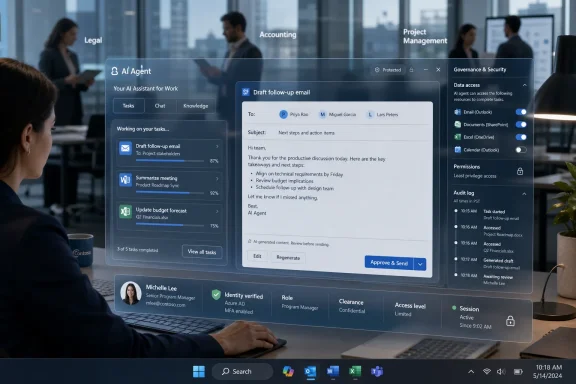 Microsoft Discovers That “Tasks” Is the Less Explosive Word
Suleyman’s clarification is not a retreat from the automation thesis. It is a cleanup operation around the most politically dangerous interpretation of it. When a Microsoft executive says AI will reach human-level performance on most professional tasks, listeners do not hear a tidy taxonomy of labor economics; they hear a clock ticking over the desks of lawyers, accountants, project managers, marketers, analysts, and developers.That is why the wording matters. “Jobs” implies headcount, layoffs, careers, mortgages, and social consequences. “Tasks” implies workflow, productivity, and software adoption. One is a labor-market warning; the other is a product roadmap.
Microsoft would much rather have the second conversation. The company can sell Copilot, agents, Azure AI infrastructure, and whatever comes after the Windows desktop as tools that remove drudgery rather than tools that remove people. That framing is not necessarily dishonest, but it is incomplete. A task is not a job, yet a job without enough defensible tasks becomes a budget line waiting for the next reorganization.
The company’s rhetorical problem is that AI has been marketed with maximal ambition for years. The pitch has not been “better autocomplete for quarterly reports.” It has been agents that reason, plan, execute, summarize, search, code, book, negotiate, triage, and collaborate. If that pitch is real, the labor implications are real too.
The White-Collar Panic Was Built Into the Product Pitch
The reaction to Suleyman’s original remarks was predictable because the AI industry has spent the past two years collapsing the distinction between assistive software and substitute labor. “Agent” is not a neutral term. It suggests something that can act on behalf of a user, pursue goals, use tools, and finish work without constant supervision.That is a very different promise from the old software productivity cycle. Word processors did not claim to be junior associates. Spreadsheets did not introduce themselves as finance analysts. Email clients did not ask for an identity in the corporate directory.
Modern AI systems are being sold precisely because they appear to cross that boundary. Microsoft’s own agentic framing asks enterprises to imagine software not merely as an application but as a participant in the work environment. Once AI agents are discussed as entities that need permissions, memory, credentials, governance, and identity, it becomes harder to insist that job anxiety is a misunderstanding by nervous workers.
The tension is especially sharp for Microsoft because its traditional strength is the work computer itself. Windows, Office, Teams, SharePoint, Exchange, Active Directory, GitHub, Azure, and Microsoft 365 form the substrate of digital office labor. If AI is going to automate white-collar tasks, Microsoft sits closer than almost anyone to the place where that automation will be deployed.
That makes Suleyman’s clarification both plausible and convenient. It is plausible because companies really do buy automation one workflow at a time. It is convenient because the cumulative effect of those workflow decisions can still be fewer junior roles, smaller support teams, thinner back offices, and a very different career ladder.
The Task-versus-Job Distinction Is Real, but It Is Not Reassuring
There is a serious argument behind Suleyman’s clarification. Economists have long understood jobs as bundles of tasks. A single role includes routine work, exception handling, coordination, accountability, judgment, compliance, communication, and politics. Software usually does not swallow that bundle in one bite.In that sense, saying AI automates tasks rather than jobs is accurate. A contract lawyer does not only draft clauses. An accountant does not only reconcile numbers. A project manager does not only update status reports. A marketer does not only generate copy. Much of the actual value of these roles comes from deciding what matters, detecting when the inputs are bad, persuading other humans, and taking responsibility when the output affects money or risk.
But the distinction is not a shield. Many organizations do not need AI to replace every part of a role before they change hiring plans. If a tool allows ten people to do the work that previously required twelve, the job category still exists, but two jobs may not. If a senior employee can use AI to perform work once delegated to entry-level staff, the profession still exists, but the on-ramp narrows.
That is the entry-level problem hiding behind the “tasks” language. Early-career white-collar work is often task-heavy by design. Juniors research, summarize, format, draft, test, clean data, build first passes, prepare decks, respond to tickets, and learn by doing the low-status work that senior employees later review. Those tasks are exactly where generative AI is strongest.
So the near-term danger may not be that AI replaces a fully formed professional. It may be that AI replaces the apprenticeship layer that creates one. A company can honestly say no jobs were eliminated by a tool while quietly hiring fewer people into the jobs that used to start careers.
The Mundane Work Was Also the Training Ground
The phrase “mundane tasks” makes automation sound almost charitable. Nobody wants to spend a career copying numbers between systems, turning meeting notes into action items, rewriting boilerplate, or hunting through documentation for the same answer every week. Removing that work sounds like progress.Yet mundane work is often how people learn the shape of a domain. The junior admin who resets accounts learns which departments are disorganized. The help desk technician who handles repetitive tickets learns which policies are broken. The analyst who cleans a spreadsheet learns where the data lies. The paralegal who reviews documents learns how cases are actually built.
AI can reduce drudgery, but it can also remove the repetition through which workers develop judgment. That tradeoff rarely appears in keynote demos. The demo shows the polished result: a summarized thread, a generated memo, a completed spreadsheet, a drafted response. It does not show the years of pattern recognition that allow a human reviewer to know when the polished output is wrong.
This is why WindowsForum readers should treat the “tasks, not jobs” clarification as the beginning of the debate, not the end. The question is not whether AI can save time on office busywork. It already can. The question is how organizations preserve expertise when the first-pass work increasingly happens inside a model.
IT departments have seen this pattern before in other forms. Automation scripts made some manual administration unnecessary, but they also demanded better systems thinking. Cloud services abstracted away server maintenance, but they created new operational risks around identity, cost, and configuration. AI will likely follow the same path: less manual grind, more dependence on people who understand the system well enough to challenge it.
Microsoft’s Agentic Future Still Points Toward Labor Substitution
The broader Microsoft story makes Suleyman’s clarification harder to read as a simple softening. At Build 2026, the company’s message was not that AI would sit politely beside existing apps forever. Microsoft has been pushing toward an agentic model in which software can operate across contexts, coordinate work, and become a more active layer in computing.That direction is important. The old Windows metaphor was user-first: a person opens apps, manages files, clicks buttons, and decides what happens next. The agentic metaphor shifts more initiative to software. A user states an intent, and an agent navigates the tools.
Project Solara, as described in recent reporting, fits that shift. The idea of an “invisible” operating environment hosting an agent shell is not just another UI experiment. It suggests Microsoft is thinking beyond the app grid and toward a workplace where agents assemble services dynamically around tasks.
That is exciting if the agent is doing work you hate. It is unsettling if the agent is doing work that once justified a role on your team. The same technical capability supports both stories.
Satya Nadella’s reported suggestion that AI agents should be treated like employees sharpens the point. In enterprise IT terms, “treated like employees” means identity, permissions, access control, monitoring, lifecycle management, and accountability. That is a sensible security posture. But culturally, it also invites the comparison Microsoft is trying to avoid: if an agent has an identity, a manager, access rights, and assigned work, it starts to resemble a digital worker.
Microsoft can argue that this is about governance rather than replacement. It is right to do so. But governance is necessary precisely because these systems are being entrusted with more consequential tasks. Nobody asks whether a calculator should have an HR-like identity.
The Enterprise Adoption Curve Will Be Slower Than the Hype Cycle
Suleyman’s 12-to-18-month horizon deserves skepticism, not because AI progress is fake, but because enterprise change is slow, messy, and constrained by systems that do not appear in demo videos. Businesses run on old databases, custom workflows, compliance obligations, vendor contracts, undocumented processes, and employees who know where the bodies are buried. An AI model that performs impressively in a controlled task still has to survive that environment.The automation of white-collar work is not simply a model-capability problem. It is an integration problem. It is a data-quality problem. It is a liability problem. It is a permissions problem. It is a change-management problem. And, especially in regulated sectors, it is an audit problem.
Windows administrators know this better than most. A capability that looks simple in a Microsoft presentation may become complicated the moment it touches conditional access policies, retention rules, data loss prevention, privileged identities, shadow IT, third-party plug-ins, and regional privacy requirements. The agent that can summarize a meeting is one thing. The agent that can initiate a financial process, alter customer records, or advise on a legal matter is another.
That gap does not make Suleyman wrong about direction. It makes the timeline suspect. AI may become capable of performing many professional tasks before enterprises are willing to let it perform them unsupervised. The difference between can do and may do is where much of the next decade’s IT work will live.
The LLM Is a Tool, but Tools Change the Bargaining Power
The Windows Central community reaction quoted in the original story captures a common and justified skepticism: large language models are clever tools, not magic minds. They guess, hallucinate, depend on training data, and often require careful prompting. Anyone who has used them for real work has seen both the flash of usefulness and the thud of confident nonsense.That skepticism is healthy. It prevents the industry from treating every generated paragraph as intelligence and every demo as destiny. AI systems remain brittle in ways that matter, especially when facts, edge cases, and accountability are on the line.
But calling an LLM “just a tool” can also understate the economic effect. A spreadsheet is just a tool, but it changed finance departments. A compiler is just a tool, but it changed programming. A search engine is just a tool, but it changed research, publishing, advertising, and knowledge work. Tools matter because they change how many people are needed, what skills are scarce, and who captures the value.
The real question is not whether AI is conscious, human, or independently wise. It does not have to be any of those things to affect employment. It only has to be good enough, cheap enough, and integrated enough to let managers redesign workflows around it.
That is where the “guessing machine” critique runs into the procurement department. If a model is wrong five percent of the time, it may be unusable for some tasks and perfectly acceptable for others with review. If it saves an hour a day for a thousand employees, it will be bought despite its flaws. If it lets a senior worker skip the first draft, the junior worker who used to prepare that draft may feel the impact even if the model remains philosophically unimpressive.
The Loudest AI Executives Are Arguing Over Timing, Not Direction
Suleyman is not alone in making stark claims about AI and white-collar work. Anthropic CEO Dario Amodei has warned that AI could wipe out a large share of entry-level white-collar jobs and raise unemployment substantially within a few years. Nvidia CEO Jensen Huang has repeatedly argued that young people should think beyond coding as the default high-status technology career, pointing instead to fields such as manufacturing, biology, farming, and education.These comments are not identical, and they should not be flattened into one apocalypse narrative. Amodei’s warnings tend to emphasize labor-market shock and the need to stop sugarcoating risk. Huang’s comments often serve a different purpose: reframing the future around domains that will use AI rather than around the act of writing code itself. Suleyman’s latest clarification tries to place Microsoft in a more measured camp, where AI transforms tasks while humans remain central.
Still, the disagreement is mostly about speed, severity, and framing. Few major AI executives are saying white-collar work will remain structurally unchanged. The consensus, if there is one, is that work done at a computer is becoming more automatable, more compressible, and more exposed to software-mediated productivity gains.
That consensus should make workers and IT leaders wary of both extremes. The “everyone is unemployed next year” version is too blunt. The “nothing changes because AI makes mistakes” version is too complacent. The likely path is uneven, sector-specific, and organizationally disruptive in ways that will be obvious only after hiring patterns, promotion ladders, and team sizes have already shifted.
This is how technological change often arrives. Not as a single day when jobs vanish, but as a thousand local decisions: do not backfill that role, assign the intern’s work to Copilot, replace a vendor with an agent workflow, centralize support, delay graduate hiring, expect every employee to produce more. By the time the labor statistics catch up, the lived experience has already changed.
Windows Becomes the Front Line of the New Office Automation
For Windows users and administrators, this debate is not abstract. The PC remains the main stage for white-collar work, and Microsoft is trying to make AI a native actor on that stage. Copilot in Windows, Copilot in Microsoft 365, GitHub Copilot, Azure AI services, Teams agents, Power Platform automation, and identity-aware enterprise agents all point toward the same destination: AI embedded into the daily machinery of office computing.That means the Windows environment becomes a policy battleground. Who can invoke an agent? What data can it read? Can it take actions, or only suggest them? Are its outputs retained? Are prompts discoverable? Can sensitive data leak into model interactions? Can a user install an unofficial agent that bypasses enterprise controls? Can an agent’s action be attributed cleanly when something goes wrong?
These are not theoretical concerns for sysadmins. They are the practical shape of AI adoption. The more Microsoft blurs the line between user, app, and agent, the more administrators need tooling that treats AI activity as first-class operational telemetry.
There is also a support burden coming. Employees will not simply ask IT why Outlook crashed; they will ask why Copilot produced the wrong summary, why an agent accessed a file, why a workflow ran twice, why a generated email included confidential language, or why an AI assistant gave different answers to two employees. That is a new class of help desk ticket, and it will not be solved by telling users the model is “just a tool.”
Security teams will be especially cautious. An agent that can act across services expands the blast radius of compromised credentials, bad permissions, prompt injection, and overbroad access. The old principle of least privilege becomes harder when the user’s assistant is designed to roam.
The Human-in-the-Loop Era Will Be More Political Than Technical
The near-term compromise will be human oversight. AI drafts, humans approve. AI summarizes, humans verify. AI proposes, humans decide. This arrangement is comforting, and in many cases it is necessary.But “human in the loop” can become a fig leaf if the loop is overloaded. A worker asked to review a flood of AI-generated material may become a rubber stamp. A manager who is told the AI is usually right may stop checking edge cases. A company that keeps humans formally accountable while pushing more decisions through automation may shift risk downward while keeping productivity gains upward.
That is the political economy of AI adoption. Executives promise empowerment. Vendors promise efficiency. Workers inherit the obligation to supervise machines whose outputs are fast, plausible, and sometimes wrong. The human remains “in control” on paper, but the pace and volume of automated work can make meaningful control difficult.
The best organizations will treat oversight as a real function, not a ceremonial checkbox. They will define which tasks can be automated, which require review, which are prohibited, and which demand domain experts. They will measure error rates, escalation patterns, and downstream consequences. They will also resist the temptation to make every worker absorb AI governance as unpaid cognitive overhead.
The worst organizations will do what bad organizations always do with new tools: buy them for status, deploy them unevenly, undertrain staff, ignore warnings, and then blame users when the system fails. Microsoft’s language about tasks may help those companies justify cuts while claiming transformation. That is why the framing deserves scrutiny.
The Career Advice Is Getting Stranger Because the Old Ladder Is Cracking
The most destabilizing part of the AI labor debate is not the claim that some tasks will be automated. Workers have absorbed automation for generations. The destabilizing part is that the traditional advice for entering the knowledge economy is losing coherence.For decades, the advice was relatively simple: learn to code, become analytically literate, get comfortable with office software, develop communication skills, and climb through increasingly complex work. Now, AI executives are telling young people that coding may not be the guaranteed refuge it once seemed, that entry-level white-collar work may shrink, and that the future may reward domain expertise over generic digital production.
There is truth in that. If AI makes it easier to generate code, text, images, analysis, and plans, then merely producing the first draft becomes less valuable. The premium shifts toward knowing what should be built, why it matters, whether it is correct, and how it fits into a real-world system.
But this advice can sound glib coming from executives whose companies benefit from the disruption. “Go into biology” or “learn manufacturing” is not a labor-market plan. It is a gesture toward sectors where physical reality, regulation, embodied skill, and domain knowledge slow pure software substitution. Those sectors matter, but they cannot instantly absorb everyone who might otherwise have entered software, consulting, finance, marketing, or administrative work.
The better career advice is less slogan-like. Learn how systems fail. Learn a domain deeply enough to evaluate AI output. Learn enough technical literacy to direct machines without being mystified by them. Learn communication, because organizations still run on trust, conflict, persuasion, and judgment. And, yes, learn to use AI tools without confusing their fluency for authority.
Microsoft’s Real Bet Is That Every Worker Becomes a Manager of Machines
Underneath the messaging, Microsoft’s strategic bet is becoming clear: the future office worker is less a direct producer of every artifact and more a supervisor, editor, orchestrator, and accountable owner of AI-assisted output. That is a profound change, even if the job title remains the same.In this model, the accountant manages AI-generated reconciliations. The lawyer reviews AI-drafted language. The project manager coordinates agents that update schedules and chase dependencies. The marketer directs campaigns assembled from automated research, copy, and segmentation. The developer spends less time writing boilerplate and more time specifying, reviewing, testing, and integrating.
That future is not necessarily dystopian. Many workers would welcome fewer repetitive tasks and more time for judgment. Many small businesses could gain capabilities previously available only to larger firms. Many disabled workers could benefit from systems that reduce friction and expand access. Many overstretched IT teams could automate toil that currently consumes their days.
But the productivity dividend will not distribute itself fairly. Without deliberate choices, the gains will accrue to vendors, shareholders, and executives while workers face higher expectations, thinner teams, and more surveillance. The same AI that removes drudgery can also intensify work.
Microsoft’s role is therefore not just technical. As one of the central vendors of workplace infrastructure, it will shape the defaults. Defaults around data access, identity, logging, admin control, licensing, retention, and user experience will determine whether AI feels like a governed tool or an uninvited co-worker with too much access.
The “Tasks” Correction Leaves the Hardest Questions Untouched
Suleyman’s clarification solves a communications problem, but it does not settle the workplace problem. The hardest questions are not semantic. They are organizational.If AI automates half of a role’s tasks, does the worker get more meaningful work or a higher quota? If AI reduces the need for junior staff, how does the profession train seniors? If AI agents require identities and permissions, who audits their behavior? If a model-generated recommendation causes harm, who is responsible: the user, the vendor, the employer, or the system designer?
Those questions cannot be answered by saying “tasks, not jobs.” They require policy, product design, labor negotiation, and managerial discipline. They also require honesty about incentives. Companies buy automation because they expect economic benefits. Sometimes those benefits mean better service or faster work. Sometimes they mean fewer people.
The near future will likely contain both. Some workers will become more productive and more valuable because AI extends their reach. Some will see their work degraded into supervising automated output under tighter deadlines. Some jobs will survive but become less entry-level friendly. Some departments will shrink quietly.
That is why the correction should be read as a more precise warning rather than a reassurance. The near-term AI shock may not look like a robot firing your accountant. It may look like every accountant being expected to handle more clients, every analyst producing more decks, every developer reviewing more generated code, and every help desk technician supporting both humans and their semi-autonomous assistants.
The Practical Reading for Windows Shops Is Narrower and More Urgent
For IT professionals, the lesson is not to argue endlessly over whether AI will replace “jobs” in the abstract. The practical question is which tasks inside your organization are about to become AI-mediated and whether your governance is ready before the tools arrive through licensing changes, user demand, or executive mandate.That requires an inventory of work, not just software. Which repetitive workflows involve sensitive data? Which teams are already pasting content into public tools? Which departments want agents to take action across Microsoft 365? Which outputs require formal review? Which logs would you need after a mistake? Which employees are being asked to rely on AI without training?
The answers will differ by organization, but the shape of the work is already visible. AI adoption will ride on existing identity systems, document stores, chat platforms, browsers, endpoint policies, and cloud services. In Microsoft environments, that means the AI conversation quickly becomes an Entra, Purview, Defender, Intune, Teams, SharePoint, and Windows conversation.
This is where Microsoft’s “tasks” language meets reality. A task does not float in the air. It touches files, permissions, workflows, records, customers, and regulated data. Automating it safely means understanding the systems beneath it.
The organizations that do this well will not be the ones that ban AI reflexively or deploy it recklessly. They will be the ones that separate low-risk acceleration from high-risk delegation, build auditability early, and give workers permission to challenge AI output without being treated as obstacles to progress.
The Fine Print Behind Microsoft’s Softer Sentence
Suleyman’s revised emphasis gives Windows users, administrators, and business leaders a better way to parse the next wave of AI claims. It does not make the claims harmless. It simply moves the debate from science-fiction replacement to the more immediate terrain of workflow redesign.- AI is more likely to transform white-collar work task by task than by eliminating entire professions in a single dramatic break.
- Entry-level roles remain especially exposed because they contain many of the repeatable drafting, summarizing, research, and formatting tasks that current AI systems handle best.
- Microsoft’s agentic strategy makes identity, permissions, logging, and data governance central concerns for Windows and Microsoft 365 administrators.
- The difference between AI assistance and labor substitution will often be decided by management incentives, not by model capability alone.
- Workers who combine domain judgment, technical literacy, and the ability to verify AI output will be better positioned than those whose value rests mainly on producing first drafts.
- Enterprises should treat AI agents as operational actors that require controls, not as harmless productivity features that can be switched on without consequence.
References
- Primary source: Windows Central
Published: 2026-06-10T09:50:08.176827
Microsoft AI chief backtracks on job loss fears — while Satya Nadella pushes for AI agents to be treated like employees | Windows Central
Mustafa Suleyman says AI won't take over white-collar jobs in the next 18 months, but it'll automate mundane tasks.www.windowscentral.com - Related coverage: tomshardware.com
Anthropic CEO says AI could cause up to 20% unemployment within five years, wipe out half of all entry-level white collar jobs | Tom's Hardware
AI is seemingly the train that cannot be stoppedwww.tomshardware.com - Related coverage: futurefactors.ai
Will AI Automate White-Collar Jobs? The Honest 2026 Take
Will AI automate white-collar jobs in 18 months? Microsoft's AI chief thinks so. Here's the honest take on what he said and how to protect your career.futurefactors.ai - Related coverage: unite.ai
Microsoft’s AI Chief Puts 18 Months on White-Collar Work – Unite.AI
Mustafa Suleyman, Microsoft's head of AI, told the Financial Times this week that "most, if not all" white-collar computer tasks will be "fully automated" within 12 to 18 months. Lawyers, accountants, project managers, m...www.unite.ai
- Related coverage: moneycontrol.com
AI will wipe out 50 percent of entry-level white collar jobs by 2030, Anthropic CEO Dario Amodei says
Anthropic CEO Dario Amodei warns AI could replace half of all entry-level jobs by 2030, leaving millions without work.www.moneycontrol.com - Related coverage: economictimes.indiatimes.com
Microsoft AI chief Mustafa Suleyman predicts widespread white-collar job automation within 12-18 months - The Economic Times
Suleyman predicted that creating customised AI models will soon be as simple as launching a blog or podcast today. Within two to three years, he said, AI agents could manage substantial portions of institutional workflows.economictimes.indiatimes.com
- Related coverage: aieatingtheworld.com
Microsoft AI Chief: White-Collar Automation in 18 Months
Mustafa Suleyman predicts AI will fully automate most professional computer-based tasks within 18 months. Here's what the data actually shows.www.aieatingtheworld.com - Related coverage: techradar.com
'I think we’re going to have a human-level performance on most, if not all, professional tasks': Microsoft AI chief thinks AI will replace most white-collar work in the 12 to 18 months - so is this the end for human workers? | TechRadar
Mustafa Suleyman unsurprisingly thinks AI will bring big changeswww.techradar.com - Related coverage: hindustantimes.com
Microsoft AI CEO says most white-collar jobs to be replaced with AI in 12 months; ‘models coding better than humans’ | World News
Microsoft CEO in an interview said that most white collar jobs including lawyers, accountants will be replace with AI with ability to manage workflows. | World Newswww.hindustantimes.com - Related coverage: zerohedge.com
Microsoft AI CEO Warns Most White Collar Jobs Fully Automated "Within Next 12-18 Months"; Anthropic Fears Potential For 'Heinous Crimes'<!-- --> | ZeroHedge
ZeroHedge - On a long enough timeline, the survival rate for everyone drops to zero www.zerohedge.com
- Related coverage: startupfortune.com
Microsoft's AI chief says white-collar work may be automated fast - Startup Fortune
Microsoft AI chief Mustafa Suleyman says most white-collar tasks could be automated within 12 to 18 months, but enterprise adoption is still far behindstartupfortune.com - Related coverage: searchenginejournal.com
White-Collar Will Be Fully Automated In 18 Months – So What Makes You Different?
Three voices (a CEO, a tech executive, and a philosopher) converged on the same uncomfortable truth about what humans are actually for in an AI era.www.searchenginejournal.com
