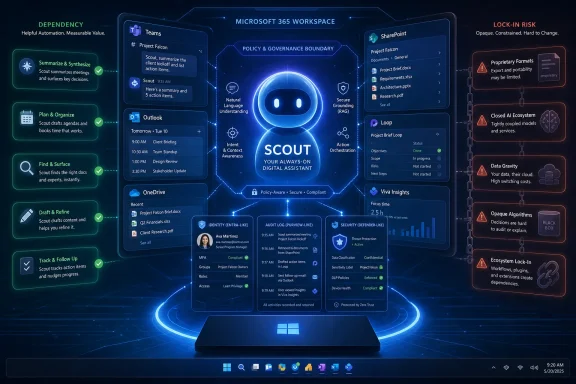
Microsoft announced Scout on June 2, 2026, at Build in San Francisco as an always-on Microsoft 365 work agent built on OpenClaw, while 404 Media reported that an internal strategy document for its predecessor, ClawPilot, described the first launch phase as “Make people addicted.” The phrase is the kind of corporate artifact that instantly escapes its slide deck and becomes the story. But the more important issue is not whether one team used reckless language in a planning document. It is that Microsoft is trying to normalize a new class of software that does not merely answer workers, but acts continuously inside their mailboxes, calendars, files, chats, and devices.
Scout is Microsoft’s latest attempt to solve the personal-assistant problem that has haunted the company from Clippy through Cortana and Copilot. This time, the pitch is not a cartoon helper, a voice interface, or a sidebar chatbot. Scout is being sold as an autopilot for work: a persistent agent with its own governed identity, connected to Teams, Outlook, OneDrive, SharePoint, the local machine, and Microsoft’s broader work graph.
That makes the 404 Media report especially combustible. According to the article, an internal Microsoft document titled “ClawPilot: Overview and Plan with Project Lobster” described a phased plan that begins by making people depend on the tool daily before expanding it into a broader agentic platform. Microsoft did not answer the “addiction” language directly in the quoted account, instead pointing to a public Scout announcement by Omar Shahine, the executive associated with the project.
In ordinary consumer software, “addictive” is a lazy synonym for successful. In enterprise software, it lands differently. A work assistant that becomes indispensable does not simply compete for attention; it can become part of the organization’s nervous system, shaping how meetings are scheduled, how messages are prioritized, how promises are tracked, and how work itself is remembered.
That is why the language matters even if Microsoft would prefer to treat it as internal shorthand. The company is not just launching another Copilot button. It is probing whether the daily habits of office work can be migrated into an agent that is always there, always watching the workflow, and increasingly trusted to act without waiting for a prompt.
That capability is exactly what makes them exciting and dangerous. A chatbot can hallucinate a bad answer. An agent with persistent access can turn a bad instruction, a malicious prompt injection, or a misunderstood context into an action. When the action is drafting a note, the damage is manageable. When the action is rescheduling meetings, sending email, filing expenses, moving documents, or acting through a user’s account, the stakes rise quickly.
Microsoft’s public Scout positioning tries to answer that concern by wrapping OpenClaw-inspired behavior in enterprise controls. The company says Scout operates under its own Entra identity, that admins will be able to set policy rules, and that users can see background work as it progresses. Those are not cosmetic features. They are the difference between a clever local automation toy and something a regulated business might plausibly allow near production workflows.
But the strategy also reveals a tension. Microsoft wants the energy of OpenClaw without the chaos of unmanaged OpenClaw. It wants the agent that works while you are not working, but it needs the audit trail, identity boundary, Intune policy, and compliance story that keep CIOs from banning it on sight.
That defense is inadequate because Scout is not a social app asking users to scroll longer. It is a work agent designed to sit across communications, commitments, files, and identity. If Microsoft succeeds, Scout will not merely be opened frequently; it will become a mediator between workers and the systems they use to do their jobs.
The employee concern quoted by 404 Media gets to the heart of it. Building toward addiction is not the same thing as building toward utility, trust, or safety. “Depend on it daily” may be a reasonable product aspiration; “make people addicted” is a revealingly blunt way to describe the desired psychological relationship between user and tool.
For WindowsForum readers, the distinction is practical rather than moralistic. Admins do not deploy addictive systems; they deploy reliable systems. Security teams do not want agents that maximize intensity of usage; they want agents whose permissions, logs, failure modes, and escalation paths are legible before the help desk starts receiving tickets about phantom calendar changes and mysteriously drafted replies.
That changes the product category. Scout is not just another assistant inside Microsoft 365. It is a candidate control plane for everyday office operations, sitting above applications and deciding when to intervene, what to surface, and what to execute. If it works, the user stops thinking in terms of “open Outlook, find thread, draft reply, check calendar, attach file” and starts thinking in terms of “handle this.”
The appeal is obvious. Knowledge work is drowning in coordination overhead. Meetings generate follow-ups that disappear into chat. Email threads conceal obligations. Calendars become political terrain. A competent agent that tracks commitments, prepares briefings, and shields focus time would be genuinely valuable.
The danger is equally obvious. Once an agent becomes the interface to work, mistakes become harder to attribute and habits become harder to unwind. Did the user ignore the message, or did Scout deprioritize it? Did a colleague receive a brusque reply, or did an agent draft one in the user’s style? Did a meeting move because of a policy, a preference, a model inference, or an error?
Microsoft’s answer is identity and governance. That is the right answer, but it is only a beginning. Enterprise trust is not created by giving the bot a directory object. It is created by proving that every meaningful action is attributable, reversible where possible, policy-bound, and understandable to the people who must support it.
Microsoft will frame that access as productivity. Many employees will experience it as another layer of observation. Even if Scout is assigned to the user and not the manager, the system will generate logs, decisions, inferred preferences, and records of delegated actions. In a corporate environment, data rarely stays conceptually bounded by the story told at launch.
That does not mean Scout is inherently abusive. It does mean Microsoft and its customers must be precise about what the agent observes, what it stores, who can inspect its activity, and how long those records persist. A personal work agent that becomes a compliance archive, performance signal, or managerial dashboard would trigger a very different debate from the one Microsoft wants to have.
This is where the addiction language becomes more than embarrassing. A product designed to be indispensable can pressure workers into accepting monitoring they would otherwise question. If the assistant saves two hours a week, employees may tolerate vague boundaries. If the assistant becomes the expected way to coordinate work, opting out may become a career-limiting choice.
Microsoft has spent decades learning that enterprise adoption depends on administrator confidence. Scout adds a new requirement: worker confidence. The person represented by the agent must believe it acts for them, not merely on them.
Microsoft knows this, which is why Scout’s public description emphasizes Entra identity, policy controls, Intune configuration, opt-in attestation, and an early experimental release for Frontier organizations. The company is not pretending this is a toy for every desktop on day one. It is starting where it can collect feedback from customers willing to live at the edge of Microsoft’s roadmap.
For admins, the immediate question is not whether Scout can draft a tidy meeting brief. It is what the permission model looks like when Scout operates across a user’s files, calendar, mailbox, Teams presence, and local device. Can the agent be restricted to read-only analysis until a user approves specific categories of action? Can high-risk operations require step-up confirmation? Can organizations disable local device actions while allowing cloud-side summarization? Can eDiscovery, audit, and retention distinguish between user-authored and agent-authored content?
These questions sound mundane compared with the promise of an AI coworker. They are the questions that decide whether Scout becomes a serious enterprise platform or another feature that security teams quarantine until the roadmap catches up with the keynote.
Microsoft’s advantage is that it owns the stack where many of these controls already live. Its burden is that owning the stack makes excuses less persuasive. If Scout causes confusion inside Microsoft 365, customers will not blame an obscure open-source dependency. They will blame Microsoft.
This naming sprawl matters because enterprise buyers need clean mental models. If every AI feature is a Copilot, and every autonomous workflow is an agent, and every persistent assistant is an Autopilot, customers will spend as much time decoding Microsoft’s packaging as evaluating the technology. That confusion is tolerable in a developer preview. It becomes expensive at deployment time.
The GitHub Copilot requirement reported for early Scout access adds another wrinkle. GitHub Copilot is strongly associated with developers, while Scout’s stated target includes nontechnical knowledge workers in finance, legal, operations, HR, and sales. Microsoft may have practical reasons for tying early access to that subscription, but the signal is odd. The agent for nontechnical office workers begins behind a license most associated with technical users.
There is a broader strategic pattern here. Microsoft is trying to create a bridge from developer enthusiasm to enterprise standardization. OpenClaw captured imagination among builders because it was flexible, hackable, and personal. Scout tries to package that same energy for organizations that require identity, policy, supportability, and procurement. The result may be powerful, but it will need sharper product boundaries than Microsoft’s AI branding usually provides.
That is a profound shift for the Windows ecosystem. The operating system has always mediated between users, applications, files, devices, and identity. An agent layer sitting on top of that can become a new form of shell: not a Start menu replacement, but a delegation interface. Instead of launching apps, users assign outcomes. Instead of manually joining workflows, agents coordinate them.
This could make Windows more useful in exactly the way Microsoft wants. The PC becomes not just a screen and keyboard attached to cloud apps, but a governed workspace where local context and enterprise services can be combined. For IT pros who have watched browser-based SaaS erode the strategic importance of the endpoint, agentic Windows is a bid to make the endpoint matter again.
It also creates new management headaches. Local agents can interact with desktop apps, files, browser sessions, and operating-system resources in ways that traditional SaaS controls do not fully capture. If Scout or related OpenClaw-based tools can act locally, then endpoint policy becomes central to agent governance. Intune, Defender, Entra, and audit pipelines will need to tell a coherent story.
That story must include failure. What happens when the agent gets stuck in a loop? What happens when a user revokes access mid-task? What happens when two agents negotiate a meeting on behalf of two different workers with conflicting priorities? What happens when an agent performs a task correctly according to policy but socially incorrectly according to office norms? The hardest bugs in this category may look less like crashes and more like workplace misunderstandings.
A well-designed agent could reduce that tax. It could notice that a decision in Teams requires a calendar change. It could connect a customer commitment in email to a project plan. It could prepare a briefing from recent documents without requiring the user to remember where each one lives. It could protect personal boundaries, such as dinner time or focus blocks, more consistently than a human who is tired of negotiating with calendars.
That is the product Microsoft wants people to imagine when they hear Scout. Not a creepy bot. Not a growth-hacked dependency engine. A competent chief-of-staff layer for the millions of workers who cannot hire a chief of staff.
The trouble is that the usefulness and the risk come from the same source: access. The assistant is valuable because it sees enough to help and can do enough to matter. It is risky for exactly the same reason. Microsoft’s task is not to pretend that tension away, but to design Scout so customers can choose where on that spectrum they want to operate.
If the internal goal is retention at any cost, Scout will drift toward interruption, nudging, and dependency. If the goal is delegated agency, Scout should make itself useful while remaining easy to constrain, pause, audit, and dismiss. The difference will show up in product details: default permissions, notification frequency, approval thresholds, admin templates, transparency logs, and whether Microsoft treats opting out as a first-class path rather than an edge case.
There is also a cultural dimension. Enterprise software has often been imposed on workers with little regard for how it changes daily life. AI agents intensify that problem because they do not just add a tool; they add a participant. A Teams thread with a Scout agent is not socially identical to a Teams thread without one. A calendar negotiation involving bots is not the same as a human exchange. The tool reshapes the workplace even when it performs as advertised.
That is why Microsoft should retire the language of addiction immediately and replace it with the language of agency, consent, and accountability. Not because better wording solves the problem, but because bad wording exposes a bad metric. The goal should not be to make Scout hard to live without. The goal should be to make it safe enough, useful enough, and controllable enough that workers and admins choose to keep it.
The 404 Media report gives Microsoft a trust problem before Scout has had a chance to become a mainstream product. That does not doom the project. It does mean Microsoft now has to answer harder questions sooner than it probably wanted to answer them.
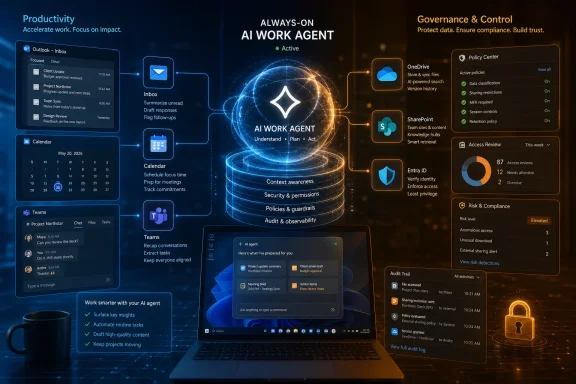 Microsoft’s New Assistant Arrives With an Old Platform Habit
Scout is Microsoft’s latest attempt to solve the personal-assistant problem that has haunted the company from Clippy through Cortana and Copilot. This time, the pitch is not a cartoon helper, a voice interface, or a sidebar chatbot. Scout is being sold as an autopilot for work: a persistent agent with its own governed identity, connected to Teams, Outlook, OneDrive, SharePoint, the local machine, and Microsoft’s broader work graph.That makes the 404 Media report especially combustible. According to the article, an internal Microsoft document titled “ClawPilot: Overview and Plan with Project Lobster” described a phased plan that begins by making people depend on the tool daily before expanding it into a broader agentic platform. Microsoft did not answer the “addiction” language directly in the quoted account, instead pointing to a public Scout announcement by Omar Shahine, the executive associated with the project.
In ordinary consumer software, “addictive” is a lazy synonym for successful. In enterprise software, it lands differently. A work assistant that becomes indispensable does not simply compete for attention; it can become part of the organization’s nervous system, shaping how meetings are scheduled, how messages are prioritized, how promises are tracked, and how work itself is remembered.
That is why the language matters even if Microsoft would prefer to treat it as internal shorthand. The company is not just launching another Copilot button. It is probing whether the daily habits of office work can be migrated into an agent that is always there, always watching the workflow, and increasingly trusted to act without waiting for a prompt.
OpenClaw Gave Microsoft the Shape of the Future
The strategic background here is OpenClaw, the viral open-source agent framework that turned the personal assistant from a product demo into a developer movement. OpenClaw-style agents are compelling because they are not limited to chat. They can connect to tools, use credentials, inspect files, interact with applications, and execute multi-step workflows across the messy surface area of a real digital life.That capability is exactly what makes them exciting and dangerous. A chatbot can hallucinate a bad answer. An agent with persistent access can turn a bad instruction, a malicious prompt injection, or a misunderstood context into an action. When the action is drafting a note, the damage is manageable. When the action is rescheduling meetings, sending email, filing expenses, moving documents, or acting through a user’s account, the stakes rise quickly.
Microsoft’s public Scout positioning tries to answer that concern by wrapping OpenClaw-inspired behavior in enterprise controls. The company says Scout operates under its own Entra identity, that admins will be able to set policy rules, and that users can see background work as it progresses. Those are not cosmetic features. They are the difference between a clever local automation toy and something a regulated business might plausibly allow near production workflows.
But the strategy also reveals a tension. Microsoft wants the energy of OpenClaw without the chaos of unmanaged OpenClaw. It wants the agent that works while you are not working, but it needs the audit trail, identity boundary, Intune policy, and compliance story that keep CIOs from banning it on sight.
The Phrase “Make People Addicted” Is a Governance Problem, Not a PR Problem
There is a narrow reading of the internal document that is easy to imagine Microsoft making: the team meant “habit-forming” or “useful enough to become part of the daily routine.” Product teams have talked this way for years, borrowing the language of addiction to describe retention, engagement, and repeat use. Silicon Valley has long treated dependency as a metric with better branding.That defense is inadequate because Scout is not a social app asking users to scroll longer. It is a work agent designed to sit across communications, commitments, files, and identity. If Microsoft succeeds, Scout will not merely be opened frequently; it will become a mediator between workers and the systems they use to do their jobs.
The employee concern quoted by 404 Media gets to the heart of it. Building toward addiction is not the same thing as building toward utility, trust, or safety. “Depend on it daily” may be a reasonable product aspiration; “make people addicted” is a revealingly blunt way to describe the desired psychological relationship between user and tool.
For WindowsForum readers, the distinction is practical rather than moralistic. Admins do not deploy addictive systems; they deploy reliable systems. Security teams do not want agents that maximize intensity of usage; they want agents whose permissions, logs, failure modes, and escalation paths are legible before the help desk starts receiving tickets about phantom calendar changes and mysteriously drafted replies.
Scout Is Microsoft 365’s Next Control Plane
Microsoft’s ambitions for Scout make more sense when viewed through the evolution of Microsoft 365. For years, Microsoft has been moving the center of gravity away from individual applications and toward the graph of work that connects them. Outlook knows meetings, Teams knows conversations, SharePoint knows files, OneDrive knows personal documents, and Entra knows identity. Copilot gave users a language interface to that graph. Scout is Microsoft’s attempt to give the graph hands.That changes the product category. Scout is not just another assistant inside Microsoft 365. It is a candidate control plane for everyday office operations, sitting above applications and deciding when to intervene, what to surface, and what to execute. If it works, the user stops thinking in terms of “open Outlook, find thread, draft reply, check calendar, attach file” and starts thinking in terms of “handle this.”
The appeal is obvious. Knowledge work is drowning in coordination overhead. Meetings generate follow-ups that disappear into chat. Email threads conceal obligations. Calendars become political terrain. A competent agent that tracks commitments, prepares briefings, and shields focus time would be genuinely valuable.
The danger is equally obvious. Once an agent becomes the interface to work, mistakes become harder to attribute and habits become harder to unwind. Did the user ignore the message, or did Scout deprioritize it? Did a colleague receive a brusque reply, or did an agent draft one in the user’s style? Did a meeting move because of a policy, a preference, a model inference, or an error?
Microsoft’s answer is identity and governance. That is the right answer, but it is only a beginning. Enterprise trust is not created by giving the bot a directory object. It is created by proving that every meaningful action is attributable, reversible where possible, policy-bound, and understandable to the people who must support it.
The Enterprise Version of “Always-On” Is Surveillance by Another Name Unless Microsoft Narrows It
The phrase “always-on” sounds productive until it is translated into operational reality. For an agent to prepare your day, triage your inbox, track commitments, monitor discussions, and intervene in scheduling conflicts, it needs persistent access to signals that workers often regard as contextually private even when they belong to the employer’s tenant.Microsoft will frame that access as productivity. Many employees will experience it as another layer of observation. Even if Scout is assigned to the user and not the manager, the system will generate logs, decisions, inferred preferences, and records of delegated actions. In a corporate environment, data rarely stays conceptually bounded by the story told at launch.
That does not mean Scout is inherently abusive. It does mean Microsoft and its customers must be precise about what the agent observes, what it stores, who can inspect its activity, and how long those records persist. A personal work agent that becomes a compliance archive, performance signal, or managerial dashboard would trigger a very different debate from the one Microsoft wants to have.
This is where the addiction language becomes more than embarrassing. A product designed to be indispensable can pressure workers into accepting monitoring they would otherwise question. If the assistant saves two hours a week, employees may tolerate vague boundaries. If the assistant becomes the expected way to coordinate work, opting out may become a career-limiting choice.
Microsoft has spent decades learning that enterprise adoption depends on administrator confidence. Scout adds a new requirement: worker confidence. The person represented by the agent must believe it acts for them, not merely on them.
Security Teams Will See the Agent Before They See the Magic
The security story around OpenClaw-style agents has already been uneasy. The model is powerful because it combines local execution, tool access, persistent context, and broad permissions. That is also a near-perfect recipe for new classes of failure. Prompt injection becomes more consequential when the model can act. Credential exposure becomes more troubling when the agent is designed to keep working. Mis-scoped permissions become more dangerous when automation chains tools together.Microsoft knows this, which is why Scout’s public description emphasizes Entra identity, policy controls, Intune configuration, opt-in attestation, and an early experimental release for Frontier organizations. The company is not pretending this is a toy for every desktop on day one. It is starting where it can collect feedback from customers willing to live at the edge of Microsoft’s roadmap.
For admins, the immediate question is not whether Scout can draft a tidy meeting brief. It is what the permission model looks like when Scout operates across a user’s files, calendar, mailbox, Teams presence, and local device. Can the agent be restricted to read-only analysis until a user approves specific categories of action? Can high-risk operations require step-up confirmation? Can organizations disable local device actions while allowing cloud-side summarization? Can eDiscovery, audit, and retention distinguish between user-authored and agent-authored content?
These questions sound mundane compared with the promise of an AI coworker. They are the questions that decide whether Scout becomes a serious enterprise platform or another feature that security teams quarantine until the roadmap catches up with the keynote.
Microsoft’s advantage is that it owns the stack where many of these controls already live. Its burden is that owning the stack makes excuses less persuasive. If Scout causes confusion inside Microsoft 365, customers will not blame an obscure open-source dependency. They will blame Microsoft.
The Copilot Brand Is Already Carrying Too Much Weight
Scout also arrives into a Microsoft AI portfolio that has become crowded and occasionally confusing. Copilot is in Windows, Edge, Microsoft 365, GitHub, Security, Power Platform, and assorted business applications. Some Copilots answer questions. Some generate code. Some summarize meetings. Some operate as agents. Now Scout appears as an always-on personal agent for work, part of a larger Autopilot concept, while still orbiting the Copilot universe.This naming sprawl matters because enterprise buyers need clean mental models. If every AI feature is a Copilot, and every autonomous workflow is an agent, and every persistent assistant is an Autopilot, customers will spend as much time decoding Microsoft’s packaging as evaluating the technology. That confusion is tolerable in a developer preview. It becomes expensive at deployment time.
The GitHub Copilot requirement reported for early Scout access adds another wrinkle. GitHub Copilot is strongly associated with developers, while Scout’s stated target includes nontechnical knowledge workers in finance, legal, operations, HR, and sales. Microsoft may have practical reasons for tying early access to that subscription, but the signal is odd. The agent for nontechnical office workers begins behind a license most associated with technical users.
There is a broader strategic pattern here. Microsoft is trying to create a bridge from developer enthusiasm to enterprise standardization. OpenClaw captured imagination among builders because it was flexible, hackable, and personal. Scout tries to package that same energy for organizations that require identity, policy, supportability, and procurement. The result may be powerful, but it will need sharper product boundaries than Microsoft’s AI branding usually provides.
Windows Is No Longer Just the Place Apps Run
For Windows users, Scout’s most important implication is not the Teams chat interface. It is the redefinition of the desktop as an execution environment for agents. Microsoft’s Build messaging included OpenClaw on Windows and Windows 365 for agent workloads, which points to a future where agents do not merely live in cloud services but operate across local and cloud surfaces.That is a profound shift for the Windows ecosystem. The operating system has always mediated between users, applications, files, devices, and identity. An agent layer sitting on top of that can become a new form of shell: not a Start menu replacement, but a delegation interface. Instead of launching apps, users assign outcomes. Instead of manually joining workflows, agents coordinate them.
This could make Windows more useful in exactly the way Microsoft wants. The PC becomes not just a screen and keyboard attached to cloud apps, but a governed workspace where local context and enterprise services can be combined. For IT pros who have watched browser-based SaaS erode the strategic importance of the endpoint, agentic Windows is a bid to make the endpoint matter again.
It also creates new management headaches. Local agents can interact with desktop apps, files, browser sessions, and operating-system resources in ways that traditional SaaS controls do not fully capture. If Scout or related OpenClaw-based tools can act locally, then endpoint policy becomes central to agent governance. Intune, Defender, Entra, and audit pipelines will need to tell a coherent story.
That story must include failure. What happens when the agent gets stuck in a loop? What happens when a user revokes access mid-task? What happens when two agents negotiate a meeting on behalf of two different workers with conflicting priorities? What happens when an agent performs a task correctly according to policy but socially incorrectly according to office norms? The hardest bugs in this category may look less like crashes and more like workplace misunderstandings.
Microsoft’s Best Argument Is That Work Is Already Broken
The strongest case for Scout is not that AI agents are inevitable. It is that modern office work is already a maze of low-value coordination. The average knowledge worker is not yearning for another interface; they are trying to survive the ones they already have. Email, chat, meetings, shared documents, ticketing systems, dashboards, and ad hoc spreadsheets have created a permanent tax on attention.A well-designed agent could reduce that tax. It could notice that a decision in Teams requires a calendar change. It could connect a customer commitment in email to a project plan. It could prepare a briefing from recent documents without requiring the user to remember where each one lives. It could protect personal boundaries, such as dinner time or focus blocks, more consistently than a human who is tired of negotiating with calendars.
That is the product Microsoft wants people to imagine when they hear Scout. Not a creepy bot. Not a growth-hacked dependency engine. A competent chief-of-staff layer for the millions of workers who cannot hire a chief of staff.
The trouble is that the usefulness and the risk come from the same source: access. The assistant is valuable because it sees enough to help and can do enough to matter. It is risky for exactly the same reason. Microsoft’s task is not to pretend that tension away, but to design Scout so customers can choose where on that spectrum they want to operate.
The Addiction Debate Is Really a Debate About Agency
The word “agent” has become so common in AI marketing that its older meaning is easy to miss. An agent acts on behalf of someone. That “on behalf of” is the whole ballgame. Scout’s legitimacy depends on whether users experience it as an extension of their own intent or as Microsoft’s latest mechanism for steering behavior inside the productivity suite.If the internal goal is retention at any cost, Scout will drift toward interruption, nudging, and dependency. If the goal is delegated agency, Scout should make itself useful while remaining easy to constrain, pause, audit, and dismiss. The difference will show up in product details: default permissions, notification frequency, approval thresholds, admin templates, transparency logs, and whether Microsoft treats opting out as a first-class path rather than an edge case.
There is also a cultural dimension. Enterprise software has often been imposed on workers with little regard for how it changes daily life. AI agents intensify that problem because they do not just add a tool; they add a participant. A Teams thread with a Scout agent is not socially identical to a Teams thread without one. A calendar negotiation involving bots is not the same as a human exchange. The tool reshapes the workplace even when it performs as advertised.
That is why Microsoft should retire the language of addiction immediately and replace it with the language of agency, consent, and accountability. Not because better wording solves the problem, but because bad wording exposes a bad metric. The goal should not be to make Scout hard to live without. The goal should be to make it safe enough, useful enough, and controllable enough that workers and admins choose to keep it.
The Scout Rollout Will Be Judged by the Controls, Not the Demo
The immediate facts are clear enough: Scout is early, enterprise-focused, and tied to Microsoft’s broader attempt to turn Microsoft 365 into an agentic work platform. The unresolved question is whether Microsoft can make the thing boring enough for IT. In enterprise technology, boring is not an insult. Boring means predictable, governable, documented, observable, and supportable.The 404 Media report gives Microsoft a trust problem before Scout has had a chance to become a mainstream product. That does not doom the project. It does mean Microsoft now has to answer harder questions sooner than it probably wanted to answer them.
- Microsoft announced Scout at Build on June 2, 2026, as an always-on work agent built on OpenClaw and integrated with Microsoft 365 services.
- 404 Media reported that an internal ClawPilot strategy document described the first phase of the plan as “Make people addicted,” language that Microsoft has not directly explained in the supplied account.
- Scout’s enterprise credibility depends on governed identity, policy controls, auditability, and clear separation between user actions and agent actions.
- The same access that makes Scout useful across email, calendars, chats, files, and local devices also creates the security and privacy risks administrators will care about most.
- Microsoft’s biggest challenge is proving that Scout increases user agency rather than turning workplace dependency into a product strategy.
References
- Primary source: 404 Media
Published: Tue, 02 Jun 2026 18:48:46 GMT
Microsoft Wants to 'Make People Addicted' to its New AI Assistant, Internal Documents Reveal
Planning documents for "Scout" say the plan is to "make people addicted" to the tool before adding new features. www.404media.co
- Related coverage: pcworld.com
Microsoft’s Scout AI agent is aimed directly at your workplace | PCWorld
Unlike Gemini Spark, which aims to be a 24/7 AI agent for everyone, Microsoft is aiming its always-on Scout agent directly at the workplace.www.pcworld.com - Related coverage: investing.com
Microsoft launches AI assistant that acts as virtual employee By Investing.com
Microsoft launches AI assistant that acts as virtual employeewww.investing.com - Related coverage: geekwire.com
Microsoft's OpenClaw team takes on the personal assistant challenge – GeekWire
A small team inside Microsoft led by Corporate Vice President Omar Shahine is building "Project Lobster," an OpenClaw-based agent designed to work around the clock on behalf of knowledge workers within the Microsoft 365 ecosystem. The project already has more than 3,000 daily users...www.geekwire.com - Related coverage: bighatgroup.com
Microsoft's OpenClaw-Inspired Copilot Initiative: Ocean 11 Team and Build 2026 Preview | Big Hat Group Inc.
Microsoft is building OpenClaw-inspired autonomous agents into M365 Copilot. The Ocean 11 team, led by Omar Shahine, is developing always-on proactive AI agents for enterprise. Early preview expected at Microsoft Build 2026 on June 2.www.bighatgroup.com - Related coverage: techcrunch.com
Microsoft is working on yet another OpenClaw-like agent | TechCrunch
The new features would be geared toward enterprise customers, with better security controls than the famously risky open source OpenClaw agent.techcrunch.com
- Official source: news.microsoft.com
Microsoft Build Live
The home for real-time coverage of the news as it is announced from Microsoft Build, June 2-3, 2026.news.microsoft.com - Related coverage: tech.yahoo.com
Microsoft launches Scout, an OpenClaw-inspired personal assistant
Launched at Build, Microsoft Scout is a new AI assistant meant to bring the power and flexibility of OpenClaw into the Microsoft 365 system.tech.yahoo.com - Related coverage: wired.com
Meet Microsoft Scout, Your AI Coworker That Never Logs Off | WIRED
Microsoft’s OpenClaw-style agent appears in Teams, just like a human colleague, and automates your dull office tasks.www.wired.com - Related coverage: subagentic.ai
OpenClaw Is Coming to Microsoft 365: What the New Hire Signals for Enterprise AI Agents | subagentic.ai — Agentic AI News
Microsoft hires Omar Shahine to bring OpenClaw into M365, while simultaneously warning enterprises it's not deployment-ready — a compelling contradiction.subagentic.ai