

Autonomous AI products now live or die by how quickly and safely they learn from real use, not just by the raw power of a foundational model alone — Microsoft’s new “signals loop” framing makes that shift explicit and shows how fine‑tuning, telemetry, and operational speed are converging into the core architecture for world‑class AI apps and agents.
The first wave of modern AI applications favored speed to market: ragged retrieval‑augmented generation (RAG) and clever prompt engineering on top of off‑the‑shelf LLMs delivered rapid prototypes and useful assistants. Those fast wins quickly exposed a limit: many production scenarios — healthcare documentation, enterprise code completion, automated agents that act on a user’s behalf — demand consistently reliable, auditable, and evolving performance that prompting alone cannot sustainably provide. Microsoft frames the response to that limit as the signals loop: capture user interactions and operational telemetry in real time, feed that data into evaluation and fine‑tuning workflows, and use iterative updates (including reinforcement learning when appropriate) to make models and product experiences measurably better over time. That architecture shift is more than marketing. Microsoft positions Azure AI Foundry as the integrated platform that stitches model choice, training, evaluation, governance, deployment, and “provisioned throughput” together so teams can iterate rapidly — and with enterprise guarantees. The platform promises reliability (Microsoft cites a 99.9% availability SLA for Azure AI models) and operational levers such as Provisioned Throughput Units (PTUs) to control latency and capacity at scale. Those guarantees and primitives are central to organizations that need predictable performance for mission‑critical workflows.
Signals loops convert ephemeral user behavior into structured learning signals: acceptance rates, retention of generated content, correction patterns, support‑ticket traces, and human review labels. That data becomes the fuel for fine‑tuning, synthetic sample generation, and reinforcement learning that refine the agent’s policy and output distribution.
Parameter‑efficient methods such as LoRA (Low‑Rank Adaptation) have made fine‑tuning less resource‑intensive by enabling teams to train tiny adapter matrices instead of full model weights. The original LoRA work and subsequent community extensions demonstrate that high‑quality adaptation is possible with orders‑of‑magnitude fewer trainable parameters — enabling many more organizations to adopt fine‑tuning practically. Distillation — training smaller “student” models to mimic larger teachers — is also a common strategy for delivering model performance on constrained budgets or devices. Distillation and LoRA together allow teams to balance cost, latency, and fidelity in production. Industry reporting shows a broad adoption of distillation techniques to commercialize powerful models cost‑effectively.
But the technical promise comes bundled with new responsibilities. Teams must verify vendor claims with reproducible tests, engineer for privacy and compliance from the first design sprint, and bake conservative safety nets into every update cycle. In regulated domains, the signals loop must include predetermined change controls, rigorous validation, and human oversight. When implemented thoughtfully, continuous fine‑tuning and signals loops will be the difference between a novelty assistant and a genuinely trustworthy, autonomous product that scales with customers’ needs.
Source: Microsoft Azure The Signals Loop: Fine-tuning for world-class AI apps and agents | Microsoft Azure Blog
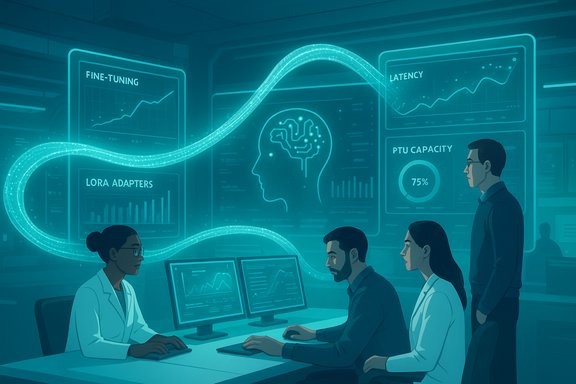 Background / Overview
The first wave of modern AI applications favored speed to market: ragged retrieval‑augmented generation (RAG) and clever prompt engineering on top of off‑the‑shelf LLMs delivered rapid prototypes and useful assistants. Those fast wins quickly exposed a limit: many production scenarios — healthcare documentation, enterprise code completion, automated agents that act on a user’s behalf — demand consistently reliable, auditable, and evolving performance that prompting alone cannot sustainably provide. Microsoft frames the response to that limit as the signals loop: capture user interactions and operational telemetry in real time, feed that data into evaluation and fine‑tuning workflows, and use iterative updates (including reinforcement learning when appropriate) to make models and product experiences measurably better over time. That architecture shift is more than marketing. Microsoft positions Azure AI Foundry as the integrated platform that stitches model choice, training, evaluation, governance, deployment, and “provisioned throughput” together so teams can iterate rapidly — and with enterprise guarantees. The platform promises reliability (Microsoft cites a 99.9% availability SLA for Azure AI models) and operational levers such as Provisioned Throughput Units (PTUs) to control latency and capacity at scale. Those guarantees and primitives are central to organizations that need predictable performance for mission‑critical workflows. Why the signals loop matters: more than a slogan
From copilots to co‑workers
Copilots were the gateway drug — delightful, helpful, and attention‑grabbing. But being an assistant is increasingly not enough. The next step for value is autonomy: agents that can orchestrate tools, remember context across long interactions, and take multi‑step actions reliably on behalf of users. To make that leap, systems must continuously learn from outcomes: what suggestions were accepted, what completions were retained, where legal or safety flags rose, and where users looped back to fix model errors.Signals loops convert ephemeral user behavior into structured learning signals: acceptance rates, retention of generated content, correction patterns, support‑ticket traces, and human review labels. That data becomes the fuel for fine‑tuning, synthetic sample generation, and reinforcement learning that refine the agent’s policy and output distribution.
Practical payoff: Microsoft customer examples
Microsoft points to two flagship, internal examples that show how the signals loop can compound improvements.- Dragon Copilot, a clinical assistant that merges Dragon Medical One dictation, DAX ambient listening, and fine‑tuned generative models, uses a repository of clinical data plus live telemetry to iteratively refine its models. Microsoft reports that their fine‑tuned models now outperform baseline foundation models by approximately 50% on their internal metrics — a striking number, but one that should be read as an internal benchmark derived from proprietary clinical evaluation pipelines rather than a third‑party‑validated figure. Dragon Copilot’s public rollout and product announcements back Microsoft’s broader claims about clinical focus and usage.
- GitHub Copilot shifted from early, prompt‑driven completions to a mid‑training and post‑training signals loop that leverages hundreds of thousands of real‑world examples and reinforcement learning with synthetic data. Microsoft and GitHub say Copilot reached more than 20 million all‑time users and that the new code completions model achieved a material uplift in key product metrics: >30% improvement in retained code suggestions and ~35% speed improvements in completions. Those figures come from official company announcements and the Azure blog; independent reporting corroborates the 20‑million user milestone shared on Microsoft earnings calls.
Azure AI Foundry: the plumbing for signals loops
What Azure AI Foundry brings to the table
Azure AI Foundry stitches together the capabilities teams need to operationalize a signals loop:- Model choice and flexible compute — access to proprietary and open models, plus serverless and managed compute options to match costs to use cases.
- Provisioned Throughput Units (PTUs) — a capacity model that lets teams buy guaranteed processing and latency targets for steady workloads, turning an otherwise bursty, token‑priced system into a predictable, production‑grade service. Microsoft documents PTU sizing and latency targets per model and highlights PTU calculators for workload planning.
- SLA and reliability — Azure’s documentation and product pages reference a 99.9% availability SLA for Azure AI services, which is a key commercial distinction versus direct cloud APIs that may not offer financial‑backed SLAs. That SLA is a critical enabler for enterprise adoption in regulated or high‑uptime environments.
- Unified lifecycle — tools for dataset ingestion, fine‑tuning, evaluation, deployment, and telemetry aggregation in a single control plane to shorten iteration loops.
PTUs and latency guarantees — what they mean in practice
PTUs are not a magic bullet. They are a capacity abstraction designed to let teams trade money for predictable throughput and latency when consistent performance is essential. Azure’s PTU documentation spells out token‑per‑minute assumptions, minimum deployment sizes, and expected latency percentiles per model — the necessary engineering inputs for accurate SLO planning. For teams building production agents or high‑frequency completions (e.g., real‑time code suggestions in IDEs), PTUs make capacity predictable and provide a way to avoid noisy‑neighbor throttling during critical business hours.Fine‑tuning is now mainstream — but the how matters
Why fine‑tuning is no longer optional
As foundational models commoditize, differentiation moves to what the model knows about your users and domain and how it behaves in your interface. Fine‑tuning remains the most direct route to align model outputs to domain semantics, legal guardrails, and product expectations.Parameter‑efficient methods such as LoRA (Low‑Rank Adaptation) have made fine‑tuning less resource‑intensive by enabling teams to train tiny adapter matrices instead of full model weights. The original LoRA work and subsequent community extensions demonstrate that high‑quality adaptation is possible with orders‑of‑magnitude fewer trainable parameters — enabling many more organizations to adopt fine‑tuning practically. Distillation — training smaller “student” models to mimic larger teachers — is also a common strategy for delivering model performance on constrained budgets or devices. Distillation and LoRA together allow teams to balance cost, latency, and fidelity in production. Industry reporting shows a broad adoption of distillation techniques to commercialize powerful models cost‑effectively.
The signal engineering stack
Operationalizing fine‑tuning requires tooling and workflows:- Collect and label signals: retention, accept/reject, edit deltas, human review ratings, and safety flags.
- Curate training corpora: combine real‑world corrected samples with synthetic, hand‑crafted examples to cover edge cases and rare failure modes.
- Parameter‑efficient fine‑tuning: apply LoRA or adapters for incremental updates without prohibitive cost.
- Validation and automated evaluation: benchmark candidate models with deterministic tests and A/B experiments against real product metrics.
- Controlled rollout and monitoring: staged deployments with rollback, drift detection, and continuous telemetry ingestion.
Strengths: what signals loops unlock
- Compounding product improvement — every accepted suggestion, correction, and support ticket becomes a learning signal. Over time, that creates a product flywheel that is hard to replicate with one‑off prompt engineering.
- Domain safety and alignment — targeted fine‑tuning with curated clinical, legal, or enterprise data reduces risky outputs and makes model behavior explainable and auditable within specific contexts.
- Cost efficiency at scale — parameter‑efficient adaptation (LoRA) and distillation techniques let teams keep inference costs manageable while still improving task performance.
- Predictable operations — capacity constructs like PTUs plus formal SLAs are essential for embedding LLMs in production systems that cannot tolerate high variance in latency or availability.
Risks and trade‑offs: what to watch for
Claims vs. verifiable reality
Public product posts and vendor blogs naturally highlight peak outcomes. Microsoft’s blog claims (for example, Dragon Copilot’s ~50% outperformance of base models) are meaningful signals but derive from internal evaluation pipelines; independent, peer‑reviewed validation in high‑stakes domains like medicine is still rare and should be treated with caution until third‑party audits or studies confirm clinical safety and effectiveness. Product teams and buyers must ask for the underlying evaluation methodology, thresholds for clinical acceptance, and error‑mode analyses instead of accepting headline percentages at face value.Hallucinations and automation bias in high‑risk domains
Even with fine‑tuning and retrieval, LLMs can hallucinate plausible but incorrect facts. Healthcare is a prime example where a convincing but wrong assertion can harm a patient. Notable industry incidents and research show hallucination remains a systemic challenge; mitigating it requires grounding, atomic fact‑checking, and explicit confidence estimation. Regulatory bodies such as the FDA are actively defining lifecycle and change‑management expectations for AI/ML software as a medical device — meaning continuous learning systems must be built with predetermined change control plans and lifecycle governance to comply with evolving rules. Buyers in regulated sectors must design signals loops that include audit trails, rollback capability, and conservative escalation policies for uncertain outputs.Data governance, privacy, and consent
Signals loops rely on capturing and storing user interactions. That raises data classification, retention, and consent questions — particularly when telemetry includes PII, health records, or proprietary code. Organizations must ensure telemetry ingestion and training pipelines comply with internal data governance policies and external regulations (HIPAA, GDPR, etc.. Techniques such as on‑premise fine‑tuning, private endpoints, and differential privacy should be considered where legal constraints limit data export. The enterprise SLA and compliance features of cloud platforms reduce friction but do not eliminate the need for careful design and legal review.Operational complexity and organizational alignment
Signals loops require cross‑functional investment: product managers to define metrics, SREs and platform engineers to run pipelines and PTU planning, ML engineers to fine‑tune and evaluate, and legal/compliance teams to approve release criteria. The value of fast iteration comes at the cost of more integrated workflows and tighter coordination. Companies that treat fine‑tuning as a rare event — rather than a continuous product capability — will fall behind.Practical recommendations for teams building signals loops
Start with measurable product metrics, not model metrics
Design the loop around product KPIs: retention of suggestions, time‑to‑complete tasks, error correction rates, or clinician documentation time saved. Model‑level metrics (perplexity, token accuracy) are useful, but they must map to user outcomes you can measure and A/B test.Build telemetry with provenance and consent
Capture both the user action (accepted/edited/rejected) and the full provenance: input prompt, model version, retrieval context, timestamps, and user role. Make data retention and anonymization explicit up front to avoid downstream compliance headaches.Use parameter‑efficient tuning and synthetic sampling deliberately
LoRA and distillation make fine‑tuning affordable; combine small, high‑quality human‑labeled datasets with synthetic, adversarial examples to stress‑test edge cases. Track which synthetic strategies actually improve product metrics and which merely overfit to test suites.Automate evaluation and guardrails
Deploy continuous evaluation suites that run on candidate models before rollout. Include automated hallucination detectors, retrieval‑grounding checks, and domain‑specific tests. For healthcare and other regulated domains, require a human‑in‑the‑loop sign‑off for any behavior that could materially affect outcomes.Plan capacity and SLOs with PTUs in mind
Model choice dramatically changes token costs and latency. Use PTU calculators and run load tests that mirror real IDE/completion or clinical‑scribing loads to size throughput. Provision for regional redundancy and clear rollback plans for capacity incidents.The strategic horizon: what leaders should consider now
- Fine‑tuning and continuous learning will be the primary axes for product differentiation in many enterprise AI categories.
- Platforms that package model governance, SLAs, and capacity planning (the “plumbing” for signals loops) will accelerate adoption — but responsibility for safety and accuracy stays with product teams.
- Regulatory and clinical oversight is accelerating; organizations should treat lifecycle control plans (PCCPs) and robust audit trails as required features, not optional governance add‑ons.
Conclusion
The signals loop is not a single technology but an operating model: a product, data, and engineering stack that treats learning from usage as the primary mechanism for sustained improvement. Microsoft’s Azure AI Foundry and flagship Copilots make a persuasive case that this loop can be industrialized — with PTUs, SLAs, and integrated fine‑tuning tooling — so that agents evolve from reactive assistants into reliable, proactive co‑workers.But the technical promise comes bundled with new responsibilities. Teams must verify vendor claims with reproducible tests, engineer for privacy and compliance from the first design sprint, and bake conservative safety nets into every update cycle. In regulated domains, the signals loop must include predetermined change controls, rigorous validation, and human oversight. When implemented thoughtfully, continuous fine‑tuning and signals loops will be the difference between a novelty assistant and a genuinely trustworthy, autonomous product that scales with customers’ needs.
Source: Microsoft Azure The Signals Loop: Fine-tuning for world-class AI apps and agents | Microsoft Azure Blog
Attachments

Last edited:
