

Google DeepMind’s latest research preview, SIMA 2, has taken one of the most explicit paths from “game-playing bot” toward a generalist, embodied agent by training on commercial 3D games such as Goat Simulator 3 and No Man’s Sky and by embedding Google’s Gemini reasoning models to let the agent think about goals, plan multi-step actions, and even generate its own training tasks. This new iteration more than doubles the original SIMA’s success on complex in-game objectives, demonstrates self-improvement loops that reduce dependence on human labels, and intentionally treats open-world video games as a laboratory for the long-term goal of embodied AI and robotics.
SIMA began as a research project at DeepMind to build a single agent that follows free-form language instructions across many different simulated 3D environments. The original work trained agents using human keyboard-and-mouse play data across multiple research and commercial worlds; that approach produced a surprisingly general learner but left notable gaps in reasoning and long-horizon planning. The SIMA research agenda has always been explicit: use diverse virtual worlds as a safe, scalable training ground for agents that can later transfer skills to physical robots. SIMA 2 extends that idea by placing a powerful, multimodal language-reasoning model (Gemini) at the agent’s core. Rather than being only an instruction follower, SIMA 2 can form internal plans, generate and validate training tasks, and iteratively improve from its own experience — the kind of cycle the team argues is essential for building more general, embodied intelligence. DeepMind published a detailed research preview describing these changes and released demo materials showing SIMA 2 operating inside several commercial games and procedurally generated worlds.
The most direct implication: SIMA 2 pushes academic and industrial thinking on whether open-world games can accelerate generalization research. If a single agent can reliably adapt to many different worlds without per-game engineering, that’s a powerful architecture for future robotics. But the practical path to consumer gaming companions — low latency, on-device inference, and clear privacy guarantees — remains separate and will require distinct engineering and productization choices.
For Windows users and the gaming ecosystem, SIMA 2 is a preview of what intelligent, interactive in-game agents might one day look like: agents that can reason, explain themselves, and learn from failure. For now, the work should be read as a rigorous, exciting step on the research trajectory toward embodied intelligence — a stage that merits cautious optimism and close scrutiny as it moves from lab demos to production possibilities.
Source: Dexerto Google’s newest gaming AI is training on Goat Simulator 3 & No Man’s Sky - Dexerto
 Background
SIMA began as a research project at DeepMind to build a single agent that follows free-form language instructions across many different simulated 3D environments. The original work trained agents using human keyboard-and-mouse play data across multiple research and commercial worlds; that approach produced a surprisingly general learner but left notable gaps in reasoning and long-horizon planning. The SIMA research agenda has always been explicit: use diverse virtual worlds as a safe, scalable training ground for agents that can later transfer skills to physical robots. SIMA 2 extends that idea by placing a powerful, multimodal language-reasoning model (Gemini) at the agent’s core. Rather than being only an instruction follower, SIMA 2 can form internal plans, generate and validate training tasks, and iteratively improve from its own experience — the kind of cycle the team argues is essential for building more general, embodied intelligence. DeepMind published a detailed research preview describing these changes and released demo materials showing SIMA 2 operating inside several commercial games and procedurally generated worlds. What SIMA 2 actually is
- A multimodal agent: SIMA 2 receives pixel observations, interprets textual/emoji prompts, and issues keyboard-and-mouse actions — the same primitive interface a human player uses.
- Reasoning-enabled: A Gemini model grants the agent the ability to explain and plan in natural language, allowing it to convert high-level goals into multi-step action sequences.
- Self-improving: After an initial phase of human gameplay supervision, SIMA 2 uses Gemini to generate tasks and to score its own attempts; those self-generated trajectories feed further training.
- Multiworld-generalist: It is trained and evaluated on many different games and custom research environments to measure zero-shot and transfer performance across unseen worlds.
Why the team trained on games like Goat Simulator 3 and No Man’s Sky
Commercial open-world and sandbox games are attractive training environments for several scientific reasons:- They provide rich, unpredictable physics and affordances — monkeying with objects, navigating complex geometry, and improvising with emergent systems (e.g., No Man’s Sky’s planetary exploration or Goat Simulator 3’s comedic emergent interactions).
- They expose the agent to diverse visuals, tool use, and goals without exposing researchers to the cost and risk of physical trials.
- They let researchers collect human demonstrations at scale (keyboard/mouse traces combined with natural-language annotations) that anchor the agent’s repertoire of skills.
- Many games create long-horizon tasks and puzzles that are good stress tests for planning and reasoning.
How SIMA 2 is built: technical overview
Two-layer workflow: reason + act
SIMA 2 stacks a Gemini-powered embodied reasoning layer on top of an action-generation layer that converts plan outputs into low-level keyboard/mouse signals. This design gives the agent the ability to:- Parse high-level instructions and map them to intermediate natural language reasoning.
- Evaluate candidate strategies by scoring expected outcomes (via Gemini) and then select an action plan.
- Execute the plan through a controller trained on human gameplay and self-generated trajectories.
Multimodal inputs and outputs
Gemini provides a multimodal interface: SIMA 2 can accept text, images, and short voice inputs (in demos), and can output natural-language reasoning traces that make its internal decisions inspectable. That inspection matters for debugging, safety audits, and human-in-the-loop correction during training. The agent also understands simple pictorial instructions and emoji prompts, a pragmatic choice that covers a surprising fraction of in-game commands.Self-improvement loop
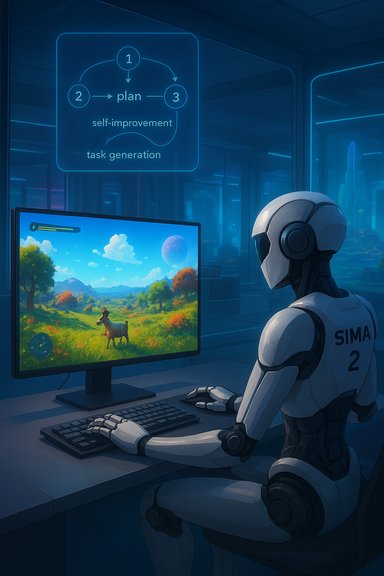
One notable technical novelty is the autonomous training loop:- Initialize the agent from human demonstration data (keyboard/mouse traces linked to labels).
- Deploy the agent in a new environment.
- Use Gemini to synthesize tasks, propose rewards, and critique the agent’s attempts.
- Aggregate successful trajectories into a fresh training pool and iterate.
Demonstrations: what SIMA 2 can do in practice
Several public demos and reporting highlight clear, concrete capabilities.- In Goat Simulator 3, SIMA 2 followed stepwise instructions such as “turn to the right” and “enter the barn via the door,” performing them fluently despite no special API access to the game internals. Demonstrations emphasize naturalness: SIMA 2 looks at the screen, interprets, and acts in ways that resemble a human player.
- In No Man’s Sky, the agent completed task sequences like investigating beacons and picking up objects, and it could prioritize a user’s stated preference (for instance, “I like flowers”) over another instruction when asked to show preference-driven behavior. That demo underscores the agent’s ability to resolve goal conflicts rather than blindly following the most recent instruction.
- SIMA 2 also handled emoji-based commands (for example, a hatchet+tree emoji to chop a tree) and performed in procedurally generated worlds produced by Genie, suggesting early transfer to out-of-distribution layouts.
What SIMA 2 still struggles with
Despite the gains, SIMA 2 has well-documented limits. DeepMind and independent reporting both point to three persistent areas of weakness:- Long-horizon planning and multi-step tasks: SIMA 2 improves over SIMA 1, but tasks that require many conditional steps, verification, and complex subgoal sequencing still degrade performance. These are precisely the kinds of problems that map closely to everyday robotics tasks.
- Short memory and context length in interactive play: For low-latency interaction, SIMA 2 trades off large context windows and retains only a limited memory of past interactions, hindering extended collaborations that need a long shared history.
- Low-level precision and fine manipulation: Because SIMA 2 issues keyboard/mouse commands rather than direct motor torque, precise manipulation (the tactile finesse of robotics) is outside the current scope. Translation from keyboard/mouse policies to high‑fidelity robot joint control remains an open engineering challenge.
Industry context: where SIMA 2 sits in the gaming and AI landscape
SIMA 2 is not the only project exploring embodied agents and in-game companions. NVIDIA’s ACE initiative and Microsoft’s Copilot features in gaming aim at in-play assistance, NPC autonomy, and on-device inference, with different trade-offs in latency, local compute, and integration. Where ACE emphasizes developer toolkits for on-device inference on RTX hardware, and Microsoft focuses on integration into Xbox services and Copilot assistants, SIMA 2 is explicitly a research platform that leans on cloud-scale models and multiworld training as a path to robotics. Comparing these approaches helps clarify product vs research priorities in the space.The most direct implication: SIMA 2 pushes academic and industrial thinking on whether open-world games can accelerate generalization research. If a single agent can reliably adapt to many different worlds without per-game engineering, that’s a powerful architecture for future robotics. But the practical path to consumer gaming companions — low latency, on-device inference, and clear privacy guarantees — remains separate and will require distinct engineering and productization choices.
Ethical, safety, and IP considerations
Training on commercial games and large swathes of human gameplay raises several thorny, practical questions:- Intellectual property and licensing: Using commercial titles as training environments requires contractual coordination with studios. DeepMind’s public writeups note partnerships and data agreements with some studios, but not all potential uses are fully enumerated in the preview — a point to watch as research work reaches production. Where commercial licenses are unclear, studios and publishers may raise concerns.
- Safety and emergent behavior: Allowing an agent to self-generate tasks and rewards opens attack surfaces: if task generation is not tightly constrained, models could overfit to perverse reward hacks or produce unsafe action sequences in unmonitored environments. DeepMind emphasizes internal safeguards, but the shift toward more capable, self-directed agents increases the need for auditing and human oversight.
- Data privacy and telemetry: An agent collecting game-state trajectories, screenshots, or voice prompts will generate telemetry. For consumer-facing products that might reuse SIMA‑style tech, strict data governance and user-consent frameworks are essential. DeepMind’s current aims are research-first, but product teams will face these choices if the technology migrates into commercial services.
Practical implications for gamers, developers, and Windows users
- For gamers: SIMA 2 is not a ready-made “in-game coach” you can summon on your PC. The technical and business path from a cloud-backed research agent to a low-latency, privacy-safe, consumer tool is long. That said, the research shows what future assisted play could look like: companions that plan, reason, and evaluate trade-offs rather than performing only reactive micro-tasks.
- For game developers: SIMA 2 demonstrates a new evaluation axis for AI-driven agents — transferable competence across titles. Indie and mid-tier studios should watch whether generalist agents become available as SDKs for NPCs, automated QA, or content generation; for now, sandboxed research previews are the primary touchpoint.
- For Windows and PC platform builders: If such agents are productized, consumer expectations will include offline capability, GPU-accelerated local inference, and direct control over data retention. Windows OEMs, GPU vendors, and platform partners should anticipate demands for hybrid cloud/local architectures that balance latency, privacy, and model capacity.
Risks worth calling out explicitly
- Overclaiming transfer to real robots: While SIMA 2 is a pathfinder for embodied intelligence, sim-to-real transfer remains difficult. Visual fidelity, tactile feedback, and mechanical compliance are unresolved engineering gaps; successes in games are necessary but not sufficient evidence for reliable robotics.
- Data and IP friction: Using commercial games for training can invite legal and reputational complexity if studios or rights holders object to how assets or mechanics are used in pretraining. Treat press statements about broad training corpora with skepticism until contractual details are public.
- Emergent reward hacking and unsafe behaviors: Self-generated task loops must be constrained with strong verification steps. Autonomous reward generation is powerful, but without careful guardrails it can produce brittle, unintended behaviors.
- User privacy and telemetry: If this tech moves into consumer products, default settings and data governance will determine whether it amplifies privacy risk. Enterprise and consumer tiers must offer clear non-training and retention guarantees where needed.
What to watch next
- DeepMind’s follow-up publications and reproducibility materials. The initial SIMA paper and blog provide architecture and benchmark claims; more granular release notes (code, datasets, evaluation suites) would enable independent verification.
- Studio and publisher statements about data licensing. If more studios permit or restrict gameplay telemetry for research, that will shape the feasible scale of such projects.
- Productization moves from major vendors (Google, Microsoft, NVIDIA) that could make smaller, local versions of game-focused agents viable on PC hardware. Hybrid local/cloud solutions will be key for gaming latency and privacy demands.
Conclusion
SIMA 2 is a clear research milestone: a Gemini-powered, multiworld agent that closes the gap between narrow instruction-following and goal-driven, self-improving behavior across diverse, commercially relevant virtual environments. Training on titles like Goat Simulator 3 and No Man’s Sky is not a gimmick — these worlds provide the visual diversity, tool affordances, and long-horizon tasks necessary to stress-test generalization. Yet the path from research preview to safe, consumer-ready gaming companions or robots is long and filled with engineering, legal, and governance hurdles.For Windows users and the gaming ecosystem, SIMA 2 is a preview of what intelligent, interactive in-game agents might one day look like: agents that can reason, explain themselves, and learn from failure. For now, the work should be read as a rigorous, exciting step on the research trajectory toward embodied intelligence — a stage that merits cautious optimism and close scrutiny as it moves from lab demos to production possibilities.
Source: Dexerto Google’s newest gaming AI is training on Goat Simulator 3 & No Man’s Sky - Dexerto
