

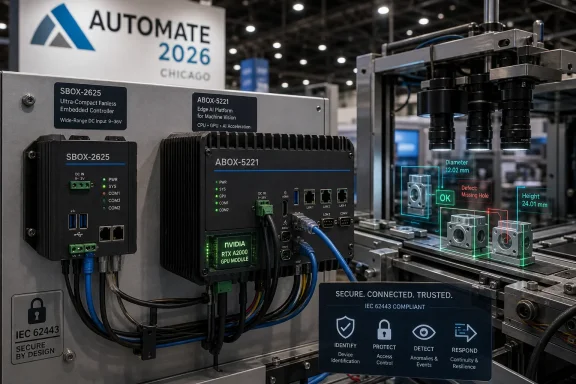
SINTRONES Technology used Automate 2026, held June 22–25 at McCormick Place in Chicago, to spotlight its SBOX-2625 ultra-compact fanless embedded computer and ABOX-5221 edge AI platform for smart manufacturing, positioning both systems as factory-floor engines for control, inspection, and analytics. The announcement is not just another embedded-hardware booth note. It is a small but telling snapshot of where industrial computing is heading: away from centralized dashboards that observe the line and toward rugged edge boxes that make decisions on it.
That shift matters because smart manufacturing is no longer a glossy phrase reserved for pilot projects and trade-show videos. It is becoming a procurement category, with buyers asking whether a system can survive heat, vibration, dust, voltage swings, legacy interfaces, cybersecurity audits, and AI workloads at the same time. SINTRONES’ pitch at Automate 2026 lands squarely in that messy middle, where Windows, Linux, PLCs, cameras, GPUs, serial devices, and security frameworks all have to coexist without turning the factory floor into a science project.
The interesting thing about SINTRONES’ Automate 2026 showing is not that the company brought two industrial PCs to a robotics and automation event. That is expected. The more revealing move is that the two systems tell a split story about the modern factory: one machine for deterministic, always-on equipment control, and another for heavier AI inference and machine vision.
The SBOX-2625 is the smaller, lower-power half of that story. It is pitched as an ultra-compact fanless embedded computer built around Intel’s Processor N-series, including Twin Lake options such as the N150, with industrial connectivity and expansion for machine control and factory networking. In practical terms, this is the kind of box that disappears into a cabinet, enclosure, kiosk, gantry, or machine bay and is judged less by benchmark charts than by whether it keeps running.
The ABOX-5221 is the more muscular counterpart. Built around 14th Gen Intel Core processors and optional discrete GPU support, including NVIDIA RTX Embedded Ada options according to SINTRONES’ product materials, it is aimed at workloads where cameras, models, and production events meet in real time. That puts it closer to automated optical inspection, defect detection, process monitoring, and anomaly detection than basic I/O coordination.
Together, the two machines form a familiar but increasingly important architecture. A factory does not need every edge node to be an AI workstation, and it does not need every controller to be a barely programmable appliance. It needs a hierarchy of reliable compute, with small systems close to machines and larger systems close to vision, analytics, and inference.
That “boring” role is exactly why it matters. Manufacturing environments are full of existing machines that do not speak modern cloud-native language, and the job of edge computing is often translation rather than transformation. Serial ports, digital I/O, Ethernet, USB peripherals, watchdog timers, wide-voltage power inputs, and fanless thermal design are the unromantic details that decide whether an automation upgrade becomes durable infrastructure or a maintenance headache.
SINTRONES’ published SBOX-2625 specifications underline that point. The system supports DDR5 memory, dual 2.5GbE ports, multiple USB and COM configurations, TPM 2.0, wireless expansion through M.2, and a 9–36V DC input with protection features. It is also listed with Windows 11 IoT Enterprise LTSC and Ubuntu 24.04 LTS support, which is the kind of dual-platform positioning that reflects the actual split personality of industrial IT.
For WindowsForum readers, that Windows 11 IoT Enterprise LTSC detail is worth pausing on. The factory floor is one of the places where Microsoft’s long-term servicing model still makes intuitive sense. You do not want a line controller behaving like a consumer laptop, chasing feature updates when the priority is repeatability, validation, and uptime.
The processor choice is similarly pragmatic. Twin Lake, as Intel’s successor to Alder Lake-N in this low-power class, is not trying to compete with workstation silicon. Its appeal is performance per watt, availability, and adequate compute for edge-control workloads where thermal headroom and physical footprint often matter more than peak throughput.
Automated optical inspection, wafer inspection, electronics manufacturing, precision assembly verification, and process monitoring all share a basic requirement: the system has to see, decide, and act quickly enough to matter. A defect caught after a batch is finished is a report. A defect caught at the station is control.
That is why the ABOX-5221’s expansion story matters. PCIe support for frame grabbers, accelerator cards, and specialized modules is not a spec-sheet ornament in machine vision. It is how vendors connect industrial cameras, deterministic acquisition hardware, and application-specific cards into something that can survive actual deployment.
The GPU options are equally significant, though they should be read with industrial caution. NVIDIA RTX support gives the ABOX-5221 a credible path for modern inference workloads, but “AI-ready” hardware does not automatically produce useful AI outcomes. Manufacturers still need training data, model validation, repeatable lighting, camera calibration, integration with line controls, and a maintenance plan for what happens when the model gets confused.
That is where many factory AI projects stall. The demo can identify a defect under ideal conditions; the production deployment must identify it during vibration, glare, shift changes, supplier variability, tooling wear, and partial obstruction. SINTRONES is selling the platform, but the hard work remains in the integration.
That means ruggedization is not a footnote. A smart factory full of consumer-grade PCs, improvised USB hubs, unmanaged thermal loads, and undocumented network adapters is not smart. It is fragile. Industrial edge systems exist because the factory floor punishes assumptions imported from the office.
Fanless design is part of that discipline. Fans are easy to understand and easy to overlook, but moving parts introduce failure modes in dusty and hot environments. A sealed or semi-sealed fanless box with predictable thermals may look conservative compared with a flashy AI workstation, but conservative is often what earns trust in production.
Power input is another underappreciated detail. A wide DC input range with protection against overcurrent, overvoltage, surge, and reversed polarity is not glamorous, but it reflects the reality that industrial installations are rarely as neat as a lab bench. When a box is mounted in a cabinet near motors, relays, and long cable runs, electrical resilience becomes part of uptime.
Connectivity closes the loop. Dual 2.5GbE, 10GbE options on higher-end edge AI systems, serial support, USB, DIO, M.2 expansion, wireless modules, and camera interfaces all speak to the same problem: factories are heterogeneous. Modern manufacturing does not replace everything at once; it layers new intelligence onto old assets.
Windows 11 IoT Enterprise LTSC fits that world better than mainstream consumer Windows because it prioritizes a longer support cadence and a more controlled servicing model. For machine builders and plant IT teams, the ability to validate an image and keep it stable is often more important than gaining every new platform feature the moment it ships. That is not anti-innovation; it is operational realism.
The coexistence with Ubuntu 24.04 LTS is just as important. Many AI, robotics, and computer-vision pipelines are developed first in Linux environments, especially when NVIDIA tooling, containers, Python frameworks, and open-source libraries are involved. A vendor that lists both Windows IoT and Ubuntu LTS is implicitly acknowledging that the factory edge is no longer a single-OS monoculture.
For administrators, that creates both opportunity and complexity. A Windows-based HMI and a Linux-based inference node may be part of the same inspection cell. Security policy, update windows, network segmentation, logging, remote access, and backup procedures need to span both worlds.
This is where hardware vendors can either help or hinder. A rugged edge box with TPM support, consistent firmware controls, documented OS support, and stable availability gives IT teams something governable. A one-off mini PC with consumer BIOS behavior and uncertain lifecycle does not.
That matters because manufacturing is now a favored target for ransomware crews and industrial extortion. Production downtime is expensive, supply chains are interconnected, and many plants still run equipment that was never designed for hostile networks. A compromised factory system is not merely an IT incident; it can become a safety, quality, delivery, and revenue incident.
The edge makes that risk more complicated. Every new camera-connected AI box, remote maintenance gateway, wireless module, and Windows IoT endpoint expands the management surface. The promise of real-time insight comes with the burden of real-time exposure.
Secure-by-design language is therefore necessary, though not sufficient. Buyers should still ask hard questions about firmware updates, vulnerability disclosure, SBOM availability, default credentials, secure boot, TPM usage, remote-management controls, and how long the vendor intends to maintain software images. A lifecycle framework is a starting point, not a magic shield.
The better interpretation is that industrial buyers are finally forcing hardware vendors to speak the language of cybersecurity earlier in the conversation. In that sense, IEC 62443 is not just a compliance detail. It is a sign that operational technology and information technology are converging under the same risk model.
SINTRONES’ two-system showcase fits that environment because it avoids pretending that one edge computer can be the whole factory. The SBOX-2625 handles the compact controller story. The ABOX-5221 handles the AI vision and analytics story. Both point toward a modular architecture in which compute is distributed according to workload, physical constraints, and risk.
That modularity is likely to define the next phase of manufacturing digitization. Central cloud platforms will still collect metrics, train models, manage fleets, and support business analytics. But the first useful decision may increasingly happen beside the line, inside the cabinet, or next to the camera.
The economics are also changing. AI inference at the edge has become practical enough that manufacturers can consider it for targeted quality-control tasks rather than only broad research programs. At the same time, low-power processors have become capable enough to handle control-adjacent tasks without requiring large, expensive, power-hungry systems.
That combination is the real story behind the booth language. Smart manufacturing is becoming less about giant platform promises and more about deployable nodes. The winners will not necessarily be the vendors with the most extravagant AI claims, but those whose systems integrate cleanly into brownfield plants.
For the SBOX-2625, the practical questions start with fit. Does the system have the right I/O for the machine? Does it tolerate the cabinet environment? Can it run the required Windows or Linux workload for the expected lifecycle? Can the plant standardize on it across multiple lines or sites?
For the ABOX-5221, the questions become more application-specific. Which cameras are supported? Is the inference workload CPU-bound, GPU-bound, or I/O-bound? Does the inspection software require Windows, Linux, or both? How will false positives and false negatives be handled operationally?
Then there is the network. Edge AI systems are often placed at the awkward boundary between operational technology and enterprise IT. They need access to production data, cameras, and machine signals, but they may also need model updates, remote support, logging, and integration with quality systems. That boundary is where good architecture matters most.
None of this diminishes SINTRONES’ announcement. It clarifies it. The company is offering hardware for a demanding class of deployments, but the return on investment will depend on engineering discipline as much as product capability.
This is where processor roadmaps, OS support, and vendor availability become more than procurement trivia. A compact industrial PC that looks attractive in a pilot can become a liability if the exact configuration disappears before a full rollout. Conversely, a slightly less exciting system with stable availability and predictable support can be the better industrial choice.
Twin Lake’s low-power positioning and Intel’s embedded lifecycle messaging are relevant here because industrial customers care about continuity. The same goes for 14th Gen Intel Core systems in edge AI deployments, where buyers may want consistent CPU, GPU, and driver behavior across multiple inspection stations. Stability is a feature.
Windows 11 IoT Enterprise LTSC also fits into the lifecycle equation. Administrators can build a standard image, validate it against applications and peripherals, and avoid the churn associated with frequent feature changes. In a factory, that kind of predictability can be worth more than a faster upgrade cadence.
The unresolved challenge is that AI software lifecycles move faster than industrial hardware lifecycles. Models, frameworks, GPU drivers, container runtimes, and security patches all evolve quickly. Vendors and integrators will need to bridge that mismatch without turning production lines into constantly shifting development environments.
SINTRONES’ SBOX-2625 and ABOX-5221 will not, by themselves, make a factory smart; no embedded computer can carry that burden alone. But their Automate 2026 positioning captures the direction of travel: intelligence is moving closer to machines, Windows and Linux are sharing the edge, and cybersecurity is becoming part of the product story before the first unit ships. The next contest in manufacturing will not be over who can say “Edge AI” the loudest, but who can make it boring enough to trust on a line that cannot afford to stop.
That shift matters because smart manufacturing is no longer a glossy phrase reserved for pilot projects and trade-show videos. It is becoming a procurement category, with buyers asking whether a system can survive heat, vibration, dust, voltage swings, legacy interfaces, cybersecurity audits, and AI workloads at the same time. SINTRONES’ pitch at Automate 2026 lands squarely in that messy middle, where Windows, Linux, PLCs, cameras, GPUs, serial devices, and security frameworks all have to coexist without turning the factory floor into a science project.
 SINTRONES Is Selling the Edge as the New Control Room
The interesting thing about SINTRONES’ Automate 2026 showing is not that the company brought two industrial PCs to a robotics and automation event. That is expected. The more revealing move is that the two systems tell a split story about the modern factory: one machine for deterministic, always-on equipment control, and another for heavier AI inference and machine vision.The SBOX-2625 is the smaller, lower-power half of that story. It is pitched as an ultra-compact fanless embedded computer built around Intel’s Processor N-series, including Twin Lake options such as the N150, with industrial connectivity and expansion for machine control and factory networking. In practical terms, this is the kind of box that disappears into a cabinet, enclosure, kiosk, gantry, or machine bay and is judged less by benchmark charts than by whether it keeps running.
The ABOX-5221 is the more muscular counterpart. Built around 14th Gen Intel Core processors and optional discrete GPU support, including NVIDIA RTX Embedded Ada options according to SINTRONES’ product materials, it is aimed at workloads where cameras, models, and production events meet in real time. That puts it closer to automated optical inspection, defect detection, process monitoring, and anomaly detection than basic I/O coordination.
Together, the two machines form a familiar but increasingly important architecture. A factory does not need every edge node to be an AI workstation, and it does not need every controller to be a barely programmable appliance. It needs a hierarchy of reliable compute, with small systems close to machines and larger systems close to vision, analytics, and inference.
The SBOX-2625 Makes the Case for Boring Reliability
The SBOX-2625 is easy to underestimate because its role is not glamorous. It is not the AI box that gets the promotional render with simulated neural-network overlays. It is the compact controller designed to sit in constrained industrial environments, linking machines, sensors, networks, and human-machine interfaces.That “boring” role is exactly why it matters. Manufacturing environments are full of existing machines that do not speak modern cloud-native language, and the job of edge computing is often translation rather than transformation. Serial ports, digital I/O, Ethernet, USB peripherals, watchdog timers, wide-voltage power inputs, and fanless thermal design are the unromantic details that decide whether an automation upgrade becomes durable infrastructure or a maintenance headache.
SINTRONES’ published SBOX-2625 specifications underline that point. The system supports DDR5 memory, dual 2.5GbE ports, multiple USB and COM configurations, TPM 2.0, wireless expansion through M.2, and a 9–36V DC input with protection features. It is also listed with Windows 11 IoT Enterprise LTSC and Ubuntu 24.04 LTS support, which is the kind of dual-platform positioning that reflects the actual split personality of industrial IT.
For WindowsForum readers, that Windows 11 IoT Enterprise LTSC detail is worth pausing on. The factory floor is one of the places where Microsoft’s long-term servicing model still makes intuitive sense. You do not want a line controller behaving like a consumer laptop, chasing feature updates when the priority is repeatability, validation, and uptime.
The processor choice is similarly pragmatic. Twin Lake, as Intel’s successor to Alder Lake-N in this low-power class, is not trying to compete with workstation silicon. Its appeal is performance per watt, availability, and adequate compute for edge-control workloads where thermal headroom and physical footprint often matter more than peak throughput.
The ABOX-5221 Shows Where AI Actually Enters the Factory
If the SBOX-2625 represents the control layer, the ABOX-5221 represents the inspection and analytics layer. SINTRONES’ framing around AI machine vision is unsurprising, but it is also grounded in one of the clearest industrial use cases for edge AI. Cameras generate too much data, too quickly, for every decision to make a round trip to a remote cloud service.Automated optical inspection, wafer inspection, electronics manufacturing, precision assembly verification, and process monitoring all share a basic requirement: the system has to see, decide, and act quickly enough to matter. A defect caught after a batch is finished is a report. A defect caught at the station is control.
That is why the ABOX-5221’s expansion story matters. PCIe support for frame grabbers, accelerator cards, and specialized modules is not a spec-sheet ornament in machine vision. It is how vendors connect industrial cameras, deterministic acquisition hardware, and application-specific cards into something that can survive actual deployment.
The GPU options are equally significant, though they should be read with industrial caution. NVIDIA RTX support gives the ABOX-5221 a credible path for modern inference workloads, but “AI-ready” hardware does not automatically produce useful AI outcomes. Manufacturers still need training data, model validation, repeatable lighting, camera calibration, integration with line controls, and a maintenance plan for what happens when the model gets confused.
That is where many factory AI projects stall. The demo can identify a defect under ideal conditions; the production deployment must identify it during vibration, glare, shift changes, supplier variability, tooling wear, and partial obstruction. SINTRONES is selling the platform, but the hard work remains in the integration.
Smart Manufacturing Is Becoming a Hardware Discipline Again
For the last decade, much of the industrial digital-transformation conversation sounded like a software story. Vendors talked about dashboards, analytics, digital twins, cloud platforms, predictive maintenance, and enterprise visibility. Those layers still matter, but the Automate 2026 message from SINTRONES points to a correction: smart manufacturing only works if the physical compute layer is credible.That means ruggedization is not a footnote. A smart factory full of consumer-grade PCs, improvised USB hubs, unmanaged thermal loads, and undocumented network adapters is not smart. It is fragile. Industrial edge systems exist because the factory floor punishes assumptions imported from the office.
Fanless design is part of that discipline. Fans are easy to understand and easy to overlook, but moving parts introduce failure modes in dusty and hot environments. A sealed or semi-sealed fanless box with predictable thermals may look conservative compared with a flashy AI workstation, but conservative is often what earns trust in production.
Power input is another underappreciated detail. A wide DC input range with protection against overcurrent, overvoltage, surge, and reversed polarity is not glamorous, but it reflects the reality that industrial installations are rarely as neat as a lab bench. When a box is mounted in a cabinet near motors, relays, and long cable runs, electrical resilience becomes part of uptime.
Connectivity closes the loop. Dual 2.5GbE, 10GbE options on higher-end edge AI systems, serial support, USB, DIO, M.2 expansion, wireless modules, and camera interfaces all speak to the same problem: factories are heterogeneous. Modern manufacturing does not replace everything at once; it layers new intelligence onto old assets.
The Windows Angle Is Stability, Not Desktop Familiarity
Windows in manufacturing is often misunderstood by people who think of the operating system only through the consumer desktop. In industrial settings, Windows is not attractive because it has a Start menu. It is attractive because decades of tooling, drivers, HMI applications, database connectors, device SDKs, and operator workflows already depend on it.Windows 11 IoT Enterprise LTSC fits that world better than mainstream consumer Windows because it prioritizes a longer support cadence and a more controlled servicing model. For machine builders and plant IT teams, the ability to validate an image and keep it stable is often more important than gaining every new platform feature the moment it ships. That is not anti-innovation; it is operational realism.
The coexistence with Ubuntu 24.04 LTS is just as important. Many AI, robotics, and computer-vision pipelines are developed first in Linux environments, especially when NVIDIA tooling, containers, Python frameworks, and open-source libraries are involved. A vendor that lists both Windows IoT and Ubuntu LTS is implicitly acknowledging that the factory edge is no longer a single-OS monoculture.
For administrators, that creates both opportunity and complexity. A Windows-based HMI and a Linux-based inference node may be part of the same inspection cell. Security policy, update windows, network segmentation, logging, remote access, and backup procedures need to span both worlds.
This is where hardware vendors can either help or hinder. A rugged edge box with TPM support, consistent firmware controls, documented OS support, and stable availability gives IT teams something governable. A one-off mini PC with consumer BIOS behavior and uncertain lifecycle does not.
Cybersecurity Has Moved From Checkbox to Procurement Filter
SINTRONES’ reference to IEC 62443-4-1 is not the loudest part of the announcement, but it may be the part that ages best. IEC 62443-4-1 deals with secure product development lifecycle practices for industrial automation and control systems. In plainer English, it is about whether security is built into the way products are designed, developed, tested, maintained, and patched.That matters because manufacturing is now a favored target for ransomware crews and industrial extortion. Production downtime is expensive, supply chains are interconnected, and many plants still run equipment that was never designed for hostile networks. A compromised factory system is not merely an IT incident; it can become a safety, quality, delivery, and revenue incident.
The edge makes that risk more complicated. Every new camera-connected AI box, remote maintenance gateway, wireless module, and Windows IoT endpoint expands the management surface. The promise of real-time insight comes with the burden of real-time exposure.
Secure-by-design language is therefore necessary, though not sufficient. Buyers should still ask hard questions about firmware updates, vulnerability disclosure, SBOM availability, default credentials, secure boot, TPM usage, remote-management controls, and how long the vendor intends to maintain software images. A lifecycle framework is a starting point, not a magic shield.
The better interpretation is that industrial buyers are finally forcing hardware vendors to speak the language of cybersecurity earlier in the conversation. In that sense, IEC 62443 is not just a compliance detail. It is a sign that operational technology and information technology are converging under the same risk model.
Automate 2026 Was the Right Stage for This Particular Pitch
Automate is not a consumer electronics show, and that distinction matters. The audience is not primarily hunting for novelty. It is looking for parts of an automation stack that can be justified to engineering, operations, maintenance, finance, and IT at the same time.SINTRONES’ two-system showcase fits that environment because it avoids pretending that one edge computer can be the whole factory. The SBOX-2625 handles the compact controller story. The ABOX-5221 handles the AI vision and analytics story. Both point toward a modular architecture in which compute is distributed according to workload, physical constraints, and risk.
That modularity is likely to define the next phase of manufacturing digitization. Central cloud platforms will still collect metrics, train models, manage fleets, and support business analytics. But the first useful decision may increasingly happen beside the line, inside the cabinet, or next to the camera.
The economics are also changing. AI inference at the edge has become practical enough that manufacturers can consider it for targeted quality-control tasks rather than only broad research programs. At the same time, low-power processors have become capable enough to handle control-adjacent tasks without requiring large, expensive, power-hungry systems.
That combination is the real story behind the booth language. Smart manufacturing is becoming less about giant platform promises and more about deployable nodes. The winners will not necessarily be the vendors with the most extravagant AI claims, but those whose systems integrate cleanly into brownfield plants.
The Hard Part Is Not Buying the Box
There is a temptation in every industrial trade-show cycle to treat new hardware as the arrival of a solution. That is rarely how factories work. The hardware is an enabling condition; the solution is what happens after it is wired, mounted, imaged, secured, connected, validated, monitored, and maintained.For the SBOX-2625, the practical questions start with fit. Does the system have the right I/O for the machine? Does it tolerate the cabinet environment? Can it run the required Windows or Linux workload for the expected lifecycle? Can the plant standardize on it across multiple lines or sites?
For the ABOX-5221, the questions become more application-specific. Which cameras are supported? Is the inference workload CPU-bound, GPU-bound, or I/O-bound? Does the inspection software require Windows, Linux, or both? How will false positives and false negatives be handled operationally?
Then there is the network. Edge AI systems are often placed at the awkward boundary between operational technology and enterprise IT. They need access to production data, cameras, and machine signals, but they may also need model updates, remote support, logging, and integration with quality systems. That boundary is where good architecture matters most.
None of this diminishes SINTRONES’ announcement. It clarifies it. The company is offering hardware for a demanding class of deployments, but the return on investment will depend on engineering discipline as much as product capability.
The Real Buying Decision Is About Lifecycle
Industrial buyers tend to think in years, not quarters. A plant may run a machine for a decade or longer, and even when the control hardware is refreshed, the surrounding process may remain largely unchanged. That makes lifecycle management one of the most important issues in embedded computing.This is where processor roadmaps, OS support, and vendor availability become more than procurement trivia. A compact industrial PC that looks attractive in a pilot can become a liability if the exact configuration disappears before a full rollout. Conversely, a slightly less exciting system with stable availability and predictable support can be the better industrial choice.
Twin Lake’s low-power positioning and Intel’s embedded lifecycle messaging are relevant here because industrial customers care about continuity. The same goes for 14th Gen Intel Core systems in edge AI deployments, where buyers may want consistent CPU, GPU, and driver behavior across multiple inspection stations. Stability is a feature.
Windows 11 IoT Enterprise LTSC also fits into the lifecycle equation. Administrators can build a standard image, validate it against applications and peripherals, and avoid the churn associated with frequent feature changes. In a factory, that kind of predictability can be worth more than a faster upgrade cadence.
The unresolved challenge is that AI software lifecycles move faster than industrial hardware lifecycles. Models, frameworks, GPU drivers, container runtimes, and security patches all evolve quickly. Vendors and integrators will need to bridge that mismatch without turning production lines into constantly shifting development environments.
The Booth Demo Points to the Factory IT Checklist
SINTRONES’ Automate 2026 showcase is best read as a practical checklist for where smart manufacturing deployments are going next. The products are specific, but the pattern is broader: compact control nodes, heavier AI vision nodes, long-life operating systems, secure development practices, and enough connectivity to deal with old and new equipment at once.- Manufacturers should separate control workloads from AI inspection workloads instead of assuming one edge system should do everything.
- Windows 11 IoT Enterprise LTSC remains relevant where validated applications, long service windows, and predictable update behavior matter more than consumer-style feature velocity.
- Ubuntu LTS support is increasingly important because many AI, robotics, and vision workflows are built around Linux-first tooling.
- Hardware security features and secure development lifecycle claims should be treated as procurement starting points, not substitutes for architecture, patching, and monitoring.
- Edge AI projects should be judged by production outcomes such as defect detection speed, yield improvement, downtime reduction, and operator workload, not by accelerator branding alone.
- The most successful smart-factory deployments will likely come from boring integration excellence rather than dramatic booth demos.
SINTRONES’ SBOX-2625 and ABOX-5221 will not, by themselves, make a factory smart; no embedded computer can carry that burden alone. But their Automate 2026 positioning captures the direction of travel: intelligence is moving closer to machines, Windows and Linux are sharing the edge, and cybersecurity is becoming part of the product story before the first unit ships. The next contest in manufacturing will not be over who can say “Edge AI” the loudest, but who can make it boring enough to trust on a line that cannot afford to stop.
References
- Primary source: Embedded Computing Design
Published: 2026-07-02T16:30:11.336808
SINTRONES Highlights SBOX-2625 and ABOX-5221 for Smart Manufacturing at Automate 2026 - Embedded Computing Design
SINTRONES Technology showcased its latest innovations for industrial automation at Automate 2026. Demonstrations included how Edge AI, machine vision, and intelligent control technologies help manufacturers improve productivity, quality, and operational efficiency across modern production...embeddedcomputing.com - Related coverage: sintrones.com
Powerful SBOX-2625: Ultra-Compact Intel Atom Fanless PC
Boost IoT efficiency with the robust SBOX-2625. This ultra-compact fanless computer features Intel Atom x7000RE processors, dual 2.5GbE, and 4K display support.www.sintrones.com - Related coverage: sintrones.com.tw
Ultra-Compact Edge Computer SBOX-2625 搭載 Intel Twin Lake 的超輕量嵌入式電腦 | SINTRONES 鑫創電子
SINTRONES 鑫創電子推出 SBOX-2625 超輕量邊緣運算電腦 (Ultra-Compact Edge Computer),搭載 Intel® Twin Lake 與 Amston Lake 處理器,效能提升 70% 且體積縮減 50%。支援 -40°C 至 70°C 寬溫運作、TPM 2.0 與雙 2.5GbE 埠,是工業自動化、智慧零售與 IIoT 環境的理想選擇。www.sintrones.com.tw - Related coverage: sintroncorp.com
High-Bandwidth 10GbE Edge AI Computer ABOX-5221(P)(G), SINTRON Technology Corp.
Intel® Core™ Processors (14th Gen) with Discrete GPU Options and High-Bandwidth 10GbE Edge AI Computer www.sintroncorp.com
- Related coverage: assured-systems.com
SBOX-2625 | Official Sintrones Distributor and Integrator
Assured Systems is an official distributor and integrator of Sintrones products, supplying the SBOX-2625 fully configured.www.assured-systems.com - Related coverage: landing.sintrones.com

Expo Manufactura 2026 | Powering Intelligent Industrial Edge | SINTRONES
Explore cutting-edge edge computing solutions with SINTRONES at Expo Manufactura 2026, enhancing industrial automation and operational efficiency in demanding environments.
landing.sintrones.com
- Related coverage: builders.intel.com
Quantum information processing concept.
Quantum information processing concept. AI and quantum computing for powerful data elaboration. central processing unit, glowing 3d cpu. Superconducting qubits, photons particles. AI circuitry tech. Includes embedded 16x9, 4x3, 1x1 renditionsbuilders.intel.com
