

Microsoft’s roadmap for scaling “agentic” AI in 2026 is not a manifesto for tinkering — it’s a practical checklist for enterprises that want to move from pilot projects to production-scale digital teammates without burning trust, data, or budgets along the way.
Nitasha Chopra, VP and COO of Microsoft Copilot Studio, distilled that checklist into six capabilities enterprises must master to scale agentic AI effectively. Her framework — which amplifies capabilities already announced across Microsoft’s Copilot portfolio — is a useful lens for CIOs, CDOs, and AI leaders planning to operationalize agents inside regulated, complex enterprises. The six capabilities Chopra highlights are: making agent creation accessible to nondevelopers, enabling agents to own end-to-end workflows, coordinating multiple agents to deliver real-world outcomes, choosing the right models for each agent, allowing agents to act across enterprise systems, and scaling agents without losing governance and control.
These are not abstract aspirations. Over the past 18 months vendors and standards groups have rapidly introduced the building blocks that make each capability practical: low-code agent authoring tools, multi-agent orchestration patterns, identity for non-human actors, open agent protocols for cross-vendor coordination, and enterprise-grade controls for lifecycle management and automated testing. Yet the engineering and organizational work required to make these features reliable, secure, and cost-effective at scale is far from trivial. This article unpacks each capability, validates the technical claims behind the hype, and maps the operational trade-offs that IT leaders must navigate in 2026.
Companies that approach agentic AI as a multidisciplinary program — one that couples engineering rigor with policy and people — will convert curiosity into sustained business value. Those that chase the latest feature without establishing controls will find themselves managing the downstream costs of sprawl, security incidents, and compliance failures. The difference between the two is not a technology bet; it’s an operational discipline.
Source: Cloud Wars Six Capabilities Enterprises Need to Scale Agentic AI in 2026
 Background / Overview
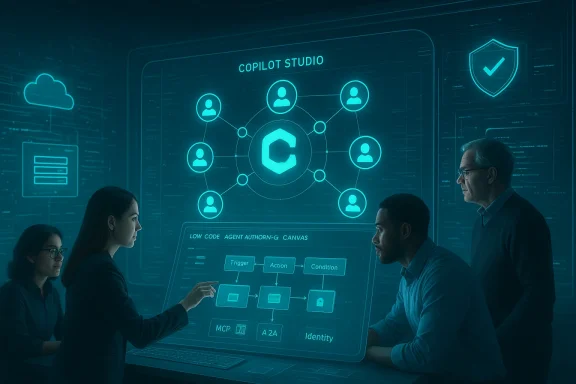
Nitasha Chopra, VP and COO of Microsoft Copilot Studio, distilled that checklist into six capabilities enterprises must master to scale agentic AI effectively. Her framework — which amplifies capabilities already announced across Microsoft’s Copilot portfolio — is a useful lens for CIOs, CDOs, and AI leaders planning to operationalize agents inside regulated, complex enterprises. The six capabilities Chopra highlights are: making agent creation accessible to nondevelopers, enabling agents to own end-to-end workflows, coordinating multiple agents to deliver real-world outcomes, choosing the right models for each agent, allowing agents to act across enterprise systems, and scaling agents without losing governance and control.These are not abstract aspirations. Over the past 18 months vendors and standards groups have rapidly introduced the building blocks that make each capability practical: low-code agent authoring tools, multi-agent orchestration patterns, identity for non-human actors, open agent protocols for cross-vendor coordination, and enterprise-grade controls for lifecycle management and automated testing. Yet the engineering and organizational work required to make these features reliable, secure, and cost-effective at scale is far from trivial. This article unpacks each capability, validates the technical claims behind the hype, and maps the operational trade-offs that IT leaders must navigate in 2026.
Why this matters now
Enterprises that treat agents as experiments will lose the race to those that make agents part of the operating model. Agents move value when they are trusted, accountable, and instrumented — not when they merely live on a developer’s laptop or a single siloed team’s cloud tenant. The rush to adopt has exposed three immediate pressures:- Agent sprawl: tens or hundreds of agents deployed across functions create security, cost, and compliance headaches.
- Interoperability gaps: agents that cannot talk to each other or to enterprise systems create brittle workflows and duplicated effort.
- Governance deficits: lack of identity, lifecycle rules, and audit trails make it impossible to assign responsibility when agents act autonomously.
1) Ability for anyone to turn intent into agents
What Microsoft and others are claiming
The barrier between idea and agent has historically been technical: specifying tools, crafting API calls, and wiring complex connectors. New low-code and natural-language agent builders — exemplified by Microsoft’s Copilot Studio and the Agent Builder in Microsoft 365 Copilot Chat — aim to let business users express intent in everyday language and generate agents from that intent. This democratization reduces development cycle time and allows subject-matter experts (SMEs) to author agents that reflect business rules and context.Why this is credible
Major platform vendors have instrumented low-code authoring flows and prebuilt connectors that make this possible. Vendor announcements and product docs show that authoring canvases, guided templates, and immediate test/playback experiences are now mainstream in enterprise-grade agent platforms. The combination of prebuilt connectors to systems like Microsoft 365 and Power Platform plus natural-language scaffolding reliably shortens authoring cycles.Strengths
- Rapid iteration: SMEs can prototype agents in days rather than months.
- Better alignment: Business owners can encode goals directly, reducing specification loss in handoffs.
- Scale by volume: Organizations can scale agent adoption across teams rather than centralizing to a single development shop.
Risks and caveats
- Latent complexity: Natural language removes friction but not responsibility. Poorly specified intents produce agents that behave unpredictably.
- Shadow agents: When nontechnical users create agents, governance must prevent unapproved access to systems and sensitive data.
- Testing needs: Low-code does not replace rigorous functional and security testing, especially when agents act upon systems.
2) Agents that can own workflows end-to-end
What is changing
Early agents were helpers; modern agents can take ownership of tasks and workflows: initiating actions, chaining steps, and completing business processes without manual handoffs. Microsoft’s “agent flows” and “Workflows Agent” family exemplify this trend by combining reasoning with deterministic workflow primitives so agents can operate predictably.Validation
Product documentation and vendor announcements confirm agents now support multi-step flows, conditional branching, and long-running execution. Platforms expose features for checkpoints, human approvals, and rollback mechanisms — essential for reliable, auditable automation.Benefits
- Realized automation value: End-to-end execution turns recommendations into completed work, delivering measurable time savings.
- Consistency and auditability: Repeatable agent flows generate logs and artifacts that are easier to review than scattered human actions.
- Reduced operator load: Agents can own routine and well-defined processes, freeing staff for higher-value decisions.
Where enterprises must be cautious
- Failure modes: Long-running agent workflows raise the cost of mistakes. Agents must surface state, rationale, and failure contexts so humans can intervene safely.
- Accountability: Organizations must define who owns an agent’s outcomes — the agent creator, the business sponsor, or an operations team — and embed that into HR and compliance workflows.
- Security of actions: Agents that write back to systems must have least-privilege credentials, granular scopes, and audit trails.
3) Power to coordinate agents for real outcomes
The problem of sprawl and the solution of orchestration
As agents proliferate, simply tracking them is not enough. They must coordinate. The industry response is multi-layered: vendor-native orchestrators (ServiceNow’s AI Agent Orchestrator, Workday’s Agent System of Record) plus open agent-to-agent protocols (Model Context Protocol (MCP) and Linux Foundation's Agent2Agent/A2A). Orchestration is both a governance necessity and a design pattern for composing agents into teams that mirror organizational structures.Technical reality check
Open standards and orchestration patterns are real and increasingly adopted. MCP provides a well-defined way for models to access external tools and data with authenticated, scoped access; A2A enables cross-owner negotiation and task handoffs. Microsoft’s Copilot Studio documentation and multiple vendor roadmaps show explicit support for these standards and for multi-agent orchestration features in production preview.Advantages
- Modularity: Build small, focused agents that specialize and collaborate rather than monolithic “do-everything” agents.
- Ownership mapping: Orchestration helps map each step of a workflow to an owning agent and an owning team, simplifying accountability.
- Resilience: Team-based agent design isolates faults and allows parallelism where appropriate.
Critical risks and unanswered questions
- Protocol security: MCP and A2A reduce integration friction but introduce new attack surfaces, including tool poisoning, prompt injection, and permission escalation.
- Governance complexity: Orchestration requires centralized telemetry and policy enforcement — a nontrivial engineering effort.
- Inter-vendor trust: A2A-style exchanges across organizations demand strong authentication, provenance, and failure containment models.
4) Flexibility to control agent models
Why model choice matters
Not every agent needs the same LLM. Some tasks require high-recall reasoning models; others need compact, cost-efficient models for simple automation. Enterprises need the flexibility to assign models with appropriate cost, latency, and compliance characteristics to specific agents — without fragmenting the management plane.Real-world vendor capabilities
Platforms now offer “bring-your-own-model” and controlled model selection, integrating third-party models and vendor-provided families. Microsoft, for example, supports integrating more than one model family into Copilot Studio workflows and provides tuning and enterprise model options to align capability with policy and cost.Business benefits
- Cost optimization: Lower-cost models can manage high-volume, low-risk tasks while premium models handle complex reasoning.
- Compliance and data boundaries: Some models may be restricted from accessing sensitive data; model selection enforces these boundaries.
- Performance tuning: Selecting a model that matches the workload reduces latency and improves user experience.
Operational challenges
- Governance of the model mix: Ensuring appropriate model use requires policy engines and runtime checks.
- Auditability across models: Different models may provide different trace artifacts; normalizing telemetry is essential.
- Vendor lock-in risk: Relying on a single vendor’s model families without portable policies risks future migration costs.
5) Agents that can act across your systems
From suggestion to action
Agents become exponentially more valuable when they can act — not just suggest. Recent platform features enable agents to use “computer use” capabilities that automate interactions with web and desktop UIs and to call into enterprise APIs via standardized protocols like MCP.Why this is practical now
Vendors have shipped toolkits and connectors that allow agents to execute actions with scoped credentials and logged outcomes. Identity frameworks now include non-human identities (for example, agent identities integrated with enterprise identity providers) that enable fine-grained access control.Measurable upsides
- Speed and accuracy: Agents acting directly remove human translation and manual steps, reducing latency and reducing error rates from repetitive work.
- End-to-end visibility: Actions performed by agents can be instrumented, traced, and reconciled against business records.
- Elevated ROI: Automation that completes tasks — rather than merely recommending them — is where significant labor cost reduction emerges.
Security and control implications
- Privileged access must be tightly scoped: agents need ephemeral credentials, just-in-time approvals, and least-privilege scopes to minimize blast radius.
- Interaction with UIs is brittle: UI automation can break with app updates; prefer API-based integrations where possible and treat UI automation as a stopgap.
- Data exfiltration risk: Agents that can read and write across systems increase the attack surface for data leakage; Data Loss Prevention (DLP) controls must be extended to agents.
6) Capability to scale agents without sacrificing control
Governance, lifecycle, and testing
At the core of scaling agentic AI is governance. Microsoft and other platform vendors have introduced lifecycle management tooling, enterprise controls, identity integration, and automated agent evaluation — tooling that enables automated testing of agents, pre-deployment checks, and continuous monitoring once agents are live.Why this is critical
Without lifecycle governance, agent deployments become a maintenance nightmare: undocumented agents, unknown permissions, and untested behaviors accumulate and create systemic risk. Automated agent evaluation and test harnesses help treat agents like software artifacts with QA gates, versioning, and regression testing.The vendor promise
Features such as agent evaluation (automated test sets running inside authoring platforms), Entra-like agent identity, and integrations with enterprise information protection systems show that platforms are converging on an enterprise operational model for agents.Implementation pitfalls
- Test coverage: Automated tests must include functional, security, and adversarial tests (e.g., prompt-injection resistance). Many enterprises underinvest in adversarial testing.
- Continuous governance: Policies and controls are only effective if they run continuously and can scale — manual approval workflows do not.
- Organizational change: Governance tooling succeeds only when paired with clear operating procedures, role definitions, and training.
Cross-vendor landscape: what the market looks like in 2026
Several vendors and initiatives now shape the agentic AI ecosystem:- Microsoft: Copilot Studio is positioning itself as a low-code hub with Model Context Protocol support, multi-agent orchestration, and agent lifecycle tooling.
- ServiceNow: Building native agent orchestration capabilities that integrate with workflow history and observability of billions of workflow executions.
- Workday: Positioning an Agent System of Record to manage agents as first-class workforce entities — governance, onboarding, lifecycle, and marketplace.
- Open standards: MCP and Agent2Agent (A2A) are becoming foundational interoperability layers, reducing bespoke connector work.
Security and safety — the elephant in the room
Open standards and deeper system access come with real security trade-offs. Public reporting and security research have already demonstrated attack classes that are unique to agentic systems:- MCP and tool-publishing attacks: Malicious or compromised MCP servers can present look-alike tools, enable tool-poisoning, or permit prompt-injection vectors that combine tools to exfiltrate data.
- Supply-chain exposures: Agents composed of third-party skills risk inheriting vulnerabilities from those vendors.
- Identity abuse: Non-human identities increase the need for granular, audited identity lifecycle management and anomaly detection.
- Strict least-privilege and ephemeral credentials for agent identities.
- Runtime policy enforcement and behavior whitelisting.
- Adversarial testing and red-team assessments that simulate real-world attacks on agent flows.
- Centralized telemetry and anomaly detection tuned to agent patterns (e.g., unusual data access sequences, high-volume actions, or anomalous command combinations).
Governance, people, and process — not just technology
Scaling agents is as much an organizational change problem as a technology problem. The technical capabilities described above will fail without parallel investment in three areas:- Clear ownership and accountability. Assign a named owner for each production agent and associate SLAs, logging responsibilities, and escalation contacts.
- Change management and training. Nontechnical users creating agents must be trained in safe authoring practices, testing, and governance workflows.
- Policy-backed guardrails. Define policies for who may create agents, which data connectors are permitted, classification thresholds that trigger human approval, and cost-control mechanisms.
Practical playbook: how to operationalize the six capabilities
Below is a pragmatic sequence IT leaders can adopt to take Chopra’s capabilities from concept to production reality.- Inventory and categorize agent initiatives.
- Audit all existing agents and prototypes.
- Classify agents by risk, data sensitivity, business impact, and owner.
- Create an Agent Governance Board.
- Include security, legal, compliance, business sponsors, and platform engineers.
- Define policy templates for modeling, deployment, and monitoring.
- Standardize identity for agents.
- Provision non-human identities in your enterprise directory.
- Apply least-privilege, JIT approval, and ephemeral tokens for agent actions.
- Require staging and automated evaluation.
- Use agent evaluation frameworks and adversarial test suites before production.
- Enforce automated checks for data access, policy conformance, and safety.
- Adopt open protocols where appropriate.
- Favor MCP/A2A for interoperability but gate connectors through your MCP server with validation and schema constraints.
- Build cost and performance policies.
- Define model-selection rules (e.g., high-sensitivity tasks use private, tuned models; routine tasks use cost-optimized models).
- Implement runtime metering and budget alerts to prevent runaway costs.
- Monitor and iterate with observability.
- Centralize logs, telemetry, and business outcome metrics.
- Run periodic red-team exercises and compliance audits.
Measuring success: metrics that matter
Operational metrics should track both technical reliability and business impact:- Business outcome metrics: cycle time reduction, cost per transaction, error-rate reduction, and user satisfaction.
- Trust and safety metrics: number of policy violations, blocked actions, security incidents attributed to agents.
- Operational health metrics: uptime of agent orchestration, mean time to detect/mitigate agent failures, and test coverage for agent evaluation suites.
- Cost metrics: model usage per agent, cost per completed workflow, and spend variance against forecast.
Critical assessment: where vendors overpromise — and where the value really is
Vendors increasingly sell composable, turnkey agent stacks. That messaging is useful but can obscure the manifold integration, data quality, and governance work required to deliver sustained business value.- Overpromises: The idea that agents will effortlessly replace human workers or that “just author an agent” will unlock immediate ROI is oversimplified. Integration complexities, data hygiene, and approvals often create weeks or months of work after the initial authoring.
- Real value: Where agents shine is in structured, repeatable processes where intent is clear, data is accessible, and outcomes are measurable. Examples include HR onboarding, contract review routings, customer service triage, and finance reconciliations.
Closing recommendations: an operational checklist for leaders
- Start with a governance-first posture: define who can build, deploy, and terminate agents before accelerating adoption.
- Treat agents as employees: assign owners, define SOPs, and integrate agents into your audit and compliance programs.
- Make model choice policy-driven: balance risk, cost, and performance with explicit, documented rules.
- Invest in continuous testing: adversarial tests, regression suites, and live monitoring must be part of the pipeline.
- Embrace open protocols — but secure them: MCP and A2A reduce integration work but require hardened servers, validated connectors, and runtime policy enforcement.
- Fund change management: users, sponsors, and auditors must be trained; reward mechanisms should encourage safe and measured experimentation.
Final thought
The six capabilities Chopra outlines are a pragmatic synthesis of vendor innovation and real enterprise needs. Platforms today provide the technical scaffolding — low-code authoring, multi-agent orchestration, identity for agents, open protocols, and evaluation tooling — that make scalable agentic deployments achievable. Yet the work that separates a handful of successful pilots from a company where agents reliably drive business outcomes is organizational: governance, rigorous testing, clear accountability, and cultural change.Companies that approach agentic AI as a multidisciplinary program — one that couples engineering rigor with policy and people — will convert curiosity into sustained business value. Those that chase the latest feature without establishing controls will find themselves managing the downstream costs of sprawl, security incidents, and compliance failures. The difference between the two is not a technology bet; it’s an operational discipline.
Source: Cloud Wars Six Capabilities Enterprises Need to Scale Agentic AI in 2026
