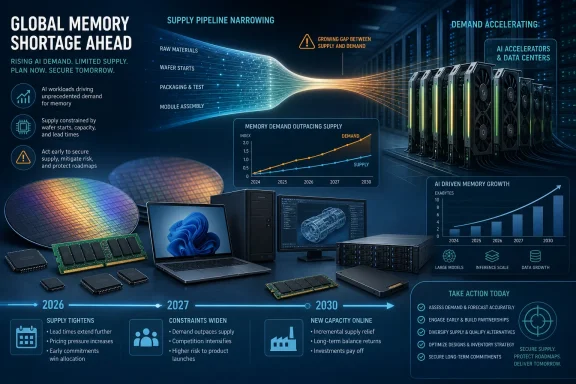
CEO Kwak Noh-jung delivered the warning on July 10 as SK hynix evaluates additional manufacturing sites outside South Korea. The company is also trading American depositary receipts on Nasdaq, where its first day produced a 12.76 percent rise, commonly rounded to 13 percent. The signals are significant, but they do not guarantee that every PC, server, or memory module will become more expensive or difficult to obtain. They establish a planning risk that buyers should manage before major refresh programs reach the purchasing stage.
AI Has Complicated the Old Memory-Cycle Playbook
For decades, memory markets followed a familiar pattern. Suppliers expanded production during profitable periods, additional output pressured prices, investment slowed, and a later recovery encouraged another round of expansion.
That cycle has not disappeared, but AI infrastructure has complicated it. High Bandwidth Memory, or HBM, is an important part of modern AI computing, and SK hynix, Samsung Electronics, and Micron Technology are identified in the source coverage as leaders in that market. Demand for AI-oriented memory is therefore developing alongside continued demand for conventional memory products.
NVIDIA CEO Jensen Huang said that shortages of AI memory would persist for several years and that SK hynix would remain NVIDIA’s largest memory supplier. That statement addresses NVIDIA’s supplier relationship and expectations; it does not, by itself, prove that every part of the broader memory market will remain undersupplied for the same period.
Kwak’s forecast is similarly specific. He is warning that customer demand could continue to exceed SK hynix’s own production capability beyond 2030, not asserting that every memory product from every supplier will be unavailable throughout that period.
“We expect next year to be the tightest supply year in the industry’s history,” Kwak said. He added that demand could remain beyond the company’s supply capability even after 2030.
The distinction matters. A supplier-level capacity gap can affect pricing, contracts, product availability, and investment decisions without producing a universal shortage across every memory category. For procurement teams, the forecast should be treated as a reason to improve visibility and alternatives—not as proof that immediate stockpiling is necessary.
The 2027 Crunch Is Visible in the Wafer Gap
In March 2026, SK Group Chairman Chey Tae-won said the industry faced a structural wafer shortage exceeding 20 percent and predicted that the gap would not close until after 2030.
Memory manufacturers cannot add qualified output immediately. New facilities require suitable sites, utilities, construction, equipment installation, process development, workforce preparation, and customer qualification. Announced spending may improve future production without resolving a near-term capacity gap.
SK hynix plans to double its memory-wafer production over the next five years. Its warning is therefore not based on an expectation that production will remain flat. The company expects to increase output substantially while still facing demand above its own supply capability.
Kwak also said more customers were signing extended supply contracts because they expected the shortage to last longer. Such agreements can give customers better visibility into future availability and give suppliers clearer information for capacity planning. A possible implication is that output not covered by longer-term commitments could become less predictable, although the disclosed facts do not establish how much capacity has already been committed or which buyers would receive priority.
Timeline
March 2026 — SK Group Chairman Chey Tae-won warns of a structural wafer shortage exceeding 20 percent and predicts that the gap will close only after 2030.
July 10 — SK hynix CEO Kwak Noh-jung predicts that 2027 will be the tightest memory-supply year in industry history and says demand could remain above the company’s supply capability beyond 2030.
Nasdaq trading — SK hynix ADRs trade on Nasdaq. On their first trading day, they rise 12.76 percent, commonly rounded to 13 percent.
Five-year expansion period — SK hynix plans to double its memory-wafer production while evaluating possible future manufacturing locations in the United States, Japan, and Southeast Asia.
Wall Street’s First-Day Response
SK hynix’s ADRs rose 12.76 percent on their first day of Nasdaq trading, a gain widely rounded to 13 percent. The reported figures placed the company’s market capitalization at $1.22 trillion at Friday’s close. ADR proceeds totaled $26.5 billion.
Those numbers show strong first-day trading performance and the scale of the transaction. They should not be stretched into unsupported conclusions about individual investor motives, the company’s valuation framework, or the long-term effect of the listing.
Kwak said SK hynix needed to move closer to the center of the U.S. AI ecosystem, collaborate more closely with participants there, grow with them, and contribute to the ecosystem. His statement explains the company’s stated strategic interest in a stronger U.S. presence. Whether Nasdaq trading or future U.S. investments produce specific commercial, engineering, or customer benefits will depend on execution and should not be treated as an established outcome.
The first-day rise also does not validate every long-range shortage forecast. Market prices can react to many factors, and a single trading session cannot prove how memory supply, AI spending, or semiconductor construction will develop through 2030.
New Facilities Are a Long-Term Answer to a Near-Term Constraint
SK hynix, Samsung, and Micron are preparing extensive manufacturing investments. The timing is critical: SK hynix identifies 2027 as the tightest year, while several major capacity programs extend over five years or through 2035.
| Program | Company | Location | Investment or scale | Timing | Stated purpose |
|---|---|---|---|---|---|
| Memory-wafer expansion | SK hynix | Existing and future sites | Double wafer production | Next five years | Increase memory output |
| South Korean manufacturing initiative | SK hynix and Samsung Electronics | Southwestern South Korea | 400 trillion won, approximately $266 billion, from each company | Five-year capacity target | Help double national memory-production capacity |
| Advanced-chip packaging facility | SK hynix | Indiana | Approximately $4 billion | Under development | Expand U.S. advanced packaging |
| AI solutions company | SK hynix | United States | Planned $10 billion investment | Not specified | Pursue AI-related opportunities and ecosystem participation |
| Expanded U.S. manufacturing plan | Micron Technology | United States | More than $250 billion, increased from $200 billion | Through 2035 | Expand memory and technology capacity |
| Possible future wafer manufacturing | SK hynix | United States, Japan, or Southeast Asia | No decision announced | Under evaluation | Add geographically competitive wafer capacity |
The table illustrates a timing mismatch rather than proving a particular market outcome. Large investments are underway or planned, but announced projects do not produce qualified chips immediately.
SK hynix operates facilities in Icheon and Cheongju and is constructing a facility in Yongin. It is also participating with Samsung in the South Korean manufacturing initiative. These projects demonstrate the scale of planned expansion, but their effect on supply will depend on completion schedules, production ramp-up, yields, and customer qualification.
Kwak said candidate regions for additional manufacturing must provide sufficient land, power, water, and skilled workers while maintaining competitive manufacturing costs. The United States, Japan, and Southeast Asia are under consideration, and no final location has been announced.
That decision will require trade-offs among operating costs, available infrastructure, workforce, customer proximity, and execution speed. The disclosed facts do not establish which region has the best overall economics or which location SK hynix currently favors.
The U.S. Fab Question Is an Execution Test
Semiconductor manufacturing decisions involve more than subsidies or political support. A wafer facility requires a suitable site, dependable utilities, specialized equipment, trained personnel, and a production process capable of meeting customer requirements.
SK hynix’s approximately $4 billion advanced-chip packaging project in Indiana provides the company with a U.S. manufacturing commitment. A future wafer facility would represent a separate and more extensive decision, and SK hynix has not announced where such a project will be built.
The company’s stated criteria provide a useful way to evaluate future announcements. Procurement teams and investors should look beyond headline investment totals and ask:
- Has a final site been selected?
- Have power, water, land, and construction requirements been secured?
- What is the expected construction and production schedule?
- When is customer qualification expected to begin?
- Is the announced investment tied to specific production capacity?
- How much of that capacity is intended for HBM, conventional DRAM, or other products?
Those questions help distinguish a long-range investment plan from capacity that can affect the market during the 2027–2030 planning window.
Possible Effects Beyond AI Memory
The verified reporting centers on AI memory, wafer capacity, and SK hynix’s ability to meet customer demand. It does not establish that shortages have already spread across computers, smartphones, and automobiles.
A broader effect on conventional memory is possible, but it should be presented as analysis rather than as a reported outcome. Memory producers must make decisions about capital, equipment, personnel, and product mix. Strong demand in one category could influence investment decisions elsewhere, but the available facts do not quantify such an effect or establish that conventional DRAM allocation will be reduced.
For Windows buyers, several possible outcomes deserve monitoring:
- OEM quotes could remain valid for shorter periods.
- Preferred configurations could develop longer lead times.
- Pricing could become less predictable during large refresh projects.
- Suppliers could propose substitute system models or memory modules.
- Identical configurations could become harder to maintain across multiyear deployments.
These are procurement risks, not confirmed market outcomes. Organizations should ask suppliers for evidence specific to their contracts, models, regions, and delivery schedules rather than assuming an industry forecast applies uniformly to every purchase.
The degree of protection available to consumers and enterprises also varies by vendor and contract. It may be reasonable to infer that a large negotiated agreement offers different options from an individual retail purchase, but the provided reporting does not establish that consumers will necessarily be least protected or that enterprise customers automatically possess greater negotiating power.
Windows Administrators Should Inventory Before They Buy
Windows administrators do not need to purchase RAM solely because SK hynix issued a long-range forecast. They do need an accurate record of what is installed, what is under pressure, what can be upgraded, and what must instead be replaced.
For an individual Windows device, begin with these checks:
- Open Settings > System > About and review Installed RAM under the device specifications.
- Open Task Manager > Performance > Memory to view current memory use, available capacity, speed, slots used, and other information exposed by the system.
- Observe memory pressure during a representative workload, not only immediately after startup. Include the browser, collaboration software, security tools, management agents, virtual machines, development tools, and business applications the user normally runs.
- Record the computer’s manufacturer, exact model, serial or service identifier, installed RAM, and expected retirement date.
Administrators can also use PowerShell to inventory installed physical memory modules:
Get-CimInstance Win32_PhysicalMemory |
    Select-Object BankLabel,Capacity,Speed,PartNumber
The Capacity value is returned in bytes. For a more readable display, an administrator can create a calculated capacity field:
Get-CimInstance Win32_PhysicalMemory |
    Select-Object BankLabel,
        @{Name='CapacityGB';Expression={[math]::Round($_.Capacity / 1GB, 2)}},
        Speed,
        PartNumber
This inventory identifies installed modules, but it does not conclusively establish the maximum supported RAM, the correct module type, firmware restrictions, or whether a listed part is approved for a specific system. Hardware model information and maximum supported memory must be validated with the OEM’s documentation or support channel before modules are purchased.
Administrators should also distinguish installed capacity from actual need. A machine with 16 GB may be adequate for one role and consistently constrained in another. Conversely, high utilization during a brief workload spike does not automatically justify a fleet-wide upgrade.
Useful planning fields include:
- Device owner and business unit
- Manufacturer and exact model
- Installed capacity and module count
- Available slots, where reliably reported
- Typical and peak memory use
- OEM-documented maximum capacity
- OEM-approved or validated module specifications
- Warranty implications of field upgrades
- Refresh year and replacement model
- Applications expected to be added before retirement
The result should be a decision-ready inventory, not merely a list of total RAM by device.
A Procurement Playbook for 2027–2030
Replace speculative purchasing with a defined procurement process.
1. Assign an owner
Designate one accountable owner for memory and system-configuration risk. Depending on the organization, that may be an endpoint engineering lead, infrastructure manager, procurement director, or hardware asset manager.
The owner should coordinate technical validation, supplier discussions, financial planning, and refresh schedules. Responsibility should not be divided so broadly that no one can identify affected devices or approve alternatives.
2. Complete inventory within 30 days
Set a 30-day deadline to inventory supported Windows endpoints, workstations, servers, and other systems covered by upcoming refresh or expansion plans.
At minimum, capture installed RAM, utilization, system model, expected retirement date, upgradeability, and the OEM-documented maximum. Flag devices whose memory is already constraining normal work.
3. Build a 2027–2030 refresh forecast
Map expected purchases and upgrades by quarter or fiscal year through 2030. Include:
- Windows endpoint refreshes
- Workstation deployments
- Server expansions
- Virtual desktop infrastructure
- Local AI or development workloads
- New offices and hiring plans
- Acquisitions or consolidation projects
- Systems approaching warranty expiration
Separate confirmed projects from possible demand so that budgets are not committed to speculative inventory.
4. Approve alternate OEM systems and modules
Create an approved-alternatives list before preferred products become difficult to obtain. For each standard device, identify:
- A primary OEM SKU
- At least one alternate SKU where operationally practical
- Required RAM capacity and performance
- Acceptable factory-installed configurations
- Validated field-upgrade modules
- Firmware or warranty requirements
- Application and security compatibility
- Imaging, driver, and management readiness
Do not assume that a module with similar headline specifications is compatible. Validate exact requirements with the system manufacturer and test representative hardware before broad deployment.
5. Ask contract-level questions
When renewing hardware agreements or requesting bids, ask suppliers:
- Is the quoted configuration covered by an allocation commitment?
- Under what conditions may the supplier substitute memory, storage, or the complete system model?
- Must substitutions receive written customer approval?
- What lead times are guaranteed, and what remedies apply if they are missed?
- How long is pricing valid?
- Can memory-price changes be passed through after a purchase order is accepted?
- Are minimum or maximum purchase volumes required?
- Can orders be moved between approved SKUs without penalty?
- How will end-of-life or component-change notices be communicated?
- Are equivalent replacement modules documented and supported by the OEM?
- Can delivery be phased without losing agreed pricing or allocation?
- What cancellation, rescheduling, and inventory-holding terms apply?
The answers should be documented in the contract or statement of work rather than left as informal sales assurances.
6. Define purchase triggers
Establish conditions that justify earlier purchasing, such as a confirmed project, sustained memory pressure, an OEM end-of-life notice, a documented lead-time increase, or a budgeted refresh entering its deployment window.
An executive forecast by itself should not be the trigger. This approach prevents panic-buying while allowing the organization to act quickly when its own evidence changes.
7. Review quarterly
Update the inventory, refresh forecast, alternate-product list, supplier lead times, and pricing assumptions every quarter through at least 2027. Increase the review frequency if vendors begin changing configurations, quote periods, or delivery commitments.
The goal is resilience. Excess modules can become obsolete, remain unused, lose warranty coverage, or fail to match future systems. Approved alternatives and reliable inventory data generally provide more flexibility than an indiscriminate stockpile.
Related Forecasts Are Signals, Not an Industry Consensus
Several organizations have issued related warnings, but their statements differ in scope and timing.
UBS Group expects the global DRAM industry to remain undersupplied through at least the second quarter of 2028. That is an industry-level forecast covering a defined period.
Kwak’s statement extends beyond 2030 but focuses on customer demand relative to SK hynix’s supply capability. It should not automatically be read as a prediction that the entire memory industry will remain undersupplied through the same date.
Micron CEO Sanjay Mehrotra said it was unclear when memory supply would catch continuously rising demand. Micron also increased its planned U.S. investment from $200 billion to more than $250 billion through 2035.
NVIDIA’s Jensen Huang discussed persistent shortages of AI memory and SK hynix’s supplier relationship with NVIDIA. His statement concerns AI memory and NVIDIA’s expectations, not every conventional memory market.
Bank of America forecasts global hyperscale cloud capital expenditure of approximately $851 billion this year and $1.15 trillion next year. It also reports that leading hyperscalers raised roughly $244 billion this year and interprets that activity as balance-sheet optimization rather than evidence of funding stress.
These are related indicators, but they do not constitute a single industry consensus. They come from a memory manufacturer, a competing manufacturer, an AI-chip company, a financial institution, and an investment bank, each examining different markets and forecasting periods.
A reasonable analytical conclusion is that continued AI infrastructure spending could keep pressure on memory supply while new capacity is under construction. That remains a possible implication, not a guaranteed result. AI investment could slow, architectures could become more memory-efficient, projects could be delayed, or newly qualified production could arrive faster than expected.
Watch Contracts, Construction, and OEM Behavior
Forecasts through 2030 carry substantial uncertainty. The strongest evidence will come from measurable execution.
Signals supporting SK hynix’s warning would include:
- More customers signing extended supply agreements
- Persistently longer delivery times
- Continued high levels of AI infrastructure investment
- New facilities encountering lengthy construction or qualification periods
- OEMs shortening quote validity or requesting broader substitution rights
- Suppliers repeatedly raising capacity targets without closing the reported gap
Signals pointing toward a less constrained market would include:
- Canceled or reduced customer commitments
- Slower hyperscaler capital spending
- Lower utilization of deployed AI infrastructure
- Earlier-than-expected production ramps
- Stable or declining lead times
- Broader availability of equivalent products
- OEMs offering longer price protection and fewer substitution conditions
WindowsForum readers should focus especially on supplier behavior that affects actual purchases. A global forecast matters less to an endpoint team than an OEM changing a delivery commitment, retiring a standard configuration, or proposing a component substitution.
What the 2027 Warning Means in Practice
The central facts are serious but do not justify panic:
- SK hynix expects 2027 to be the tightest memory-supply year in industry history.
- The company says customer demand could remain above its own supply capability beyond 2030.
- SK Group previously identified a structural wafer shortage exceeding 20 percent.
- SK hynix plans to double memory-wafer production over five years.
- SK hynix, Samsung, and Micron are identified as leaders in HBM.
- SK hynix is constructing a facility in Yongin and developing an advanced-chip packaging facility in Indiana.
- Possible future SK hynix wafer-manufacturing locations in the United States, Japan, and Southeast Asia remain under evaluation.
- SK hynix ADRs rose 12.76 percent on their first day of Nasdaq trading, with a reported $1.22 trillion market capitalization at Friday’s close and $26.5 billion in ADR proceeds.
- UBS, Micron, NVIDIA, and Bank of America have provided related but distinct signals about memory supply or AI infrastructure spending.
- None of those statements guarantees a universal shortage of Windows PC memory or proves that every buyer will face the same pricing and availability conditions.
The actionable conclusion is straightforward. Assign an owner, finish a hardware inventory within 30 days, build a 2027–2030 refresh forecast, validate OEM-supported upgrade limits, approve alternate systems and modules, and put allocation, substitution, lead-time, and pricing questions into supplier contracts.
SK hynix’s warning should change planning discipline, not trigger indiscriminate buying. Organizations that know what memory they have, what their systems support, when replacements are due, and which alternatives are approved will be better prepared whether AI demand keeps supply tight beyond 2030 or new capacity brings the market back into balance sooner.
References
- Will the worst-ever 'chip shortage' hit next year? SK Hynix CEO: Supply will fall short of demand for the next decade - 富途牛牛 富途牛牛 · Sat, 11 Jul 2026 00:52:45 GMT