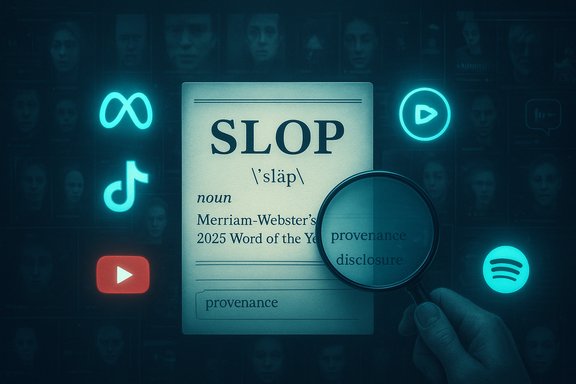
Merriam‑Webster’s pick of “slop” as its 2025 Word of the Year crystallizes a cultural turn: after three years of explosive generative‑AI adoption, public vocabulary finally has a single, scornful word for the glut of low‑quality, mass‑produced digital content flooding feeds and search results. The decision is less a linguistic curiosity and more a practical signal — platforms, publishers, advertisers and developers must now reckon with a mainstream label for what many users already call junk AI output.
That work matters because the future isn’t binary: AI can be a force multiplier for creativity, accessibility and productivity — or it can be an industrial engine for low‑value noise. The difference will be the combination of product design, honest economics, careful governance and human stewardship. Merriam‑Webster gave us a handy word to point at the problem. Now the harder tasks remain: measuring it, staffing the fixes, and redesigning incentives so that 2026 produces more genuine value — and less slop.
Source: Windows Central https://www.windowscentral.com/soft...low-quality-content-as-a-cultural-phenomenon/
 Background
What Merriam‑Webster actually announced
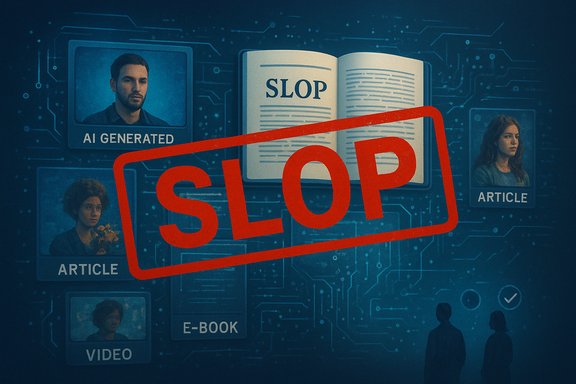
Merriam‑Webster’s editors selected “slop” for 2025 and described the usage now most searched for as “digital content of low quality that is produced usually in quantity by means of artificial intelligence.” The entry recasts a centuries‑old word — originally “soft mud,” then “pig food” and later general rubbish — into the age of generative media, from uncanny short videos and fake celebrity clips to mass‑produced, thinly edited e‑books. The pick reflects a measurable spike in lookups and an editorial judgment that the term best captured public conversation this year.Why this matters beyond wordplay
Choosing a Word of the Year is shorthand for how language mirrors social experience. This year, that experience is dominated by a tension we’ve lived with for months: generative AI can scale creativity, but it also scales low effort and misinformation. Merriam‑Webster’s selection isn’t a policy prescription, but it is a cultural diagnosis — a recognition that consumers, critics and creators have already developed a shorthand to call out content that adds little value.Where “slop” shows up: platforms, products and real‑world effects
YouTube and the monetization clampdown
Platforms bore the brunt of 2025’s slop surge. YouTube moved to tighten its monetization rules in mid‑2025, explicitly targeting mass‑produced, repetitive and low‑value videos — including many forms of fully automated AI uploads — by clarifying and expanding its YouTube Partner Program review criteria. The update emphasized human involvement, originality and substantive transformation as thresholds for advertiser‑friendly eligibility; channels relying on AI voiceovers, templated slideshows, or thinly edited compilations saw the most immediate risk. Reporters and creator‑focused outlets framed the move as a bid to protect creator incomes and advertiser trust while conceding the practical difficulty of reliable, consistent enforcement.- What changed in practice:
- Stricter review for mass‑produced uploads.
- Requirement for demonstrable human editing or commentary on AI‑assisted videos.
- Reclassification of “repetitive content” into a broader “inauthentic content” rubric.
OpenAI, Sora and the economics of a slop factory
The rise of short‑form AI video apps accelerated the volume problem. OpenAI’s Sora — an app that generates short videos from text prompts — became both a cultural lightning rod and a cost center. Analysts and journalists produced back‑of‑envelope calculations suggesting OpenAI could be incurring costs on the order of tens of millions per day to serve free or heavily subsidized video generation — a figure widely quoted as roughly $15 million per day. Those figures are estimates, grounded in reported download numbers, analyst GPU‑cost assumptions and Sora’s pricing plans; OpenAI declined to publish definitive operating numbers when asked. Readers should treat the $15M/day figure as an informed industry estimate, not a company confirmation.- Why the number matters: it reframes “slop” as an industrial output problem — not only a cultural annoyance but a large‑scale infrastructure and economics challenge for companies that subsidize high‑volume, low‑value outputs to drive engagement.
Slop on the political stage and in the newsroom
Beyond entertainment, slop has real civic costs. Research and reporting in 2025 showed mass AI‑generated videos used for misinformation and extreme partisan amplification racking up hundreds of millions to billions of views in aggregate on some platforms. Those episodes prompted collaborative takedowns, new platform‑researcher partnerships, and attention from regulators in several countries. The presence of faked videos and convincingly altered clips raised fresh worries about elections, public health messaging and the trustworthiness of archival content.The cultural spin: “touch grass,” attachment to models, and the warmth problem
“Touch grass” and the anti‑slop meme
Merriam‑Webster’s roundup also flagged related slang such as “touch grass” — an admonition to go offline and engage with the physical world — which rose alongside debates about AI’s role in social isolation, parasocial relationships and declining media literacy. Linguistically, the meme set functions as a social corrective: not just an insult but a recommended behavior to escape the spiral of low‑quality online stimulation.Model personality and user attachment
The slop debate isn’t limited to short videos. The rollout of new conversational models (notably OpenAI’s GPT‑5) triggered user backlash because some regulars preferred the older, warmer personality of GPT‑4o. When companies change the tone of their assistants — trimming sycophancy or tightening factuality — they can provoke strong emotional reactions from users who had come to rely on those tools for companionship or mental‑health support. OpenAI’s decision to restore access to GPT‑4o for some paying users after complaints illustrates how “product quality” in 2025 blends technical metrics with felt relational experience. This dynamic helps explain why the word “slop” resonates: it’s not just content quality, but the drift from human nuance to robotic sameness that users reject.Background, value and harm: separating slop from useful AI
What slop is not
Not all AI output is slop. Generative tools power:- Accessibility features such as OCR, captioning and image descriptions that materially improve usability for people with disabilities.
- Developer workflows: code review, bug spotting, scaffolding and automated test generation.
- Data summarization and research triage that can save hours of repetitive work.
Harm vectors to watch
Slop amplifies several harms:- Misinformation and deepfakes that erode trust in media.
- Copyright and provenance problems when training or outputs reuse protected material.
- Economic churn as ad monetization moves away from templated, low‑value content.
- Deskilling, when workers accept unverified AI drafts that degrade domain expertise over time.
Business and policy responses: platforms, publishers and governments
Platform policies and enforcement dilemmas
YouTube’s monetization changes from July 2025 illustrate a pragmatic approach: keep AI tooling available but insist that monetizable content demonstrate human value. Enforcement is the challenge. Automated flagging systems are error‑prone, and human reviewers are expensive and slow. Political and regulatory pressure — including new ad‑labeling laws in jurisdictions like South Korea — will push platforms to tighten disclosure and provenance requirements for AI‑assisted ads and content. Expect more platform rulebooks, but also more public debate about whether rules are fair and whether they over‑penalize small creators.Commercial choices: subsidize, monetize, or tax
Companies face three blunt choices when slop scales:- Subsidize large, loss‑making content generation (a growth/adoption play).
- Monetize more aggressively (fees, premium tiers, or ads in generated outputs).
- Limit features or require opt‑in and disclosure to protect long‑term trust.
Workplace governance and “AI fluency”
Companies embedding AI into workflows — including those asking managers to consider “AI fluency” in performance — must avoid converting tooling usage into blunt metrics that reward quantity over quality. Internal memos and reporting in 2025 showed some teams exploring AI‑use metrics in reviews, which triggered debate about fairness, auditability and worker consent. Policies that treat AI as a drafting assistant (and require evidence and human sign‑off) are less likely to produce poor outcomes than simple usage quotas.Practical recommendations for technologists and Windows users
For creators and Windows power users
- Treat AI output as a first draft: validate facts, cite sources, and add original voice.
- Preserve provenance: annotate AI‑assisted work with logs and prompts where feasible.
- Use local tools for preprocessing (OCR, offline editing) before feeding content into cloud models.
- For Windows users: embrace AI features that help productivity (OCR in Windows 11, Copilot for drafts) but disable or gate features that automatically publish or share content without review.
For platform and product teams
- Require provenance metadata for AI‑generated media surfaced to the public.
- Invest in lightweight human review and rapid appeal routes to reduce false takedowns.
- Design monetization rules that reward demonstrable transformation, not mere automation.
- Publish transparent impact reports on moderation accuracy and enforcement outcomes.
For policy makers and regulators
- Prioritize disclosure laws for advertising that uses synthetic media.
- Fund independent audit programs that can evaluate platform enforcement and model outputs for bias and misinformation.
- Encourage standards for model explanation and content provenance that platforms can implement interoperably.
Strengths, weaknesses and the long view
Notable strengths of the current landscape
- Generative AI tools deliver genuine productivity gains across many domains — from code to accessibility.
- Public attention (and words like “slop”) create political pressure for better platform governance.
- Industry experiments — even loss‑making ones like Sora — accelerate understanding of model costs and user behavior.
Real risks and weaknesses
- Economic models that subsidize high‑volume, low‑quality outputs can warp attention markets and fund misinformation.
- Automated moderation is brittle; enforcement mistakes will damage creators and public trust.
- Workplaces that lean on AI without verification risk fairness and accuracy problems in evaluations and decisions.
What to watch in 2026
- Whether major platforms converge around a common definition of “authentic” or diverge into walled approaches to AI content.
- Whether training‑data transparency laws or advertising disclosure rules gain traction across major markets.
- How model economics evolve: will real unit costs for video generation fall fast enough to make Sora‑style services sustainable without large subsidies?
Conclusion: slop as signal, not destiny
Merriam‑Webster’s choice of “slop” is blunt, memorable and culturally potent — and that’s the point. The word captures a feeling that large swaths of AI output in 2025 are disposable, untrustworthy and often pointless. But the label also offers clarity: by naming the problem, societies can decide how to respond. Platforms are already adjusting monetization and moderation rules; regulators are testing disclosure regimes; and product teams are debating how to keep the valuable parts of AI while cutting out the sludge.That work matters because the future isn’t binary: AI can be a force multiplier for creativity, accessibility and productivity — or it can be an industrial engine for low‑value noise. The difference will be the combination of product design, honest economics, careful governance and human stewardship. Merriam‑Webster gave us a handy word to point at the problem. Now the harder tasks remain: measuring it, staffing the fixes, and redesigning incentives so that 2026 produces more genuine value — and less slop.
Source: Windows Central https://www.windowscentral.com/soft...low-quality-content-as-a-cultural-phenomenon/