

Qualcomm’s Snapdragon X2 Plus promises to be the practical tipping point for Arm‑powered Windows laptops — not because it is the flashiest chip in the room, but because it targets the price bands and real‑world power envelopes where most buyers and businesses actually live. Early hands‑on testing and vendor briefings show a chip that borrows the high‑end DNA of the X2 Elite family (notably the Adreno X2‑45 GPU and an 80 TOPS Hexagon NPU) while tuning core counts, cache and clocks to land squarely in mainstream ultrabooks and enterprise fleets — and those moves could force x86 vendors to rethink power, thermals and AI on device strategy.
Windows on Arm has been steadily maturing for the past several years, but adoption has been constrained by three recurring fault lines: emulation and app compatibility, sustained performance in thin designs, and on‑device AI capability. Qualcomm’s X2 family addressed those gaps at the high end with the X2 Elite and X2 Elite Extreme, and X2 Plus is the deliberate volume play — a chip designed for the $799–$1,299 laptop segment where OEMs sell the majority of units and enterprises refresh fleets. That positioning, combined with claimed efficiency and NPU leadership, is what makes the X2 Plus a strategic product rather than a mere line extension. Microsoft’s platform plans also shape the context: device‑targeted Windows images (often discussed under the “26H1”/Bromine nickname) are being prepared to ensure NPU runtimes, drivers and firmware are validated for X2‑class silicon at launch. That coordinated silicon‑OS‑OEM approach reduces day‑one risk and accelerates practical adoption in both consumer and enterprise channels.
Why that matters in practice:
But raw TOPS is not the whole story:
Enterprises still need to plan:
The X2 Plus looks like a credible, immediate threat to some x86 laptop segments, but whether Arm truly “breaks” into mainstream enterprise and consumer markets will depend as much on final SKUs, pricing, memory configurations and software compatibility as it does on raw TOPS or benchmark charts. Early impressions from vendor previews are strong, but the decisive moment will arrive when reviewers test shipping devices in real‑world scenarios and enterprises pilot them at scale.
Source: Windows Central https://www.windowscentral.com/hardware/qualcomm/qualcomm-announces-snapdragon-x2-plus-ces-2026/
 Background: why the X2 Plus matters now
Windows on Arm has been steadily maturing for the past several years, but adoption has been constrained by three recurring fault lines: emulation and app compatibility, sustained performance in thin designs, and on‑device AI capability. Qualcomm’s X2 family addressed those gaps at the high end with the X2 Elite and X2 Elite Extreme, and X2 Plus is the deliberate volume play — a chip designed for the $799–$1,299 laptop segment where OEMs sell the majority of units and enterprises refresh fleets. That positioning, combined with claimed efficiency and NPU leadership, is what makes the X2 Plus a strategic product rather than a mere line extension. Microsoft’s platform plans also shape the context: device‑targeted Windows images (often discussed under the “26H1”/Bromine nickname) are being prepared to ensure NPU runtimes, drivers and firmware are validated for X2‑class silicon at launch. That coordinated silicon‑OS‑OEM approach reduces day‑one risk and accelerates practical adoption in both consumer and enterprise channels.What Snapdragon X2 Plus is — a technical overview
Two SKUs, shared high‑end DNA
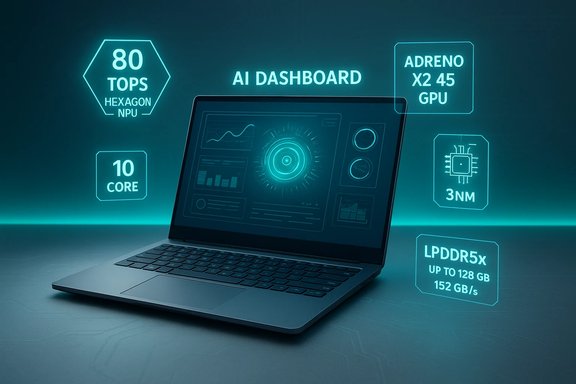
- Two main variants: a 10‑core X2P‑64‑100 and a 6‑core X2P‑42‑100. Both are built on the same 3nm process node and Oryon CPU microarchitecture lineage as the X2 Elite family.
- Both SKUs share the Adreno X2‑45 GPU family and the Hexagon NPU rated at 80 TOPS (INT8) — the latter is a defining feature that keeps the chip decidedly premium despite the “Plus” name.
Key specs called out in vendor materials and early coverage
- Peak performance core boost up to 4.0 GHz (both SKUs).
- 10‑core model: up to 34 MB cache and GPU clocks up to 1.7 GHz. 6‑core model: lower cache and GPU clocks (GPU ~0.9 GHz on some SKUs) to hit more affordable thermal/power envelopes.
- Memory: support for LPDDR5x up to vendor‑selected capacities and bandwidths (Qualcomm materials reference configurations up to 128 GB and around 152 GB/s in certain product choices). OEM choices on memory capacity and bandwidth will determine the final experience.
Why the common NPU matters
Both X2 Plus SKUs carry the same 80 TOPS Hexagon NPU as the Elite parts. That parity means mainstream X2 Plus systems inherit the same on‑device AI throughput claims as premium models, which is pivotal for Windows features that rely on local inference: Copilot+ experiences, Automatic Super Resolution, Studio Effects, and agent‑style tasks. In short: the NPU is the product’s secret sauce, not a marketing add‑on.Performance claims and hands‑on results — what we can verify
Vendor and press numbers
Qualcomm’s briefing and early press preview materials highlight generational gains over the prior X‑series parts: up to 35% single‑core, 17% multi‑core, and 29% GPU gains for the 10‑core X2 Plus compared with Snapdragon X Plus, as well as large NPU improvements. Early hands‑on Geekbench 6.5 runs performed on pre‑production systems matched Qualcomm’s public slides in the press preview.Benchmarks that mattered in the preview
- Geekbench 6.5 (CPU): X2 Plus engineering units outperformed some on‑market Intel Core Ultra 7 (Ultra 2 family) mobile chips in single‑ and multi‑core runs at comparable power targets. The hands‑on data showed the X2 Plus delivering higher single‑thread responsiveness and stronger sustained performance under battery constraints versus selected Intel parts.
- UL Procyon AI / Geekbench AI: X2 Plus recorded very high scores (Geekbench AI scores in the 80k range in vendor slides and early runs) that put it multiple times ahead of the Intel Core Ultra samples used in Qualcomm’s comparisons. These deltas are large and track with the 80 TOPS NPU specification.
Cross‑validation with independent press coverage
Independent outlets covering Qualcomm’s CES event reported the same SKU split, 80 TOPS NPU claim, and performance positioning of X2 Plus as a mid‑premium part designed for mainstream laptops. Those outlets repeated the 35% single‑core claim and the 4.0 GHz boost figure while noting that OEM thermal design and firmware tuning will determine retail outcomes.Important verification caveats
- Many of the headline numbers originate in vendor‑controlled briefings or engineering‑sample demos. These are useful directional indicators but not final retail guarantees. Independent retail reviews will be the final arbiter.
- The comparisons with Intel in Qualcomm materials are often power‑normalized to equal envelopes (a fair approach for laptops), but details matter: how “same power” is defined (PL1/PL2/sustained chassis limit) changes outcomes. Treat vendor power‑normalized charts with careful scrutiny.
Battery life, thermals and real‑world behavior
Qualcomm’s messaging — and early hands‑on impressions — emphasize sustained performance on battery as a central advantage. Engineering units in the preview ran cool and quiet under sustained loads, with no aggressive fan ramping or sudden throttling when unplugged. Qualcomm also claims up to 43% lower power versus previous generations in particular scenarios, which supports the “multi‑day” battery narratives for light use.Why that matters in practice:
- Thin‑and‑light OEM designs gain more usable sustained performance headroom when the SoC maintains clocks at lower power and heat.
- Enterprise fleets get consistent behavior for predictable deployments.
- For buyers, perceived responsiveness (single‑thread interactivity) often trumps raw multi‑core peak numbers in day‑to‑day use.
AI on device: the Hexagon advantage (and why it isn’t just TOPS)
The Hexagon NPU’s 80 TOPS rating is the X2 Plus’s headline advantage. Benchmarks like Geekbench AI and Procyon show dramatic throughput deltas versus currently shipping x86 NPUs used in some Intel Core Ultra 2 parts. That throughput allows concurrent local agent workloads, low‑latency inference for user features and improved privacy characteristics versus cloud‑only models.But raw TOPS is not the whole story:
- Real‑world gains depend on model quantization, memory bandwidth, runtime optimizations and framework support (ONNX, TensorFlow Lite, etc.. TOPS is a useful comparative headline, but application‑level performance requires the entire software stack to be mature.
- Microsoft’s device‑targeted platform work (26H1/Bromine) is designed precisely to ensure these runtimes and driver stacks are validated on day‑one for X2 devices. That reduces one major adoption risk.
The competitive picture: Intel’s Panther Lake and the x86 response
Intel’s Core Ultra Series 3, codenamed Panther Lake, is the clearest near‑term x86 counterpunch. Intel positions Panther Lake as the company’s first client platform on Intel 18A, with a multi‑chiplet design, upgraded CPU cores, a refreshed Xe3 GPU architecture and a much larger platform TOPS figure across the SoC family. Intel’s architectural preview promises significant gains in CPU, GPU and NPU performance — and the company has said Panther Lake‑based products will ship broadly in the same early‑2026 timeframe. How the matchup looks today:- On raw NPU throughput, Panther Lake’s platform TOPS claims will close the gap in many configurations; Intel has publicly suggested high aggregate TOPS figures across platform components. But vendor TOPS math can be aggregated differently; practical per‑model NPU behavior will vary.
- Qualcomm’s advantage, at least initially, is NPU efficiency and a mature Hexagon software ecosystem on Windows for the targeted local AI workloads. Intel’s Panther Lake will bring strong competition, particularly in graphics and single‑thread performance as it reaches production hardware.
- AMD is also preparing refreshed Ryzen AI silicon, which adds another variable to the competitive matrix and will shape OEM choices across price and performance tiers.
Enterprise features and manageability
One of the overlooked but strategic moves in Qualcomm’s messaging is wider availability of Snapdragon Guardian remote manageability on X2 Plus devices: out‑of‑band updates, remote lock/wipe, and device tracking. Those features have been an Intel vPro stronghold and are critical for business adoption. By offering similar manageability primitives on Arm platforms, Qualcomm removes a significant enterprise barrier to migration.Enterprises still need to plan:
- Imaging and provisioning for device‑targeted Windows images (Bromine/26H1) and potential SKU‑level servicing differences.
- Validation of critical legacy apps under emulation or native Arm builds.
- Driver and firmware lifecycle expectations for early‑wave hardware.
Concerns, risk factors and unknowns
No single chip launch erases ecosystem realities. The X2 Plus has clear strengths, but buyers and IT teams should weigh the following risks.- Vendor demo vs. retail reality: Many top scores were produced on engineering‑sample or Qualcomm‑validated reference hardware. OEM thermals, BIOS, firmware tuning and final power targets often change retail performance. Treat early numbers as directional pending independent retail reviews.
- Software compatibility edge cases: Windows‑on‑Arm compatibility is vastly improved, but niche enterprise apps, older drivers and some GPU‑heavy creative pipelines still show inconsistencies under emulation. Enterprises must test mission‑critical software before rollout.
- Gaming and anti‑cheat: Game support has improved, but anti‑cheat ecosystems and some high‑profile titles remain spotty. Qualcomm and Microsoft are working with vendors, yet game‑by‑game validation remains necessary for serious gamers.
- Memory and component supply pressure: LPDDR5x prices and availability — driven by data‑center and AI demand — can push OEMs to ship X2 Plus laptops with reduced memory or to price devices higher than anticipated. That supply dynamic affects all vendors and could blunt the price‑performance advantage of some configurations.
- Marketing naming vs. actual tiering: The 6‑core and 10‑core X2 Plus variants differ meaningfully in GPU clocks, cache and multi‑core throughput. OEM configuration choices could create confusing product stacks that leave buyers uncertain about which model meets their needs.
Availability, OEM plans and market impact
Qualcomm and multiple OEMs signaled that first X2 Plus laptops should appear in the first half of 2026, with OEM announcements already surfacing at CES. Early OEM messaging positions X2 Plus in mainstream ultrabooks and 2‑in‑1 designs from brands like HP, Lenovo, ASUS and others. Those OEM lineups — if priced and configured sensibly — are the mechanism by which X2 Plus can shift market share. What to watch in the rollout:- Final retail battery and thermal tests from major reviewers.
- OEM SKU choices around LPDDR5x capacity and GPU clocking.
- Microsoft’s platform gating and whether OEMs ship devices with validated Bromine/26H1 images or default to later updates.
Technical claims: verified, cross‑checked and flagged
Below are the principal technical claims and how they stand up against public documentation and independent coverage.- Claim: X2 Plus SKUs (10‑core and 6‑core) built on 3nm with Oryon cores, Adreno X2‑45 GPU and 80 TOPS Hexagon NPU.
- Verified by multiple press reports and Qualcomm briefings; corroborated by independent coverage at CES.
- Claim: Up to 35% single‑core and 17% multi‑core gains vs. prior Snapdragon X Plus.
- These are vendor‑provided generational delta figures and were repeated by press; they are plausible in engineering tests but require retail confirmation. Treat as directionally verified but pending independent retail benchmarking.
- Claim: Geekbench AI / Procyon deltas showing X2 Plus multiples over selected Intel chips.
- Early hands‑on and vendor slides show large deltas; independent press covered similar trends. However, benchmark conditions and power normalizations differ. Flag: scores come from engineering/reference systems and should be validated on shipping OEM laptops.
- Claim: X2 Plus enables multi‑day battery life targets.
- Qualcomm and OEM targets exist, and engineering samples show strong efficiency. Flag: “multi‑day” remains a marketing target until independent retail battery tests confirm typical use outcomes.
- Claim: Intel Panther Lake will materially change the competitive landscape.
- Intel’s Panther Lake architecture and 18A process announcements are public and indicate strong competition arriving in early 2026; multiple independent sources confirm Panther Lake’s roadmap and claims.
What this means for buyers, IT pros and OEMs
- Consumers who value battery life, thinness and on‑device AI features should place X2 Plus systems on their consideration list once retail reviews are available; the mainstream price tier this chip targets is where it can move the needle.
- Enterprise IT should pilot X2 Plus devices early if they plan to adopt Copilot+ features or want to exploit local NPU capabilities, but they must require OEM confirmation on Bromine/26H1 image support, driver servicing policies and provide their own validation labs for critical apps.
- OEMs have the chance to differentiate through thermal design, memory and GPU clocking choices; the companies that ship thoughtfully configured, clearly messaged SKUs will win the most trust and sales.
Conclusion
The Snapdragon X2 Plus is not a mere mid‑cycle refresh — it is Qualcomm’s pragmatic play for laptop volume. By bringing the same high‑throughput Hexagon NPU and a scaled Adreno X2 GPU into a carefully configured mainstream SoC, Qualcomm has created a chip that can make Arm laptops genuinely compelling to everyday buyers and enterprises once OEMs and Microsoft deliver robust retail software and firmware. That said, the competitive battlefield is heating up: Intel’s Panther Lake and AMD’s Ryzen AI plans mean that 2026 will be defined by aggressive iteration, better on‑device AI across architectures, and — importantly — the quality of OEM execution.The X2 Plus looks like a credible, immediate threat to some x86 laptop segments, but whether Arm truly “breaks” into mainstream enterprise and consumer markets will depend as much on final SKUs, pricing, memory configurations and software compatibility as it does on raw TOPS or benchmark charts. Early impressions from vendor previews are strong, but the decisive moment will arrive when reviewers test shipping devices in real‑world scenarios and enterprises pilot them at scale.
Source: Windows Central https://www.windowscentral.com/hardware/qualcomm/qualcomm-announces-snapdragon-x2-plus-ces-2026/
