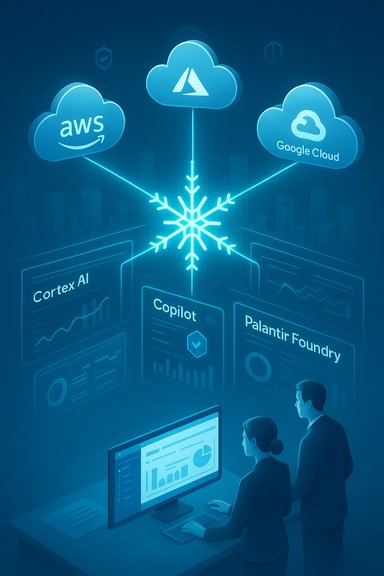
Snowflake’s recent results and partner announcements paint a picture of a company that is successfully converting platform innovation and ecosystem depth into measurable enterprise traction — but the narrative comes with important caveats about competition, valuation, and the uncertain economics of AI-driven consumption.
What’s new is simple: Snowflake reported an acceleration in product revenue growth and a notable expansion of its high-value customer cohort, while leaning into deeper cloud and ISV partnerships (including a headline partnership with Palantir) to accelerate enterprise AI adoption. These developments support the company’s long-term growth story, but they also raise questions about margin durability, hyperscaler competition, and whether premium multiples already price in near‑perfect execution.
Snowflake has repositioned itself from a cloud data‑warehouse vendor into what it calls an AI Data Cloud — a platform that not only stores and queries data but also hosts AI workloads, agents, and governed inference close to the enterprise data that fuels those models. That repositioning is being executed through product innovation (Cortex AI, Snowflake Intelligence, Gen2 warehouse features), multicloud parity, and a growing matrix of technology and SI partners. The result: measurable signs of accelerating consumption, net revenue retention that stays elevated, and a swelling cohort of customers spending meaningful amounts on the platform.
These changes are visible in the company’s second quarter of fiscal 2026 results, which showed an acceleration in product revenue growth and stronger operating leverage than prior quarters — metrics investors and IT leaders watch closely as the company pushes into AI workloads. Major publications and earnings transcripts reflect a consistent set of financial takeaways that support this narrative.
The partnership wave — particularly the Palantir deal — is a positive for customers who need interoperability and turnkey AI pipelines. For investors, the upside is real but conditional: Snowflake needs to convert AI interest into steady, predictable consumption across hundreds more large accounts to justify the premium the market has assigned.
(Analysis informed by the provided Globe and Mail / Zacks content and corroborated against earnings transcripts, press coverage, and company statements.
Source: The Globe and Mail SNOW Benefits From Expanding Partner Base: A Sign for More Upside?
What’s new is simple: Snowflake reported an acceleration in product revenue growth and a notable expansion of its high-value customer cohort, while leaning into deeper cloud and ISV partnerships (including a headline partnership with Palantir) to accelerate enterprise AI adoption. These developments support the company’s long-term growth story, but they also raise questions about margin durability, hyperscaler competition, and whether premium multiples already price in near‑perfect execution.
 Background / Overview
Snowflake has repositioned itself from a cloud data‑warehouse vendor into what it calls an AI Data Cloud — a platform that not only stores and queries data but also hosts AI workloads, agents, and governed inference close to the enterprise data that fuels those models. That repositioning is being executed through product innovation (Cortex AI, Snowflake Intelligence, Gen2 warehouse features), multicloud parity, and a growing matrix of technology and SI partners. The result: measurable signs of accelerating consumption, net revenue retention that stays elevated, and a swelling cohort of customers spending meaningful amounts on the platform.These changes are visible in the company’s second quarter of fiscal 2026 results, which showed an acceleration in product revenue growth and stronger operating leverage than prior quarters — metrics investors and IT leaders watch closely as the company pushes into AI workloads. Major publications and earnings transcripts reflect a consistent set of financial takeaways that support this narrative.
Financial snapshot: growth, customers, and forward guidance
The headline numbers
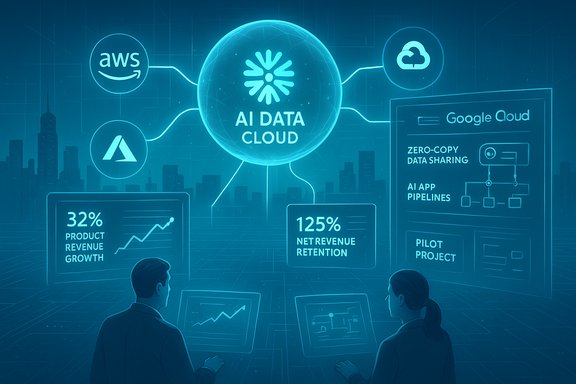
- Product revenue for Q2 was reported at roughly $1.09 billion, an acceleration that equates to about 32% year‑over‑year growth.
- Net Revenue Retention (NRR) remained in the mid‑120s (around 125%), a level typically associated with healthy expansion within existing enterprise accounts.
- The company added 533 net new customers in the quarter, including 15 Global 2000 names; 50 customers crossed the $1 million trailing‑12‑month revenue threshold during the quarter, bringing the >$1M cohort to 654.
Guidance and margins
Snowflake raised its fiscal product‑revenue outlook and guided to continued improvement in non‑GAAP operating margins, signaling that the company is chasing a path toward scaled profitability while still investing aggressively in product and go‑to‑market. Margin expansion was visible in the quarter (non‑GAAP operating margin in the low double digits was reported by some aggregators), but the long‑term margin story depends on converting AI interest into steady consumption rather than one‑off infrastructure spikes.The partner ecosystem: a growth multiplier
Multicloud and hyperscaler alignment
Snowflake’s multicloud model — the ability to run in AWS, Microsoft Azure, and Google Cloud — is a strategic differentiator for customers that want cloud flexibility. That said, the company’s go‑to‑market has produced clear cloud‑level wins: Azure was reported as the fastest‑growing cloud for Snowflake during the quarter, up roughly 40% year‑over‑year, a datapoint that highlights tighter field alignment and product integrations with Microsoft. This Azure momentum helps expand Snowflake’s addressable market, particularly across regions and accounts where Microsoft has stronger enterprise traction.- Benefits of cloud partner depth:
- Faster enterprise sales cycles where field teams are coordinated.
- Product‑level integrations (BI, OneLake/Power BI, Copilot hooks) that reduce friction for Microsoft customers.
- Regional scale via Microsoft’s global datacenter footprint.
System integrators, technology partners, and vertical plays
Snowflake’s go‑to‑market also relies on a broad partner base of SIs and technology vendors. Those partners can accelerate deployments, add vertical accelerators (manufacturing, healthcare, financial services), and create solutions that are harder for hyperscalers to displace.- Recent verticalization examples include integrations with Siemens for OT/IT scenarios and with other industrial partners to ingest edge telemetry into governed Snowflake data tables — a move intended to create stickier, mission‑critical workloads.
The Palantir tie‑up: practical interoperability or headline optics?
On October 16, 2025, Snowflake and Palantir announced a strategic partnership to integrate Snowflake’s AI Data Cloud with Palantir’s Foundry and Artificial Intelligence Platform (AIP). The integration emphasizes bidirectional, zero‑copy interoperability between Foundry and Snowflake Iceberg tables and names Eaton as a flagship customer already reaping benefits from the combined stack. The press release highlights faster data pipelines, governed single sources of truth, and accelerated AI app development as immediate outcomes.Why the partnership matters
- Practical interoperability: Zero‑copy data sharing reduces ETL and duplication friction — a real operational win for teams that want governed, real‑time access to the same enterprise dataset across analytic and operational applications.
- Faster time‑to‑value for AI apps: By combining Snowflake’s governance and storage model with Palantir’s workflow and model operationalization tools, customers can shorten development cycles for agentic and inference‑driven applications.
- Strategic logos: Eaton’s public reference as a pilot customer gives the deal early credibility and an enterprise use case that other customers can benchmark.
Caveats and realistic expectations
- This is a strategic integration, not an acquisition. It improves workflow interoperability but does not suddenly eliminate the need for cloud compute, GPU provisioning, or specialized ML infrastructure where required.
- Palantir has partnerships across the AI/analytics ecosystem (including competitors of Snowflake), and similar integrations with other data platforms exist. The commercial impact will depend on uptake beyond marquee pilots. Independent coverage and the official press release provide consistent framing but the magnitude of the revenue or usage impact remains to be seen in subsequent quarters.
Competition: why hyperscalers and specialized platforms keep Snowflake honest
Snowflake sits in a crowded and well‑funded segment. The biggest competitive pressure comes from hyperscalers — AWS, Google Cloud, and Microsoft — as they integrate analytics, storage, and model services into increasingly attractive bundles.- AWS continues to iterate on Redshift, SageMaker, and new choices for inference that integrate closely with its ecosystem. Large enterprises still run significant Snowflake workloads on AWS for reasons of latency, cost, or historical preference.
- Google Cloud has aggressively pushed BigQuery as a serverless data‑warehouse alternative while pairing with NVIDIA and other AI vendors to offer distinctive GPU and model services. BigQuery’s pricing model and Google’s AI momentum make it a credible hyperscaler‑native alternative for many analytics workloads.
Valuation and stock performance: premium multiples, elevated expectations
Snowflake’s shares have been strong year‑to‑date in the periods leading up to and following the Q2 report, outperforming broader sector indices in several slices of 2025 reporting. That market optimism is tied to the company’s AI positioning, customer expansion metrics, and guidance raises. At the same time, Snowflake trades at a premium Price/Sales multiple compared with the broader Internet Software group and has received “overvalued” or low value‑score commentary from some analytics shops. Zacks and other data providers have published P/S metrics and value scores that underscore the stock’s premium valuation. These figures are time‑sensitive and change with market moves and new estimates; treat them as snapshot indicators rather than immutable facts.- The implication for investors: Snowflake’s execution bar is high. Missing growth or margin expectations could lead to meaningful multiple compression given the premium baseline.
For enterprise IT and WindowsForum readers: practical takeaways
- Map workloads first, then pick platform(s). Snowflake excels for governed, cross‑cloud analytics and AI where data sharing and portability matter. If your workload is heavily hyperscaler‑native or primarily model‑training intensive, evaluate hyperscaler options or specialized ML platforms in parallel.
- Model TCO conservatively. AI workloads have volatile resource footprints. Model inference, fine‑tuning, and large embedding stores can create unexpectedly high consumption bills if not architected with cost control. Consider storage tiering, egress, and inference locality in your TCO model.
- Use partner integrations to reduce operational friction. Native integrations (for example, the Snowflake‑Palantir interoperability) can eliminate brittle ETL pipelines and accelerate app delivery — valuable for vertical use cases where time‑to‑value matters.
- Pilot and measure AI productionization. Move beyond PoCs: measure steady state inference costs, latency SLAs, retraining cadence, and governance overhead before rolling AI into mission‑critical workflows.
Strengths, risks, and the road ahead — an analyst’s critical view
Notable strengths
- Strong customer expansion: The acceleration in the >$1M customer cohort is a classic SaaS bellwether that, if sustained, supports durable high‑value revenue.
- Compelling partner matrix: Deepening ties with Microsoft/Azure and system integrators can materially expand reach and shorten adoption cycles for enterprise customers.
- Product innovation targeted at AI: Native SQL‑centric AI primitives and the Cortex ecosystem lower the barrier for enterprises that want governed, explainable AI close to their data.
Material risks
- Hyperscaler competition and pricing pressure: The big cloud vendors are integrating analytics and AI stacks with aggressive price/performance tradeoffs. That competition can squeeze growth or force Snowflake to invest more in discounting.
- Consumption volatility from AI workloads: AI-driven usage patterns can be lumpy — a single large inference pipeline or retraining initiative can spike consumption unpredictably and make revenue less smooth.
- Valuation sensitivity: With premium multiples baked into the stock price, even small misses or slower-than-expected expansion of AI usage could produce outsized downside for investors.
Unverifiable or time‑sensitive claims to watch
Some third‑party metrics (value scores, forward P/S ratios, exact year‑to‑date returns) are updated frequently by market data vendors. Statements about exact multiple levels or short‑term stock returns should be treated as time‑sensitive and verified against the latest vendor data before making investment decisions. The uploaded analysis that framed some of these valuation numbers is useful context but dated snapshots may not reflect current market prices.What to watch next (quarterly checklist)
- Sequential product revenue growth and the company’s guidance trajectory in Q3 and FY26.
- Net revenue retention trends: sustained NRR >120% remains a crucial indicator of expansion inside current accounts.
- Growth in the >$1M customer cohort: continued expansion signals entrenchment and multi‑workload adoption.
- Measured outcomes from partner integrations (for example, Azure‑specific go‑to‑market lifts and Palantir joint use cases) documented in case studies and customer rollouts.
- Evidence that AI workloads are shifting from POC to sustained production use with predictable consumption profiles.
Conclusion
Snowflake’s latest quarter and the expanding partner ecosystem — including cloud providers, systems integrators, and a strategic Palantir integration — have created tangible pathways for growth in the AI era. The company is showing credible signs of converting product innovation into commercial outcomes: accelerating revenue, a widening cohort of seven‑figure customers, and improved operational leverage. At the same time, Snowflake’s trajectory faces realistic headwinds. Hyperscaler competition, the unpredictable nature of AI consumption, and elevated valuation multiples mean the company’s execution must be consistent and measurable. For IT leaders, the message is pragmatic: Snowflake offers strong technical and governance capabilities for cross‑cloud AI workloads, but procurement and architecture decisions should map workloads to the most cost‑efficient and governance‑compliant platform — potentially combining hyperscaler services and Snowflake where each makes sense.The partnership wave — particularly the Palantir deal — is a positive for customers who need interoperability and turnkey AI pipelines. For investors, the upside is real but conditional: Snowflake needs to convert AI interest into steady, predictable consumption across hundreds more large accounts to justify the premium the market has assigned.
(Analysis informed by the provided Globe and Mail / Zacks content and corroborated against earnings transcripts, press coverage, and company statements.
Source: The Globe and Mail SNOW Benefits From Expanding Partner Base: A Sign for More Upside?