

TrueAchievements has listed Sokogem (Windows) for August 6, 2026, identifying Windows as the platform and Marcus Fernandes alongside the entry, but the page currently functions more as an early database marker than a complete release announcement, with no price, publisher, system requirements, or store link supplied. The important news is not that a small puzzle game has suddenly become a major Windows launch. It is that an established browser title appears to be moving toward a packaged Windows release connected to the Xbox achievement ecosystem, while the public-facing details remain conspicuously incomplete. For players, achievement hunters, and administrators responsible for managed gaming PCs, the listing is a signal—not yet a finished release brief.
The TrueAchievements page gives us a compact set of facts. The title is Sokogem (Windows), the platform is Windows, and the displayed date is August 6, 2026. The page also names Marcus Fernandes, places the content under “Misc.,” and displays the number 261, although the supplied page text does not clearly establish what that number measures.
That last ambiguity is representative of the entire listing. TrueAchievements has created the usual framework around the game—achievements, news, forum, walkthrough, reviews, scores, price, screenshots, following, and wish-list functions—but the available text contains very little of the information normally needed to evaluate an actual Windows release. There is no confirmed storefront, publisher, developer, regional availability, purchase price, installation size, minimum Windows version, processor requirement, graphics requirement, or accessibility declaration.
The date therefore needs to be handled carefully. TrueAchievements is displaying August 6, 2026 beside the Windows listing, but the supplied material does not include a corresponding announcement from Microsoft, a developer, a publisher, or a Windows storefront. It is reasonable to treat that as the date currently attached to the database entry; it would be premature to treat every commercial and technical detail of the release as settled.
This distinction matters because gaming databases often see the outline of a product before customers see its store page. Achievement metadata, platform records, artwork, screenshots, and release scheduling can surface at different times. A record may be accurate while still being incomplete, and it may be updated before launch without the change representing a cancellation, delay, or technical problem.
What TrueAchievements has exposed is the shape of an impending product. What it has not yet exposed is the product’s complete Windows proposition.
That distinction is the mechanical hook. According to descriptions published by Plays.org, CulinarySchools.org, Y8-linked portals, and other browser-game distributors, movement continues until the player or an object encounters an obstacle. Gems and stones can be pushed across the board, holes can create failure states, and rocks can reportedly be used to make otherwise dangerous spaces traversable.
Those sites broadly agree on the central design: place the required gems into chests, unlock the door, and escape. They also describe keyboard, touch, and gamepad-style input, with the browser version intended to work across desktop and mobile devices. The consistency of those descriptions makes it likely that they are syndicating or embedding the same underlying game rather than reviewing several unrelated products that happen to share a name.
Their surrounding metadata is much less dependable. Some portals provide conflicting or generic claims about release timing, ownership, ratings, modes, and publishers; at least one description appears to mix Sokogem with mechanics belonging to a different game. That is exactly why the TrueAchievements listing should not be filled in by inference.
The browser version can tell us what Sokogem has historically looked like and how its puzzle rules have been described. It cannot, by itself, tell us who is publishing the Windows package, whether the artwork or level set has changed, whether the application is native or wrapped web content, whether achievements have altered progression, or whether the Windows edition includes additional stages.
The comparison makes the central problem clear. The browser game supplies context, while the Windows listing supplies platform intent. Neither source, on its own, gives us a complete description of the product expected on August 6, 2026.
Within the Xbox and TrueAchievements ecosystem, the parenthetical label commonly separates a Windows achievement stack from console editions or other platform-specific releases. It means the Windows build is being tracked as its own product identity rather than merely treated as a website that happens to run in Edge or another browser.
That identity is important to achievement hunters because Xbox-linked Windows releases can occupy their own place in a player’s profile. Progress, completion percentages, unlock timestamps, and Gamerscore become persistent account records rather than local browser data. Even a short puzzle game can therefore attract an audience substantially different from the casual players who encounter it through a web portal.
The TrueAchievements page itself reinforces that interpretation. It is structured around the site’s normal game-tracking functions, including achievements, walkthroughs, scores, reviews, forum activity, pricing, and release information. Search-indexed TrueAchievements material also associates Sokogem’s Windows title with level-based achievement records, indicating that the game is already visible within the site’s achievement data rather than existing only as a placeholder name.
That does not establish how the executable will be distributed. It does, however, make a purely editorial or accidental listing less likely. Someone has supplied enough structured game data for TrueAchievements to recognize Sokogem as a Windows achievement title.
The most plausible reading is that the familiar browser puzzle is being converted, packaged, or republished as a discrete Windows game tied to Microsoft’s gaming services. The exact form of that conversion remains unannounced in the provided material, so it should remain an inference rather than be promoted to fact.
For Sokogem, that skeleton is unusually revealing. A level-based puzzle game naturally lends itself to milestone achievements, and TrueAchievements’ indexed references point toward that kind of structure. It suggests that progression through the stages—not high scores, multiplayer competition, or open-ended challenge modes—is likely to be the organizing principle of the Windows list.
This is commercially useful even when the game itself is modest. Achievement hunters search for predictable completions, separate Windows stacks, straightforward level requirements, and releases that can be scheduled into completion targets. A title that might otherwise disappear among thousands of casual puzzle games gains a specific audience merely by becoming legible to achievement databases.
That audience is not necessarily asking whether Sokogem reinvents Sokoban. It is asking whether the achievements unlock correctly, whether every required level is accessible, whether progress tracks consistently, whether the game can be completed without an external guide, and whether the Windows version has a separate list from any console release.
The database listing begins to answer only the first-order question: this is a Windows title that belongs in an achievement-tracking environment. It does not answer the operational questions that determine whether the release earns a good reputation among completionists.
That omission matters more than it might appear. In a conventional review, a minor save bug is an inconvenience. In an achievement-focused release, a broken level trigger or missed completion flag can become the defining fact about the game, overwhelming every discussion of art, design, or price.
Packaging an HTML5 game for Windows can range from a nearly untouched web wrapper to a meaningful platform adaptation. At the minimal end, the developer preserves the existing assets and logic, adds platform authentication and achievements, and distributes the result as an app. At the more ambitious end, the Windows version may include revised controls, higher-resolution assets, new levels, additional languages, controller navigation, cloud synchronization, and platform-specific menus.
Each path creates different risks. A lightweight wrapper can preserve the original experience but inherit browser-oriented assumptions about aspect ratio, focus, scaling, save storage, and input. A deeper port can improve the game while introducing new bugs in collision logic, achievement triggers, save migration, or level sequencing.
Sokogem’s movement system may make that adaptation less trivial than the simple visuals suggest. Sliding until contact, transferring momentum to movable objects, handling holes, and determining whether a chest has received the correct number of gems all depend on deterministic state transitions. The underlying rules must remain consistent across keyboard, controller, and any supported touch interface.
Puzzle games are particularly unforgiving when ports alter input timing or board-state behavior. A shooter can survive minor variance in movement speed; a deterministic sliding puzzle cannot casually change where an object stops. If a controller produces an extra direction, a key repeats unexpectedly, or focus changes during input, the player can lose a carefully prepared position.
A good Windows package would therefore need more than an achievement API. It would need reliable input debouncing, clear restart controls, stable level-state storage, predictable scaling, and a menu that works without requiring a mouse. None of these features is confirmed by the TrueAchievements material, but they are the practical tests that will separate a competent port from a hurried wrapper.
A Microsoft Store or Xbox page would normally settle several immediate questions. It could identify the publisher and developer, show a formal description, state the release date in the user’s region, provide an age rating, list supported capabilities, and clarify whether the product is available for PC, console, handheld devices, or some combination.
It might also reveal whether Sokogem supports Xbox cloud saves, controller input, touch, family sharing, or other account-level functionality. Those labels matter because “Windows” by itself describes a broad platform, not a reliable feature set.
The lack of a supplied store page also prevents a clean answer about acquisition. There is currently no grounded basis for claiming that Sokogem will be sold individually, included in a subscription, released free of charge, or bundled with another game. Its history as a freely playable browser title does not determine the business model of an achievement-enabled Windows package.
Nor can the browser version establish the application’s security or installation model. A web page running in Edge is constrained by the browser’s sandbox and permissions. An installed app may have a different package identity, storage model, update mechanism, network behavior, and account integration.
For home users, those details may amount to a download decision. For managed environments, they determine whether the application can be approved, deployed, blocked, inventoried, or removed through existing policy.
Until the official product page appears, the safest description is narrow: TrueAchievements lists Sokogem for Windows with an August 6, 2026 date. Everything beyond that should be separated into reported browser-game characteristics and unanswered Windows-release questions.
That makes attribution discipline especially important. Page layouts often place staff names near content metadata, and TrueAchievements publishes news and database material created or maintained by contributors. Without a label preserved in the supplied text, assigning Fernandes a production role would be speculation.
The defensible formulation is simply that TrueAchievements names Marcus Fernandes in association with the listing. The same restraint applies to “Misc.,” which appears as the content category. That category may describe the page item rather than the game’s genre, particularly because the supplied title is “Sokogem (Windows) News and Videos.”
Similarly, the number 261 should not be converted into a player count, follower count, score, comment count, or catalog identifier without a clear label. It is a number associated with the listing, but its meaning is not established by the source extract.
These may sound like small editorial precautions, yet they are essential in a story with so few verified details. When the source contains one name and one unexplained number, an incautious article can quickly transform interface debris into a fictional development history.
The absence of a named developer is itself useful information. It tells us that the release remains at a metadata stage where the platform and date are more visible than the business entity responsible for delivering the game.
The technical challenge will instead sit in the service layer. Xbox account sign-in, achievement reporting, local persistence, optional cloud synchronization, display scaling, suspend-and-resume behavior, and controller handling can all fail independently of the core puzzle engine.
Achievement reporting is particularly sensitive to state restoration. If a player completes a level while offline, the game needs to preserve enough information to submit the appropriate unlock later. If the player moves between PCs, local and cloud progress need a conflict policy that does not erase a more advanced save.
Even if Sokogem does not support cloud saves, the developer or publisher should say so clearly. A browser game teaches players that progress may be tied to a particular browser profile or local storage. A Windows game associated with an Xbox account can create a different expectation, even when synchronization is not actually promised.
Display behavior is another likely fault line. Pixel-art games can look sharp at integer scaling ratios but blurry when stretched without care. Ultrawide screens, windowed mode, high-DPI laptops, handheld-sized displays, and multiple monitors can expose assumptions that were invisible inside a fixed browser canvas.
None of these concerns means the Windows edition is likely to fail. They mean that the quality of this port will be measured by a layer the browser descriptions cannot evaluate. The puzzles may already exist; the new work is making them feel native to the environment in which they are being sold or tracked.
Sokogem invites exactly that temptation. Browser descriptions portray a finite series of compact stages, and the indexed achievement information appears to follow level milestones. That combination points toward a structured, completion-oriented experience rather than an endless mode.
But completion time cannot be responsibly inferred from the number of stages alone. Sliding puzzles vary widely in difficulty, and a small board can take longer than a large one when a single misplaced gem creates an unrecoverable state. The Windows version could also differ from the browser edition in level count, order, tutorial structure, or achievement conditions.
The release may require clearing every puzzle, or achievements may stop before the final stage. It could include cumulative actions, optional objectives, title-update content, or triggers that behave differently from their descriptions. None of those possibilities is confirmed, which is why a completion estimate would be manufactured rather than reported.
The same caution applies to Gamerscore totals. The source extract confirms the game’s presence inside TrueAchievements but does not provide a verified total in the supplied fact table. Readers should not assume a standard value, an expanded value, or a particular number of achievements merely because other inexpensive Windows puzzle releases follow familiar patterns.
The responsible pre-launch assessment is qualitative. Sokogem appears suited to achievement hunters because it is a finite puzzle game with level-oriented progress. How easy, fast, or reliable that completion will be remains to be tested on the actual Windows build.
A title name alone is not enough for application control. Administrators typically need a store product identity, package family information, publisher identity, signing details, installation source, and update behavior. None of that is present in the supplied TrueAchievements text.
If Sokogem is delivered through Microsoft’s storefront infrastructure, organizations that restrict consumer applications may already have policies governing acquisition. If it is distributed through another channel, the evaluation changes. A browser-hosted copy and an installed Xbox-enabled Windows package should not be treated as technically interchangeable simply because the puzzles look the same.
Administrators should also distinguish game blocking from broader web-content policy. Preventing installation of a packaged version would not necessarily prevent access to browser-hosted editions. Conversely, blocking a web-game domain would say nothing about an app obtained through an approved store.
The relevant lesson is not that Sokogem presents a known security threat; no such claim is supported by the material. It is that incomplete release metadata should not be used to create product-specific allow or deny rules. Wait for a verifiable package and publisher identity, then apply the organization’s existing software policy.
For shared family PCs, classrooms, labs, and gaming cafés, the practical concerns are similar but less formal. Account sign-in, local progress, cloud behavior, age rating, licensing, and update ownership need to be understood before the application is installed broadly.
Several portals agree closely on Sokogem’s basic objective and controls. That convergence is useful for understanding the likely source game. Other pages surround those accurate basics with unsupported claims, generic promotional language, contradictory ownership statements, or mechanics that do not match the better-documented version.
This is common in syndicated web gaming. A distributor supplies an embeddable build and a short description; hosting sites reproduce it, rewrite it, or automatically expand it. Search engines then present all of those pages as independent sources even when much of the information originates from the same feed.
The Windows listing could improve that situation by creating a canonical, signed, account-linked edition. A proper store page would give the game an official publisher name, product description, capabilities list, privacy terms, and support route. It would replace a cloud of inconsistent portal metadata with a product identity controlled by the party responsible for the release.
Alternatively, a sparse or inaccurate store page could merely add one more ambiguous record. The difference will depend on whether the eventual publisher treats the Windows launch as a real platform release or simply another distribution endpoint.
That is why the missing official page matters beyond price and system requirements. It is the document that should tell users which Sokogem they are getting, who stands behind it, and where responsibility lies when something goes wrong.
Release databases can receive dates through publisher feeds, platform metadata, achievement records, editorial research, or pre-release schedules. A date may be accurate at the moment it is entered and still change before the product becomes purchasable. The supplied material does not explain the origin of Sokogem’s date.
Players should therefore use August 6 as a monitoring point. It is the day currently associated with the Windows entry, not proof that the game will become available at a particular hour, in every region, through a particular store, or at a predetermined price.
If an official store page appears, its regional listing should become the primary reference for availability. If the TrueAchievements date changes without an accompanying announcement, that should be reported as a database update rather than automatically characterized as a developer-announced delay.
The same principle applies if the game appears earlier in achievement feeds than in search results. Backend availability, review access, certification data, and public sale are separate stages. Seeing unlocks or metadata does not necessarily mean ordinary customers can acquire the game.
For a small release, this may feel like excessive caution. It is nevertheless the only way to avoid turning a thin database entry into a false launch promise.
The first missing element is authoritative ownership. A developer and publisher need to be named by an official storefront or announcement. That would allow players to distinguish the Windows edition from the many browser-hosted copies and establish where support requests belong.
The second is a proper feature list. Controller support, keyboard controls, touch input, cloud saves, offline behavior, supported languages, accessibility options, and display modes should be declared rather than inferred from browser editions.
The third is commercial clarity. A visible price, regional availability, licensing terms, and any subscription inclusion should be confirmed by the store through which the game is offered. Free browser access does not imply that the packaged edition will be free, just as a paid app would not necessarily make the browser copies illegitimate.
The fourth is technical accountability. System requirements may be modest, but they should still identify supported Windows versions and any architecture or account requirements. The installation size and package capabilities would also help users decide whether the release is appropriate for handhelds, low-storage devices, or locked-down PCs.
Finally, achievement behavior needs real-world verification. The list can exist in a database while one or more triggers malfunction in the shipping build. Completionists should wait for tested unlock reports before assuming that a straightforward-looking list produces a straightforward completion.
What we cannot yet see is how much has been added in the transition. There is no supplied evidence of new levels, revised visuals, extra modes, narrative expansion, multiplayer, leaderboards, or accessibility improvements. There is equally no proof that the Windows version is an unchanged wrapper.
That uncertainty should shape expectations. Sokogem is not currently presenting itself as a sweeping remake. Its appeal is more likely to rest on convenience: an installable version, Xbox-account integration, achievements, and a cleaner place in a Windows game library.
Convenience can be a meaningful product feature. A browser game may be scattered across portals, save progress inconsistently, or lack a durable relationship with a player’s gaming identity. A packaged edition can turn a disposable web session into an owned or account-associated game.
But account integration also raises the standard. Once progress is recorded on Xbox services, failures become visible and persistent. Once money is charged, players expect support. Once software is installed, Windows users expect reliable scaling, input, saving, and removal.
Sokogem’s Windows edition will therefore succeed or fail less on whether gem-pushing is a sound puzzle concept—it already appears to be a coherent one—and more on whether the platform conversion respects the expectations created by the Windows and achievement labels.
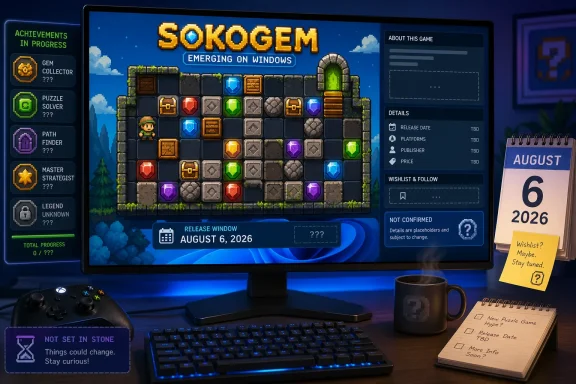 Sokogem Has a Date, but Not Yet a Full Identity
The TrueAchievements page gives us a compact set of facts. The title is Sokogem (Windows), the platform is Windows, and the displayed date is August 6, 2026. The page also names Marcus Fernandes, places the content under “Misc.,” and displays the number 261, although the supplied page text does not clearly establish what that number measures.That last ambiguity is representative of the entire listing. TrueAchievements has created the usual framework around the game—achievements, news, forum, walkthrough, reviews, scores, price, screenshots, following, and wish-list functions—but the available text contains very little of the information normally needed to evaluate an actual Windows release. There is no confirmed storefront, publisher, developer, regional availability, purchase price, installation size, minimum Windows version, processor requirement, graphics requirement, or accessibility declaration.
The date therefore needs to be handled carefully. TrueAchievements is displaying August 6, 2026 beside the Windows listing, but the supplied material does not include a corresponding announcement from Microsoft, a developer, a publisher, or a Windows storefront. It is reasonable to treat that as the date currently attached to the database entry; it would be premature to treat every commercial and technical detail of the release as settled.
This distinction matters because gaming databases often see the outline of a product before customers see its store page. Achievement metadata, platform records, artwork, screenshots, and release scheduling can surface at different times. A record may be accurate while still being incomplete, and it may be updated before launch without the change representing a cancellation, delay, or technical problem.
What TrueAchievements has exposed is the shape of an impending product. What it has not yet exposed is the product’s complete Windows proposition.
The Browser Game Explains the Name, but Not the Windows Package
Sokogem is not an entirely unknown concept. Existing browser-game portals describe a compact, Sokoban-inspired puzzle game in which a small character moves gems into treasure chests, opens an exit, and advances through increasingly constrained stages. The game is generally presented as a two-dimensional sliding puzzle rather than a conventional one-tile-at-a-time crate-pushing clone.That distinction is the mechanical hook. According to descriptions published by Plays.org, CulinarySchools.org, Y8-linked portals, and other browser-game distributors, movement continues until the player or an object encounters an obstacle. Gems and stones can be pushed across the board, holes can create failure states, and rocks can reportedly be used to make otherwise dangerous spaces traversable.
Those sites broadly agree on the central design: place the required gems into chests, unlock the door, and escape. They also describe keyboard, touch, and gamepad-style input, with the browser version intended to work across desktop and mobile devices. The consistency of those descriptions makes it likely that they are syndicating or embedding the same underlying game rather than reviewing several unrelated products that happen to share a name.
Their surrounding metadata is much less dependable. Some portals provide conflicting or generic claims about release timing, ownership, ratings, modes, and publishers; at least one description appears to mix Sokogem with mechanics belonging to a different game. That is exactly why the TrueAchievements listing should not be filled in by inference.
The browser version can tell us what Sokogem has historically looked like and how its puzzle rules have been described. It cannot, by itself, tell us who is publishing the Windows package, whether the artwork or level set has changed, whether the application is native or wrapped web content, whether achievements have altered progression, or whether the Windows edition includes additional stages.
| Area | Existing browser game | TrueAchievements Windows entry | Still unconfirmed |
|---|---|---|---|
| Delivery | Runs through modern web browsers | Listed specifically for Windows | Storefront and packaging format |
| Core play | Sliding puzzle built around gems, chests, obstacles, and exits | No gameplay description supplied | Whether mechanics or levels have changed |
| Input | Reportedly supports keyboard, touch, and gamepad controls | No input details supplied | Controller certification and remapping |
| Progress | Browser versions reportedly save progress locally | Connected to an achievement-tracking page | Cloud saves and cross-device synchronization |
| Commercial model | Commonly offered through free browser portals | Price section exists but no price is supplied | Purchase price, bundles, or subscription access |
| Technical profile | HTML5-style browser delivery is widely reported | Windows is the only confirmed platform in the listing | Windows requirements, architecture, and installation size |
The Parenthetical “Windows” Carries More Weight Than It Looks
For ordinary PC players, “Windows” may sound redundant. A browser game already runs on a Windows PC, so what changes when a database adds Sokogem (Windows) as a distinct title?Within the Xbox and TrueAchievements ecosystem, the parenthetical label commonly separates a Windows achievement stack from console editions or other platform-specific releases. It means the Windows build is being tracked as its own product identity rather than merely treated as a website that happens to run in Edge or another browser.
That identity is important to achievement hunters because Xbox-linked Windows releases can occupy their own place in a player’s profile. Progress, completion percentages, unlock timestamps, and Gamerscore become persistent account records rather than local browser data. Even a short puzzle game can therefore attract an audience substantially different from the casual players who encounter it through a web portal.
The TrueAchievements page itself reinforces that interpretation. It is structured around the site’s normal game-tracking functions, including achievements, walkthroughs, scores, reviews, forum activity, pricing, and release information. Search-indexed TrueAchievements material also associates Sokogem’s Windows title with level-based achievement records, indicating that the game is already visible within the site’s achievement data rather than existing only as a placeholder name.
That does not establish how the executable will be distributed. It does, however, make a purely editorial or accidental listing less likely. Someone has supplied enough structured game data for TrueAchievements to recognize Sokogem as a Windows achievement title.
The most plausible reading is that the familiar browser puzzle is being converted, packaged, or republished as a discrete Windows game tied to Microsoft’s gaming services. The exact form of that conversion remains unannounced in the provided material, so it should remain an inference rather than be promoted to fact.
Achievement Metadata Is Now Part of the Marketing
Small Windows games increasingly arrive in public view through their achievements before their storefront descriptions. That reverses the traditional promotional order: instead of a trailer leading to previews and then a final achievement list, achievement-tracking communities may see the skeleton of the release while the publisher’s marketing page is still absent or unfinished.For Sokogem, that skeleton is unusually revealing. A level-based puzzle game naturally lends itself to milestone achievements, and TrueAchievements’ indexed references point toward that kind of structure. It suggests that progression through the stages—not high scores, multiplayer competition, or open-ended challenge modes—is likely to be the organizing principle of the Windows list.
This is commercially useful even when the game itself is modest. Achievement hunters search for predictable completions, separate Windows stacks, straightforward level requirements, and releases that can be scheduled into completion targets. A title that might otherwise disappear among thousands of casual puzzle games gains a specific audience merely by becoming legible to achievement databases.
That audience is not necessarily asking whether Sokogem reinvents Sokoban. It is asking whether the achievements unlock correctly, whether every required level is accessible, whether progress tracks consistently, whether the game can be completed without an external guide, and whether the Windows version has a separate list from any console release.
The database listing begins to answer only the first-order question: this is a Windows title that belongs in an achievement-tracking environment. It does not answer the operational questions that determine whether the release earns a good reputation among completionists.
That omission matters more than it might appear. In a conventional review, a minor save bug is an inconvenience. In an achievement-focused release, a broken level trigger or missed completion flag can become the defining fact about the game, overwhelming every discussion of art, design, or price.
A Familiar Puzzle Can Still Become a Different Product
It would be easy to assume that the Windows edition is simply the browser game placed inside an installable container. That is possible, but the current evidence does not prove it.Packaging an HTML5 game for Windows can range from a nearly untouched web wrapper to a meaningful platform adaptation. At the minimal end, the developer preserves the existing assets and logic, adds platform authentication and achievements, and distributes the result as an app. At the more ambitious end, the Windows version may include revised controls, higher-resolution assets, new levels, additional languages, controller navigation, cloud synchronization, and platform-specific menus.
Each path creates different risks. A lightweight wrapper can preserve the original experience but inherit browser-oriented assumptions about aspect ratio, focus, scaling, save storage, and input. A deeper port can improve the game while introducing new bugs in collision logic, achievement triggers, save migration, or level sequencing.
Sokogem’s movement system may make that adaptation less trivial than the simple visuals suggest. Sliding until contact, transferring momentum to movable objects, handling holes, and determining whether a chest has received the correct number of gems all depend on deterministic state transitions. The underlying rules must remain consistent across keyboard, controller, and any supported touch interface.
Puzzle games are particularly unforgiving when ports alter input timing or board-state behavior. A shooter can survive minor variance in movement speed; a deterministic sliding puzzle cannot casually change where an object stops. If a controller produces an extra direction, a key repeats unexpectedly, or focus changes during input, the player can lose a carefully prepared position.
A good Windows package would therefore need more than an achievement API. It would need reliable input debouncing, clear restart controls, stable level-state storage, predictable scaling, and a menu that works without requiring a mouse. None of these features is confirmed by the TrueAchievements material, but they are the practical tests that will separate a competent port from a hurried wrapper.
The Missing Microsoft Store Page Is the Largest Gap
TrueAchievements is a valuable secondary source for Xbox releases, especially when achievement records appear ahead of broad publicity. It is not a substitute for the product page from the company actually selling or distributing the software.A Microsoft Store or Xbox page would normally settle several immediate questions. It could identify the publisher and developer, show a formal description, state the release date in the user’s region, provide an age rating, list supported capabilities, and clarify whether the product is available for PC, console, handheld devices, or some combination.
It might also reveal whether Sokogem supports Xbox cloud saves, controller input, touch, family sharing, or other account-level functionality. Those labels matter because “Windows” by itself describes a broad platform, not a reliable feature set.
The lack of a supplied store page also prevents a clean answer about acquisition. There is currently no grounded basis for claiming that Sokogem will be sold individually, included in a subscription, released free of charge, or bundled with another game. Its history as a freely playable browser title does not determine the business model of an achievement-enabled Windows package.
Nor can the browser version establish the application’s security or installation model. A web page running in Edge is constrained by the browser’s sandbox and permissions. An installed app may have a different package identity, storage model, update mechanism, network behavior, and account integration.
For home users, those details may amount to a download decision. For managed environments, they determine whether the application can be approved, deployed, blocked, inventoried, or removed through existing policy.
Until the official product page appears, the safest description is narrow: TrueAchievements lists Sokogem for Windows with an August 6, 2026 date. Everything beyond that should be separated into reported browser-game characteristics and unanswered Windows-release questions.
Marcus Fernandes Is Named, but the Page Does Not Define the Role
The supplied TrueAchievements text places Marcus Fernandes beside the date, platform, category, and the number 261. It does not include a sentence explicitly saying that Fernandes developed, published, designed, or owns Sokogem.That makes attribution discipline especially important. Page layouts often place staff names near content metadata, and TrueAchievements publishes news and database material created or maintained by contributors. Without a label preserved in the supplied text, assigning Fernandes a production role would be speculation.
The defensible formulation is simply that TrueAchievements names Marcus Fernandes in association with the listing. The same restraint applies to “Misc.,” which appears as the content category. That category may describe the page item rather than the game’s genre, particularly because the supplied title is “Sokogem (Windows) News and Videos.”
Similarly, the number 261 should not be converted into a player count, follower count, score, comment count, or catalog identifier without a clear label. It is a number associated with the listing, but its meaning is not established by the source extract.
These may sound like small editorial precautions, yet they are essential in a story with so few verified details. When the source contains one name and one unexplained number, an incautious article can quickly transform interface debris into a fictional development history.
The absence of a named developer is itself useful information. It tells us that the release remains at a metadata stage where the platform and date are more visible than the business entity responsible for delivering the game.
The Windows Version Will Be Judged on Services, Not Visual Ambition
Nothing in the available material suggests Sokogem is positioning itself as a technically demanding PC showcase. Its established form is a compact pixel-art puzzle game with discrete boards and simple directional controls. That should make the baseline hardware burden modest, although no official requirements have been supplied.The technical challenge will instead sit in the service layer. Xbox account sign-in, achievement reporting, local persistence, optional cloud synchronization, display scaling, suspend-and-resume behavior, and controller handling can all fail independently of the core puzzle engine.
Achievement reporting is particularly sensitive to state restoration. If a player completes a level while offline, the game needs to preserve enough information to submit the appropriate unlock later. If the player moves between PCs, local and cloud progress need a conflict policy that does not erase a more advanced save.
Even if Sokogem does not support cloud saves, the developer or publisher should say so clearly. A browser game teaches players that progress may be tied to a particular browser profile or local storage. A Windows game associated with an Xbox account can create a different expectation, even when synchronization is not actually promised.
Display behavior is another likely fault line. Pixel-art games can look sharp at integer scaling ratios but blurry when stretched without care. Ultrawide screens, windowed mode, high-DPI laptops, handheld-sized displays, and multiple monitors can expose assumptions that were invisible inside a fixed browser canvas.
None of these concerns means the Windows edition is likely to fail. They mean that the quality of this port will be measured by a layer the browser descriptions cannot evaluate. The puzzles may already exist; the new work is making them feel native to the environment in which they are being sold or tracked.
Achievement Hunters Should Resist Pre-Launch Arithmetic
TrueAchievements users are accustomed to evaluating a game from its achievement list. When the requirements are level-based and the game is short, it is tempting to estimate completion time before anyone has tested the final build.Sokogem invites exactly that temptation. Browser descriptions portray a finite series of compact stages, and the indexed achievement information appears to follow level milestones. That combination points toward a structured, completion-oriented experience rather than an endless mode.
But completion time cannot be responsibly inferred from the number of stages alone. Sliding puzzles vary widely in difficulty, and a small board can take longer than a large one when a single misplaced gem creates an unrecoverable state. The Windows version could also differ from the browser edition in level count, order, tutorial structure, or achievement conditions.
The release may require clearing every puzzle, or achievements may stop before the final stage. It could include cumulative actions, optional objectives, title-update content, or triggers that behave differently from their descriptions. None of those possibilities is confirmed, which is why a completion estimate would be manufactured rather than reported.
The same caution applies to Gamerscore totals. The source extract confirms the game’s presence inside TrueAchievements but does not provide a verified total in the supplied fact table. Readers should not assume a standard value, an expanded value, or a particular number of achievements merely because other inexpensive Windows puzzle releases follow familiar patterns.
The responsible pre-launch assessment is qualitative. Sokogem appears suited to achievement hunters because it is a finite puzzle game with level-oriented progress. How easy, fast, or reliable that completion will be remains to be tested on the actual Windows build.
IT Departments Need the Store Identity Before Making Policy
Sokogem is unlikely to become a major enterprise deployment concern. Even so, its listing illustrates a recurring Windows administration problem: users often encounter game metadata, achievement pages, or promotional material before administrators can inspect the corresponding package.A title name alone is not enough for application control. Administrators typically need a store product identity, package family information, publisher identity, signing details, installation source, and update behavior. None of that is present in the supplied TrueAchievements text.
If Sokogem is delivered through Microsoft’s storefront infrastructure, organizations that restrict consumer applications may already have policies governing acquisition. If it is distributed through another channel, the evaluation changes. A browser-hosted copy and an installed Xbox-enabled Windows package should not be treated as technically interchangeable simply because the puzzles look the same.
Administrators should also distinguish game blocking from broader web-content policy. Preventing installation of a packaged version would not necessarily prevent access to browser-hosted editions. Conversely, blocking a web-game domain would say nothing about an app obtained through an approved store.
The relevant lesson is not that Sokogem presents a known security threat; no such claim is supported by the material. It is that incomplete release metadata should not be used to create product-specific allow or deny rules. Wait for a verifiable package and publisher identity, then apply the organization’s existing software policy.
For shared family PCs, classrooms, labs, and gaming cafés, the practical concerns are similar but less formal. Account sign-in, local progress, cloud behavior, age rating, licensing, and update ownership need to be understood before the application is installed broadly.
The Browser Ecosystem Shows Why Provenance Matters
Searching for Sokogem produces many playable copies and descriptions across browser-game portals. That distribution gives the title visibility, but it also creates a provenance problem: the same game can be described by dozens of sites with varying levels of accuracy.Several portals agree closely on Sokogem’s basic objective and controls. That convergence is useful for understanding the likely source game. Other pages surround those accurate basics with unsupported claims, generic promotional language, contradictory ownership statements, or mechanics that do not match the better-documented version.
This is common in syndicated web gaming. A distributor supplies an embeddable build and a short description; hosting sites reproduce it, rewrite it, or automatically expand it. Search engines then present all of those pages as independent sources even when much of the information originates from the same feed.
The Windows listing could improve that situation by creating a canonical, signed, account-linked edition. A proper store page would give the game an official publisher name, product description, capabilities list, privacy terms, and support route. It would replace a cloud of inconsistent portal metadata with a product identity controlled by the party responsible for the release.
Alternatively, a sparse or inaccurate store page could merely add one more ambiguous record. The difference will depend on whether the eventual publisher treats the Windows launch as a real platform release or simply another distribution endpoint.
That is why the missing official page matters beyond price and system requirements. It is the document that should tell users which Sokogem they are getting, who stands behind it, and where responsibility lies when something goes wrong.
August 6 Is a Checkpoint, Not a Guarantee
The date attached to Sokogem is precise: August 6, 2026. Precision can create an impression of certainty that the rest of the page does not yet support.Release databases can receive dates through publisher feeds, platform metadata, achievement records, editorial research, or pre-release schedules. A date may be accurate at the moment it is entered and still change before the product becomes purchasable. The supplied material does not explain the origin of Sokogem’s date.
Players should therefore use August 6 as a monitoring point. It is the day currently associated with the Windows entry, not proof that the game will become available at a particular hour, in every region, through a particular store, or at a predetermined price.
If an official store page appears, its regional listing should become the primary reference for availability. If the TrueAchievements date changes without an accompanying announcement, that should be reported as a database update rather than automatically characterized as a developer-announced delay.
The same principle applies if the game appears earlier in achievement feeds than in search results. Backend availability, review access, certification data, and public sale are separate stages. Seeing unlocks or metadata does not necessarily mean ordinary customers can acquire the game.
For a small release, this may feel like excessive caution. It is nevertheless the only way to avoid turning a thin database entry into a false launch promise.
What Must Appear Before the Listing Becomes a Release Story
The Sokogem page is already enough to justify attention from Windows achievement hunters. It is not yet enough to answer the questions a buyer should ask before spending money or installing software.The first missing element is authoritative ownership. A developer and publisher need to be named by an official storefront or announcement. That would allow players to distinguish the Windows edition from the many browser-hosted copies and establish where support requests belong.
The second is a proper feature list. Controller support, keyboard controls, touch input, cloud saves, offline behavior, supported languages, accessibility options, and display modes should be declared rather than inferred from browser editions.
The third is commercial clarity. A visible price, regional availability, licensing terms, and any subscription inclusion should be confirmed by the store through which the game is offered. Free browser access does not imply that the packaged edition will be free, just as a paid app would not necessarily make the browser copies illegitimate.
The fourth is technical accountability. System requirements may be modest, but they should still identify supported Windows versions and any architecture or account requirements. The installation size and package capabilities would also help users decide whether the release is appropriate for handhelds, low-storage devices, or locked-down PCs.
Finally, achievement behavior needs real-world verification. The list can exist in a database while one or more triggers malfunction in the shipping build. Completionists should wait for tested unlock reports before assuming that a straightforward-looking list produces a straightforward completion.
The Evidence Points to a Port, Not Yet a Transformation
The most reasonable synthesis is that Sokogem’s existing browser puzzle has been prepared for a distinct Windows release. The title matches, the genre implied by the browser material fits the achievement-oriented structure, and TrueAchievements now gives the Windows edition a platform-specific identity and date.What we cannot yet see is how much has been added in the transition. There is no supplied evidence of new levels, revised visuals, extra modes, narrative expansion, multiplayer, leaderboards, or accessibility improvements. There is equally no proof that the Windows version is an unchanged wrapper.
That uncertainty should shape expectations. Sokogem is not currently presenting itself as a sweeping remake. Its appeal is more likely to rest on convenience: an installable version, Xbox-account integration, achievements, and a cleaner place in a Windows game library.
Convenience can be a meaningful product feature. A browser game may be scattered across portals, save progress inconsistently, or lack a durable relationship with a player’s gaming identity. A packaged edition can turn a disposable web session into an owned or account-associated game.
But account integration also raises the standard. Once progress is recorded on Xbox services, failures become visible and persistent. Once money is charged, players expect support. Once software is installed, Windows users expect reliable scaling, input, saving, and removal.
Sokogem’s Windows edition will therefore succeed or fail less on whether gem-pushing is a sound puzzle concept—it already appears to be a coherent one—and more on whether the platform conversion respects the expectations created by the Windows and achievement labels.
The Concrete Signals to Watch
The listing leaves a narrow but useful set of conclusions. Readers should separate those confirmed signals from the much larger collection of details still awaiting an official product page.- TrueAchievements lists the game as Sokogem (Windows).
- The platform shown is Windows, with August 6, 2026 attached to the entry.
- Marcus Fernandes is named on the page, but the supplied text does not define a development or publishing role.
- The listing is filed under “Misc.” and displays 261 without clearly labeling what that number represents.
- Existing web portals describe Sokogem as a sliding, Sokoban-inspired gem-and-chest puzzle game, but their commercial metadata is inconsistent.
- Price, publisher, developer, storefront, requirements, cloud-save support, and final Windows features remain unconfirmed.
References
- Primary source: TrueAchievements
Published: 2026-07-12T12:20:08.146515
Sokogem (Windows) News and Videos | TrueAchievements
All the latest Sokogem (Windows) news, sales, achievements, videos and screenshots.www.trueachievements.com
- Related coverage: xbox.com
- Related coverage: mobygames.com
SokoMage Releases - MobyGames
Detailed release information for SokoMage. Including release dates, countries, product codes, publishers, developers and other credited companies.www.mobygames.com
- Related coverage: xboxachievements.com
SokoFrog Achievements - View all 22 Achievements | XboxAchievements.com
SokoFrog has 22 Achievements. View the full SokoFrog achievement list at XboxAchievements.com.www.xboxachievements.com - Related coverage: news.xbox.com
Play Anywhere, Slay Everywhere: Greedland XPA Hits Windows with a Major Update - XBOX Wire
Details on the new mode, levels and achievements in the Greedland XPA Update.news.xbox.com - Related coverage: plays.org
🕹️ Play Sokogem Game: Free Online Sokoban-Inspired Gem Organizing Video Game for Kids & Adults
Play Sokogem online for free. Sokogem is a 15-stage Sokoban-inspired path making logic puzzle game where you must push all the gems on each stage into treasure chests to unlock the level exit. Use rocks to your advantage & do not fall through any of the holes on the levels. This game is... plays.org
- Related coverage: pog.com
Play Sokogem Online For Free - Play Now on Pog.com
Sokogem is an online Jewel game for kids. It uses the Html5 technology. Play this Pixel game now or enjoy the many other related games we have at POG.www.pog.com - Related coverage: bubbleshooter.net
Sokogem - Play for free - Online Games
In Sokogem, you need to collect all the stars on each level. The stars will be located in hard-to-reach places. You can use the prince's power to lift and throw objects like platforms, enemies, and bombs.www.bubbleshooter.net - Related coverage: he.y8.com
Sokogem - שחקו עכשיו בY8.com
שחקו בחינם Sokogem בחינם בY8.com! לחצו עכשיו כדי לשחק ב Sokogem תהנו מהמשחקים הכי טובים שדומים ל Sokogem.he.y8.com - Related coverage: culinaryschools.org
Sokogem Game: Free Online Gems Sokoban Slide Puzzle Video Game for Kids
Sokogem is a 15-level Sokoban game where players push gems into treasure chests. Players move the character around the screen using either the WASD keys or the arrow keys. When you move you slide from edge to edge around the level. Push the correct number of gems into each treasure chest to...www.culinaryschools.org
- Related coverage: gamepix.com
Sokogem 🕹️ Play Now on GamePix
Want to Play Sokogem? 🕹️ On GamePix You Can Play Sokogem for Free. Start Playing Now! www.gamepix.com
- Related coverage: simple.game
Sokogem Brain Game - Play online at simple.game
Sokogem is a 2D sliding puzzle game where you must help a little creature put all the gems into the chests. Make the right moves, clear the gems and go to the next level! Keyboard (WASD, Arrows), Touch/Mouse (Swipe Up, Down, Left, Right to move the squares), Gamepad Playing sokogem free online...simple.game - Related coverage: najox.com
Sokogem Online for Free on NAJOX.com
Najox presents Sokogem, a captivating 2D sliding puzzle game that will put your problem-solving skills to the test. Join a little creature on its quest to...www.najox.com - Related coverage: kbhgames.com
Sokogem - Play Puzzle Games Online
A 2D block sliding game where you have to help a creature put all the gems back in the chest. kbhgames.com
- Related coverage: naptechgames.com
Sokogem | Play Free Online Game | NapTech Games
Play free HTML5 online games instantly without installation. NapTech Games offers casual, educational, and entertaining games for all ages.naptechgames.com
