

Sony said on June 25, 2026, that it is reducing Bungie’s workforce, with the cuts affecting most of the Destiny team and some Marathon staff, just weeks after Bungie said Destiny 2’s final live-service content update would arrive on June 9, 2026. The immediate answer is blunt: Destiny 2 is no longer Sony’s live-service anchor in the way it once was, and Bungie is being reshaped around whatever comes after it. The harder question is whether Marathon is now Bungie’s pivot point or simply the place where Sony contains the risk of a studio whose old operating model no longer fits the business.
For players, the practical takeaway is not that Destiny 2 disappears overnight. It is that the engine of constant live-service growth — the seasonal cadence, the large team, the assumption that Bungie would keep expanding the same universe indefinitely — has been formally wound down. For IT-minded readers and industry watchers, the story is bigger than one studio: this is another data point in a gaming economy where platform holders are treating creative headcount, infrastructure, and long-running services as assets to be resized when the numbers stop justifying the mythology.
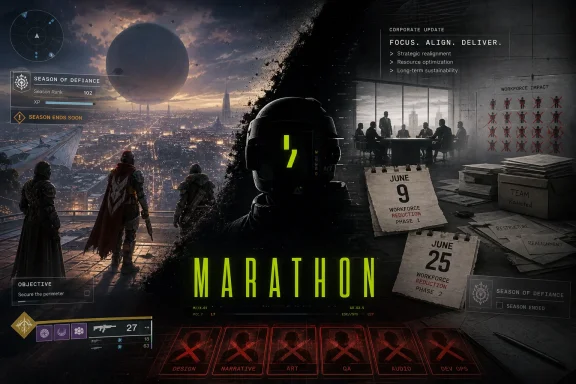
The layoffs landed with a timing that made the meaning difficult to miss. Bungie announced on May 21, 2026, that Destiny 2’s final live-service content update would release on June 9. Sony then confirmed on June 25 that it was cutting Bungie’s workforce, including most of the Destiny team and some employees working on Marathon.
That sequence matters because it changes the frame. This is not a normal post-launch contraction after a single expansion, nor a routine reallocation of staff between projects. It is a restructuring after the studio publicly marked the end of Destiny 2 as an active live-service pipeline.
Sony’s language was careful, as corporate statements usually are. The company said the move was intended to align Bungie’s resources with current priorities and long-term goals. But the substance underneath the phrasing is more revealing than the phrasing itself: most of the team attached to Destiny is no longer part of Bungie’s future at its former scale.
That does not mean Destiny has no future as a game, brand, or community. It means Destiny 2 has stopped being the center of gravity around which Bungie’s staffing, ambitions, and Sony’s live-service story can plausibly orbit. The service that once represented the dream of recurring engagement now reads more like the old world Bungie is being forced to leave behind.
The emotional weight of that shift is easy to flatten into industry jargon. Destiny 2 was not just a SKU; it was a workplace, a social graph, a recurring ritual, and one of the few live-service shooters that survived long enough to make its own design language feel ordinary. When most of that team is cut after the final live-service update, the message is not merely that a product cycle ended. It is that the organization built to feed that cycle is being dismantled.
The trouble is that live-service expertise is not the same as live-service immunity. A studio can know how to run a massive online game and still be exposed to the brutal arithmetic of maintaining one. Content teams, backend operations, narrative planning, security, tooling, QA, player support, and community management are not optional overhead when the promise is that the game never really stops.
Sony had already disclosed impairment losses tied to Bungie assets in FY2025, a financial signal that the studio’s acquired value was under pressure. Impairments do not tell the whole story by themselves, and they are not the same as a public postmortem. But they do tell investors that the expected value of assets has been revised downward.
That is why the June 25 layoffs should be read as both operational and financial. Sony is not only deciding which teams build which games. It is deciding how much Bungie can cost while it attempts to move from a post-Destiny 2 world into a Marathon-led future.
This is the uncomfortable part for anyone who remembers the optimistic live-service pitch of the early 2020s. Platform holders wanted durable engagement, predictable revenue, and communities that would keep logging in between blockbuster releases. What they got, in many cases, was an expensive race against fatigue.
A next project can miss, recover, pivot, or be given time. A load-bearing project has less room to breathe because the company around it has already been resized in anticipation of a different future. If Marathon is now the project that inherits Bungie’s institutional weight, it also inherits the pressure Destiny once absorbed.
That is a difficult inheritance. Destiny 2 had years of accumulated systems, lore, rituals, grudges, expansions, onboarding problems, and loyalists who understood the game’s flaws because they had lived inside them. Marathon does not inherit that player patience automatically. It inherits a studio reputation, but not the same social contract.
Sony’s statement that some Marathon staff were also affected complicates the simplistic version of the story. If Marathon were merely the protected successor, one might expect the cuts to fall only on Destiny. Instead, the restructuring touches the new bet too, suggesting that Sony is not just moving bodies from one franchise to another. It is shrinking the overall shape of Bungie around a narrower set of priorities.
That makes Marathon both pivot and pressure valve. It is the pivot because Bungie needs a post-Destiny center. It is the pressure valve because Sony can use it to concentrate the remaining resources, simplify the narrative for investors, and test whether Bungie can produce a new service without carrying the full institutional weight of Destiny 2.
A successful live-service game creates a paradox. The longer it runs, the more expensive and complicated it becomes to satisfy the audience that made it viable. Legacy systems accumulate. New players bounce off old complexity. Veterans demand novelty without losing what they already like. Every update must serve acquisition, retention, monetization, and community sentiment at once.
Destiny 2 lived inside that paradox for years. Bungie’s May 21 announcement turned the page by setting a final live-service update date. Sony’s June 25 restructuring then showed what happens when the organization that sustained the paradox is no longer sized for it.
This is where the story intersects with the wider restructuring mood across the games business. WindowsForum readers have already seen similar patterns in coverage of Microsoft’s gaming cuts, Xbox studio uncertainty, and AI-era corporate resizing. The details differ between Sony and Microsoft, but the theme is familiar: large platform companies are increasingly unwilling to fund sprawling creative organizations on strategic faith alone.
There is a cold logic to that, but it comes with real losses. Live-service games depend on continuity, institutional memory, and trust. Layoffs do not merely reduce payroll; they remove people who understand why a community reacts badly to one change and embraces another. That knowledge is hard to document and harder to replace.
Players should therefore think in terms of preservation, expectations, and risk. If Destiny 2 remains important to you, this is the time to finish outstanding goals, capture screenshots and videos, organize clan memories, and be realistic about how much future support can exist after most of the Destiny team has been affected. A game can remain playable while still feeling culturally over.
The deeper change is psychological. Destiny 2 players have spent years arguing about balance, expansions, vaulting, monetization, and narrative direction because the game still felt like an ongoing argument. Once the live-service pipeline ends, the argument changes from “what should Bungie fix next?” to “what should this game be remembered as?”
That is a harsher transition than many players expect. Live-service communities are built around anticipation. When anticipation is removed, communities either become archival, competitive, nostalgic, or migratory. Some players will stay because the feel of the game remains unmatched. Others will leave because the ritual was always tied to the promise of what was next.
The same logic applies to PC players who treated Destiny 2 as a long-term hardware and social benchmark. It was a game people used to test systems, organize Discord groups, and compare input latency, ultrawide behavior, frame pacing, and network feel. A winding-down service changes not only the content plan but the ecosystem of guides, builds, tools, and community troubleshooting around it.
The most dangerous comparison for Marathon is not Destiny 2 at its best. It is Destiny 2 as a cultural habit. Bungie’s old game survived because players had years of reasons to return, even when they were angry. Marathon will need to earn that habit from scratch in a market far less forgiving than the one Destiny entered.
There is also a trust deficit built into the timing. When players see layoffs affecting most of the old team and some of the new team, they do not separate corporate restructuring from product confidence. They ask whether the studio has the people, stability, and runway to support another demanding online game.
That perception matters because live-service launches are social before they are financial. A technically competent game can still fail if players believe it will be abandoned, under-supported, or reshaped too aggressively after launch. Marathon will need to communicate durability without overpromising the very permanence that Destiny 2’s ending has just called into question.
For Sony, this is the strategic tension. The company wants Bungie aligned with current priorities and long-term goals, but live-service players want evidence that a game will be supported through the messy middle. Those needs can conflict. Investors like discipline; players like commitment.
That phrasing is not meaningless, but it is incomplete. Alignment implies order and intention. Layoffs reveal that the old alignment no longer held.
In Bungie’s case, the phrase lands after a final Destiny 2 live-service update and amid prior impairment losses tied to Bungie assets. Those facts give the statement a sharper edge. Sony is not merely tidying up an org chart. It is reconciling Bungie’s cost structure with a changed view of what the studio can deliver.
WindowsForum readers who follow Microsoft’s own restructuring cycle will recognize the pattern. Coverage of Microsoft’s 2025 layoffs and later Xbox studio uncertainty has shown how platform companies increasingly frame cuts as strategic resets rather than retreats. The same vocabulary now surrounds Bungie, even though the platform, portfolio, and creative histories are different.
The risk is that “alignment” becomes a way to obscure the human and product consequences. Most of the Destiny team being affected is not an abstract alignment exercise. It is a transfer of risk from corporate planning onto employees, players, and the future project that must now carry the story forward.
Destiny 2 has long been part of the PC gaming commons. It has served as a performance test, a social hub, a benchmark for input feel, and a recurring source of troubleshooting threads. When a game of that scale winds down its live-service content, the surrounding PC ecosystem also cools.
That affects everything from content creators deciding where to invest time, to clans deciding whether to keep infrastructure running, to players deciding whether to buy expansions, cosmetics, peripherals, or subscription-adjacent services around a particular game. The question becomes less “can I still play?” and more “should I keep organizing my gaming life around this?”
For Marathon, PC confidence will be crucial. The audience Bungie needs is technically literate, skeptical, and already trained by years of live-service disappointments to look for warning signs. Layoffs before a new project has fully established itself are one such sign, even if the game itself remains a priority.
The practical advice is simple: do not make long-term assumptions based on brand memory alone. Watch what Bungie and Sony do next, not what either company says in broad terms. Staffing stability, update cadence, anti-cheat posture, PC performance, communication quality, and post-launch support will matter more than nostalgia for the Bungie name.
A live-service game depends on thousands of small judgments. Which community complaints are noise, and which are early warnings? Which balance changes will create more problems than they solve? Which old systems are too fragile to touch? Which player rituals matter even though they do not show up cleanly in a revenue model?
Those answers often live with teams, not documents. When most of a team is affected, a studio loses more than capacity. It loses memory.
That is why the Destiny cuts feel like the end of an era even if the servers keep running and the brand remains available for future use. The culture that made Destiny 2 what it was — brilliant, maddening, expensive, sticky, uneven, and occasionally transcendent — cannot be preserved through IP ownership alone.
This is also why Marathon’s inheritance is so complicated. It benefits from Bungie’s shooter pedigree and technical history. But it also arrives in the shadow of a workforce reduction that tells players the studio’s internal continuity has been broken.
Bungie was supposed to help with that. It had already lived the operational reality Sony wanted to understand. But the June 25 cuts suggest that owning live-service expertise does not automatically make the live-service business predictable.
This is the uncomfortable lesson for platform holders. You cannot simply acquire a studio with a successful online game and assume the success can be generalized. The knowledge is real, but the market context changes. The players move. The costs rise. The tolerance for another forever-game shrinks.
If Marathon succeeds, Sony can argue that the restructuring focused Bungie on the future. If it struggles, the layoffs will look less like discipline and more like a studio being squeezed between a retired anchor and an unproven replacement.
That binary may be unfair, but public markets and player communities both love simple narratives. Bungie will now operate under one: Destiny 2 is ending as a live-service project, and Marathon must show whether the studio still has a scalable future.
Those dates create the story’s skeleton. First, Bungie publicly closed the live-service chapter. Then Sony reduced the workforce attached to the old chapter and trimmed even parts of the next one. Whatever the internal planning timeline looked like, the public chronology reads as a deliberate transition from expansion to contraction.
That chronology also limits what responsible analysis can claim. Sony has not provided every operational detail, and the public facts do not support pretending to know the exact internal headcount, project roadmap, or future Destiny plans beyond the final live-service update. The thinness of the official record is itself part of the story.
When facts are thin, the safest reading is the structural one. Bungie is becoming smaller around a post-Destiny 2 future. Marathon is still important, but not untouched. Sony is applying financial discipline to a studio already shadowed by impairment losses.
That is enough to support a strong conclusion without inventing certainty. The layoffs are not just a sad coda to Destiny 2. They are the mechanism by which Sony is forcing Bungie into its next shape.
For WindowsForum readers, the useful approach is to track signals rather than vibes. Bungie’s history buys attention, not trust in perpetuity. Sony’s ownership buys resources, not immunity from market pressure.
For players, the practical takeaway is not that Destiny 2 disappears overnight. It is that the engine of constant live-service growth — the seasonal cadence, the large team, the assumption that Bungie would keep expanding the same universe indefinitely — has been formally wound down. For IT-minded readers and industry watchers, the story is bigger than one studio: this is another data point in a gaming economy where platform holders are treating creative headcount, infrastructure, and long-running services as assets to be resized when the numbers stop justifying the mythology.
 Bungie’s Layoffs Are the Epilogue to Destiny 2’s Live-Service Era
The layoffs landed with a timing that made the meaning difficult to miss. Bungie announced on May 21, 2026, that Destiny 2’s final live-service content update would release on June 9. Sony then confirmed on June 25 that it was cutting Bungie’s workforce, including most of the Destiny team and some employees working on Marathon.That sequence matters because it changes the frame. This is not a normal post-launch contraction after a single expansion, nor a routine reallocation of staff between projects. It is a restructuring after the studio publicly marked the end of Destiny 2 as an active live-service pipeline.
Sony’s language was careful, as corporate statements usually are. The company said the move was intended to align Bungie’s resources with current priorities and long-term goals. But the substance underneath the phrasing is more revealing than the phrasing itself: most of the team attached to Destiny is no longer part of Bungie’s future at its former scale.
That does not mean Destiny has no future as a game, brand, or community. It means Destiny 2 has stopped being the center of gravity around which Bungie’s staffing, ambitions, and Sony’s live-service story can plausibly orbit. The service that once represented the dream of recurring engagement now reads more like the old world Bungie is being forced to leave behind.
The emotional weight of that shift is easy to flatten into industry jargon. Destiny 2 was not just a SKU; it was a workplace, a social graph, a recurring ritual, and one of the few live-service shooters that survived long enough to make its own design language feel ordinary. When most of that team is cut after the final live-service update, the message is not merely that a product cycle ended. It is that the organization built to feed that cycle is being dismantled.
Sony Bought a Live-Service Crown Jewel and Inherited a Balance-Sheet Problem
Sony’s acquisition of Bungie was always about more than Destiny. Bungie brought live-service expertise, production muscle, community operations, and technical experience in running a game that had to survive content drops, balance controversies, infrastructure stress, and the endless churn of player expectation. To a console platform holder trying to diversify beyond single-player prestige games, that looked like strategic insurance.The trouble is that live-service expertise is not the same as live-service immunity. A studio can know how to run a massive online game and still be exposed to the brutal arithmetic of maintaining one. Content teams, backend operations, narrative planning, security, tooling, QA, player support, and community management are not optional overhead when the promise is that the game never really stops.
Sony had already disclosed impairment losses tied to Bungie assets in FY2025, a financial signal that the studio’s acquired value was under pressure. Impairments do not tell the whole story by themselves, and they are not the same as a public postmortem. But they do tell investors that the expected value of assets has been revised downward.
That is why the June 25 layoffs should be read as both operational and financial. Sony is not only deciding which teams build which games. It is deciding how much Bungie can cost while it attempts to move from a post-Destiny 2 world into a Marathon-led future.
This is the uncomfortable part for anyone who remembers the optimistic live-service pitch of the early 2020s. Platform holders wanted durable engagement, predictable revenue, and communities that would keep logging in between blockbuster releases. What they got, in many cases, was an expensive race against fatigue.
The End of Destiny 2 as an Anchor Changes What Marathon Has to Be
Before this restructuring, Marathon could be understood as Bungie’s next big bet. After it, Marathon looks more like a load-bearing wall. That distinction changes the expectations around the game before players even touch it.A next project can miss, recover, pivot, or be given time. A load-bearing project has less room to breathe because the company around it has already been resized in anticipation of a different future. If Marathon is now the project that inherits Bungie’s institutional weight, it also inherits the pressure Destiny once absorbed.
That is a difficult inheritance. Destiny 2 had years of accumulated systems, lore, rituals, grudges, expansions, onboarding problems, and loyalists who understood the game’s flaws because they had lived inside them. Marathon does not inherit that player patience automatically. It inherits a studio reputation, but not the same social contract.
Sony’s statement that some Marathon staff were also affected complicates the simplistic version of the story. If Marathon were merely the protected successor, one might expect the cuts to fall only on Destiny. Instead, the restructuring touches the new bet too, suggesting that Sony is not just moving bodies from one franchise to another. It is shrinking the overall shape of Bungie around a narrower set of priorities.
That makes Marathon both pivot and pressure valve. It is the pivot because Bungie needs a post-Destiny center. It is the pressure valve because Sony can use it to concentrate the remaining resources, simplify the narrative for investors, and test whether Bungie can produce a new service without carrying the full institutional weight of Destiny 2.
The Layoffs Say More About Live-Service Math Than Studio Drama
The easy version of this story is personality-driven: executives overreached, a studio mismanaged expectations, Sony lost patience, and workers paid the price. There may be truth in parts of that story, but it is not enough. The larger pattern is that the live-service model has become punishing even for teams that helped define it.A successful live-service game creates a paradox. The longer it runs, the more expensive and complicated it becomes to satisfy the audience that made it viable. Legacy systems accumulate. New players bounce off old complexity. Veterans demand novelty without losing what they already like. Every update must serve acquisition, retention, monetization, and community sentiment at once.
Destiny 2 lived inside that paradox for years. Bungie’s May 21 announcement turned the page by setting a final live-service update date. Sony’s June 25 restructuring then showed what happens when the organization that sustained the paradox is no longer sized for it.
This is where the story intersects with the wider restructuring mood across the games business. WindowsForum readers have already seen similar patterns in coverage of Microsoft’s gaming cuts, Xbox studio uncertainty, and AI-era corporate resizing. The details differ between Sony and Microsoft, but the theme is familiar: large platform companies are increasingly unwilling to fund sprawling creative organizations on strategic faith alone.
There is a cold logic to that, but it comes with real losses. Live-service games depend on continuity, institutional memory, and trust. Layoffs do not merely reduce payroll; they remove people who understand why a community reacts badly to one change and embraces another. That knowledge is hard to document and harder to replace.
Destiny Players Should Treat June 9 as a Boundary, Not a Shutdown
For Destiny 2 players, the important practical distinction is between the end of live-service content updates and the end of access. Bungie’s May 21 statement identified June 9, 2026, as the final live-service content update. That is a boundary around future content production, not proof by itself of an immediate shutdown of the game.Players should therefore think in terms of preservation, expectations, and risk. If Destiny 2 remains important to you, this is the time to finish outstanding goals, capture screenshots and videos, organize clan memories, and be realistic about how much future support can exist after most of the Destiny team has been affected. A game can remain playable while still feeling culturally over.
The deeper change is psychological. Destiny 2 players have spent years arguing about balance, expansions, vaulting, monetization, and narrative direction because the game still felt like an ongoing argument. Once the live-service pipeline ends, the argument changes from “what should Bungie fix next?” to “what should this game be remembered as?”
That is a harsher transition than many players expect. Live-service communities are built around anticipation. When anticipation is removed, communities either become archival, competitive, nostalgic, or migratory. Some players will stay because the feel of the game remains unmatched. Others will leave because the ritual was always tied to the promise of what was next.
The same logic applies to PC players who treated Destiny 2 as a long-term hardware and social benchmark. It was a game people used to test systems, organize Discord groups, and compare input latency, ultrawide behavior, frame pacing, and network feel. A winding-down service changes not only the content plan but the ecosystem of guides, builds, tools, and community troubleshooting around it.
Marathon Now Carries the Burden of Proving Bungie Still Knows the Future
Marathon’s challenge is not simply to be good. It has to prove that Bungie’s next act can justify the studio that remains after Destiny 2. That is a much heavier job than launching a new shooter under normal circumstances.The most dangerous comparison for Marathon is not Destiny 2 at its best. It is Destiny 2 as a cultural habit. Bungie’s old game survived because players had years of reasons to return, even when they were angry. Marathon will need to earn that habit from scratch in a market far less forgiving than the one Destiny entered.
There is also a trust deficit built into the timing. When players see layoffs affecting most of the old team and some of the new team, they do not separate corporate restructuring from product confidence. They ask whether the studio has the people, stability, and runway to support another demanding online game.
That perception matters because live-service launches are social before they are financial. A technically competent game can still fail if players believe it will be abandoned, under-supported, or reshaped too aggressively after launch. Marathon will need to communicate durability without overpromising the very permanence that Destiny 2’s ending has just called into question.
For Sony, this is the strategic tension. The company wants Bungie aligned with current priorities and long-term goals, but live-service players want evidence that a game will be supported through the messy middle. Those needs can conflict. Investors like discipline; players like commitment.
The Industry Has Learned to Say “Alignment” When It Means Contraction
Corporate restructuring language has become its own dialect. Companies rarely say a bet got smaller, a strategy narrowed, or a prior plan failed to justify its cost. They say resources are being aligned with priorities and long-term goals.That phrasing is not meaningless, but it is incomplete. Alignment implies order and intention. Layoffs reveal that the old alignment no longer held.
In Bungie’s case, the phrase lands after a final Destiny 2 live-service update and amid prior impairment losses tied to Bungie assets. Those facts give the statement a sharper edge. Sony is not merely tidying up an org chart. It is reconciling Bungie’s cost structure with a changed view of what the studio can deliver.
WindowsForum readers who follow Microsoft’s own restructuring cycle will recognize the pattern. Coverage of Microsoft’s 2025 layoffs and later Xbox studio uncertainty has shown how platform companies increasingly frame cuts as strategic resets rather than retreats. The same vocabulary now surrounds Bungie, even though the platform, portfolio, and creative histories are different.
The risk is that “alignment” becomes a way to obscure the human and product consequences. Most of the Destiny team being affected is not an abstract alignment exercise. It is a transfer of risk from corporate planning onto employees, players, and the future project that must now carry the story forward.
For PC and Windows Players, the Real Impact Is Ecosystem Confidence
This is not a Windows platform story in the narrow sense. There is no patch to install, no registry key to change, no driver setting that fixes a studio restructuring. But for Windows gamers, sysadmins managing gaming labs, streamers, hardware reviewers, and community organizers, the Bungie cuts are still a signal worth reading.Destiny 2 has long been part of the PC gaming commons. It has served as a performance test, a social hub, a benchmark for input feel, and a recurring source of troubleshooting threads. When a game of that scale winds down its live-service content, the surrounding PC ecosystem also cools.
That affects everything from content creators deciding where to invest time, to clans deciding whether to keep infrastructure running, to players deciding whether to buy expansions, cosmetics, peripherals, or subscription-adjacent services around a particular game. The question becomes less “can I still play?” and more “should I keep organizing my gaming life around this?”
For Marathon, PC confidence will be crucial. The audience Bungie needs is technically literate, skeptical, and already trained by years of live-service disappointments to look for warning signs. Layoffs before a new project has fully established itself are one such sign, even if the game itself remains a priority.
The practical advice is simple: do not make long-term assumptions based on brand memory alone. Watch what Bungie and Sony do next, not what either company says in broad terms. Staffing stability, update cadence, anti-cheat posture, PC performance, communication quality, and post-launch support will matter more than nostalgia for the Bungie name.
The Human Cost Is Not Separate From the Product Story
It is tempting in industry analysis to treat layoffs as background context and products as the real subject. That is backwards for live-service games. The people are the product’s continuity.A live-service game depends on thousands of small judgments. Which community complaints are noise, and which are early warnings? Which balance changes will create more problems than they solve? Which old systems are too fragile to touch? Which player rituals matter even though they do not show up cleanly in a revenue model?
Those answers often live with teams, not documents. When most of a team is affected, a studio loses more than capacity. It loses memory.
That is why the Destiny cuts feel like the end of an era even if the servers keep running and the brand remains available for future use. The culture that made Destiny 2 what it was — brilliant, maddening, expensive, sticky, uneven, and occasionally transcendent — cannot be preserved through IP ownership alone.
This is also why Marathon’s inheritance is so complicated. It benefits from Bungie’s shooter pedigree and technical history. But it also arrives in the shadow of a workforce reduction that tells players the studio’s internal continuity has been broken.
Sony’s Live-Service Ambition Gets a Public Stress Test
Sony’s broader live-service strategy has always had a difficult relationship with the company’s identity. PlayStation built much of its modern prestige on carefully authored single-player games, while live service requires a different metabolism: constant iteration, community operations, monetization discipline, and a willingness to be publicly wrong every week.Bungie was supposed to help with that. It had already lived the operational reality Sony wanted to understand. But the June 25 cuts suggest that owning live-service expertise does not automatically make the live-service business predictable.
This is the uncomfortable lesson for platform holders. You cannot simply acquire a studio with a successful online game and assume the success can be generalized. The knowledge is real, but the market context changes. The players move. The costs rise. The tolerance for another forever-game shrinks.
If Marathon succeeds, Sony can argue that the restructuring focused Bungie on the future. If it struggles, the layoffs will look less like discipline and more like a studio being squeezed between a retired anchor and an unproven replacement.
That binary may be unfair, but public markets and player communities both love simple narratives. Bungie will now operate under one: Destiny 2 is ending as a live-service project, and Marathon must show whether the studio still has a scalable future.
The Calendar Now Matters More Than the Corporate Statement
The most important dates are not complicated. Bungie said on May 21 that Destiny 2’s final live-service content update would arrive on June 9. Sony said on June 25 that it was reducing Bungie’s workforce, including most of the Destiny team and some Marathon staff.Those dates create the story’s skeleton. First, Bungie publicly closed the live-service chapter. Then Sony reduced the workforce attached to the old chapter and trimmed even parts of the next one. Whatever the internal planning timeline looked like, the public chronology reads as a deliberate transition from expansion to contraction.
That chronology also limits what responsible analysis can claim. Sony has not provided every operational detail, and the public facts do not support pretending to know the exact internal headcount, project roadmap, or future Destiny plans beyond the final live-service update. The thinness of the official record is itself part of the story.
When facts are thin, the safest reading is the structural one. Bungie is becoming smaller around a post-Destiny 2 future. Marathon is still important, but not untouched. Sony is applying financial discipline to a studio already shadowed by impairment losses.
That is enough to support a strong conclusion without inventing certainty. The layoffs are not just a sad coda to Destiny 2. They are the mechanism by which Sony is forcing Bungie into its next shape.
The Signal Players and IT Pros Should Watch From Here
The next phase will not be defined by one announcement. It will be defined by whether Bungie’s remaining organization can communicate clearly, support existing players responsibly, and bring Marathon forward without making the game feel like a corporate rescue plan in shooter form.For WindowsForum readers, the useful approach is to track signals rather than vibes. Bungie’s history buys attention, not trust in perpetuity. Sony’s ownership buys resources, not immunity from market pressure.
- Destiny 2’s final live-service content update was set for June 9, 2026, making that date the practical boundary between an active service era and a legacy phase.
- Sony’s June 25, 2026, workforce reduction affected most of the Destiny team and some Marathon team members, so the restructuring is broader than a simple project handoff.
- Sony described the layoffs as an effort to align Bungie’s resources with current priorities and long-term goals, which indicates a narrower operating model for the studio.
- Sony’s previously disclosed FY2025 impairment losses tied to Bungie assets show that the pressure around the studio was financial as well as creative.
- Marathon now has to prove not only that it can attract players, but that Bungie can sustain a new live-service project after shrinking the organization that sustained Destiny 2.
- Destiny 2 players should treat the game as entering a legacy period and make decisions about time, purchases, clans, and content goals accordingly.
References
- Primary source: bloomberg.com
- Independent coverage: bungie.net
Bungie.net
www.bungie.net
- Primary source: WindowsForum
Microsoft Restructuring 2025: Major Xbox Divisions Affected by Layoffs and Project Cancellations | Windows Forum
In July 2025, Microsoft announced a significant workforce reduction, laying off approximately 9,000 employees, which accounts for about 4% of its global...windowsforum.com
