

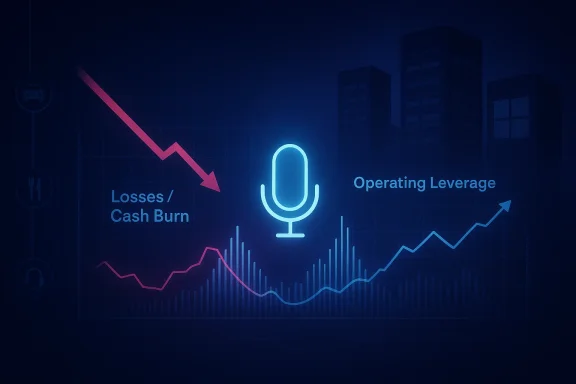
The biggest risk for SoundHound AI is not that voice AI is unimportant; it is that the company may not be able to turn strong demand into durable profits fast enough to keep pace with much larger competitors. The AOL-linked Motley Fool piece you shared frames that risk clearly: SoundHound is growing revenue, but it is still losing money, and the company’s valuation and competitive position depend on narrowing those losses rather than simply posting good top-line numbers. That concern is especially sharp because tech giants like Google and Microsoft can bundle voice capabilities into broader platforms with far deeper pockets and distribution.
SoundHound AI sits in one of the most interesting and unforgiving corners of the AI market: conversational voice interfaces. The company has built a business around speech recognition and natural-language interaction for use cases such as in-car assistants, restaurant ordering, and customer service, and it has benefited from the broader enthusiasm around AI adoption. The appeal is obvious. If voice becomes a primary interface for software, then the company that can make conversation feel fast, accurate, and useful has a real opening.
But the market is not rewarding aspiration alone. SoundHound’s challenge, as the article notes, is that revenue growth has not yet translated into reliable earnings power. The company posted a GAAP profit in the quarter cited, but that was driven by a non-cash accounting gain tied to acquisition liabilities, while the adjusted result still showed a loss. That distinction matters because investors are not buying accounting optics; they are buying a path to cash generation.
That is why the stock’s decline is so revealing. A 72% drop from highs can reflect many things, but in SoundHound’s case it reflects a market that wants more proof that the business model can scale without burning capital forever. A company can have exciting technology, strong customer interest, and still be a difficult investment if each new dollar of revenue requires too much cost to win.
The competitive backdrop makes the problem harder. Voice AI is not a niche that can be defended by clever branding alone. Google’s Gemini and Microsoft Copilot Voice have the advantage of massive ecosystems, broad distribution, and the kind of infrastructure that smaller companies struggle to match. In that environment, the biggest risk is not merely execution; it is structural asymmetry.
The article’s logic is sound: revenue growth matters, but losses matter more when the market is asking whether the company has a durable edge. If SoundHound can’t show that its gross profit and operating leverage are improving, then high growth can actually become a warning sign rather than a celebration. Investors may begin to worry that demand is real, but monetization efficiency is not.
SoundHound needs the second kind. If it can add customers while reducing the cost structure needed to serve them, the business becomes more credible. If it keeps adding customers but requires heavy spending to do so, the market will continue to discount the stock.
The AOL piece is right to highlight Google’s Gemini and Microsoft Copilot Voice as direct threats. These products benefit from enormous distribution advantages and can be improved using broader platform data, cloud resources, and bundled enterprise relationships. A smaller company may have better focus, but focus is not the same as structural leverage.
SoundHound’s value proposition has to clear a much higher bar. It needs to show not only that it is capable, but that it is clearly better in enough high-value situations to justify buying it separately.
Still, vertical usefulness is not the same thing as vertical dominance. A company can win pilots, sign partnerships, and even become embedded in workflows without creating a high-margin economic engine. Many AI companies discover that customers love the idea of voice interfaces but negotiate hard on pricing once the novelty fades.
But every advantage comes with operational complexity. Car environments require reliability and integration. Restaurant environments require uptime, customization, and support. In both cases, the vendor has to deliver real performance without making customers feel trapped.
Investors should be cautious about reading too much into accounting gains that do not reflect ongoing business strength. A company can have a profitable quarter on paper and still be structurally unprofitable in practice. For a high-growth AI company, the quality of earnings matters at least as much as the quantity.
SoundHound is being valued in that tougher environment. That is why growth alone is not enough. If losses remain wide while competitors continue to strengthen, the market has a simple and unforgiving conclusion: the business is interesting, but the stock is too risky.
The company then faces a difficult loop: it needs to spend to grow, but spending widens losses; it needs to narrow losses, but doing so too aggressively could slow growth. That tension is why execution matters so much.
That is where the story either becomes compelling or stalls. If the company can demonstrate that new revenue carries more incremental profit than before, confidence can improve quickly. If not, the market will keep viewing the stock as a speculation on future execution rather than a business that has earned its multiple.
That is why the stock’s decline can coexist with strong revenue growth. The market is signaling that it wants evidence of a sturdier business, not just a hotter product category. In that sense, the biggest risk is not that SoundHound lacks demand. It is that demand may arrive faster than the company can convert it into a durable financial model.
Investors should keep an eye on the same signals the article highlights: sustained growth, shrinking losses, and proof that the company can move toward profitability without losing momentum. If those trends continue, the stock’s current weakness could eventually look excessive. If they do not, the market will likely keep treating SoundHound as a cautionary tale about how hard it is for a smaller AI company to outrun the giants.
Source: AOL.com What Is the Biggest Risk for SoundHound AI?
 Background
SoundHound AI sits in one of the most interesting and unforgiving corners of the AI market: conversational voice interfaces. The company has built a business around speech recognition and natural-language interaction for use cases such as in-car assistants, restaurant ordering, and customer service, and it has benefited from the broader enthusiasm around AI adoption. The appeal is obvious. If voice becomes a primary interface for software, then the company that can make conversation feel fast, accurate, and useful has a real opening.But the market is not rewarding aspiration alone. SoundHound’s challenge, as the article notes, is that revenue growth has not yet translated into reliable earnings power. The company posted a GAAP profit in the quarter cited, but that was driven by a non-cash accounting gain tied to acquisition liabilities, while the adjusted result still showed a loss. That distinction matters because investors are not buying accounting optics; they are buying a path to cash generation.
That is why the stock’s decline is so revealing. A 72% drop from highs can reflect many things, but in SoundHound’s case it reflects a market that wants more proof that the business model can scale without burning capital forever. A company can have exciting technology, strong customer interest, and still be a difficult investment if each new dollar of revenue requires too much cost to win.
The competitive backdrop makes the problem harder. Voice AI is not a niche that can be defended by clever branding alone. Google’s Gemini and Microsoft Copilot Voice have the advantage of massive ecosystems, broad distribution, and the kind of infrastructure that smaller companies struggle to match. In that environment, the biggest risk is not merely execution; it is structural asymmetry.
Why Profitability Is the Core Issue
Profitability is not just one metric among many for SoundHound; it is the metric that determines whether the company can remain strategically independent. A voice AI company that never reaches scale economics can still be valuable, but it is far more likely to become dependent on partnerships, acquisitions, or a takeout bid from a larger technology player. That is a very different outcome from becoming a standalone platform company.The article’s logic is sound: revenue growth matters, but losses matter more when the market is asking whether the company has a durable edge. If SoundHound can’t show that its gross profit and operating leverage are improving, then high growth can actually become a warning sign rather than a celebration. Investors may begin to worry that demand is real, but monetization efficiency is not.
The difference between growth and scalable growth
There is a major distinction between a company growing quickly and a company growing efficiently. The first can look impressive on slides and earnings calls. The second is what ultimately supports a higher valuation over time.SoundHound needs the second kind. If it can add customers while reducing the cost structure needed to serve them, the business becomes more credible. If it keeps adding customers but requires heavy spending to do so, the market will continue to discount the stock.
- Strong revenue growth is necessary, but not sufficient.
- Narrowing losses matter because they show operating leverage.
- GAAP and non-GAAP results both need scrutiny.
- Cash burn is more important than narrative momentum.
- Margins tell investors whether the model is improving.
- A profitable roadmap matters more than one good quarter.
Competition From Deep-Pocketed Giants
SoundHound’s other major risk is that it is competing against firms that can subsidize voice AI for strategic reasons. Google and Microsoft do not need voice assistants to be standalone profit centers in the near term. They can use them to deepen ecosystem lock-in, drive cloud consumption, and improve the usability of products customers already pay for. That is a brutal advantage in a market where customers often prefer integrated solutions.The AOL piece is right to highlight Google’s Gemini and Microsoft Copilot Voice as direct threats. These products benefit from enormous distribution advantages and can be improved using broader platform data, cloud resources, and bundled enterprise relationships. A smaller company may have better focus, but focus is not the same as structural leverage.
Why ecosystem power matters more than feature quality
In AI markets, a better feature is not always enough. If a giant can offer “good enough” voice capability inside an existing suite, many customers will accept it rather than adopt a separate vendor. That is especially true in enterprise settings, where procurement, compliance, and integration costs all matter.SoundHound’s value proposition has to clear a much higher bar. It needs to show not only that it is capable, but that it is clearly better in enough high-value situations to justify buying it separately.
- Larger rivals can bundle voice AI into existing subscriptions.
- Bigger platforms can cross-sell voice features into broader workflows.
- Enterprise buyers often prefer fewer vendors, not more.
- Ecosystem lock-in can make switching costs painful.
- Cloud and model infrastructure are easier for giants to fund.
- Brand trust can accelerate adoption in regulated sectors.
Vertical Use Cases Are Promising but Not a Shield
One of SoundHound’s strengths is that its technology has visible real-world applications. In-car assistants and restaurant ordering are not abstract demos; they are practical environments where voice is useful. That matters because enterprise buyers tend to care less about hype and more about whether a product solves a repetitive operational problem better than existing tools.Still, vertical usefulness is not the same thing as vertical dominance. A company can win pilots, sign partnerships, and even become embedded in workflows without creating a high-margin economic engine. Many AI companies discover that customers love the idea of voice interfaces but negotiate hard on pricing once the novelty fades.
Why automotive and restaurants are attractive
These markets offer recurring interaction, clear return-on-investment logic, and a need for hands-free or low-friction interfaces. Voice can reduce wait times, improve customer experience, and create differentiated user interactions in places where typing is inconvenient or impossible.But every advantage comes with operational complexity. Car environments require reliability and integration. Restaurant environments require uptime, customization, and support. In both cases, the vendor has to deliver real performance without making customers feel trapped.
- Automotive applications need low latency and high reliability.
- Restaurant ordering must work under heavy transactional load.
- Customer service deployments need accuracy and consistency.
- Each vertical has unique integration requirements.
- Customization can improve value but raise support costs.
- Winning one deployment does not guarantee a repeatable funnel.
The Accounting Story Matters More Than It First Appears
At first glance, a quarterly GAAP profit sounds encouraging. But the article correctly points out that SoundHound’s reported profit was the result of a non-cash gain tied to acquisition-related liabilities, not a clean operational turnaround. That is an important distinction because markets often react to headline earnings before they examine the quality of those earnings.Investors should be cautious about reading too much into accounting gains that do not reflect ongoing business strength. A company can have a profitable quarter on paper and still be structurally unprofitable in practice. For a high-growth AI company, the quality of earnings matters at least as much as the quantity.
What to watch in the numbers
A better read on SoundHound’s health comes from a cluster of metrics rather than one headline figure. Revenue growth tells you whether demand exists. Gross margin tells you whether the product is becoming economically viable. Operating expenses tell you whether the company is scaling discipline. Cash burn tells you whether the runway is getting shorter or longer.- Revenue growth should stay strong and consistent.
- Gross margin should improve as scale increases.
- Operating losses should narrow over time.
- Non-GAAP adjustments should be analyzed carefully.
- GAAP results should be separated from one-time items.
- Cash flow trends matter more than short-term optics.
Why the Market Is So Sensitive Right Now
The market is punishing unprofitable AI names more harshly than it did during the earliest hype phase. That shift is important. When capital is abundant and sentiment is euphoric, investors are willing to pay for optionality. When sentiment cools, the same companies are judged by their ability to convert optionality into results.SoundHound is being valued in that tougher environment. That is why growth alone is not enough. If losses remain wide while competitors continue to strengthen, the market has a simple and unforgiving conclusion: the business is interesting, but the stock is too risky.
The valuation trap
This is the classic trap for emerging AI companies. Strong narrative, strong product story, and even strong revenue acceleration can still fail to support a durable valuation if the company lacks a path to scale economics. Once that skepticism sets in, every earnings call becomes a test.The company then faces a difficult loop: it needs to spend to grow, but spending widens losses; it needs to narrow losses, but doing so too aggressively could slow growth. That tension is why execution matters so much.
- Investors want evidence, not slogans.
- Profitability timelines affect multiples.
- High growth with persistent losses can compress valuation.
- The market can tolerate risk only if it sees progress.
- A weak balance between growth and spending invites skepticism.
- Sustained confidence requires visible operating leverage.
What the Company Needs to Prove
Management’s path to profitability has to become more concrete. Promises about scale economics are common in AI, but investors are increasingly demanding proof. SoundHound needs to show that its gross profit expands along with revenue and that operating expenses are growing more slowly than sales.That is where the story either becomes compelling or stalls. If the company can demonstrate that new revenue carries more incremental profit than before, confidence can improve quickly. If not, the market will keep viewing the stock as a speculation on future execution rather than a business that has earned its multiple.
Evidence that would help the bull case
The strongest signals would be simple, consistent, and hard to dismiss. Those signals would not require flashy product announcements. They would require disciplined financial reporting and a clear operational trend.- Faster revenue growth with better margin quality.
- Lower quarterly losses on both GAAP and non-GAAP bases.
- Strong customer retention in core verticals.
- Expanding deployment size across existing accounts.
- Better unit economics as contracts scale.
- Evidence that operating costs are being controlled.
- Fewer adjustments needed to explain profitability.
Investor Takeaway: Risk Is Still the Story
The most important lesson from the AOL-linked piece is that SoundHound’s risk is not simply “AI competition.” It is the combination of competition and incomplete profitability. A promising niche company can survive intense competition if it is already cash-generative. A still-unprofitable company facing giants has a much harder road.That is why the stock’s decline can coexist with strong revenue growth. The market is signaling that it wants evidence of a sturdier business, not just a hotter product category. In that sense, the biggest risk is not that SoundHound lacks demand. It is that demand may arrive faster than the company can convert it into a durable financial model.
How to think about the stock now
For investors, this creates a straightforward but uncomfortable framework. SoundHound may still work as a high-risk growth bet, but the margin for error is thin. Any disappointment in sales growth, margin expansion, or customer wins can pressure the stock quickly. Any hint that losses are not narrowing can do the same.- Treat profitability as the key milestone.
- Watch for evidence of operating leverage.
- Compare SoundHound with bundled AI alternatives.
- Separate one-time accounting gains from real improvement.
- Monitor whether big-tech competition is intensifying.
- Assume volatility will remain high.
Strengths and Opportunities
SoundHound still has real strengths, and they should not be dismissed just because the stock has been weak. The company is operating in a category with clear long-term potential, and it has already established that its products can win interest across important commercial use cases. If it can translate that interest into tighter economics, the upside remains real.- Voice AI remains a compelling interface category.
- Automotive and restaurant use cases are practical and scalable.
- Strong revenue growth shows demand is real.
- Vertical specialization can create customer stickiness.
- Product focus may allow faster iteration than giant rivals.
- A cleaner profitability story could re-rate the stock quickly.
- Narrowing losses would strengthen confidence in the model.
Risks and Concerns
The risks are equally clear, and they are what make this a difficult stock to own without conviction. SoundHound is still unprofitable, and the cost of staying unprofitable is rising as competition intensifies. The company must win not just customers, but also economics.- Deep-pocketed rivals can bundle similar features.
- Losses leave less room for strategic mistakes.
- Accounting gains can obscure operational weakness.
- Customer acquisition may remain expensive.
- Vertical deployments may not scale efficiently.
- Market patience can fade quickly.
- Valuation can compress if progress stalls.
Looking Ahead
The next few quarters will probably decide whether SoundHound is becoming a disciplined growth story or remaining a promising but fragile one. The most useful indicators will be revenue growth consistency, margin improvement, and whether management can show that losses are narrowing in a way that reflects genuine operating leverage rather than accounting noise. The competitive field will also matter because any acceleration from Google or Microsoft would force SoundHound to defend its niche more aggressively.Investors should keep an eye on the same signals the article highlights: sustained growth, shrinking losses, and proof that the company can move toward profitability without losing momentum. If those trends continue, the stock’s current weakness could eventually look excessive. If they do not, the market will likely keep treating SoundHound as a cautionary tale about how hard it is for a smaller AI company to outrun the giants.
- Quarterly revenue growth trends.
- GAAP and non-GAAP loss reduction.
- Gross margin movement.
- Customer wins in key verticals.
- Competitive pressure from bundled voice AI.
- Management’s execution against profitability targets.
Source: AOL.com What Is the Biggest Risk for SoundHound AI?
