

The semiconductor trade remains the market’s main tell as of June 25, 2026, with the Philadelphia Semiconductor Index still holding its uptrend while broader participation looks mixed, speculative Nasdaq volume is elevated, and Friday’s Russell reconstitution adds another layer of forced-flow noise. That is not a clean bull case or a clean bear case. It is a market asking whether leadership can broaden before chip momentum finally tires. For traders and portfolio managers, the answer may matter more than any single index close this week.
The note’s central argument is hard to miss: this is still “the semis world,” and everyone else is merely renting space in it. That sounds glib, but it captures the uncomfortable reality of a market where headline indexes can droop while parts of the tape quietly improve underneath. When a narrow leadership group carries the psychology of the market, the first job is not to admire the leaders; it is to watch for the moment they stop confirming the story.
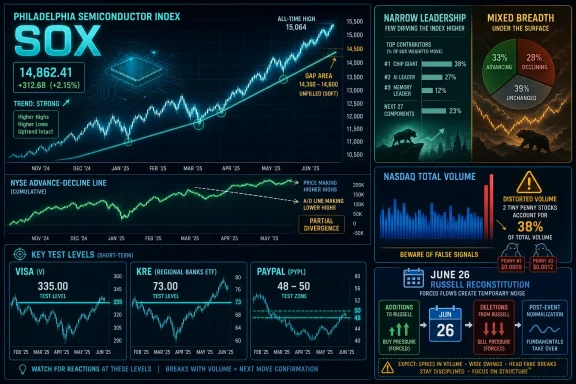
The Semiconductor Index has not yet committed the kind of technical sin that changes a trend. According to the chart read presented here, it has not made a lower high, and it has not broken the uptrend line. That leaves the bull case intact, but not invulnerable.
The suggested test is a gap near 14,500 on the SOX. A gap-fill would not automatically prove that the chip trade has another leg higher, but it would show that buyers still respond when the group is challenged. Failure there, especially if it comes with weak breadth or a break of the uptrend, would be more troubling than an ordinary one-day decline.
The larger point is that semiconductor strength is no longer just a sector call. It has become the market’s liquidity proxy, artificial-intelligence proxy, growth proxy, and risk-appetite proxy all at once. That concentration makes the signal powerful, but it also makes it brittle.
But the volume picture was less flattering. When up volume and down volume were included, the market looked more in line with the S&P’s weakness. That undercuts the bullish breadth read because it suggests the advancing names may not have carried enough conviction to overwhelm the heavier selling elsewhere.
This is the market’s current contradiction. There are enough improving internals to keep bears from declaring victory, but not enough broad demand to make bulls comfortable. The indexes can still be pulled around by mega-cap and semiconductor leadership, while the average stock tells a less dramatic story.
The more constructive detail is that new lows did not expand for the first time in more than a week. That matters because persistent expansion in new lows often signals deeper internal damage beneath a calm index surface. A pause in that deterioration does not equal a repair, but it is at least the market declining to make the problem worse.
This matters because volume is supposed to tell us something about conviction. But when a huge portion of turnover is concentrated in ultra-low-priced issues, the aggregate volume number becomes less useful as a sign of institutional demand. It may instead be telling us that speculative traders are chasing volatility wherever it is easiest to manufacture.
That does not mean the market must immediately roll over. Speculation can persist, and in strong tapes it can even become self-reinforcing. But when penny-stock churn appears alongside narrow leadership and a market dependent on semiconductors, it suggests investors are not merely buying growth; they are also reaching for lottery tickets.
This is where the note’s tone is useful. It does not treat speculation as a moral failure. It treats it as evidence. Markets can tolerate speculative behavior, but they become more fragile when speculation is doing too much of the volume work.
That kind of tape is exhausting because it denies both sides a clean confirmation. Bulls cannot point to synchronized upside, and bears cannot point to cascading internal damage. Instead, the market chops, rotates, and forces traders to decide whether divergence is early evidence of repair or early evidence of distribution.
The Thursday test described here is simple but important. If indexes rally while breadth turns lackluster, then the market remains trapped in the same narrow-leadership pattern. If breadth holds while semiconductors regain altitude, then the rally has a better chance of becoming something sturdier.
This is where many investors get fooled. They look for a single headline number — the S&P, Nasdaq, or SOX — and ignore the relationship among them. In this tape, the relationship is the story.
The note’s caution around Bloom Energy is a good example. When a stock moves from one index context to another, the chart can become temporarily less reliable because index funds, benchmark managers, and arbitrage desks may dominate the tape. A stock can fall sharply or rally sharply for reasons that have little to do with discretionary investor conviction.
That matters for small-cap and momentum traders because end-of-quarter positioning already tends to create mechanical flows. Add Russell reconstitution, and it becomes harder to separate genuine demand from mandated portfolio adjustment. A stock that looks like it is breaking out may simply be receiving index-related demand; a stock that looks like it is breaking down may be suffering from forced deletion pressure.
This does not make technical analysis useless. It makes timing more dangerous. The better interpretation is to treat the next several sessions as a flow-heavy zone where confirmation should carry a higher burden of proof.
The utility move has resistance overhead, so this is not a clean all-clear signal. Still, the fact that the group is improving while semiconductors dominate attention creates a different kind of market texture. It suggests investors are not merely liquidating risk; they are redistributing it.
That redistribution can be read two ways. Bulls may argue that sector rotation is healthy and keeps the market from overheating. Bears may counter that defensive participation often improves when investors begin hedging against growth exhaustion.
The more useful answer is conditional. If utilities rise while semiconductors consolidate and breadth improves, rotation is constructive. If utilities rise because semiconductors finally break and risk appetite evaporates, the same chart becomes a warning.
This is relevant to equities because macro positioning often leaks across asset classes. If precious metals and oil are already deeply disliked, the next surprise may not come from further collapse but from stabilization. If the dollar is already heavily loved, a reversal there could alter the backdrop for commodities, multinationals, and risk assets.
The note mentions that GLD did not quite reach the expected 360 area, but sentiment has already moved to an extreme. That is a useful reminder that price and sentiment do not always bottom together. Sometimes the emotional washout arrives before the chart target, and sometimes the chart target is reached only after sentiment has already begun to repair.
The broader market implication is that equities are not trading in isolation. Semiconductors may be the visible leadership group, but currency and commodity sentiment can still influence the next rotation.
A move through that zone would suggest the stock is escaping a flattening pattern. It would also give traders a way to participate in a market that may be broadening beyond semiconductors without chasing the most extended part of the tape. In a market this narrow, boring confirmation can be more valuable than exciting speculation.
The timing is also notable. Visa recently traded just below that 335 level, close enough that the line matters in practical terms. A failed push would reinforce the idea that large-cap non-chip leadership remains hesitant. A successful push would add one more piece of evidence that the market is trying to rotate rather than simply lean harder on semiconductors.
The key is not to turn Visa into a grand macro thesis. It is a test case. If more high-quality non-chip names begin clearing similar resistance, the either-or market becomes less either-or.
The levels are straightforward. The 48 area would approach a downtrend line, and 50 would fill a gap. A collapse under 40 would invalidate the constructive read. That is a clear technical map, but the language rightly avoids pretending the company has earned renewed trust.
KRE, the regional banking ETF, is treated differently. The chart “looks terrific,” but the note does not fully trust it, partly because larger banks have already run. That skepticism is healthy. Regional banks can rally sharply when rate expectations, credit fears, and deposit worries ease, but they remain sensitive to any renewed stress in commercial real estate, funding costs, or economic growth.
A trade back under 73 is flagged as a caution point for KRE. That is a narrow technical line, but it represents a broader idea: financials need confirmation from more than just price. In a market dominated by semiconductors, bank strength would be meaningful, but only if it survives the first real test.
Papa John’s is trying to build a base, but it needs to chew through the 37–38 area before the setup becomes more interesting. The language is patient rather than promotional. A stock mapping out a base is not the same thing as a stock completing one.
CDW gets a more constructive but still conditional read. The recent pullback could be the right shoulder of a head-and-shoulders bottom, but last week’s low is the line that should not break. That is the kind of setup technicians like because it defines both the opportunity and the failure point.
Mission Produce is too thinly traded for confident interpretation. That caveat is important and often ignored. Thin stocks can make dramatic moves that look meaningful on a chart but reflect limited liquidity more than durable demand.
GE Vernova receives the most candid assessment. The stock rallied sharply after a previous negative read, stopped at resistance, and may have left an island-like structure overhead. The proposed range between roughly 900 and 1,150 is wide, and the confidence level is low.
That humility is not weakness. It is a recognition that some charts become too noisy, too emotional, or too event-driven to offer a high-quality edge. In a market where investors are desperate for leaders beyond semiconductors, it is tempting to force narratives onto stocks like GE Vernova. The better move is sometimes to admit that the chart is tradable only with modest conviction.
Bloom Energy is even more complicated because of index movement. The note declines to make a firm call because the stock is about to leave the Russell 2000. That is the right instinct. When outside forces dominate, chart analysis should step back rather than pretend nothing has changed.
That framework is especially useful in a choppy tape. Chop punishes conviction that is too broad and too early. It rewards traders who know what would change their mind.
The important thing is to avoid treating each chart as an isolated puzzle. Visa clearing resistance would matter more if breadth improves. KRE holding 73 would matter more if financials broaden. SOX filling its gap would matter more if it does not come at the expense of everything else.
That is the market’s challenge right now. It is not enough for one thing to work. The tape needs more things to work at the same time.
 The Chip Tape Is Still Writing the Market’s Script
The note’s central argument is hard to miss: this is still “the semis world,” and everyone else is merely renting space in it. That sounds glib, but it captures the uncomfortable reality of a market where headline indexes can droop while parts of the tape quietly improve underneath. When a narrow leadership group carries the psychology of the market, the first job is not to admire the leaders; it is to watch for the moment they stop confirming the story.The Semiconductor Index has not yet committed the kind of technical sin that changes a trend. According to the chart read presented here, it has not made a lower high, and it has not broken the uptrend line. That leaves the bull case intact, but not invulnerable.
The suggested test is a gap near 14,500 on the SOX. A gap-fill would not automatically prove that the chip trade has another leg higher, but it would show that buyers still respond when the group is challenged. Failure there, especially if it comes with weak breadth or a break of the uptrend, would be more troubling than an ordinary one-day decline.
The larger point is that semiconductor strength is no longer just a sector call. It has become the market’s liquidity proxy, artificial-intelligence proxy, growth proxy, and risk-appetite proxy all at once. That concentration makes the signal powerful, but it also makes it brittle.
Breadth Improved Just Enough to Complicate the Bear Case
The tape described in the note was not strong, but it also was not uniformly weak. The advance-decline line was mildly positive even as the S&P 500 slipped, which is the kind of divergence technicians like to see when they are searching for hidden resilience. It means more stocks rose than fell, even though the capitalization-weighted index did not reward that fact.But the volume picture was less flattering. When up volume and down volume were included, the market looked more in line with the S&P’s weakness. That undercuts the bullish breadth read because it suggests the advancing names may not have carried enough conviction to overwhelm the heavier selling elsewhere.
This is the market’s current contradiction. There are enough improving internals to keep bears from declaring victory, but not enough broad demand to make bulls comfortable. The indexes can still be pulled around by mega-cap and semiconductor leadership, while the average stock tells a less dramatic story.
The more constructive detail is that new lows did not expand for the first time in more than a week. That matters because persistent expansion in new lows often signals deeper internal damage beneath a calm index surface. A pause in that deterioration does not equal a repair, but it is at least the market declining to make the problem worse.
Nasdaq’s Penny-Stock Volume Is a Warning, Not a Footnote
The note’s sharpest observation may be the one about Nasdaq volume. If roughly six billion of fifteen billion shares traded were concentrated in two penny stocks, that is not ordinary liquidity; it is speculative froth expressing itself in the cheapest possible corner of the tape. The raw percentage — around 40 percent — is large enough to distort the read on activity across the exchange.This matters because volume is supposed to tell us something about conviction. But when a huge portion of turnover is concentrated in ultra-low-priced issues, the aggregate volume number becomes less useful as a sign of institutional demand. It may instead be telling us that speculative traders are chasing volatility wherever it is easiest to manufacture.
That does not mean the market must immediately roll over. Speculation can persist, and in strong tapes it can even become self-reinforcing. But when penny-stock churn appears alongside narrow leadership and a market dependent on semiconductors, it suggests investors are not merely buying growth; they are also reaching for lottery tickets.
This is where the note’s tone is useful. It does not treat speculation as a moral failure. It treats it as evidence. Markets can tolerate speculative behavior, but they become more fragile when speculation is doing too much of the volume work.
The Either-Or Market Is the Real Enemy
The most important phrase in the note is “either/or market.” That is the condition where indexes and breadth seem to take turns rather than rise together. One day the headline averages stabilize while participation weakens; another day the average stock improves while the indexes sag.That kind of tape is exhausting because it denies both sides a clean confirmation. Bulls cannot point to synchronized upside, and bears cannot point to cascading internal damage. Instead, the market chops, rotates, and forces traders to decide whether divergence is early evidence of repair or early evidence of distribution.
The Thursday test described here is simple but important. If indexes rally while breadth turns lackluster, then the market remains trapped in the same narrow-leadership pattern. If breadth holds while semiconductors regain altitude, then the rally has a better chance of becoming something sturdier.
This is where many investors get fooled. They look for a single headline number — the S&P, Nasdaq, or SOX — and ignore the relationship among them. In this tape, the relationship is the story.
Russell Reconstitution Turns Timing Into a Risk Factor
The Russell 2000 Momentum Index becoming overbought around July 1 lands at an awkward moment. The June 2026 Russell reconstitution is final after the U.S. market close on Friday, June 26, with the newly reconstituted indexes reflected at the open on Monday, June 29. That timing can produce forced buying, forced selling, and price action that has less to do with chart purity than with benchmark mechanics.The note’s caution around Bloom Energy is a good example. When a stock moves from one index context to another, the chart can become temporarily less reliable because index funds, benchmark managers, and arbitrage desks may dominate the tape. A stock can fall sharply or rally sharply for reasons that have little to do with discretionary investor conviction.
That matters for small-cap and momentum traders because end-of-quarter positioning already tends to create mechanical flows. Add Russell reconstitution, and it becomes harder to separate genuine demand from mandated portfolio adjustment. A stock that looks like it is breaking out may simply be receiving index-related demand; a stock that looks like it is breaking down may be suffering from forced deletion pressure.
This does not make technical analysis useless. It makes timing more dangerous. The better interpretation is to treat the next several sessions as a flow-heavy zone where confirmation should carry a higher burden of proof.
Utilities Quietly Offer the Market’s Most Interesting Rotation
While the market watches semiconductors, utilities have crossed a downtrend line and are up around six percent this month, according to the note. That is not the kind of leadership that gets momentum traders excited, but it may be the kind that tells us something about rotation. Defensive sectors do not need to lead forever to matter; they only need to show that money is willing to move somewhere other than the hottest growth trade.The utility move has resistance overhead, so this is not a clean all-clear signal. Still, the fact that the group is improving while semiconductors dominate attention creates a different kind of market texture. It suggests investors are not merely liquidating risk; they are redistributing it.
That redistribution can be read two ways. Bulls may argue that sector rotation is healthy and keeps the market from overheating. Bears may counter that defensive participation often improves when investors begin hedging against growth exhaustion.
The more useful answer is conditional. If utilities rise while semiconductors consolidate and breadth improves, rotation is constructive. If utilities rise because semiconductors finally break and risk appetite evaporates, the same chart becomes a warning.
The Sentiment Washout Is Happening Outside Equities
The DSI readings cited for gold, silver, and oil are striking. Gold and silver at 10 and oil at 12 suggest deeply pessimistic sentiment in those markets, while the U.S. dollar at 83 points to a crowded bullish reading. Those are not automatic trade signals, but they do show where emotional extremes may be building.This is relevant to equities because macro positioning often leaks across asset classes. If precious metals and oil are already deeply disliked, the next surprise may not come from further collapse but from stabilization. If the dollar is already heavily loved, a reversal there could alter the backdrop for commodities, multinationals, and risk assets.
The note mentions that GLD did not quite reach the expected 360 area, but sentiment has already moved to an extreme. That is a useful reminder that price and sentiment do not always bottom together. Sometimes the emotional washout arrives before the chart target, and sometimes the chart target is reached only after sentiment has already begun to repair.
The broader market implication is that equities are not trading in isolation. Semiconductors may be the visible leadership group, but currency and commodity sentiment can still influence the next rotation.
Visa Is the Cleanest New-Idea Test Because It Is Boring
Visa is presented as a new idea if it can cross both a downtrend line and the roughly 335 area. That setup is interesting precisely because it is not an AI frenzy name or a penny-stock lottery ticket. It is a large-cap payments stock with a clean technical trigger and a simple invalidation framework.A move through that zone would suggest the stock is escaping a flattening pattern. It would also give traders a way to participate in a market that may be broadening beyond semiconductors without chasing the most extended part of the tape. In a market this narrow, boring confirmation can be more valuable than exciting speculation.
The timing is also notable. Visa recently traded just below that 335 level, close enough that the line matters in practical terms. A failed push would reinforce the idea that large-cap non-chip leadership remains hesitant. A successful push would add one more piece of evidence that the market is trying to rotate rather than simply lean harder on semiconductors.
The key is not to turn Visa into a grand macro thesis. It is a test case. If more high-quality non-chip names begin clearing similar resistance, the either-or market becomes less either-or.
PayPal, Regional Banks, and the Market’s Demand for Proof
PayPal is described as a serial disappointer, but one with a possible trade toward 48 or even 50. That distinction matters. A bad long-term chart can still offer a trade, but it must be treated as a trade rather than a redemption story.The levels are straightforward. The 48 area would approach a downtrend line, and 50 would fill a gap. A collapse under 40 would invalidate the constructive read. That is a clear technical map, but the language rightly avoids pretending the company has earned renewed trust.
KRE, the regional banking ETF, is treated differently. The chart “looks terrific,” but the note does not fully trust it, partly because larger banks have already run. That skepticism is healthy. Regional banks can rally sharply when rate expectations, credit fears, and deposit worries ease, but they remain sensitive to any renewed stress in commercial real estate, funding costs, or economic growth.
A trade back under 73 is flagged as a caution point for KRE. That is a narrow technical line, but it represents a broader idea: financials need confirmation from more than just price. In a market dominated by semiconductors, bank strength would be meaningful, but only if it survives the first real test.
Broken Charts Need Bases, Not Pep Talks
Several of the single-stock reads share the same underlying message: damage takes time to repair. Nutrien has collapsed since an island reversal in March and may be short-term oversold, but the note wants evidence that it can hold before becoming more constructive. That is exactly how broken charts should be treated.Papa John’s is trying to build a base, but it needs to chew through the 37–38 area before the setup becomes more interesting. The language is patient rather than promotional. A stock mapping out a base is not the same thing as a stock completing one.
CDW gets a more constructive but still conditional read. The recent pullback could be the right shoulder of a head-and-shoulders bottom, but last week’s low is the line that should not break. That is the kind of setup technicians like because it defines both the opportunity and the failure point.
Mission Produce is too thinly traded for confident interpretation. That caveat is important and often ignored. Thin stocks can make dramatic moves that look meaningful on a chart but reflect limited liquidity more than durable demand.
High-Momentum Winners Require a Different Kind of Humility
Lionsgate is in an uptrend and has not done anything wrong. That sounds positive, but the note also says it is “not my style.” That is an underrated piece of market discipline: not every valid chart has to fit every trader.GE Vernova receives the most candid assessment. The stock rallied sharply after a previous negative read, stopped at resistance, and may have left an island-like structure overhead. The proposed range between roughly 900 and 1,150 is wide, and the confidence level is low.
That humility is not weakness. It is a recognition that some charts become too noisy, too emotional, or too event-driven to offer a high-quality edge. In a market where investors are desperate for leaders beyond semiconductors, it is tempting to force narratives onto stocks like GE Vernova. The better move is sometimes to admit that the chart is tradable only with modest conviction.
Bloom Energy is even more complicated because of index movement. The note declines to make a firm call because the stock is about to leave the Russell 2000. That is the right instinct. When outside forces dominate, chart analysis should step back rather than pretend nothing has changed.
The Market Is Giving Traders Levels, Not Answers
The practical value of this note is not that it predicts the next market move. It does something more useful: it identifies the levels and relationships that would make the next move more believable. The SOX gap, the semiconductor uptrend, Visa near 335, PayPal near 48–50, KRE near 73, and the Russell timing window all give traders a framework.That framework is especially useful in a choppy tape. Chop punishes conviction that is too broad and too early. It rewards traders who know what would change their mind.
The important thing is to avoid treating each chart as an isolated puzzle. Visa clearing resistance would matter more if breadth improves. KRE holding 73 would matter more if financials broaden. SOX filling its gap would matter more if it does not come at the expense of everything else.
That is the market’s challenge right now. It is not enough for one thing to work. The tape needs more things to work at the same time.
The Clues That Matter Before the Holiday Tape Takes Over
With the July 4 holiday period approaching, the market is entering a stretch where liquidity, quarter-end flows, and index mechanics can exaggerate moves. That does not mean the signals are useless, but it does mean traders should be careful about over-interpreting a single session. The next few days matter most if they confirm one another.- The semiconductor index remains the decisive leadership tell because it has not broken its uptrend or made a lower high.
- The market’s breadth improvement is helpful but incomplete because volume did not confirm the advance-decline line as strongly.
- Nasdaq’s penny-stock volume points to speculative excess and makes headline volume less trustworthy.
- Russell reconstitution on June 26 and the June 29 effective open can distort small-cap and momentum-stock price action.
- Visa, KRE, and utilities are useful tests of whether leadership can broaden beyond the chip complex.
- Broken charts such as PayPal, Nutrien, and Papa John’s need defined levels and proof of repair rather than hopeful narratives.
References
- Primary source: TheStreet Pro
Published: Wed, 24 Jun 2026 23:04:00 GMT
Watching the Semiconductors for Clues | TheStreet Pro
This remains an either/or market. But the semis are at an important point and we’re watching to see if they can rally here.pro.thestreet.com
