

SPAR Holding BV’s move to Microsoft Dynamics 365 Finance and Supply Chain Management has quietly retooled how one of the world’s most recognizable convenience‑store networks replenishes fresh food, processes invoices, and keeps shelves stocked on tight overnight schedules—replacing a bespoke, aging order system with a cloud‑native, integrated platform that automates high‑volume, perishable supply flows and scales across formats.
SPAR began as a single shop in the Netherlands in 1932 and today operates as a voluntary retail network spanning dozens of countries, focused on local convenience and fresh food formats. The group’s global footprint and franchise structure create a natural tension between centralized scale and local assortment, a tension that drives the need for sophisticated replenishment and integration capabilities. In the Netherlands, SPAR operates hundreds of convenience points—neighborhood stores and petrol‑station-based SPAR Express locations—organized under the SPAR Holding BV umbrella and participating in the Superunie cooperative. These stores vary from high‑volume supermarket footprints to small, location‑specific convenience outlets; that variation is precisely why replenishment and forecast accuracy must be both automated and flexible. SPAR Holding BV’s core operational challenge before modernization was a fragmented ordering and fulfillment landscape: a legacy order platform that had been heavily customized, disconnected third‑party tools, and manual invoice matching that strained finance and supply teams. The company selected Dynamics 365 Finance and Dynamics 365 Supply Chain Management to modernize ordering, fulfillment, and supplier invoicing into a single, cloud‑hosted operational plane.
Source: Microsoft SPAR Holding BV makes it fast and fresh with Dynamics 365 | Microsoft Customer Stories
 Background / Overview
SPAR began as a single shop in the Netherlands in 1932 and today operates as a voluntary retail network spanning dozens of countries, focused on local convenience and fresh food formats. The group’s global footprint and franchise structure create a natural tension between centralized scale and local assortment, a tension that drives the need for sophisticated replenishment and integration capabilities. In the Netherlands, SPAR operates hundreds of convenience points—neighborhood stores and petrol‑station-based SPAR Express locations—organized under the SPAR Holding BV umbrella and participating in the Superunie cooperative. These stores vary from high‑volume supermarket footprints to small, location‑specific convenience outlets; that variation is precisely why replenishment and forecast accuracy must be both automated and flexible. SPAR Holding BV’s core operational challenge before modernization was a fragmented ordering and fulfillment landscape: a legacy order platform that had been heavily customized, disconnected third‑party tools, and manual invoice matching that strained finance and supply teams. The company selected Dynamics 365 Finance and Dynamics 365 Supply Chain Management to modernize ordering, fulfillment, and supplier invoicing into a single, cloud‑hosted operational plane. What SPAR implemented
Core platform and scope
- Cloud ERP: Dynamics 365 Finance for accounts, payments, and invoicing workflows.
- Supply chain backbone: Dynamics 365 Supply Chain Management to manage orders, inventory, and fulfillment logic across formats.
- Azure services: monitoring and integrations running on Azure (Application Insights and serverless integration patterns in related SPAR projects).
Third‑party integrations and orchestration
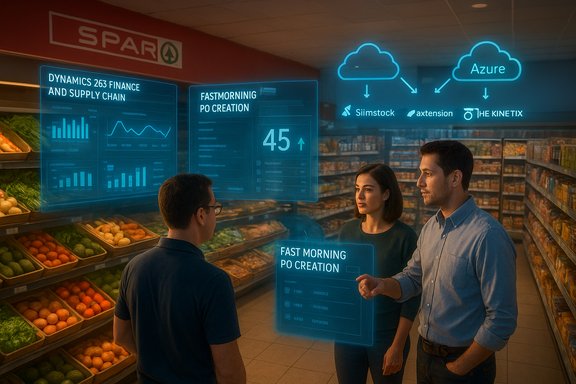
SPAR did not attempt to migrate every capability into Dynamics itself. Instead, the company integrated specialized ISVs and tools to handle demand forecasting, invoice capture, and EDI/document exchange:- Demand planning: SlimStock handles daily demand analysis and replenishment recommendations integrated into the Dynamics ordering flow.
- Invoice capture and matching: Axtension Invoice Processing and ISP Next automate supplier invoice entry and matching with Dynamics.
- EDI and partner automation: SPAR has also worked with platforms such as TIE Kinetix and partner ecosystems to move partner automation and document exchanges to the cloud and connect them to Dynamics 365 F&SCM.
How it runs day‑to‑day: processes and metrics
The new flow designed around Dynamics 365 automates what were previously painstaking manual tasks:- Orders from stores (including perishable SKUs) flow into Dynamics from a third‑party order entry app each morning; the system processes thousands of orders and generates the first round of purchase orders at 9:30 AM to meet tight supplier cut‑offs. This morning cadence is critical for next‑day delivery of highly perishable foods.
- Scale handled: Dynamics 365 is configured to manage more than 150,000 unique SKUs in SPAR’s environment and to support finance operations that handle an average of about 5,000 supplier payments per week, with automated invoice entry and matching in the process chain. These are the operational numbers reported by SPAR in its Dynamics case narrative.
- Touchless replenishment: Integrated demand planning (SlimStock), ordering logic in Dynamics, and warehouse orchestration produce an “efficient and touchless” replenishment process that allows a very small planning team (reported as three planners) to manage broad assortments across distribution formats.
- Finance automation: Dynamics 365 Finance ties into automated invoice processing, unique customer pricing, discount tracking, and monthly reporting; the reported effect is fewer manual corrections and faster reporting cycles.
Implementation story and partner landscape
SPAR’s modernization can be read as a typical enterprise Dynamics adoption pattern: reduced customization, iterative rollout, and reliance on the ecosystem for vertical capabilities.- SPAR’s team designed a standardized process workflow template for ordering and fulfillment to reduce the diverging local customizations that had made the legacy environment brittle. The vendor narrative stresses that stores moved away from “overly customized disconnected order systems” toward Dynamics‑driven standard processes.
- The company’s Azure‑first and event‑driven integration strategy (documented in an earlier SPAR NL case) shows that Dynamics 365 became part of a broader cloud architecture that uses serverless tooling and event messaging to sync POS, fulfillment, and analytics. That same Azure integration mindset is visible in regional SPAR projects and helps explain why SPAR connected SlimStock and other external engines rather than embedding every function in Dynamics itself.
- EDI and partner automation vendors (for example, TIE Kinetix’s FLOW platform) have been contracted to replace legacy document exchange and connect suppliers directly into the Dynamics environment—another signal that SPAR favours orchestrated cloud integrations over monolithic, custom code.
Notable strengths and wins
- Operational scale with a small team. The most striking operational winning point is SPAR’s ability to manage huge SKU breadth and daily ordering cadence with a very small planning team—enabled by automation and intelligent integrations. This is a classic efficiency multiplier for convenience retail where margins are tight and labor is expensive.
- Fresher supply chains and faster cut‑offs. Automating the morning order cut‑off and supplier PO generation enables SPAR to capture more timely replenishment windows for perishable items, increasing on‑shelf availability for fresh produce and prepared foods. That operational tightness directly supports the brand promise of being “the local food store of choice.”
- Ecosystem approach reduces reinvention. By integrating SlimStock for demand planning and dedicated invoice capture tools, SPAR avoided costly reinvention while benefiting from domain expertise in forecasting and invoice processing. This reduces both implementation risk and long‑term maintenance exposure.
- Cloud and monitoring for reliability. Using Azure telemetry (for example, Application Insights) to monitor transaction flow, especially during the critical 90‑minute procurement window, reduces operational risk by surfacing issues early. This monitoring posture is a major improvement over legacy black‑box brokers.
Risks, caveats, and what to watch for
While the results are compelling, several practical risks and caveats should temper expectations for organizations planning a similar path.- Vendor and ecosystem lock‑in. SPAR’s architecture explicitly leans into Microsoft’s cloud and Dynamics platform, which is efficient but means roadmap, licensing, and feature direction are heavily influenced by Microsoft’s product cadence and pricing. Over‑reliance on one ecosystem complicates late‑stage divergence to alternative stacks.
- Data quality is the hidden cost. ERP automation magnifies the impact of poor master data. Dynamics will run processes at scale, but if item master, supplier hierarchies, pricing matrices, and tax attributes aren’t clean and governed, automation amplifies errors and reconciliation costs. Historical reports and partner accounts in the retail sector consistently flag master data and mapping as the major line‑item during migration. SPAR’s success was enabled in part by early focus on standardization; others should budget heavily for data governance.
- Integration complexity and partner management. The “best‑of‑breed” approach brings many separate vendors—each with their own SLAs, upgrade cycles, and API behaviour. Orchestration must be governed carefully, with clear RACI for who owns end‑to‑end testing, monitoring, and escalation when a morning ordering window fails. TIE Kinetix, SlimStock, Axtension and others must be treated as critical path, not optional extras.
- Change management and retailer heterogeneity. SPAR’s stores vary in format and local preferences. Standardizing processes reduces complexity, but too‑rigid templates can erode valuable local differentiation. The implementation choice must strike a balance: standard processes for backbone activities with configurable, governed exceptions for local assortment and promotions.
- Metrics transparency and audited ROI. Many case narratives provide operational claims (SKU counts, payments per week, hours saved), but independent audited financial returns or margin uplifts are rarely published. Readers should treat published operational numbers as directional and instrument their own pilots to measure actual time‑to‑value, cost‑per-order, waste reduction and margin impact. Where possible, insist on pre‑ and post‑implementation KPIs and contractually agreed success metrics with integrators.
How SPAR’s story fits broader retail modernization patterns
SPAR’s pattern—use Dynamics 365 as a unified ledger and order engine, route specialized problems to best‑of‑breed ISVs, and run an Azure‑first, event‑driven integration layer—is now common among large retailers seeking to become data‑driven without building every capability in‑house. That combination captures three practical benefits:- Faster time to value by leveraging pre‑built commerce and planning capabilities from ISVs.
- Lower long‑term maintenance overhead by minimizing heavy customizations inside the core ERP.
- Improved operational observability through cloud monitoring and event telemetry, which is essential for high‑cadence, perishable supply flows.
Practical checklist for retailers planning a similar project
- Define the “single source of truth” for master data (items, suppliers, prices) before cutover; allocate ample time for cleansing and mapping.
- Pilot the morning order cadence and supplier cut‑offs in a limited geography to validate latency, data flow and supplier SLAs.
- Choose ISVs for specialized capabilities (demand planning, invoice capture, EDI) that offer proven connectors or clear API contracts to Dynamics 365.
- Instrument telemetry and alerts (Application Insights, logging, process dashboards) for the critical procurement windows—monitor before and after go‑live.
- Specify operational KPIs (on‑shelf availability, order‑to‑PO latency, invoice exceptions per week, planner headcount) and use them to validate ROI claims.
- Plan governance around upgrades—minimize custom code in Dynamics to reduce upgrade risk and coordinate ISV upgrade windows with ERP releases.
Final analysis — why this matters to retail IT leaders
For retailers selling highly perishable goods in dense convenience formats, the central challenge is not merely an ERP replacement; it is converting a loosely coordinated set of local ordering behaviours into reliable, auditable, and automated processes that guarantee freshness without exploding operating cost. SPAR’s implementation of Dynamics 365 Finance and Supply Chain Management addresses that challenge by making the ERP the backbone of ordering, while relying on specialized partners for forecasting, EDI, and invoice automation. The combination reduces manual labor, tightens order windows, and produces faster supplier payment cycles—outcomes that directly protect margins and customer trust. The tradeoffs are real: tight vendor coupling, the need for rigorous master‑data governance, partner coordination risk, and the requirement for disciplined change management. But SPAR shows that with a clear architecture—ERP as system of record, event‑driven integration layer on Azure, and best‑of‑breed ISVs for domain complexity—convenience retailers can dramatically shrink the headcount and friction needed to keep thousands of small stores stocked with fresh food. For retailers evaluating modernization, SPAR’s playbook is a pragmatic reference: standardize where it matters, integrate where you get better domain capability, instrument everything, and treat data as the project’s real currency.Conclusion
SPAR Holding BV’s Dynamics 365 journey is a textbook example of how cloud ERP—when paired with focused ISVs and an event‑driven Azure integration layer—can convert a customized, high‑touch retail order process into a reliable, scalable, and largely automated supply chain. The result is sharper freshness guarantees for customers, fewer manual invoices for finance teams, and dramatically improved planning throughput for a very small operations core team. The story also serves as a pragmatic reminder: automation magnifies both benefits and mistakes, so data governance, careful partner selection, and measurable KPIs are non‑negotiable for any retailer that wants to replicate SPAR’s success.Source: Microsoft SPAR Holding BV makes it fast and fresh with Dynamics 365 | Microsoft Customer Stories
