

Big Tech’s latest moves make one thing clear: AI is no longer a single, monolithic capability bolted onto apps — it is the connective tissue weaving together creativity, commerce and workplace automation, with companies shifting from one-size-fits-all models to specialized AI stacks and immersive, data-rich physical experiences that blend marketing, entertainment and direct monetization.
The past few weeks have delivered a concentrated set of announcements that together sketch where platforms, media companies and enterprise software are headed.
These developments are not incremental; they reshape discovery, engagement and the enterprise operating model. The near-term winners will be organizations that combine technical rigor, ethical guardrails and operational discipline — and that can turn today’s exploratory AI pilots into reliable, auditable products that customers and regulators can trust.
Source: PYMNTS.com Big Tech Moves Toward Specialized AI and Immersive Retail | PYMNTS.com
 Background / Overview
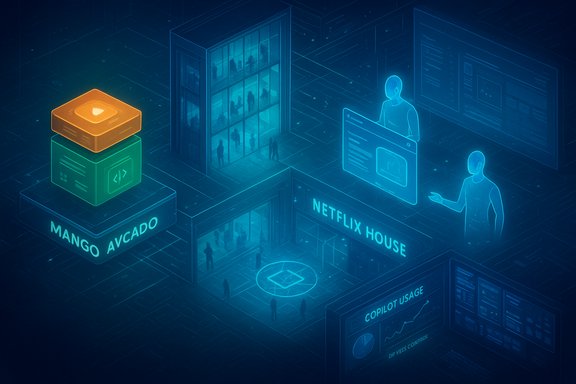
The past few weeks have delivered a concentrated set of announcements that together sketch where platforms, media companies and enterprise software are headed.- Meta is reported to be building purpose-built models — Mango for image and video generation and Avocado for text and code — signaling a move away from a single large language model toward modality-specific engines tuned for cost, performance and product fit.
- Netflix unveiled Netflix House, a permanent, year‑round chain of immersive venues that turns franchises into walk‑through, data‑driven experiences and new retail/food revenue channels. The first locations target King of Prussia (Philadelphia) and Galleria Dallas in late 2025, with further expansion planned.
- Microsoft published its Copilot Usage Report 2025, describing how device context shapes behavior: health questions dominate mobile interactions while desktop skews heavily to work and technical queries — a pattern with big product, safety and governance consequences. The analysis covers a 37.5 million conversation sample and emphasizes time-of-day and seasonal rhythms in user intent.
- Salesforce signed a definitive agreement to acquire Qualified, a vendor of agentic, always‑on marketing agents that convert inbound website traffic into pipeline — a clear bet on agentification of sales and marketing workflows inside Salesforce’s Agentforce strategy. The transaction is expected to close in early FY2027, pending regulatory approvals.
Why specialization matters: Meta’s Mango and Avocado
What’s being built
Meta’s internal roadmap reportedly includes:- Mango — a model targeted at image and video generation and editing, intended to power creator tools, ads and social features that rely on visual content.
- Avocado — a text- and code-focused model optimized for reasoning, coding, and other linguistic tasks.
Strengths and rationale
- Efficiency and cost control. Specialized models let engineering teams trade off precision, latency and compute cost across workloads (e.g., a small text‑reasoning model for chat, a larger visual model with expensive video decoding when needed).
- Product fit. Visual generation for short‑form video and creator tools requires different training data, optimization and safety guardrails than code synthesis or long-form reasoning.
- Competitive posture. Visual AI is now a core battleground for engagement and advertising; owning a strong multimodal stack is a strategic necessity for social platforms seeking to monetize creators and advertisers.
Risks and unknowns
- Safety and hallucinations. Visual and video generation introduces new vectors for misinformation, deepfakes and copyright infringement that require both detection tooling and human workflows.
- Data and provenance. Visual editing and “world models” that reason about environments raise harder questions about dataset provenance and the ability to trace outputs back to licensed sources.
- Execution risk. Building and integrating multiple large models is costly and operationally complex; time-to-market, developer ecosystems and model quality relative to leaders will determine whether specialization becomes an advantage or a fragmentation cost. Independent reporting highlights the aggressive timeline and the intensity of competition from OpenAI, Google and others.
Immersive retail and fandom as monetization: Netflix House
The proposition
Netflix House is a shift from ephemeral pop-ups to permanent theatricalized retail — multi‑room, interactive experiences tied to franchises such as Stranger Things, Wednesday, One Piece and others. The concept blends:- Themed attractions and escape‑room style games
- Data‑driven personalization of experiences (adapting environments based on audience behavior)
- Ancillary revenue streams (food & beverage, merchandise, paid experiences and tickets)
Why this is important for media and retail
- New revenue diversification. Streaming ARPUs and ad monetization hit limits; permanent physical venues turn IP into recurring real‑world revenue and capture rich, first‑party behavioral data.
- Deep engagement and retention. Immersive visits create longer dwell times and brand intimacy that can translate to subscription retention, merchandise sales and social buzz.
- Testbed for personalization. On‑site behavior generates signals (movement, dwell, choices) that can feed back into recommendation systems or content design in ways passive viewing cannot.
Risks, regulatory and operational questions
- Privacy and data collection. Real‑world sensors and behavioral personalization raise consent and data‑retention issues that differ from streaming telemetry. Retail teams and legal counsels must define clear policies about what is collected, how it’s used, and opt‑out flows.
- Brand dilution and operational overhead. Running theatrical venues is a different discipline from streaming tech — staffing, safety, local regulation, and seasonal foot traffic introduce new operational complexity.
- Longevity of interest. The novelty effect can be strong; sustaining repeat visitation depends on frequent refreshes, local relevance and cost of attendance. Early reporting and investor materials emphasize refresh cycles and location-specific experiences as the durability strategy.
Copilot usage patterns: health, context and the governance gap
The headline data
Microsoft’s Copilot Usage Report 2025 analyzes roughly 37.5 million de‑identified conversations and reports a strong device-context split:- Mobile: Health‑related conversations are the most common topic across hours and months.
- Desktop: Work‑related, technical and productivity queries dominate during business hours.
- Temporal rhythms such as weekday programming peaks and weekend gaming spikes also emerge.
Why this matters to product and security teams
- Contextual UI design. A single Copilot UI cannot serve both late‑night emotional conversations on mobile and dense productivity tasks on desktop; UX, disclosure and grounding must adapt by device and intent.
- Safety engineering. Health queries on mobile raise nuanced safety needs: triage to verified sources, escalation paths to professionals, and conservative phrasing to avoid actionable medical advice that could harm users.
- Policy & compliance. Regulatory frameworks for medical advice and consumer protection vary across regions — product teams must map Copilot behaviors to legal boundaries and implement explicit guardrails where necessary.
Validation and cross-checking
Microsoft’s own blog post and several independent write-ups align on the device split and the scale of the analysis. Community technologists have raised methodological caveats — notably that the dataset excludes enterprise and education accounts and that topic/intent labels are automated by classifiers rather than human coders. This means the signals are strong but warrant conservative interpretation when shaping policy and clinical interactions.Agentic enterprise: Salesforce buys Qualified
What the acquisition buys
Qualified’s core product is an agentic marketing layer that runs “always‑on” AI agents on websites to qualify leads, schedule meetings, and route high-intent prospects — effectively automating early SDR (sales development rep) functions with configurable guardrails. Salesforce positions the deal as an acceleration of its Agentforce effort to embed autonomous agents across sales and marketing workflows.The operational shift
This acquisition makes explicit what many enterprise teams are already testing: AI agents will not just assist humans, they will act on behalf of businesses — triaging leads, initiating contact, and handing off when human judgment is required.- Benefits include faster response times, 24/7 qualification and the ability to scale SDR-like functions without linear headcount growth.
- It also tightens the integration between discovery, qualification and CRM — agents become a front-line pipeline engine inside Salesforce’s stack.
Risks and guardrails
- Authority and provenance. Who is accountable when an autonomous agent misrepresents product terms, promises a trial incorrectly, or exposes pricing prematurely?
- Data leakage. Agents that surface customer intent and PII require strict access control, encryption, and audit trails.
- Customer experience. Poorly tuned agents can erode trust; humans must design graceful escalation and handoff flows.
Cross‑cutting implications for WindowsForum readers and IT teams
Technical architecture and developer impact
- Expect model diversification in vendor SDKs and APIs — teams will need to map which model to call for which use case (image generation vs. code reasoning), and architect model routing and cost controls accordingly.
- Real‑time, agentic workflows demand low‑latency product feeds, tokenized checkout or delegation primitives, and robust observability to tie a conversation to an eventual order or CRM record. Many community writeups emphasize the importance of canonical product metadata and real‑time inventory synchronization.
Security, governance and compliance
- Harden connectors and data policies for agents: define scopes, limit data exposure, and ensure auditable decisions and logs.
- Deploy safety layers for medical, legal and financial intents: conservative templates, escalation to human experts, and mandated provenance links.
- Plan for third‑party risk management: physical venues, merchandising partners, and experiential vendors introduce new supply‑chain and consumer protection obligations.
Business and go‑to‑market
- Retailers and brands must treat GEO (Generative Engine Optimization) as the new discipline: structured, machine‑readable content becomes the signal agents use to surface merchants.
- For media companies, permanent immersive venues are a test of whether fandom converts to repeat visits and sustainable revenue.
- Sales and marketing leaders should plan pilot programs for agentic funnels, instrumenting conversion, return and dispute metrics separately from legacy channels. Community guidance recommends auditing feeds, instrumenting observability and testing fraud vectors early.
Short checklist: immediate steps for technical leaders
- Audit product and catalog metadata for machine‑readability (GTINs, canonical SKUs, shipping and return policies).
- Define agent scopes and delegation policies: what an agent may and may not do without human signoff.
- Instrument end‑to‑end observability linking agent prompt → recommendation → checkout → fulfillment → returns.
- Implement conservative safety layers for health/medical and financial intents; include explicit provenance and referral pathways.
- Build an integration testbed for agentic commerce (mock callbacks, tokenized payments, idempotent order ingestion).
- Start a pilot for immersive experiences or brand partnerships with clear KPIs for retention, revenue per visit and data privacy metrics.
Critical assessment: what’s promising — and what to watch
Notable strengths
- Better product fit through specialization. Companies optimizing models by modality should see UX and efficiency gains when models are smaller, focused and cheaper to run at scale.
- New monetization channels. Immersive retail and agentic marketing open diversified revenues beyond subscriptions and ad impressions.
- Operational automation. Agentification promises to shorten sales cycles and scale marketing productivity if agents are well‑governed.
Key risks
- Trust and safety. Health dominance in Copilot usage and autonomous agent actions in sales require stronger, auditable guardrails — both technically and legally.
- Concentration of discovery power. If agents become the dominant discovery layer, platforms could command new gatekeeper power with attendant monetization and transparency concerns.
- Execution and cost. Multiplying large models and running immersive physical venues are expensive bets; the winners will be those who can operationalize quality, safety and steady refresh cycles.
Conclusion
The recent flurry of moves from Meta, Netflix, Microsoft and Salesforce shows an industry shifting from early exploration to institutionalizing AI: models are specialized for purpose, experiences are becoming immersive and monetized, and autonomous agents are being embedded directly into revenue workflows. For Windows administrators, developers and retail/marketing teams, the mandate is clear: prepare infrastructure, rethink metadata and governance, and treat agentic features as first‑class systems with monitoring, safety and legal controls.These developments are not incremental; they reshape discovery, engagement and the enterprise operating model. The near-term winners will be organizations that combine technical rigor, ethical guardrails and operational discipline — and that can turn today’s exploratory AI pilots into reliable, auditable products that customers and regulators can trust.
Source: PYMNTS.com Big Tech Moves Toward Specialized AI and Immersive Retail | PYMNTS.com
