

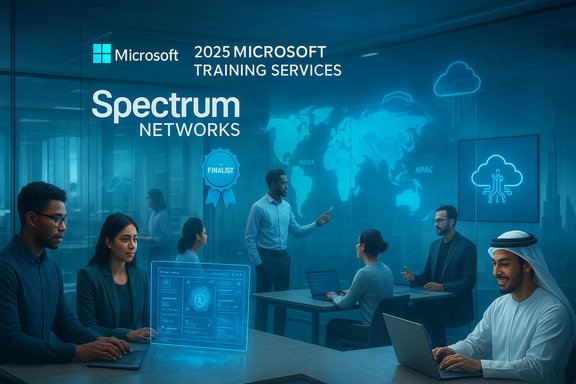
Spectrum Networks’ announcement that it has been named a global finalist in the 2025 Microsoft Training Services Partner of the Year Awards marks a notable milestone for the Dubai‑and‑Mumbai‑based training specialist and underscores Microsoft’s continued focus on scalable, outcomes‑driven skilling in an AI‑first era. The recognition places Spectrum on the shortlist alongside established global training houses and regional specialists, and arrives at a moment when enterprises are prioritizing practical Copilot, Azure AI, and governance-ready training as a business imperative.
Microsoft’s Partner of the Year Awards are an annual, global program that recognizes partners who deliver measurable customer outcomes using Microsoft Cloud and AI technologies. The 2025 cycle attracted a large field—Microsoft reports more than 4,600 nominations from over 100 countries—and winners and finalists were announced in the run‑up to Microsoft Ignite. Microsoft frames the awards around demonstrable impact: measurable learner outcomes, role‑based curricula, certification conversion, and the ability to tailor learning to industry and enterprise requirements. The Training Services category specifically honors partners that deliver scalable, role‑based skilling across Microsoft’s cloud, AI, security, and data portfolios. In 2025 the rubric placed extra emphasis on AI and Copilot enablement—judges rewarded partners that built practical pathways for enterprises to operationalize Copilot, agentic AI patterns, and Azure AI features, and that could show certification success and time‑to‑value improvements. Microsoft’s official winners page lists Koenig Solutions as the category winner, with Digital China, Spectrum Networks, and NetCom Learning named as finalists.
However, the finalist badge is a starting point, not a procurement endpoint. Headline marketing metrics—especially cumulative learner counts like “1,000,000+ empowered”—are company‑declared figures and require validation through named references, voucher/certification reports, and Partner Center confirmations before they can be relied on for contracting decisions. Enterprises should insist on lab architecture diagrams, security attestations (SOC 2, pen test summaries), FinOps controls, and pilot acceptance criteria before awarding large-scale programs.
Spectrum Networks’ finalist recognition places it in the spotlight at a time when Microsoft partners that demonstrate rapid, governed pathways for Copilot and Azure AI adoption are in high demand. The award nod is a meaningful commercial credential and a persuasive marketing asset; converting that momentum into durable enterprise engagements will require the operational evidence and contractual safeguards procurement teams routinely demand. Spectrum’s next commercial steps—publishing procurement‑grade artifacts, sharing named references, and demonstrating lab and governance rigour—will determine whether the finalist badge becomes a lasting competitive advantage or a transient marketing headline.
Source: The Hindu Spectrum Networks recognized as a finalist of 2025 Microsoft Training Services Partner of the Year Award
 Background and overview
Microsoft’s Partner of the Year Awards are an annual, global program that recognizes partners who deliver measurable customer outcomes using Microsoft Cloud and AI technologies. The 2025 cycle attracted a large field—Microsoft reports more than 4,600 nominations from over 100 countries—and winners and finalists were announced in the run‑up to Microsoft Ignite. Microsoft frames the awards around demonstrable impact: measurable learner outcomes, role‑based curricula, certification conversion, and the ability to tailor learning to industry and enterprise requirements. The Training Services category specifically honors partners that deliver scalable, role‑based skilling across Microsoft’s cloud, AI, security, and data portfolios. In 2025 the rubric placed extra emphasis on AI and Copilot enablement—judges rewarded partners that built practical pathways for enterprises to operationalize Copilot, agentic AI patterns, and Azure AI features, and that could show certification success and time‑to‑value improvements. Microsoft’s official winners page lists Koenig Solutions as the category winner, with Digital China, Spectrum Networks, and NetCom Learning named as finalists. What Spectrum Networks announced (summary of the press release)
Spectrum Networks’ public release—distributed from its Mumbai and Dubai offices and syndicated through trade channels—declares the company a finalist in the 2025 Microsoft Training Services Partner of the Year Awards. The announcement highlights several central claims:- A Microsoft finalist designation for Training Services, presented as validation of Spectrum’s Microsoft‑aligned skilling approach.
- A curriculum model combining role‑based learning, live instruction, on‑demand hands‑on labs, and certification pathways intended to shorten time‑to‑value.
- A stated organizational scale described in marketing copy as having “empowered 1,000,000+ professionals over two decades,” and a portfolio of authorized vendor programs beyond Microsoft (AWS, Google Cloud, RedHat, Fortinet, etc.. This is presented as a company‑declared figure in the press materials.
- An explicit focus on AI learning paths, including Microsoft Copilot and agentic AI, which Spectrum says are designed to deliver measurable business outcomes via structured hands‑on enablement.
Independent verification — what public records confirm
Two independent, authoritative confirmations are especially relevant:- Microsoft’s official Partner of the Year Awards winner/finalist listing shows the Training Services category with Koenig Solutions as the global winner and Digital China, Spectrum Networks, and NetCom Learning as finalists. This is the canonical record for the awards.
- Koenig Solutions, the named winner, and multiple trade press outlets published celebration materials describing the win and providing basic metrics and program highlights; these corroborate Microsoft’s announcement about the Training Services award.
Why finalist status matters — immediate commercial and operational impacts
Being named a Microsoft Partner of the Year finalist is more than a press headline. The recognition unlocks tangible go‑to‑market advantages for training partners:- Increased visibility with Microsoft field teams and program sponsors, which can accelerate introductions and co‑sell opportunities.
- Marketing amplification around Microsoft events (for example, Ignite), producing inbound demand from enterprises that prioritize Microsoft‑aligned providers.
- Procurement shortlisting advantages, where Microsoft‑validated partners are often given higher consideration in RFPs for training and enablement programs.
Dissecting Spectrum’s claims: what’s verifiable and what needs scrutiny
Spectrum’s press release and public materials contain a mix of verifiable facts and company‑declared marketing assertions. Below is an expedition through their major claims and recommended validation steps.Verifiable items (publicly demonstrable)
- Finalist placement: Confirmed on Microsoft’s Partner of the Year winners/finalists page.
- Program structure: Spectrum’s described blend of role‑based curricula, hands‑on labs, and certification pathways is consistent with patterns visible in their case studies and program descriptions. Program-level metrics for at least one public AI bootcamp are published by the company as a success story.
Company‑declared items requiring procurement validation
- “Empowered 1,000,000+ professionals”: This is a headline scale claim in Spectrum’s marketing materials. It is plausible for a multi‑decade training firm but remains company‑declared and should be verified with Partner Center exports, named customer references, and voucher/certification redemption reports before being used as a procurement justification.
- Certification pass‑rates and program pass figures: Case studies cite cohort pass rates and completion metrics; procurement should request anonymized cohort reports, voucher logs, and external references to corroborate internal reporting.
- Operational controls for hands‑on labs (isolation, identity, FinOps): Large‑scale lab operations require sandbox tenancy, managed identities, cost controls, and resource cleanup workflows. These technical artifacts are rarely published in press releases and should be requested as part of due diligence.
Strengths signaled by the finalist badge
Spectrum Networks’ candidacy and public materials show several strengths that align with Microsoft’s judging rubric:- Role‑based, hands‑on pedagogy: Role‑based learning plus hands‑on labs is Microsoft’s recommended approach to cloud and AI skilling; Spectrum emphasizes this blend in its materials—an element judges reward.
- Regional reach across MENA and APAC: Localized delivery and government engagement matter in these markets. Spectrum’s footprint in the Middle East, North Africa, and Asia Pacific is strategically useful for enterprises that require regional training capacity.
- Explicit Copilot and agentic AI learning paths: The company’s emphasis on Copilot and agentic AI positions it to help customers operationalize Microsoft’s most strategic product narratives for 2025. Such alignment matters in Microsoft’s evaluation and enterprise adoption programs.
Practical risks and operational gaps buyers must probe
Recognition does not replace rigorous procurement checks. Key risks to address are operational, security, and outcome‑measurement weaknesses that are common in rapid, large‑scale skilling programs:- Lab isolation and data leakage risk: Hands‑on Azure and Copilot labs can inadvertently expose tenant credentials, PII, or production networks if sandboxing is weak. Require lab architecture diagrams showing ephemeral subscriptions, network isolation (VNets/private endpoints), and automated teardown processes.
- Identity and least‑privilege controls: Verify that lab automation uses managed identities and enforces least privilege to avoid inadvertent privilege escalation into customer environments.
- Prompt privacy and model governance: Copilot and Azure OpenAI exercises may capture prompts and contextual PII. Confirm data retention policies and that prompts are not forwarded to unmanaged multi‑tenant endpoints without contractual consent. Training on Copilot/agentic AI must include governance modules.
- FinOps exposure: Hands‑on labs and model inference can produce runaway cloud bills. Require FinOps guardrails: tagging, budget alerts, monthly spend reports, and pre‑approved cost caps for pilot phases.
- Transferability and vendor lock‑in: Ask whether curricula, lab artifacts, and learning records are exportable (xAPI/SCORM) to mitigate lock‑in and enable portability if you change training vendors.
A procurement checklist — turning a finalist badge into a safe short‑list
Enterprises evaluating Spectrum Networks or similar finalists should convert marketing momentum into contractable evidence with the following checklist:- Provide an official Microsoft Partner Center export or a partner notification showing the finalist designation and submission period.
- Share two named customer references that match your industry and deployment scale, with quantifiable KPIs (certifications achieved, pre/post assessment improvements).
- Deliver anonymized voucher redemption and certification pass‑rate reports for the cohorts cited in the award submission.
- Present lab architecture diagrams detailing sandboxing, subscription isolation, network design and automated teardown/runbook processes.
- Show security/compliance posture: SOC 2 Type II or equivalent, and summaries of recent third‑party penetration tests on training platforms.
- Produce content governance and refresh policies demonstrating how Copilot/Azure AI materials are kept current.
- Include FinOps safeguards and reporting: tagging, budget alerts, and monthly consumption dashboards.
Technical considerations for Copilot and agentic AI training
Training programs that include Copilot and agent‑based automation introduce specific governance and design needs that should be part of the curriculum and contractual deliverables:- Secure agent design and governance: Curriculum must teach secure agent configuration, permission scopes, and incident playbooks for agent writebacks and automation. This prevents accidental automation of high‑risk actions.
- Model privacy and data minimization: Training should emphasize synthetic datasets and sanitized prompts to avoid persistent PII or proprietary data in model telemetry. Confirm contractual constraints on prompt retention and model‑training permissions.
- Observability and audit trails: Labs and agent pilots must generate audit logs and observability signals that security and compliance teams can review. Ask for sample logs and a retention policy.
- Human‑in‑the‑loop controls: Especially for agentic use cases, acceptability requirements and human approvals must be embedded in runbooks and training outcomes.
Competitive context: who won, and how that affects the market
Koenig Solutions was named the 2025 winner in Training Services; the company’s messaging describes large global learner volumes and AI/Copilot‑driven curriculum innovation. Other finalists include well‑established regional and global players such as Digital China and NetCom Learning. The makeup of the shortlist (incumbent global training houses plus regional specialists) signals Microsoft’s appetite for both scale and localized delivery capability when it evaluates partners. This environment benefits partners that combine technical curriculum depth, governance content, and auditable outcome measurement.What the finalist badge likely unlocks for Spectrum Networks
Short‑term commercial upsides for Spectrum are clear:- Greater exposure to Microsoft field and co‑sell channels, especially across MENA and APAC where Spectrum is active.
- Inbound demand from enterprises and public sector buyers seeking Microsoft‑validated training partners for Copilot and Azure AI adoption.
- Recruitment and partnerships momentum, as recognition helps attract instructors and expand authorized vendor relationships.
Strategic recommendations for CIOs, L&D leaders, and procurement teams
- Use the finalist badge to create a focused short‑list, not as the sole selection criterion. Ask for the procurement checklist above before awarding significant contracts.
- Insist that Copilot and agentic AI training programs include governance modules, synthetic dataset requirements, and prompt‑privacy contractual obligations. This reduces the risk of data leakage and improper model usage.
- Run a tightly scoped pilot with measurable acceptance criteria (certification conversion rate, improvement in role‑based performance KPIs, and user satisfaction scores). Use pilot outcomes to negotiate broader SOWs tied to measurable business outcomes.
- Secure transferability clauses for learning artifacts and learning record stores (LRS), and require FinOps reporting to mitigate surprise cloud spend during hands‑on labs.
Final assessment — what Spectrum’s finalist status signifies (and what it does not)
Spectrum Networks’ inclusion among the Microsoft Training Services finalists is a credible validation that the company has packaged Microsoft‑aligned skilling into offerings Microsoft’s judges found compelling. It signals capability in role‑based curricula, hands‑on labs, and AI/Copilot enablement for MENA and APAC clients. For buyers in those regions, Spectrum’s finalist badge raises the company’s discovery value and short‑listing probability.However, the finalist badge is a starting point, not a procurement endpoint. Headline marketing metrics—especially cumulative learner counts like “1,000,000+ empowered”—are company‑declared figures and require validation through named references, voucher/certification reports, and Partner Center confirmations before they can be relied on for contracting decisions. Enterprises should insist on lab architecture diagrams, security attestations (SOC 2, pen test summaries), FinOps controls, and pilot acceptance criteria before awarding large-scale programs.
Spectrum Networks’ finalist recognition places it in the spotlight at a time when Microsoft partners that demonstrate rapid, governed pathways for Copilot and Azure AI adoption are in high demand. The award nod is a meaningful commercial credential and a persuasive marketing asset; converting that momentum into durable enterprise engagements will require the operational evidence and contractual safeguards procurement teams routinely demand. Spectrum’s next commercial steps—publishing procurement‑grade artifacts, sharing named references, and demonstrating lab and governance rigour—will determine whether the finalist badge becomes a lasting competitive advantage or a transient marketing headline.
Source: The Hindu Spectrum Networks recognized as a finalist of 2025 Microsoft Training Services Partner of the Year Award
