

Spectrum Networks’ announcement that it has been named a global finalist for the 2025 Microsoft Training Services Partner of the Year award marks a notable moment for a regional training specialist stepping into a global recognition frame—Microsoft’s Partner of the Year program singled out Spectrum alongside established learning providers for outcomes-driven skilling in cloud, AI, security and data.
Spectators of the partner ecosystem should watch how finalist providers convert visibility into co-sell motions and documented client outcomes over the next 6–12 months, and buyers should insist that promised gains—faster time-to-value, closed skills gaps, and sustained adoption of Microsoft Copilot and agentic AI—are contractually measurable and operationally supported.
Source: ANI News https://www.aninews.in/news/busines...artner-of-the-year-award20251203181117/?amp=1
 Background
What the Microsoft Partner of the Year awards are
The Microsoft Partner of the Year Awards are Microsoft’s annual program to recognize partners that deliver measurable customer outcomes with Microsoft Cloud and AI technologies. In 2025 the awards spanned multiple global categories—from Azure and Modern Work to Security and Partner Innovation—and drew an especially large field: Microsoft reported more than 4,600 nominations from over 100 countries in this award cycle. Finalists and winners were announced ahead of Microsoft Ignite 2025.The Training Services category
The Training Services award honors partners who can scale effective skilling across Microsoft’s cloud, AI, security and data portfolios—measured by learner outcomes, certification success rates, role-based curricula, and the ability to tailor skilling to enterprise and industry needs. In 2025 Koenig Solutions was named the winner in this category; Spectrum Networks was listed among the finalists along with Digital China and NetCom Learning.What Spectrum Networks announced
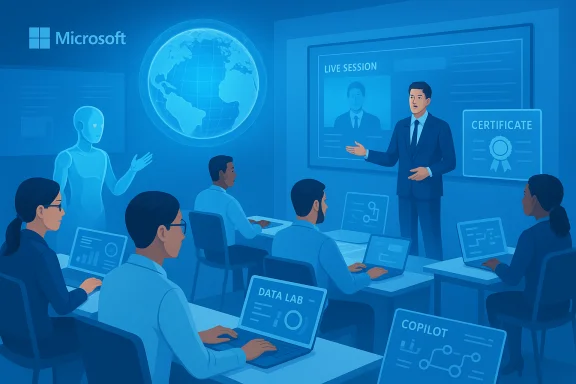
Spectrum Networks’ public release, distributed via company channels and wire services, states the company was honored as a global finalist in the Training Services category and highlights its Microsoft-focused skilling programs that blend live instruction, on-demand labs, certification pathways and role-based curricula. The company website and press materials repeat leadership commentary emphasizing the organizational capability-building objective—i.e., training “that does not just transfer knowledge but enhances organizational capability.” Spectrum also positions the award recognition as validation of its Microsoft portfolio—calling out structured AI learning paths that cover Microsoft Copilot, Agentic AI, and other AI-first content areas intended to accelerate enterprise adoption and deliver measurable business outcomes. Those claims are presented as part of its broader marketing and partner narrative.Why this matters: the practical value of a Microsoft finalist badge
Being named a Microsoft Partner of the Year finalist is more than a marketing headline: it often delivers practical go-to-market advantages, including increased visibility to Microsoft account teams, prioritized co-sell introductions, and amplification in partner marketing channels. For training providers, Microsoft endorsement helps when organizations evaluate skilling providers that must demonstrate vendor-aligned certification pathways and joint enablement capabilities. Industry observers note finalists typically gain momentum in field introductions and client shortlists—though finalists still need to convert attention into verifiable, enterprise-grade outcomes. Key takeaways from the awards program mechanics:- Microsoft emphasizes production-grade outcomes, not just proofs-of-concept; partners that quantify learner outcomes, certification pass rates, and business impact typically score better with judges.
- Finalist recognition increases market visibility and can accelerate co-sell pipeline opportunities, but it does not substitute for procurement-level evidence (named client references, audited metrics, SOWs).
Spectrum Networks: profile and track record (what the company says)
Spectrum Networks is presented publicly as a corporate training and professional services partner focused on the Middle East, North Africa, and Asia Pacific, claiming to have “empowered 1,000,000+ professionals over two decades.” The company lists authorized programs with many vendor partners—including Microsoft, AWS, Google Cloud, RedHat, Palo Alto Networks, Fortinet, Nutanix, ISACA, CompTIA and PeopleCert—and says it delivers training in domains such as AI, ML, RPA, DevOps, IoT, cloud, security and data. On its site and newsroom pages the company also publishes program-level success stories that highlight concrete metrics from government- or partner-backed initiatives—one example being a Microsoft AI Academy Data Training bootcamp that reports metrics such as total skilling hours, assessment volumes, course completion rates and certification success. Those program-level details are useful because they translate skilling activity into measurable outputs. Important caveat: the broad claim of “1,000,000+ professionals empowered” comes from Spectrum’s own materials and is not independently verified in public audit traces or third‑party reporting available at the time of writing; treat this as a company-declared scale metric that should be validated directly with named references for procurement or partner selection processes.Dissecting the evidence: what Spectrum submitted (publicly visible signals)
While Microsoft’s award judging details are confidential, public signals about Spectrum’s skilling approach and outcomes include:- Role-based curricula and certification pathways that align with Microsoft certifications and role skills.
- Hands-on labs and blended delivery (live instruction + on-demand labs).
- Documented program outcomes for at least one public government-backed AI academy, including high course completion and certification rates reported in a published success story.
Competitive context: who else was shortlisted (and who won)
Microsoft’s winners page lists Koenig Solutions as the Training Services category winner in 2025, with Digital China, Spectrum Networks, and NetCom Learning as finalists. Koenig Solutions and other winners published celebratory press materials claiming broad learner reach and AI-related skilling efforts. The presence of established global training houses such as Koenig and NetCom Learning in the shortlist underlines the competitive nature of the category. Why this matters:- The shortlist mixes global training incumbents and regional specialists, showing Microsoft assesses both scale and localized delivery capabilities.
- The winner is often the vendor that best demonstrates verifiable outcomes, rapid AI curriculum development, and measurable certification success at scale.
Critical analysis: strengths in Spectrum’s candidacy
- Focused, role-based curricula and hands-on labs
- Role-based learning plus hands-on labs is the accepted best practice for cloud and AI skilling; Spectrum’s public materials emphasize this blend, which improves retention and certification readiness.
- Regional delivery reach across MENA and APAC
- Microsoft values partners who can localize learning and deliver in multiple geographies. Spectrum’s presence in EMEA/APAC aligns with Microsoft’s co-sell and local-market enablement priorities.
- Alignment to Microsoft Copilot and agentic AI themes
- Preparing enterprises for Microsoft Copilot and agentic AI use cases is strategically valuable today; Spectrum’s explicit focus on Copilot and Agentic AI positions the company to help customers operationalize Microsoft’s agent and Copilot products.
- Demonstrable program metrics (for specific initiatives)
- The published case study that documents skilling hours, completion rates and certification success is stronger evidence than a high-level claim; it shows Spectrum can instrument and report program outcomes for at least some engagements.
Critical analysis: risks, gaps, and questions buyers should ask
- Company-declared scale and impact
- The headline “1,000,000+ professionals empowered” is a significant claim but is currently company-declared; buyers and partners should ask for named references, scope definitions (what ‘empowered’ means), and sample reporting that ties learner activity to measurable business KPIs.
- Consistency of quality at scale
- Scaling instructor-led and hybrid training while maintaining high learner satisfaction and certification pass rates is operationally hard. Procurement teams should review instructor certification, quality assurance processes, and sample course audits. Company case studies are helpful but need to be accompanied by in-contract SLAs and performance dashboards for enterprise deployments.
- Measuring business outcomes (beyond certification)
- Certification pass rates are necessary but not sufficient. Buyers should request measurable pre- and post-training performance metrics, such as reduced onboarding time, shortened time-to-value on cloud projects, productivity improvements tied to specific tools (e.g., Copilot adoption metrics), and evidence of sustained behavior change. Microsoft’s award rubric favors measurable customer outcomes; vendors that provide end-to-end impact measurement will be strongest.
- Agentic AI and governance readiness
- Training for Copilot and Agentic AI needs to be coupled with governance, security, and observability practices. Microsoft and partners have emphasized agent governance and control planes (Agent 365, Foundry, identity and Purview integrations) at Ignite 2025—training that omits governance and risk management will leave enterprises exposed. Ask providers for curricula that cover secure agent design, data leakage risk, and role-based access for agent capabilities.
- Vendor lock-in and transferability
- Enterprises should confirm whether training artifacts, custom labs, and learning paths are transferable if they change vendors or platforms; ask for exportable artifacts, learning record stores (xAPI/SCORM), and portability guarantees in contracts.
Practical guidance for IT leaders and L&D buyers
If your organization is evaluating training providers in the Microsoft ecosystem—especially those touting awards or finalist status—apply a short, verifiable checklist before selecting a partner:- Request named client references that align to your industry and similar scale of deployment.
- Ask for evidence of measurable outcomes: pre/post assessments, certification pass rates tied to cohorts, and business KPIs influenced by training.
- Validate instructor credentials and the use of Microsoft-authorized curricula and labs.
- Require governance modules for AI/Copilot/agent training: secure prompt design, data handling, identity controls, and incident playbooks.
- Insist on delivery SLAs and performance dashboards that map learning to business outcomes and make the provider’s claims auditable.
The wider market for AI skilling: context and pressures
The demand for AI skilling is not hypothetical—companies and governments are rapidly investing in upskilling and reskilling programs to close skills gaps and accelerate AI adoption. Industry reporting and vendor programs (including Microsoft’s partner skilling initiatives) show that training at scale is a major market opportunity, but the market also faces meaningful governance and operational complexity:- Enterprises increasingly deploy agentic AI (AI agents) and face new security, governance and cost-control challenges; Microsoft showcased Agent 365 and governance tooling at Ignite 2025 to address these very issues. Training must therefore include operational governance and security modules alongside feature training.
- Independent industry coverage and analyst commentary emphasize the need for measurable outcomes and role-based certification to convert AI pilots into production value. Employers and learning teams are prioritizing retraining, role redesign and credentialing as pillars of an AI-ready workforce.
Verdict: what Spectrum’s finalist status indicates — and what it does not
Spectrum Networks’ finalist badge is a meaningful validation of a Microsoft-aligned training approach that emphasizes role-based learning, hands-on labs and certification pathways. It demonstrates that Microsoft’s judges identified Spectrum among a competitive field of global and regional training providers. For organizations in MENA and APAC looking for a Microsoft-aligned skilling partner, Spectrum’s presence on the finalists list increases its discovery value and suggests it has deployed Microsoft-aligned programs at scale in some contexts. However, the finalist badge is not a substitute for procurement-grade verification. The company’s larger scale claims (for example, “1,000,000+ professionals empowered”) are public, company-declared metrics that require named references and documentary evidence before they can carry weight in procurement decisions. Buyers should treat the finalist status as a filter—a signal that merits deeper technical and contractual due diligence rather than as a procurement endpoint.Closing summary
Spectrum Networks joining the shortlist for the 2025 Microsoft Training Services Partner of the Year award is a credible milestone for a regional training specialist with documented Microsoft-aligned programs. The recognition places Spectrum in a competitive peer set that includes established global training houses and underscores the strategic importance of outcomes-driven Microsoft skilling in 2025’s enterprise AI agenda. That said, the most important next step for enterprises evaluating partners is to translate awards recognition into verifiable, audit-grade evidence—named references, measurable business outcomes, and governance-ready curricula—before committing to large-scale skilling engagements.Spectators of the partner ecosystem should watch how finalist providers convert visibility into co-sell motions and documented client outcomes over the next 6–12 months, and buyers should insist that promised gains—faster time-to-value, closed skills gaps, and sustained adoption of Microsoft Copilot and agentic AI—are contractually measurable and operationally supported.
Source: ANI News https://www.aninews.in/news/busines...artner-of-the-year-award20251203181117/?amp=1
