

On a packed virtual afternoon, a Sri Lankan–American scientist asked a question that should wake every policy maker, educator and entrepreneur in Colombo: what if Sri Lanka didn’t arrive late this time? That sharp, almost rhetorical challenge — delivered by Dr. Yasantha Rajakarunanayake at a LEADS Forum session and amplified in a Sunday Times feature — is more than exhortation. It’s a call to treat the Fourth Industrial Revolution not as distant noise but as a concrete national opportunity and risk that demand an immediate national strategy. (sundaytimes.lk)
The past industrial revolutions reshaped wealth, power and labour — and Sri Lanka, for complex historical reasons, often found itself reacting rather than leading. Today’s transformation is different. Artificial intelligence (AI) is a general-purpose technology that amplifies human ability to sense, decide and act across sectors. Where earlier revolutions required heavy physical capital — rail lines, factories, power plants — AI’s primary currency is human capital, data, and connectivity. That creates a rare low-barrier window for nations that can mobilise talent, digital infrastructure and governance quickly. Observers who track the shift from prototypes to production-grade systems now argue AI should be treatructure — with planning, governance and resilience equal to electricity and telecoms.
Sri Lanka starts with real advantages. Adult literacy runs in the low 90s percent — commonly cited around 92% in recent UNESCO-based series — giving the country a foundational baseline for upskilling at scale. Mobile connectivity already exceeds one subscription per person by a wide margin, with active mobile broadband measured in the tens of millions; this means phones — the practical platform for mass upskilling and distributed AI tools — are widely available.
But there are equally clear vulnerabilities: uneven computer literacy, stark urban–rural divides in access and skills, and a long history of policy attention diverted by political cycles and conflict. The result is that Sri Lanka has repeatedly missed windows that, had they been seized, might have reconfigured its economy for decades. The Sunday Times piece framed the present as a decisive fork: get onboard with AI now, and Sri Lanka can leapfrog; miss it, and the country risks another “arrive late” story. (sundaytimes.lk)
A now-familiar policy idea — taxing automation or robots to fund retraining and social supports — traces back to high-profile interventions. Bill Gates publicly floated the concept in 2017, arguing a tax-like mechanism could help finance worker transitions and slow disruptive adoption speeds. That idea has been widely discussed, critiqued and adapted by policymakers globally. The practical challenge is measurement and enforceability: what exactly is taxed — hardware, software, per-query inference, or profits? Each choice has trade-offs in fairness and economic incentives.
For Sri Lanka, the lesson is pragmatic: don’t get stuck debating an ideologically pure “robot tax” while the workforce frays. Instead:
The Sunday Times proposal for a 1–6 month “reverse visa” or digital nomad category is strategically sensible: attract foreign professionals who spend locally, mentor local teams, and create a knowledge ecosystem. Practical design principles:
Phase 1 (0–6 months): Foundations
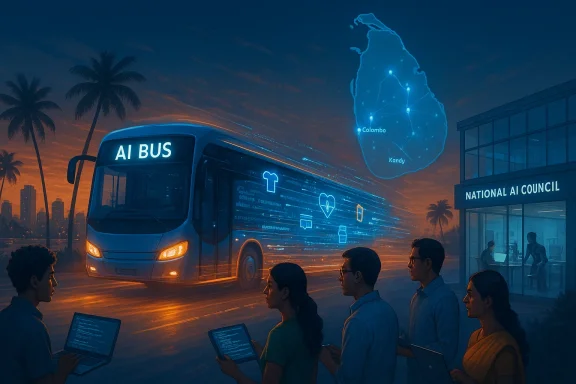
The bus is moving. Sri Lanka’s choice is concrete: stand on the platform and watch, or board with a clear seat and a plan. The LEADS Forum made the moral and economic case to board. The policy and delivery choices we make next will determine whether Sri Lanka finally arrives on time for the Fourth Industrial Revolution — and whether that arrival produces shared prosperity rather than a narrow windfall.
(sundaytimes.lk)
Source: The Sunday Times, Sri Lanka Do not miss the AI bus: Lanka and the fourth industrial revolution
 Background: why this moment matters
The past industrial revolutions reshaped wealth, power and labour — and Sri Lanka, for complex historical reasons, often found itself reacting rather than leading. Today’s transformation is different. Artificial intelligence (AI) is a general-purpose technology that amplifies human ability to sense, decide and act across sectors. Where earlier revolutions required heavy physical capital — rail lines, factories, power plants — AI’s primary currency is human capital, data, and connectivity. That creates a rare low-barrier window for nations that can mobilise talent, digital infrastructure and governance quickly. Observers who track the shift from prototypes to production-grade systems now argue AI should be treatructure — with planning, governance and resilience equal to electricity and telecoms.Sri Lanka starts with real advantages. Adult literacy runs in the low 90s percent — commonly cited around 92% in recent UNESCO-based series — giving the country a foundational baseline for upskilling at scale. Mobile connectivity already exceeds one subscription per person by a wide margin, with active mobile broadband measured in the tens of millions; this means phones — the practical platform for mass upskilling and distributed AI tools — are widely available.
But there are equally clear vulnerabilities: uneven computer literacy, stark urban–rural divides in access and skills, and a long history of policy attention diverted by political cycles and conflict. The result is that Sri Lanka has repeatedly missed windows that, had they been seized, might have reconfigured its economy for decades. The Sunday Times piece framed the present as a decisive fork: get onboard with AI now, and Sri Lanka can leapfrog; miss it, and the country risks another “arrive late” story. (sundaytimes.lk)
Overview: AI’s unique economics and what it means for Lanka
AI is discovery and amplification
AI today sits at the intersection of algorithms, compute and data. Importantly, recent advances — large language models, multimodal systems and agentic AIs — look less like isolated inventions and more like a discovery about intelligence itself. That means breakthroughs cascade quickly from labs to cloud platforms, entry for developers and startups worldwide. Open-source frameworks, cloud credits and generous community tooling make it realistic for small teams in Colombo or Kandy to ship competitive services. This pattern was central to the LEADS Forum message: AI is no longer primarily a capital‑intensive sector dominated by a handful of nations; it rewards distributed creativity and rapid iteration.Human capital is the pivot
Unlike steel plants or highways, AI’s payoff depends on skills: software engineers, data scientists, prompt designers, domain experts who can pair institutional knowledge with AI tools. Sri Lanka’s strong schooling tradition and high general literacy provide a base, but the real work is in turning that foundation into applied digital skills — MLOps, data engineering, responsible AI practice, and domain-specific AI adoption (agri‑tech, health, apparel, tourism). The policy imperative is simple: move from mass access to targeted capability building.Sector-by-sector: concrete AI use-cases that can deliver rapid returns
The Sunday Times article outlined practical, near-term applications across the economy. Below I expand on those sectoral pathways and add operational details for how they could be implemented at national scale. (sundaytimes.lk)Apparel: from design rooms to AI‑first supply chains
Sri Lanka’s apparel industry remains globally competitive but faces margin pressure and fast fashion supply cycles. Generative AI can:- Accelerate design iterations: natural-language design briefs become 3D patterns, fabric simulations and cutting lists in hours.
- Automate compliance workflows: models check regulations, label requirements and traceability metadata across multiple markets.
- Optimise production planning: demand forecasts and real-time vendor constraints feed scheduling agents.
- Run pilot “AI design accelerators” inside four major factories with public–private R&D matching funds.
- Require dataset standards and provenance for design and quality-control models to avoid IP leakage.
- Fund shared inference infrastructure (a “manufacturing AI sandbox”) so SMEs can access model inference without large capital outlays.
Education: personalised, query-driven learning at scale
Sri Lanka’s schooling culture emphasizes high-stakes exams and memorisation. AI flips the teacher–student dynamic: AI tutors and Socratic agents can personalise learning pathways, remediate gaps and scale teacher resources.- Deploy lightweight, offline-capable AI tutors on low-end smartphones for rural classrooms.
- Retrain teachers as learning architects: coach them to integrate AI tutors and evaluate higher-order skills rather than rote recall.
- Shorten degree cycles for highly-targeted vocational skills (e.g., cloud fundamentals, MLOps bootcamps) using competency-based assessments.
Healthcare: triage, diagnostics and predictive surveillance
AI-assisted triage kiosks, combined with telemedicine, can extend scarce specialist capacity into underserved districts.- Deploy validated diagnostic models (radiology, pathology) with mandatory human-in-the-loop review.
- Use environmental and epidemiological data to forecast outbreaks (e.g., dengue) weeks in advance, enabling targeted vector control.
- Insist on transparent model validation and local calibration to prevent misdiagnosis due to dataset shifts.
Agriculture and tea: precision inputs and price stabilisation
AI-driven crop surveillance (smartphone imagery, edge vision models) can detect disease early; satellite and weather-data architectures can produce hyperlocal yield forecasts. A national platform that aggregates farm-level data could:- Provide farmers with tailored fertiliser and pesticide recommendations.
- Offer lending institutions better risk models to stabilise seasonal incomes.
- Support tea estates with automated plucking‑quality analysis and logistics optimisation.
Tourism: personalised, distributed experiences
Personal AI guides could diversify tourism beyond crowded hotspots by recommending micro-experiences, scheduling transfers, and assisting language translation. That spreads economic benefits and lengthens stays, especially if paired with incentives for regional tourism development.Policy levers and the governance checklist
Effective AI adoption in Sri Lanka requires coordinated policy and programmatic action. Below are prioritized levers that balance speed with safety:- National AI Strategy with measurable targets: number of trained practitioners, AI startups funded, deployed public services.
- Education reform: modular, competency‑based credentials; national micro‑credential badges for AI skills.
- Data governance & standards: national metadata schema, privacy protections and open data for non-sensitive public information.
- Adaptive regulation: fast review lanes for low‑risk pilots; mandatory audits for high‑risk production systems.
- Workforce transition funding: retraining subsidies, apprenticeship incentives, and targeted support for regions with automation exposure.
The political economy: taxes, redistribution and the “robot tax” debate
A central unease around AI is job displacement. Historical experience shows automation displaces tasks but creates new jobs. Yet the pace and distribution of that change matter.A now-familiar policy idea — taxing automation or robots to fund retraining and social supports — traces back to high-profile interventions. Bill Gates publicly floated the concept in 2017, arguing a tax-like mechanism could help finance worker transitions and slow disruptive adoption speeds. That idea has been widely discussed, critiqued and adapted by policymakers globally. The practical challenge is measurement and enforceability: what exactly is taxed — hardware, software, per-query inference, or profits? Each choice has trade-offs in fairness and economic incentives.
For Sri Lanka, the lesson is pragmatic: don’t get stuck debating an ideologically pure “robot tax” while the workforce frays. Instead:
- Pilot narrowly targeted levies with clear uses (retraining funds, regional transition centres), coupled with sunset clauses.
- Prioritise incentives over blunt penalties: tax credits for firms that reskill displaced workers; public procurement bias for local AI providers who contribute to workforce development.
- Require transparency disclosures from large automation purchasers so policy can be data-driven rather than speculative.
From brain drain to brain gain: the digital migration model
For decades Sri Lanka’s most reliable export has been its human capital. Physical emigration delivered remittances but drained domestic capability. AI changes the calculus: remote work, remote R&D and distributed product teams mean talent can virtually migrate — working for a global employer while living in Galle or Jaffna.The Sunday Times proposal for a 1–6 month “reverse visa” or digital nomad category is strategically sensible: attract foreign professionals who spend locally, mentor local teams, and create a knowledge ecosystem. Practical design principles:
- Make visas simple, enforceable and targeted to roles that complement — not supplant — local employment.
- Link visa holders to local accelerators and co-working spaces to maximise knowledge transfer.
- Offer tax incentives for firms that sponsor local partnerships, hackathons and joint ventures.
Youth as builders: a national challenge with measurable targets
The forum’s challenge to youth — build 1,000 AI solutions for local problems in a year — is both ambitious and actionable. To translate ambition into outcomes, Sri Lanka should create a three-layer delivery model:- Civic problem catalogue: a publicly maintained registry of high-priority problems (waste management, bus schedules, crop disease) that includes datasets, success metrics and community contacts.
- National accelerator network: regional hubs that provide compute credits, mentors, and low-code/no-code toolkits to move prototypes into deployment.
- Deployment and monitoring: funding for scale pilots, local integration and independent impact measurement.
Risks and blind spots — what could go wrong
No sensible national strategy ignores risk. Key pitfalls include:- Data capture and privacy failures: rushed data collection without consent or governance can harm citizens and erode trust.
- Concentration of benefits: without deliberate distribuins could flow to a few firms or islands of the country.
- Overreliance on foreign cloud providers: sovereignty, cost and resilience concerns argue for mixed strategies — local data centres, regional cloud partnerships and targeted on‑prem inference where needed.
- Skills mismatch: a focus on undergraduate enrollment alone won’t produce MLOps engineers or domain-adapted AI product managers.
A practical 18‑month roadmap for Sri Lanka
Below is a compact, deliverable plan that balances speed with durable institutions.Phase 1 (0–6 months): Foundations
- Launch a National AI Council with multi-sector membership (government, industry, academia, diaspora).
- Publish a “Data and AI Playbook” with standards for government datasets and pilot procedures.
- Seed four AI hubs (Colombo, Kandy, Galle, Jaffna) focused on education, health, apparel and tourism respectively.
- Fund 50 regional pilots (digital agriculture, telemedicine kiosks, apparel AI) with matched private funds.
- Roll out short-form AI credentials (6–12 weeks) for 10,000 learners in cloud fundamentals and MLOps.
- Create a “reverse visa” pilot for remote knowledge workers with clear tax and labour safeguards.
- Publish independent audits of deployed pilots, measuring employment, income effects and equity.
- Launch public procurement rules that prioritise local impact (skills transfer, data return, local hosting).
- Scale up successful pilots to national programs (e.g., national dengue forecast and early-warning system).
Why time is decisive
Technologies that define industrial revolutions don’t wait. When core infrastructure actors — cloud providers, chipmakers and platform companies — industrialise model delivery and agent architectures, the competitive frame shifts rapidly. Countries that lock in a skills and governance advantage early gain durable benefits that compound over years. The Sunday Times piece and Dr. Rajakarunanayake’s forum remarks are a clear wake-up call: Sri Lanka has neither the luxury of long debates nor the option of incrementalism cloaked as strategy. (sundaytimes.lk)Conclusion: boarding the bus, not chasing it
Artificial intelligence is neither an unalloyed saviour nor an unmanageable threat. It is a powerful amplifier of human capacity whose benefits will follow the contours of governance, education and access. Sri Lanka’s core advantages — literacy, mobile penetration, an engaged diaspora and identifiable sector strengths — give it a realistic shot at converting historical vulnerabilities into comparative advantages. But turning potential into reality requires purpose: strategic investment in human capital, agile governance, catalytic funding for pilots and a national culture that prizes building over passive consumption.The bus is moving. Sri Lanka’s choice is concrete: stand on the platform and watch, or board with a clear seat and a plan. The LEADS Forum made the moral and economic case to board. The policy and delivery choices we make next will determine whether Sri Lanka finally arrives on time for the Fourth Industrial Revolution — and whether that arrival produces shared prosperity rather than a narrow windfall.
(sundaytimes.lk)
Source: The Sunday Times, Sri Lanka Do not miss the AI bus: Lanka and the fourth industrial revolution
