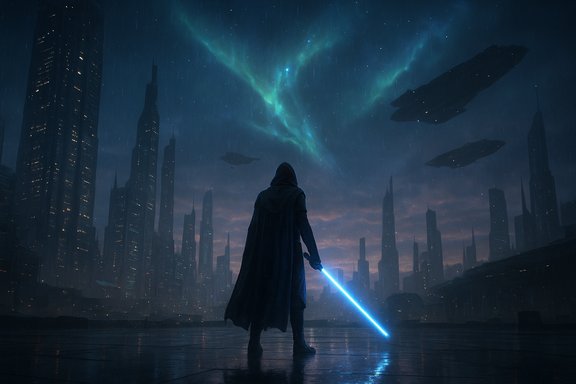
Star Wars fans woke up to one of the evening’s biggest surprises: a cinematic tease for Star Wars: Fate of the Old Republic, a new single‑player action RPG from Arcanaut Studios led by Casey Hudson — and the game’s director has now publicly promised it will land before 2030, tamping down early speculation that it could be a decade‑away project.
Star Wars: Fate of the Old Republic was unveiled during The Game Awards 2025 as a narrative‑driven action RPG set in the Old Republic era. The Game Awards cinematic presentation showcased a short, atmospheric trailer built in Unreal Engine 5, giving fans only a taste of setting and tone: a Force user in a galaxy on the brink, choices that pull you toward the Light or Dark Side, and sweeping set pieces rather than concrete gameplay detail. The project is being developed by Arcanaut Studios in collaboration with Lucasfilm Games and is explicitly billed as a spiritual successor to Knights of the Old Republic rather than a direct continuation. Arcanaut Studios, the new studio helmed by Casey Hudson, launched earlier in 2025 and has assembled a team of industry veterans to work with Lucasfilm Games. The timing of the studio’s foundation and the announcement’s early developmental framing have led many industry observers to warn that a multi‑year development cycle is likely — prompting some to suggest 2030 as a reasonable earliest‑case release year. Bloomberg‑adjacent reporting and respected industry voices framed a 2030 window as an “optimistic” guess based on the studio’s recent formation. In response to that chatter, Casey Hudson took to social media to push back on the “not till 2030” framing: “Don’t worry about the ‘not till 2030’ rumors. Game will be out before then. I’m not getting any younger!” That message has become the definitive public word on timing for now — clear on intent but short on detail.
But there is an industry‑wise counterweight: revealing projects while they are still nascent can create a public contract that’s costly to manage. Fans will expect regular updates. Leaks, speculation, and comparative disappointment (real or perceived) can erode the goodwill generated by the reveal. That’s the trade‑off: early PR wins must be matched with disciplined communications to avoid fatigue and speculation that lengthens perceived wait times. Multiple outlets covering the reveal highlighted this tension and cautioned that a healthy development cadence and transparent milestones will be necessary to sustain long‑term enthusiasm.
At the same time, the practical constraints of a newly formed studio taking on a AAA, narrative‑driven Star Wars RPG are substantial. Publicly stated intentions — Hudson’s “before 2030” — are meaningful but not determinative. Until Arcanaut publishes a development roadmap with concrete milestones, any calendar guesses remain speculative and should be framed with caution.
Readers should treat Hudson’s reassurance as an encouraging signal of intent, not as a firm release date. Expect a measured, multi‑year development cycle, likely landing in the late 2020s if the studio executes a disciplined plan and avoids major scope changes. The modern reality of AAA production is simple: quality, especially for narrative games that must live up to storied predecessors, is earned through time, iteration, and technical investment.
Casey Hudson’s short, human note — “Game will be out before then. I’m not getting any younger!” — is a reminder that, for all the optimism and hype, building classics takes time. The right outcome for players is one where Arcanaut and Lucasfilm Games take the pause necessary to deliver a worthy spiritual successor. Meanwhile, fans can savor the reveal, track studio progress across the next 12 to 36 months, and prepare for a return to the Old Republic era that aims to match, and perhaps surpass, the legacy it honors.
Source: Windows Central https://www.windowscentral.com/gami...sey-hudson-promises-release-date-before-2030/
 Background
Star Wars: Fate of the Old Republic was unveiled during The Game Awards 2025 as a narrative‑driven action RPG set in the Old Republic era. The Game Awards cinematic presentation showcased a short, atmospheric trailer built in Unreal Engine 5, giving fans only a taste of setting and tone: a Force user in a galaxy on the brink, choices that pull you toward the Light or Dark Side, and sweeping set pieces rather than concrete gameplay detail. The project is being developed by Arcanaut Studios in collaboration with Lucasfilm Games and is explicitly billed as a spiritual successor to Knights of the Old Republic rather than a direct continuation. Arcanaut Studios, the new studio helmed by Casey Hudson, launched earlier in 2025 and has assembled a team of industry veterans to work with Lucasfilm Games. The timing of the studio’s foundation and the announcement’s early developmental framing have led many industry observers to warn that a multi‑year development cycle is likely — prompting some to suggest 2030 as a reasonable earliest‑case release year. Bloomberg‑adjacent reporting and respected industry voices framed a 2030 window as an “optimistic” guess based on the studio’s recent formation. In response to that chatter, Casey Hudson took to social media to push back on the “not till 2030” framing: “Don’t worry about the ‘not till 2030’ rumors. Game will be out before then. I’m not getting any younger!” That message has become the definitive public word on timing for now — clear on intent but short on detail. What we actually know right now
- Project type and era: A single‑player, narrative‑driven action RPG set in the Old Republic era of Star Wars. The game positions player choices as a pathway between Light and Dark.
- Developer and leadership: Arcanaut Studios is the developer; Casey Hudson (director of KOTOR and the early Mass Effect trilogy) is leading the project as director. The studio formed in 2025.
- Technology: The reveal trailer was created with Unreal Engine 5, indicating modern tooling and a high‑fidelity visual ambition.
- Platforms: Announced for PC and consoles in a general sense; specific console targets were not listed, though outlets assume current generation and next generation parity will be sought. No official release window was provided during the announcement.
Why Casey Hudson’s “before 2030” matters — and what it doesn’t
Casey Hudson’s public statement performs several important functions.- It eschews panic‑level pessimism. Fans who saw early headlines predicting a decade‑long wait were reassured that the team intends to deliver within the current decade. The message is short, human, and designed to calm a community primed for delays.
- It sets a public expectation the studio will likely feel pressure to meet. Saying “before 2030” sets a soft deadline that will shape future communications and coverage. Hudson’s zinger about “not getting any younger” is intentionally personal and evocative — but not granular.
The strengths: why Fate of the Old Republic deserves optimism
1. Leadership pedigree
Casey Hudson’s track record is the headline here. He directed BioWare’s Knights of the Old Republic and the original Mass Effect trilogy — titles defined by deep narrative architecture, robust choice systems, and memorable world‑building. That pedigree pulls recruitment gravity (experienced talent wants to work with proven leaders) and creative credibility. Fans and veterans rightly see Hudson’s involvement as a meaningful signal that the project aims at a high bar.2. Lucasfilm Games partnership
Backing from Lucasfilm Games provides both IP clarity and production leverage. Having the rights holder and steward of the Star Wars brand committed publicly reduces licensing friction and signals access to narrative consultants, IP continuity safeguards, and potential publishing muscle. Those relationships matter when building AAA single‑player titles where canonical resonance and brand protection are critical.3. Modern tooling and UE5
The use of Unreal Engine 5 is an advantage. UE5’s toolset (Nanite, Lumen, and streaming systems) accelerates production of large environments and cinematic sequences while lowering the barrier to hiring experienced UE developers. That doesn’t guaranteedly shorten development time, but it gives the studio an industrial foundation aligned with current AAA practices.4. Cultural appetite and talent pipeline
There is a sizable market appetite for narrative Star Wars games that reclaim the single‑player, choice‑driven experience fans adore. This market demand makes it easier to secure investment, attract senior talent, and justify a premium production budget — all pragmatic advantages that materially improve the odds the game lands as a fully realized single‑player narrative experience. Coverage across outlets confirms both a cultural hunger and industry interest.The risks: why “before 2030” shouldn’t be read as a hard delivery date
1. Studio infancy and hiring lag
Arcanaut Studios’ recent formation is the single most load‑bearing fact shaping timeline estimates. New studios must recruit, onboard, and integrate multiple functional teams: engine programmers, combat systems engineers, narrative designers, animation crews, QA operations, and live‑ops specialists (if needed). Each of these is both time‑consuming to hire and expensive to staff. Observers repeatedly cite this as the primary reason a 2030 projection is plausible; Hudson’s optimism doesn’t change the mechanical realities of complex AAA production.2. Scope creep and ambition
The teaser signals ambition: cinematic presentation, open or large levels implied by UE5 tech, and branching Light/Dark paths. Ambition scales complexity — especially when replayability, companion systems, and choice scaffolding are core design pillars. Projects that aim to outdo legacy classics often encounter scope creep, iterative redesign cycles, and extended QA windows. Those development factors drive multi‑year timelines even for experienced teams.3. Publishing, platform, and generational timing
Modern AAA titles are shaped by platform transitions. If development stretches into the tail end of the PlayStation 5 / Xbox Series generation, platform holders may shift incentive structures, certification processes, and marketing windows around the next generation’s debut. Jason Schreier and other analysts suggested that, depending on timeline, Fate of the Old Republic could span console generations — a nontrivial complication for optimization and certification. Hudson’s “before 2030” claim implicitly asks stakeholders and players to assume a stable platform horizon, which is not guaranteed.4. Public expectations and legacy comparisons
KOTOR and KOTOR II are cultural touchstones; naming a project in that lineage invites direct comparison to near‑mythic design qualities. The higher the expectation, the more scrutiny each reveal and demo will receive. That social pressure can cause studios to delay or rework to protect long‑term reception, increasing the risk of extended timelines. Hudson’s public affirmation is intended to reassure, but it will not blunt inevitable fan standards.A realistic timeline — three scenarios
- Early delivery (optimistic): late 2027–early 2028
- Conditions required: core team assembled rapidly, tightly scoped first release, and staggered post‑launch content plan. This is unlikely given the studio’s 2025 start and the AAA single‑player ambition.
- Mid window (most plausible): 2028–2029
- Conditions required: methodical hiring, stable scope, external QA cycles of 12–18 months, and publisher/partner alignment on marketing windows. This aligns with industry commentary and Hudson’s “before 2030” statement. Multiple outlets have flagged this as the sensible public assumption absent official dates.
- Long tail (pessimistic): 2030+
- Conditions that push here: scope expansion, generational transition complications, or strategic shifts toward a staggered live‑service integration. Industry analysts have warned this remains realistic and possible — Jason Schreier labeled a 2030 estimate “optimistic” for the reasons noted above.
What Hudson’s message means for fans, press, and platform holders
- For fans: Treat “before 2030” as a tone of intent, not a release schedule. Expect staged content updates: more trailers, dev diaries, and possibly playable demos over the next 12–36 months. Prepare for a long alpha and beta cycle if the studio opts for external testing.
- For the press: Hudson’s statement is a useful clarifying quote but insufficient to anchor coverage. Reporters should continue to verify hiring, milestone reveals, and platform partner details. Analysts will watch Arcanaut’s hiring announcements and any publisher roadmaps for concrete signals.
- For platform holders and retailers: A “before 2030” claim helps planning: retail partners, digital storefronts, and marketing teams can tentatively allocate future calendar space while waiting for concrete release windows. Platform parity decisions will depend on how the console landscape evolves between 2026 and 2029.
Editorial analysis: why early reveals are both a gift and a risk
The Game Awards remains a high‑visibility launchpad for bold reveals. For Lucasfilm Games and Arcanaut, the announcement bought immediate brand momentum: the trailer generated headlines, social buzz, and a surge of goodwill among single‑player RPG fans. Early reveals attract talent, investors, and press cycles at a point when hiring momentum matters.But there is an industry‑wise counterweight: revealing projects while they are still nascent can create a public contract that’s costly to manage. Fans will expect regular updates. Leaks, speculation, and comparative disappointment (real or perceived) can erode the goodwill generated by the reveal. That’s the trade‑off: early PR wins must be matched with disciplined communications to avoid fatigue and speculation that lengthens perceived wait times. Multiple outlets covering the reveal highlighted this tension and cautioned that a healthy development cadence and transparent milestones will be necessary to sustain long‑term enthusiasm.
What to watch next (practical checklist)
- Hiring and studio growth: track Arcanaut’s job listings and LinkedIn announcements for the pace of core team assembly. Rapid hiring of senior systems engineers, narrative directors, and technical art leads would be credible signals of accelerated progress.
- Developer roadmaps: look for official milestone announcements (vertical slices, closed playtests, or engine tech demos). These are the earliest verifiable signs of real progress beyond a cinematic trailer.
- Platform and partner confirmation: formal announcements regarding platform parity (PC, PlayStation, Xbox), store partnerships, and potential exclusivity windows will materially change timeline assumptions and marketing strategies.
- Publisher or Lucasfilm Games communications: any formal roadmaps, release windows, or publisher commitments will meaningfully compress uncertainty. Lucasfilm’s internal priorities and Disney’s broader IP strategy can influence schedule and scope.
Final assessment and cautionary note
Star Wars: Fate of the Old Republic is an undeniably exciting prospect: the Old Republic era is rich narrative terrain, Casey Hudson’s leadership brings legitimate pedigree, and modern tooling like Unreal Engine 5 positions the studio to produce high‑fidelity narrative and visual work. Those are reasons to be optimistic.At the same time, the practical constraints of a newly formed studio taking on a AAA, narrative‑driven Star Wars RPG are substantial. Publicly stated intentions — Hudson’s “before 2030” — are meaningful but not determinative. Until Arcanaut publishes a development roadmap with concrete milestones, any calendar guesses remain speculative and should be framed with caution.
Readers should treat Hudson’s reassurance as an encouraging signal of intent, not as a firm release date. Expect a measured, multi‑year development cycle, likely landing in the late 2020s if the studio executes a disciplined plan and avoids major scope changes. The modern reality of AAA production is simple: quality, especially for narrative games that must live up to storied predecessors, is earned through time, iteration, and technical investment.
Casey Hudson’s short, human note — “Game will be out before then. I’m not getting any younger!” — is a reminder that, for all the optimism and hype, building classics takes time. The right outcome for players is one where Arcanaut and Lucasfilm Games take the pause necessary to deliver a worthy spiritual successor. Meanwhile, fans can savor the reveal, track studio progress across the next 12 to 36 months, and prepare for a return to the Old Republic era that aims to match, and perhaps surpass, the legacy it honors.
Source: Windows Central https://www.windowscentral.com/gami...sey-hudson-promises-release-date-before-2030/