

Microsoft is reportedly divesting Undead Labs as part of a sweeping Xbox restructuring announced July 6, 2026, even as State of Decay 3 sits above both Halo: Campaign Evolved and Gears of War: E-Day on Steam’s most-wishlisted chart. That is not just an awkward data point. It is a flashing warning light over Xbox’s strategic judgment. The company appears to be surrendering one of its clearest emerging PC-and-console opportunities at precisely the moment it needs fewer legacy bets and more expandable worlds.
As Windows Central’s Jez Corden argued this week, State of Decay 3 has become the emblem of Microsoft’s latest gaming contradiction: the business wants higher-margin, durable franchises, yet it is cutting loose a studio building exactly that kind of game. Reporting from Windows Central, PC Gamer, Gematsu, GamesRadar, Tom’s Hardware, and others describes an Xbox reset that includes roughly 3,200 job cuts and studio divestitures, with Undead Labs and Ninja Theory moving toward new ownership while their current projects continue. The corporate language is tidy. The product logic is not.
The first instinct after a large layoff is to look for the obvious failure. In gaming, that usually means the canceled title, the live-service flop, the overbuilt team, or the acquisition that never fit. But the most revealing cuts are often the ones that hit projects with visible momentum, because they expose the difference between a company managing a portfolio and a company managing a spreadsheet.
That is what makes State of Decay 3 such a strange casualty of Xbox’s reset. The game is not a speculative pitch in a back room. It is a sequel in a recognizable franchise, from a studio Microsoft bought in 2018, in a genre that has proved unusually durable across PC, console, and streaming audiences. Its Steam wishlist ranking is not a sales report, but it is a market signal — and right now, that signal says Undead Labs may have been sitting on more demand than some of Xbox’s better-known mascots.
Microsoft has spent years telling investors and players that Xbox is no longer just a console box under the television. It is a platform, a subscription, a publishing arm, a cloud service, and increasingly a multi-device games business. State of Decay 3 fits that strategy almost too neatly: a co-op survival sandbox, with a community-management hook, a long tail, and enough systemic design to grow after launch.
Instead, according to multiple reports, Microsoft is moving Undead Labs out of the Xbox first-party structure with funding to continue State of Decay 3. If that saves the game and some jobs, it is better than closure. But survival is not the same as strategy, and “someone else will finish it” is a strange outcome for a company that spent billions trying to secure the content pipeline it now says it needs.
But dismissing the ranking entirely would be just as foolish. Steam is the most important PC storefront in the world, and wishlist visibility matters because it measures intent before marketing reaches full force. If State of Decay 3 is outranking Halo: Campaign Evolved and Gears of War: E-Day there, it suggests something Xbox leadership should have wanted to understand rather than abandon.
The interesting part is not that Halo and Gears have lost all power. They have not. The interesting part is that Xbox’s legacy brands may no longer be the only engines of attention in the places Microsoft claims it wants to win.
For years, Xbox’s identity problem has been disguised as a content problem. The company has had franchises, studios, hardware, services, and marketing moments. What it has lacked is a clear hierarchy of belief: a disciplined understanding of which bets define the next decade rather than memorialize the last one.
State of Decay 3 looked like one of those next-decade bets. It is not bound to the old console-war template in the way a Halo remake inevitably is. It is not just nostalgia. It is a systems-driven survival game with co-op, emergent storytelling, base-building, and community management — precisely the sort of blend that can thrive on PC while still making sense on Xbox hardware and Game Pass.
But acquisitions do not become strategy automatically. Studios need leadership stability, production support, cultural fit, and enough time to convert ambition into shipping software. Undead Labs had a rough road almost immediately after joining Microsoft.
Founder Jeff Strain left in 2019. The COVID-19 pandemic then scrambled development across the industry, hitting collaborative, early-stage projects especially hard. State of Decay 3 was announced in 2020, but later reporting and developer commentary suggested that the reveal arrived long before the game was ready for full public expectations.
That matters. A studio that loses its founder, navigates a pandemic, supports an existing live game, and tries to scale up into a more ambitious sequel is not failing in a vacuum. It is living through the exact integration challenge Microsoft accepted when it bought the company.
The obvious counterargument is that Microsoft gave Undead Labs years. That is true in calendar time. But calendar time and productive development time are not the same thing, especially when the parent company announces early, reorganizes often, and then evaluates the result through financial pressure created elsewhere in the division.
If Microsoft decided that Undead Labs could not deliver under Xbox ownership, then the uncomfortable question is not only what Undead Labs did wrong. It is what Microsoft ownership was for.
That kind of franchise is not a perfect blockbuster machine. It is something rarer: a platform for stories players generate themselves. In an industry increasingly skeptical of expensive linear bets and increasingly ruthless toward failed live-service experiments, a systemic co-op survival game occupies valuable middle ground.
It can be updated without pretending to be a forever treadmill. It can support expansions, seasonal content, new maps, new survivor archetypes, and new difficulty layers without requiring the cynical monetization scaffolding that has poisoned so many online games. It can be both a boxed release and a service-like hobby, if handled with restraint.
That is why the comparison with Grounded and Sea of Thieves matters. Those games were not built on Xbox’s oldest iconography. They grew because they gave communities a place to return to, a set of rules to master, and enough personality to stand apart from the churn. State of Decay 3 had a plausible path into that same category.
This is where Microsoft’s reported decision becomes so hard to square with its own rhetoric. Xbox says it needs sustainable franchises. It says it needs growth beyond hardware. It says it wants games that work across console, PC, cloud, and subscription. Then, when one of its owned studios is building a game with exactly those properties, Xbox lets the studio walk.
No responsible observer should pretend Microsoft can fund everything forever. Some projects should be canceled. Some teams should be merged. Some ambitions should be narrowed. Even a company as rich as Microsoft has to choose.
But the quality of a reset depends on what it protects. A sharp restructuring cuts duplication and preserves strategic upside. A panicked restructuring treats everything not immediately accretive as expendable. The danger for Xbox is that this reset looks less like pruning and more like amputation.
The company’s recent history makes the optics worse. Microsoft has closed studios, canceled games, reduced teams, and repeatedly asked players to believe that the next reorganization will produce focus. Each cycle arrives with new language about sustainability, discipline, and growth. Each cycle leaves behind fewer reasons to trust that Xbox knows which creative bets deserve patience.
State of Decay 3 is not guaranteed to be great. It could launch late, buggy, undercooked, or commercially disappointing. But no portfolio is built only from guarantees. The point of owning studios is to cultivate asymmetric bets — projects whose upside exceeds the neatness of their near-term financial profile.
Undead Labs appeared to have one. Microsoft appears to have blinked.
For years, Game Pass was presented as the gravitational center of Microsoft’s gaming future. First-party games arriving day one were the service’s cleanest promise. The more Microsoft bought, the more that promise seemed to matter. A new State of Decay from an Xbox-owned studio would have been an obvious Game Pass tentpole.
If the game now ships outside that framework, or with altered obligations, Xbox loses more than a studio logo on a splash screen. It loses a piece of the subscription story it trained its audience to expect.
That does not necessarily mean Game Pass is doomed, or that every divested game must remain locked to the old model. In fact, new ownership could give Undead Labs more flexibility to price, market, and support the game in ways that better fit its audience. But from Microsoft’s perspective, the irony is sharp: Xbox may have subsidized years of development only to weaken its own service differentiation at the finish line.
The broader issue is that Game Pass changed player expectations faster than it changed development economics. A subscription can amplify discovery, but it does not magically make expensive games cheaper to build. It can smooth access, but it can also blur the revenue signals that help studios understand their audiences. Microsoft’s latest cuts suggest the company is still trying to reconcile those tensions — and developers are paying the price.
But legacy can become a management trap. A company that overvalues its past will keep funding familiar symbols long after the audience has shifted. A company that undervalues its past will discard the craft and identity that made those symbols matter. Xbox has somehow managed to do both at different moments.
The problem is not that Microsoft is still investing in Halo or Gears. Those franchises deserve careful stewardship. The problem is that Xbox often seems more comfortable reviving known names than recognizing when a smaller brand has found the shape of a larger opportunity.
A Halo: Combat Evolved remake can generate attention because memory is powerful. Gears of War: E-Day can do the same because origin stories are legible. But those projects are also weighed down by expectations, canon, and comparison with earlier cultural moments that may never return in the same form.
State of Decay 3 has a different burden. It has to fulfill potential rather than resurrect myth. That is difficult, but it is also liberating. The series has enough identity to matter and enough unfinished space to grow.
The reported Xbox cuts affect thousands of people across one of the most valuable companies on Earth. Some will land elsewhere quickly. Some will not. Some projects will survive with scars. Others will lose the institutional knowledge that made them viable. Every spreadsheet line represents a person who planned around a job that no longer exists.
That matters not only morally, but operationally. Game development is a memory business. Teams learn tools, pipelines, design instincts, production hazards, and each other. When companies repeatedly churn staff, they do not merely reduce cost; they destroy compounding knowledge.
Microsoft is especially vulnerable to this because its gaming strategy has leaned so heavily on scale. You cannot claim advantage from owning many studios while constantly destabilizing the people inside them. You cannot sell players on ecosystem continuity while developers experience the ecosystem as a recurring July hazard.
The phrase “short-sightedness” gets overused in gaming discourse, but here it fits. Not because every cut is wrong. Because the repeated pattern suggests Microsoft keeps paying to acquire possibility, then loses patience before that possibility matures.
But workers and players can see the contrast. A company willing to tolerate vast AI capital expenditures based on long-term strategic positioning is also telling game studios that their runway is too expensive. The message may be financially coherent inside Microsoft’s models, but culturally it lands badly.
Gaming is not Azure. Studios do not scale like data centers. Creative production is messy, slow, and dependent on trust. The same company that understands platform patience in cloud computing often seems allergic to it in Xbox.
That disconnect has haunted Microsoft for years. Xbox leadership frequently speaks the language of creators, communities, and player choice. Microsoft corporate leadership ultimately answers to margin, growth, and capital allocation. Those priorities are not inherently incompatible, but when pressure rises, the creative side usually discovers how conditional the rhetoric was.
For Undead Labs, the cruel part is that State of Decay 3 looked like a game that could have made the business case easier. It was not an art-house indulgence or a vanity project. It was a commercially legible survival sequel with PC traction and co-op upside. If even that is not safe, developers across Xbox will draw their own conclusions.
That would be good for players and better for developers than closure. It would also be a damning result for Microsoft.
If State of Decay 3 flourishes outside Xbox, it will raise the obvious question: why could Microsoft not make that happen internally? Why did a trillion-dollar company need to hand off a promising survival franchise so someone else could finish the job? Why did Xbox’s structure become a burden rather than an accelerant?
There is precedent across the industry for studios doing better after leaving large publishers. Smaller organizations can be clearer about priorities. Independent teams can move faster. New owners can provide attention that sprawling conglomerates cannot. But Microsoft did not buy studios in 2018 to prove the virtues of not being owned by Microsoft.
The company wanted first-party depth. It wanted identity. It wanted a content moat for Game Pass and Xbox. Letting Undead Labs go suggests either that the original acquisition thesis failed or that the current financial correction is overriding the very thesis Microsoft once used to justify expansion.
Neither interpretation is flattering.
Conviction does not mean funding every dream indefinitely. It means knowing what kind of business you are building and aligning decisions accordingly. If Xbox is a blockbuster publisher, it should stop pretending every quirky acquired studio is central. If Xbox is a subscription ecosystem, it should protect the games that make the subscription distinct. If Xbox is a multi-platform publishing giant, it should be ruthless about audience signals on Steam and PlayStation as well as Xbox.
Right now, Xbox often behaves as though it is all of those things and none of them. It wants the reach of a third-party publisher, the loyalty of a first-party platform, the recurring revenue of a subscription, and the cultural cachet of a creative patron. The contradictions were manageable when money was cheap and growth narratives were easy. They are much harder to hide during a reset.
That is why State of Decay 3 feels larger than its franchise status. It exposes the gap between Xbox’s stated future and its revealed priorities. A dynamic co-op survival game with strong PC interest should have been a proof point. Instead, it has become a divestiture story.
As Windows Central’s Jez Corden argued this week, State of Decay 3 has become the emblem of Microsoft’s latest gaming contradiction: the business wants higher-margin, durable franchises, yet it is cutting loose a studio building exactly that kind of game. Reporting from Windows Central, PC Gamer, Gematsu, GamesRadar, Tom’s Hardware, and others describes an Xbox reset that includes roughly 3,200 job cuts and studio divestitures, with Undead Labs and Ninja Theory moving toward new ownership while their current projects continue. The corporate language is tidy. The product logic is not.
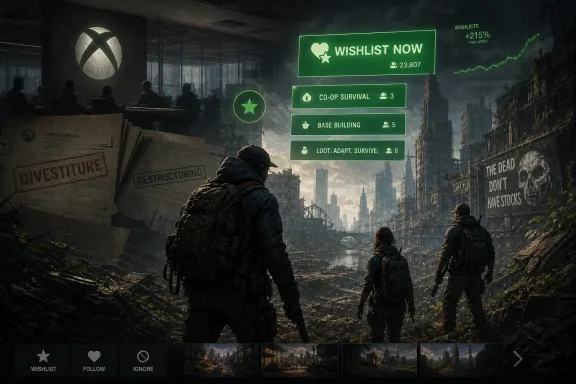 Xbox Is Cutting the Future to Repair the Past
The first instinct after a large layoff is to look for the obvious failure. In gaming, that usually means the canceled title, the live-service flop, the overbuilt team, or the acquisition that never fit. But the most revealing cuts are often the ones that hit projects with visible momentum, because they expose the difference between a company managing a portfolio and a company managing a spreadsheet.That is what makes State of Decay 3 such a strange casualty of Xbox’s reset. The game is not a speculative pitch in a back room. It is a sequel in a recognizable franchise, from a studio Microsoft bought in 2018, in a genre that has proved unusually durable across PC, console, and streaming audiences. Its Steam wishlist ranking is not a sales report, but it is a market signal — and right now, that signal says Undead Labs may have been sitting on more demand than some of Xbox’s better-known mascots.
Microsoft has spent years telling investors and players that Xbox is no longer just a console box under the television. It is a platform, a subscription, a publishing arm, a cloud service, and increasingly a multi-device games business. State of Decay 3 fits that strategy almost too neatly: a co-op survival sandbox, with a community-management hook, a long tail, and enough systemic design to grow after launch.
Instead, according to multiple reports, Microsoft is moving Undead Labs out of the Xbox first-party structure with funding to continue State of Decay 3. If that saves the game and some jobs, it is better than closure. But survival is not the same as strategy, and “someone else will finish it” is a strange outcome for a company that spent billions trying to secure the content pipeline it now says it needs.
Steam’s Wishlist Chart Is Not a Forecast, but It Is a Signal
Steam wishlists are an imperfect metric. Players hoard them, forget them, wait for discounts, and use them as reminders rather than purchase commitments. No serious analyst should convert a wishlist rank into a revenue projection by brute force.But dismissing the ranking entirely would be just as foolish. Steam is the most important PC storefront in the world, and wishlist visibility matters because it measures intent before marketing reaches full force. If State of Decay 3 is outranking Halo: Campaign Evolved and Gears of War: E-Day there, it suggests something Xbox leadership should have wanted to understand rather than abandon.
The interesting part is not that Halo and Gears have lost all power. They have not. The interesting part is that Xbox’s legacy brands may no longer be the only engines of attention in the places Microsoft claims it wants to win.
For years, Xbox’s identity problem has been disguised as a content problem. The company has had franchises, studios, hardware, services, and marketing moments. What it has lacked is a clear hierarchy of belief: a disciplined understanding of which bets define the next decade rather than memorialize the last one.
State of Decay 3 looked like one of those next-decade bets. It is not bound to the old console-war template in the way a Halo remake inevitably is. It is not just nostalgia. It is a systems-driven survival game with co-op, emergent storytelling, base-building, and community management — precisely the sort of blend that can thrive on PC while still making sense on Xbox hardware and Game Pass.
Undead Labs Was Always an Integration Test
Microsoft bought Undead Labs in 2018 during a period when Xbox was trying to rebuild its first-party credibility. That wave of acquisitions was supposed to solve an obvious weakness: Sony had prestige single-player hits, Nintendo had immortal mascots, and Xbox too often had promises. Buying studios was the shortcut to depth.But acquisitions do not become strategy automatically. Studios need leadership stability, production support, cultural fit, and enough time to convert ambition into shipping software. Undead Labs had a rough road almost immediately after joining Microsoft.
Founder Jeff Strain left in 2019. The COVID-19 pandemic then scrambled development across the industry, hitting collaborative, early-stage projects especially hard. State of Decay 3 was announced in 2020, but later reporting and developer commentary suggested that the reveal arrived long before the game was ready for full public expectations.
That matters. A studio that loses its founder, navigates a pandemic, supports an existing live game, and tries to scale up into a more ambitious sequel is not failing in a vacuum. It is living through the exact integration challenge Microsoft accepted when it bought the company.
The obvious counterargument is that Microsoft gave Undead Labs years. That is true in calendar time. But calendar time and productive development time are not the same thing, especially when the parent company announces early, reorganizes often, and then evaluates the result through financial pressure created elsewhere in the division.
If Microsoft decided that Undead Labs could not deliver under Xbox ownership, then the uncomfortable question is not only what Undead Labs did wrong. It is what Microsoft ownership was for.
The Zombie Sandbox Was Better Aligned With Xbox Than Xbox Realized
The State of Decay premise has always been stronger than its production budget. The original game, released in the Xbox 360 era, felt rough and fascinating: a zombie survival simulation more interested in scarcity, community, and consequence than cinematic heroics. State of Decay 2 expanded that foundation and, through years of updates, developed a loyal audience despite technical and structural limitations.That kind of franchise is not a perfect blockbuster machine. It is something rarer: a platform for stories players generate themselves. In an industry increasingly skeptical of expensive linear bets and increasingly ruthless toward failed live-service experiments, a systemic co-op survival game occupies valuable middle ground.
It can be updated without pretending to be a forever treadmill. It can support expansions, seasonal content, new maps, new survivor archetypes, and new difficulty layers without requiring the cynical monetization scaffolding that has poisoned so many online games. It can be both a boxed release and a service-like hobby, if handled with restraint.
That is why the comparison with Grounded and Sea of Thieves matters. Those games were not built on Xbox’s oldest iconography. They grew because they gave communities a place to return to, a set of rules to master, and enough personality to stand apart from the churn. State of Decay 3 had a plausible path into that same category.
This is where Microsoft’s reported decision becomes so hard to square with its own rhetoric. Xbox says it needs sustainable franchises. It says it needs growth beyond hardware. It says it wants games that work across console, PC, cloud, and subscription. Then, when one of its owned studios is building a game with exactly those properties, Xbox lets the studio walk.
The Reset Looks Rational Only If You Ignore the Opportunity Cost
There is a version of the Xbox restructuring that makes sense in a boardroom. The gaming division has absorbed Activision Blizzard, Bethesda, and a sprawling collection of internal studios. Costs have risen. Game development cycles are longer. Subscription economics are under pressure. Hardware growth is uncertain. The industry’s post-pandemic correction has been brutal.No responsible observer should pretend Microsoft can fund everything forever. Some projects should be canceled. Some teams should be merged. Some ambitions should be narrowed. Even a company as rich as Microsoft has to choose.
But the quality of a reset depends on what it protects. A sharp restructuring cuts duplication and preserves strategic upside. A panicked restructuring treats everything not immediately accretive as expendable. The danger for Xbox is that this reset looks less like pruning and more like amputation.
The company’s recent history makes the optics worse. Microsoft has closed studios, canceled games, reduced teams, and repeatedly asked players to believe that the next reorganization will produce focus. Each cycle arrives with new language about sustainability, discipline, and growth. Each cycle leaves behind fewer reasons to trust that Xbox knows which creative bets deserve patience.
State of Decay 3 is not guaranteed to be great. It could launch late, buggy, undercooked, or commercially disappointing. But no portfolio is built only from guarantees. The point of owning studios is to cultivate asymmetric bets — projects whose upside exceeds the neatness of their near-term financial profile.
Undead Labs appeared to have one. Microsoft appears to have blinked.
Game Pass Complicates the Story Microsoft Wants to Tell
One of the stranger wrinkles in the reporting around Undead Labs is the suggestion, noted by Windows Central and echoed in discussion around Game File’s reporting, that State of Decay 3 may no longer be obligated to launch into Xbox Game Pass under new ownership. If that proves true, it would be more than a contractual footnote. It would show how much the meaning of “Xbox game” has changed.For years, Game Pass was presented as the gravitational center of Microsoft’s gaming future. First-party games arriving day one were the service’s cleanest promise. The more Microsoft bought, the more that promise seemed to matter. A new State of Decay from an Xbox-owned studio would have been an obvious Game Pass tentpole.
If the game now ships outside that framework, or with altered obligations, Xbox loses more than a studio logo on a splash screen. It loses a piece of the subscription story it trained its audience to expect.
That does not necessarily mean Game Pass is doomed, or that every divested game must remain locked to the old model. In fact, new ownership could give Undead Labs more flexibility to price, market, and support the game in ways that better fit its audience. But from Microsoft’s perspective, the irony is sharp: Xbox may have subsidized years of development only to weaken its own service differentiation at the finish line.
The broader issue is that Game Pass changed player expectations faster than it changed development economics. A subscription can amplify discovery, but it does not magically make expensive games cheaper to build. It can smooth access, but it can also blur the revenue signals that help studios understand their audiences. Microsoft’s latest cuts suggest the company is still trying to reconcile those tensions — and developers are paying the price.
Halo and Gears Are No Longer Enough of an Answer
The wishlist comparison stings because Halo and Gears of War once represented Xbox’s clearest answer to the industry. Halo made the original Xbox credible. Gears helped define the Xbox 360’s muscle-bound confidence. Together, they became shorthand for a platform with shooters, online play, and a certain American blockbuster swagger.But legacy can become a management trap. A company that overvalues its past will keep funding familiar symbols long after the audience has shifted. A company that undervalues its past will discard the craft and identity that made those symbols matter. Xbox has somehow managed to do both at different moments.
The problem is not that Microsoft is still investing in Halo or Gears. Those franchises deserve careful stewardship. The problem is that Xbox often seems more comfortable reviving known names than recognizing when a smaller brand has found the shape of a larger opportunity.
A Halo: Combat Evolved remake can generate attention because memory is powerful. Gears of War: E-Day can do the same because origin stories are legible. But those projects are also weighed down by expectations, canon, and comparison with earlier cultural moments that may never return in the same form.
State of Decay 3 has a different burden. It has to fulfill potential rather than resurrect myth. That is difficult, but it is also liberating. The series has enough identity to matter and enough unfinished space to grow.
The Human Cost Is Not a Footnote to the Strategy
It is tempting to talk about layoffs as if they are merely symptoms of market correction. That language makes mass job loss sound like weather. It is not.The reported Xbox cuts affect thousands of people across one of the most valuable companies on Earth. Some will land elsewhere quickly. Some will not. Some projects will survive with scars. Others will lose the institutional knowledge that made them viable. Every spreadsheet line represents a person who planned around a job that no longer exists.
That matters not only morally, but operationally. Game development is a memory business. Teams learn tools, pipelines, design instincts, production hazards, and each other. When companies repeatedly churn staff, they do not merely reduce cost; they destroy compounding knowledge.
Microsoft is especially vulnerable to this because its gaming strategy has leaned so heavily on scale. You cannot claim advantage from owning many studios while constantly destabilizing the people inside them. You cannot sell players on ecosystem continuity while developers experience the ecosystem as a recurring July hazard.
The phrase “short-sightedness” gets overused in gaming discourse, but here it fits. Not because every cut is wrong. Because the repeated pattern suggests Microsoft keeps paying to acquire possibility, then loses patience before that possibility matures.
AI Spending Makes the Optics Worse
The current Microsoft context is impossible to ignore. The company is investing enormous sums in AI infrastructure, cloud capacity, and the broader race to define the next platform shift. Those bets may prove rational. They may even be essential to Microsoft’s future.But workers and players can see the contrast. A company willing to tolerate vast AI capital expenditures based on long-term strategic positioning is also telling game studios that their runway is too expensive. The message may be financially coherent inside Microsoft’s models, but culturally it lands badly.
Gaming is not Azure. Studios do not scale like data centers. Creative production is messy, slow, and dependent on trust. The same company that understands platform patience in cloud computing often seems allergic to it in Xbox.
That disconnect has haunted Microsoft for years. Xbox leadership frequently speaks the language of creators, communities, and player choice. Microsoft corporate leadership ultimately answers to margin, growth, and capital allocation. Those priorities are not inherently incompatible, but when pressure rises, the creative side usually discovers how conditional the rhetoric was.
For Undead Labs, the cruel part is that State of Decay 3 looked like a game that could have made the business case easier. It was not an art-house indulgence or a vanity project. It was a commercially legible survival sequel with PC traction and co-op upside. If even that is not safe, developers across Xbox will draw their own conclusions.
New Ownership Could Make Microsoft Look Even Worse
There is an optimistic version of this story. Undead Labs leaves Microsoft, finds a more focused owner or independent structure, finishes State of Decay 3, and ships the best game in the franchise. The team gains freedom from corporate turbulence. The series reaches more players. Xbox still benefits from some platform relationship, even if it no longer owns the asset outright.That would be good for players and better for developers than closure. It would also be a damning result for Microsoft.
If State of Decay 3 flourishes outside Xbox, it will raise the obvious question: why could Microsoft not make that happen internally? Why did a trillion-dollar company need to hand off a promising survival franchise so someone else could finish the job? Why did Xbox’s structure become a burden rather than an accelerant?
There is precedent across the industry for studios doing better after leaving large publishers. Smaller organizations can be clearer about priorities. Independent teams can move faster. New owners can provide attention that sprawling conglomerates cannot. But Microsoft did not buy studios in 2018 to prove the virtues of not being owned by Microsoft.
The company wanted first-party depth. It wanted identity. It wanted a content moat for Game Pass and Xbox. Letting Undead Labs go suggests either that the original acquisition thesis failed or that the current financial correction is overriding the very thesis Microsoft once used to justify expansion.
Neither interpretation is flattering.
Xbox’s Real Problem Is Not a Lack of Games, but a Lack of Conviction
The Xbox story of the last decade is often summarized as a shortage of exclusives. That was true for a while, but it is now too simple. Microsoft has plenty of games, plenty of studios, and plenty of IP. What it lacks is conviction sturdy enough to survive quarterly pressure.Conviction does not mean funding every dream indefinitely. It means knowing what kind of business you are building and aligning decisions accordingly. If Xbox is a blockbuster publisher, it should stop pretending every quirky acquired studio is central. If Xbox is a subscription ecosystem, it should protect the games that make the subscription distinct. If Xbox is a multi-platform publishing giant, it should be ruthless about audience signals on Steam and PlayStation as well as Xbox.
Right now, Xbox often behaves as though it is all of those things and none of them. It wants the reach of a third-party publisher, the loyalty of a first-party platform, the recurring revenue of a subscription, and the cultural cachet of a creative patron. The contradictions were manageable when money was cheap and growth narratives were easy. They are much harder to hide during a reset.
That is why State of Decay 3 feels larger than its franchise status. It exposes the gap between Xbox’s stated future and its revealed priorities. A dynamic co-op survival game with strong PC interest should have been a proof point. Instead, it has become a divestiture story.
The Steam Chart Has Already Delivered Its Verdict
The concrete lesson here is not that wishlists should run Microsoft’s gaming division. It is that market signals, studio history, and platform strategy should be read together before a company decides what is expendable. In the case of Undead Labs, those signals point in a more promising direction than Microsoft’s restructuring suggests.- State of Decay 3 is reportedly ranked higher on Steam’s wishlist chart than major Xbox-branded projects such as Halo: Campaign Evolved and Gears of War: E-Day.
- Microsoft’s Xbox restructuring reportedly includes around 3,200 job cuts through fiscal 2027 and the divestiture or separation of multiple studios.
- Undead Labs is expected to continue work on State of Decay 3 under new ownership, according to reporting from Windows Central and other outlets.
- The game’s co-op survival sandbox design aligns closely with Microsoft’s stated interest in long-tail, cross-platform, community-driven franchises.
- If State of Decay 3 succeeds outside Xbox, it will become a case study in Microsoft’s inability to nurture some of the opportunities it paid to acquire.
References
- Primary source: Windows Central
Published: 2026-07-07T09:52:08.417268
Loading…
www.windowscentral.com - Related coverage: pcgamer.com
Xbox is laying off 3,200 people and dumping 4 studios in 'the most significant restructure in Xbox history' | PC Gamer
Compulsion, Double Fine, Ninja Theory, and Undead Labs are out, and the future doesn't sound very good for Arkane either.www.pcgamer.com - Related coverage: gamesradar.com
Loading…
www.gamesradar.com - Related coverage: tomshardware.com
Microsoft 'resets' Xbox by cutting 3,200 jobs this year, divesting five game studios — firm cites 'margins that are 3-10x lower than comparable platform and publishing businesses' | Tom's Hardware
1,600 jobs will be eliminated today, the rest throughout FY27www.tomshardware.com - Related coverage: gematsu.com
Xbox to lay off 3,200 employees, divest five studios - Gematsu
Xbox has announced a major restructuring, reducing its headcount by 3,200 employees throughout fiscal year 2027, with 1,600 roles eliminated today.www.gematsu.com - Related coverage: techspot.com
Microsoft is cutting 3,200 Xbox jobs and spinning off four game studios | TechSpot
In a public memo to Xbox employees, CEO Asha Sharma confirmed that Microsoft will eliminate approximately 3,200 positions across the gaming division between now and July 2027,...www.techspot.com
- Related coverage: news.instant-gaming.com
Loading…
news.instant-gaming.com - Related coverage: dexerto.com
Xbox sells off four studios as company confirms 3,200 job cuts - Dexerto
Xbox began cutting 3,200 jobs and confirmed four studios were leaving as Sharma called the business “not healthy”www.dexerto.com - Related coverage: kobaran.com
Loading…
www.kobaran.com - Related coverage: tecnoblog.net
Loading…
tecnoblog.net - Related coverage: as.com
Loading…
as.com - Related coverage: forbes.com
Loading…
www.forbes.com - Related coverage: videogameschronicle.com
State of Decay 3’s Undead Labs named as another Xbox studio facing closure | VGC
The State of Decay studio is reportedly among those trying to find a buyer…www.videogameschronicle.com