

Valve’s claim that the “whole PC catalog” is the Steam Machine’s launch exclusive neatly captures the company’s strategy for its revived living-room gaming PC, but it should not be read as a literal compatibility guarantee. The 2026 Steam Machine is not the scattered collection of partner-built boxes that appeared in November 2015; it is a new Valve-designed system running the modern SteamOS 3 platform, backed by years of Proton development and the enormous libraries that players already own. Valve is betting that openness, continuity, and access to PC software can provide a stronger reason to buy than one heavily promoted exclusive game—even if compatibility gaps, a $1,049 starting price, and modest graphics hardware complicate that message.
Valve has spent more than a decade trying to make PC gaming comfortable in the living room. Its first major attempt combined SteamOS, the controller-oriented Big Picture interface, the original Steam Controller, Steam Link, and a category of third-party computers known collectively as Steam Machines.
That flexibility reflected the PC market, yet it undermined the simple proposition expected from a console. A PlayStation or Xbox buyer knew which hardware they were purchasing, while the term “Steam Machine” could describe anything from an entry-level compact computer to a much more expensive gaming desktop.
SteamOS 2 also faced a serious software problem. It ran on Linux, while most commercial PC games targeted Windows and Microsoft’s DirectX graphics interfaces. Native Linux ports existed, but the available library represented only a fraction of Steam’s Windows catalog, and performance could vary considerably.
That approach did not make compatibility universal, but it made thousands of Windows games practical on a Linux-based consumer device. Valve also added the Deck Verified program, shader pre-caching, controller profiles, suspend-and-resume behavior, and a polished console-style interface.
The importance of Steam Deck goes beyond handheld gaming. It allowed Valve to test the software stack, collect compatibility data, improve drivers, and establish expectations across millions of real-world systems before returning to the television.
Storage options begin with a 512GB NVMe solid-state drive, with a 2TB model available at a higher price. The machine also includes a microSD slot, Wi-Fi 6E, Bluetooth 5.3, Gigabit Ethernet, and an integrated wireless adapter for Valve’s second-generation Steam Controller.
This common specification gives developers, reviewers, and customers a meaningful baseline. A Steam Machine compatibility rating can refer to a known performance target rather than an ambiguous family of unrelated PCs.
That price makes the Steam Machine less of a direct mass-market console substitute and more of a compact premium gaming PC. It must compete not only with Xbox and PlayStation hardware, but also with Windows desktops, gaming laptops, small-form-factor builds, and cheaper devices that can stream games from another computer.
Valve has attributed much of the pricing pressure to sharply rising memory and storage costs. Even so, buyers make decisions based on the final price, not the manufacturer’s original target or supply-chain difficulties.
The accurate interpretation is that the Steam Machine participates in the broad PC software ecosystem. Valve is not creating a separate storefront with a small launch lineup, nor is it asking publishers to produce special Steam Machine editions.
For a long-time Steam customer, the device can immediately expose hundreds or even thousands of owned games. That is a powerful benefit, but the usefulness of each library depends on the individual titles inside it.
The practical buying process should therefore be:
This approach can deliver remarkably close-to-native performance. In some cases, a Windows game running through Proton behaves so smoothly that an ordinary player may never realize that the executable was not built for Linux.
Valve can also distribute title-specific fixes through Proton updates instead of waiting for each publisher to produce a native port. That centralization makes compatibility improvements faster and allows older games to benefit from community and platform-level engineering.
Valve’s challenge is therefore operational as much as technical. The company must maintain compatibility for an enormous and constantly changing software library rather than certifying a finite launch lineup.
That is why the whole-catalog message should be understood as a long-term platform objective. It is not a one-time engineering milestone that Valve can declare complete.
Valve already has influential franchises, including Half-Life, Portal, Counter-Strike, Dota, and Left 4 Dead. It could theoretically use one as a hardware lever, but doing so would provoke an obvious question: why should a PC game be restricted to one particular PC?
The company instead wants software purchases to follow the user. A game bought on Steam can potentially be played on a Windows desktop, Steam Deck, Linux workstation, streaming client, or Steam Machine without requiring another purchase.
This separates Valve from a conventional console company that subsidizes hardware to secure platform royalties and protect exclusive intellectual property. Valve wants to establish SteamOS as a credible PC gaming environment while preserving the broad hardware market that has always sustained Steam.
The Steam Machine is consequently both a product and a demonstration. It shows manufacturers what Valve considers a suitable living-room design, but it does not prevent them from building alternatives with faster graphics, additional ports, lower prices, or different form factors.
At the same time, Microsoft has been making Xbox software available across more devices and has reduced the importance of rigid console boundaries. That trend partially aligns with Valve’s argument that a catalog and user account can matter more than one exclusive box.
The competition is therefore no longer simply Steam Machine versus Xbox console. It also involves SteamOS versus Windows as the preferred interface and operating environment for handhelds, compact PCs, and television-connected gaming devices.
Installing Windows introduces trade-offs. The user may gain compatibility with unsupported games, Game Pass titles, anti-cheat systems, and peripheral utilities, but lose some of SteamOS’s appliance-like simplicity, controller-first navigation, streamlined updates, and integrated suspend behavior.
A dual-boot arrangement may appear to offer the best of both worlds, yet it adds storage overhead and maintenance complexity. On a 512GB model, allocating meaningful space to two operating systems could become inconvenient surprisingly quickly.
A Steam user can sign in and begin installing compatible purchases immediately. Cloud saves, achievements, workshop content, friend lists, community features, controller mappings, and family-sharing capabilities can follow the account rather than the physical machine.
Steam’s frequent discounts and broad backward compatibility also reduce the long-term software cost. Older PC games generally remain tied to the account instead of disappearing when a manufacturer moves to a new console generation.
The absence of a bundled controller on the cheapest model also weakens the out-of-box console comparison. Valve can reasonably assume that many PC gamers already own compatible input devices, but a living-room product priced above $1,000 still feels incomplete without one.
Steam Machine certification may encourage teams to improve controller navigation, text scaling, launcher behavior, and television readability. Those enhancements can benefit Windows players using Big Picture Mode and handheld users as well, making the certification work useful beyond Valve’s cube.
Proton support also gives smaller studios a route to SteamOS compatibility without maintaining a completely separate Linux build. That can reduce engineering costs, although it does not eliminate the need for testing.
As SteamOS hardware expands, that decision becomes harder to treat as a niche concern. A publisher declining support may exclude Steam Deck owners, Steam Machine customers, and users of third-party SteamOS devices simultaneously.
Organizations should also avoid confusing consumer compatibility with enterprise manageability. SteamOS does not replace Windows features such as Active Directory integration, established endpoint-management tooling, specialized corporate security software, or the broad application support expected on business PCs.
The Steam Machine’s 28-compute-unit RDNA 3 graphics component is closer to entry-level or lower-midrange discrete PC graphics than to current enthusiast hardware. Its 8GB of video memory may also become restrictive in demanding games using high-resolution textures, ray tracing, or poorly optimized assets.
Valve can use FidelityFX Super Resolution and dynamic resolution to produce a 4K output signal while rendering internally at a lower resolution. That can look good from normal television viewing distances, but it is not equivalent to rendering every modern game natively at 3840 by 2160 pixels and 60 frames per second.
The ideal experience would let players choose between a small number of clear profiles:
These policies reduce the power of permanent hardware exclusivity. A customer may still choose a PlayStation for earlier access or a particular console experience, but software increasingly moves across platforms over time.
Valve’s message pushes that trend to its logical extreme: the hardware does not need an exclusive game because the user’s existing PC collection is the attraction. Whether consumers accept that argument at a four-figure price is another matter.
That openness creates a risk for Valve’s own hardware sales, but it advances the larger objective. Every credible SteamOS computer makes the platform more familiar, expands the addressable audience for compatible games, and reduces the assumption that a gaming PC must run Windows.
Microsoft faces the opposite challenge. It earns licensing and ecosystem value from Windows devices, yet Windows must serve office workers, creators, administrators, and gamers simultaneously. SteamOS can focus almost entirely on gaming and optimize its interface around a controller.
Multiplayer support deserves particular scrutiny. If major competitive games remain inaccessible, the system’s catalog advantage will look much smaller to players whose gaming time revolves around one or two online titles.
A lower-cost revision could transform the product’s prospects, but Valve cannot simply remove storage or memory without harming usability. The company may instead need new component agreements, a revised board, or a later-generation design with better economics.
Valve will need to decide how strictly it controls the Steam Machine label. Too little control risks repeating the inconsistent 2015 market, while excessive control would contradict the openness it promotes.
The broader Xbox strategy will matter as well. If Microsoft continues treating Xbox as a cross-device software ecosystem, it may increasingly compete with Steam through subscriptions, stores, cloud services, and account continuity rather than through a single console.
The cadence will be delicate. Refreshing too quickly would frustrate early adopters, but waiting as long as a conventional console generation could leave the machine behind the rapidly moving PC market.
Valve’s “whole PC catalog” boast is most persuasive when treated as a statement of philosophy rather than a literal technical specification. The 2026 Steam Machine gives players a standardized, Valve-supported route into living-room PC gaming while preserving the libraries, peripherals, storefront, and flexibility they already use. Its success will depend on whether SteamOS can turn that openness into genuine appliance-like reliability—and whether enough buyers believe continuity with the PC ecosystem is worth paying considerably more than the price of a conventional console.
 Background
Valve has spent more than a decade trying to make PC gaming comfortable in the living room. Its first major attempt combined SteamOS, the controller-oriented Big Picture interface, the original Steam Controller, Steam Link, and a category of third-party computers known collectively as Steam Machines.The original Steam Machines were not one console
The Steam Machines released in November 2015 were manufactured by companies including Alienware, Zotac, and other PC vendors. Valve supplied the operating-system concept, storefront, controller, and certification framework, but customers encountered a wide range of processors, graphics cards, prices, industrial designs, and performance levels.That flexibility reflected the PC market, yet it undermined the simple proposition expected from a console. A PlayStation or Xbox buyer knew which hardware they were purchasing, while the term “Steam Machine” could describe anything from an entry-level compact computer to a much more expensive gaming desktop.
SteamOS 2 also faced a serious software problem. It ran on Linux, while most commercial PC games targeted Windows and Microsoft’s DirectX graphics interfaces. Native Linux ports existed, but the available library represented only a fraction of Steam’s Windows catalog, and performance could vary considerably.
Steam Deck changed the equation
The Steam Deck, released in 2022, gave Valve a much stronger foundation. Instead of waiting for every developer to produce a native Linux version, Valve used Proton, Wine, DXVK, VKD3D-Proton, Mesa graphics drivers, and other open-source technologies to translate Windows game behavior into something Linux could execute.That approach did not make compatibility universal, but it made thousands of Windows games practical on a Linux-based consumer device. Valve also added the Deck Verified program, shader pre-caching, controller profiles, suspend-and-resume behavior, and a polished console-style interface.
The importance of Steam Deck goes beyond handheld gaming. It allowed Valve to test the software stack, collect compatibility data, improve drivers, and establish expectations across millions of real-world systems before returning to the television.
The 2026 Steam Machine Is a Different Product
The current Steam Machine revives an old name, but it represents a more centralized and controlled project. Valve designed the approximately six-inch cube as a reference implementation of a modern SteamOS living-room PC rather than asking multiple manufacturers to define the category simultaneously.A fixed hardware target
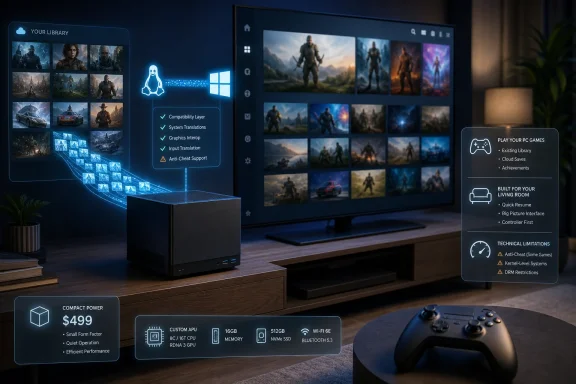
The machine uses a semi-custom AMD platform built around a six-core, 12-thread Zen 4 processor and an RDNA 3 graphics component with 28 compute units. Valve pairs that graphics hardware with 8GB of GDDR6 video memory, while the system has 16GB of DDR5 memory.Storage options begin with a 512GB NVMe solid-state drive, with a 2TB model available at a higher price. The machine also includes a microSD slot, Wi-Fi 6E, Bluetooth 5.3, Gigabit Ethernet, and an integrated wireless adapter for Valve’s second-generation Steam Controller.
This common specification gives developers, reviewers, and customers a meaningful baseline. A Steam Machine compatibility rating can refer to a known performance target rather than an ambiguous family of unrelated PCs.
Price immediately changes the comparison
The base 512GB Steam Machine launched at $1,049 without a controller, placing it well above mainstream console pricing. The 2TB system costs $1,349 on its own, while the premium bundle with the new Steam Controller and additional faceplates reaches $1,428.That price makes the Steam Machine less of a direct mass-market console substitute and more of a compact premium gaming PC. It must compete not only with Xbox and PlayStation hardware, but also with Windows desktops, gaming laptops, small-form-factor builds, and cheaper devices that can stream games from another computer.
Valve has attributed much of the pricing pressure to sharply rising memory and storage costs. Even so, buyers make decisions based on the final price, not the manufacturer’s original target or supply-chain difficulties.
What “The Whole PC Catalog” Actually Means
Valve engineer Pierre-Loup Griffais described the whole PC catalog as the company’s preferred “launch exclusive.” The phrase is strategically clever because it reframes the Steam Machine’s greatest difference from a traditional console: users do not begin with an empty library tied to a new hardware generation.Catalog access is not identical to guaranteed compatibility
Steam contains Windows games, native Linux games, older titles, experimental software, virtual-reality applications, and products with widely varying controller support. Some run perfectly under SteamOS, some require adjustments, and some do not function because of anti-cheat systems, launchers, unsupported codecs, operating-system dependencies, or developer decisions.The accurate interpretation is that the Steam Machine participates in the broad PC software ecosystem. Valve is not creating a separate storefront with a small launch lineup, nor is it asking publishers to produce special Steam Machine editions.
For a long-time Steam customer, the device can immediately expose hundreds or even thousands of owned games. That is a powerful benefit, but the usefulness of each library depends on the individual titles inside it.
Steam Machine Verified matters more than the slogan
Valve has expanded its compatibility-rating system to cover the Steam Machine. The purpose is to indicate whether a game launches cleanly, performs appropriately at default settings, displays legible text on a television, and works with the expected controller configuration without manual intervention.The practical buying process should therefore be:
- Check the Steam Machine rating for the games you play most frequently.
- Investigate recent user reports for titles without a rating or with unusual launch requirements.
- Confirm whether multiplayer games use an anti-cheat system supported on SteamOS.
- Review controller support if the game was designed primarily for a mouse and keyboard.
- Treat Windows installation as a fallback, not as proof that the default SteamOS experience is universal.
Proton Is the Real Launch Technology
The hardware may attract the headlines, but Proton is the technology that makes Valve’s catalog argument credible. Without the compatibility work completed during and after the Steam Deck era, the new Steam Machine would face the same software limitations that weakened the 2015 initiative.How Windows games run on SteamOS
Proton is a compatibility environment rather than a conventional emulator. It translates Windows APIs and game requirements into Linux-compatible equivalents, with DirectX calls commonly mapped to Vulkan through projects such as DXVK and VKD3D-Proton.This approach can deliver remarkably close-to-native performance. In some cases, a Windows game running through Proton behaves so smoothly that an ordinary player may never realize that the executable was not built for Linux.
Valve can also distribute title-specific fixes through Proton updates instead of waiting for each publisher to produce a native port. That centralization makes compatibility improvements faster and allows older games to benefit from community and platform-level engineering.
Compatibility remains a moving target
PC games are not static objects. Publishers update launchers, add anti-cheat components, change video codecs, remove online services, and modify authentication systems. A game that works today can regress after an update, while an unsupported title can become playable following a Proton, driver, or game patch.Valve’s challenge is therefore operational as much as technical. The company must maintain compatibility for an enormous and constantly changing software library rather than certifying a finite launch lineup.
That is why the whole-catalog message should be understood as a long-term platform objective. It is not a one-time engineering milestone that Valve can declare complete.
Why Valve Does Not Want Traditional Exclusives
Console manufacturers historically used exclusive games to create demand for their hardware and keep customers inside a controlled ecosystem. Valve’s incentives are different because its central business is the Steam marketplace, not the sale of one standardized console.Restricting a game would conflict with the PC model
A game available only on Valve’s Steam Machine would be difficult to justify technically. The device is fundamentally a PC, and SteamOS can run on other compatible computers. Artificially blocking a title from Windows, Steam Deck, or third-party SteamOS systems would undermine the openness Valve is trying to promote.Valve already has influential franchises, including Half-Life, Portal, Counter-Strike, Dota, and Left 4 Dead. It could theoretically use one as a hardware lever, but doing so would provoke an obvious question: why should a PC game be restricted to one particular PC?
The company instead wants software purchases to follow the user. A game bought on Steam can potentially be played on a Windows desktop, Steam Deck, Linux workstation, streaming client, or Steam Machine without requiring another purchase.
Valve can profit without winning a hardware war
Valve earns money when users buy games and other content through Steam. It can therefore benefit if another manufacturer produces a better SteamOS system, provided that device strengthens the Steam ecosystem and encourages software spending.This separates Valve from a conventional console company that subsidizes hardware to secure platform royalties and protect exclusive intellectual property. Valve wants to establish SteamOS as a credible PC gaming environment while preserving the broad hardware market that has always sustained Steam.
The Steam Machine is consequently both a product and a demonstration. It shows manufacturers what Valve considers a suitable living-room design, but it does not prevent them from building alternatives with faster graphics, additional ports, lower prices, or different form factors.
The Windows Dimension
For WindowsForum readers, the most consequential aspect of the Steam Machine is not that it replaces Windows. It is that Valve now offers a credible, consumer-friendly alternative for a category of gaming PCs that would once have shipped with Windows automatically.Microsoft’s gaming position is increasingly layered
Windows remains the dominant desktop gaming operating system and the primary development target for most PC games. DirectX, broad driver availability, Game Pass integration, modding tools, peripheral software, and publisher launchers continue to make Windows the safest option for maximum compatibility.At the same time, Microsoft has been making Xbox software available across more devices and has reduced the importance of rigid console boundaries. That trend partially aligns with Valve’s argument that a catalog and user account can matter more than one exclusive box.
The competition is therefore no longer simply Steam Machine versus Xbox console. It also involves SteamOS versus Windows as the preferred interface and operating environment for handhelds, compact PCs, and television-connected gaming devices.
The machine can run Windows, but that is not its main purpose
Valve has made Windows drivers available for the Steam Machine, allowing technically inclined owners to replace SteamOS or configure another storage arrangement. This preserves the hardware’s identity as a PC and provides a potential route to games that refuse to run under Proton.Installing Windows introduces trade-offs. The user may gain compatibility with unsupported games, Game Pass titles, anti-cheat systems, and peripheral utilities, but lose some of SteamOS’s appliance-like simplicity, controller-first navigation, streamlined updates, and integrated suspend behavior.
A dual-boot arrangement may appear to offer the best of both worlds, yet it adds storage overhead and maintenance complexity. On a 512GB model, allocating meaningful space to two operating systems could become inconvenient surprisingly quickly.
Consumer Impact
The Steam Machine presents a particularly strong argument to people who already own large Steam libraries and want to move between a desk, handheld, and television. Its value is much harder to establish for newcomers comparing hardware solely by price and frame rate.Existing libraries reduce the hidden cost
Console launch prices rarely represent the full cost of entering an ecosystem. Buyers may need new games, additional subscriptions, proprietary accessories, or upgraded versions of software they already own elsewhere.A Steam user can sign in and begin installing compatible purchases immediately. Cloud saves, achievements, workshop content, friend lists, community features, controller mappings, and family-sharing capabilities can follow the account rather than the physical machine.
Steam’s frequent discounts and broad backward compatibility also reduce the long-term software cost. Older PC games generally remain tied to the account instead of disappearing when a manufacturer moves to a new console generation.
The audience is narrower at $1,049
The strongest potential customers include:- Steam Deck owners who want a more powerful television system with a familiar interface.
- PC gamers with substantial existing libraries who do not want to repurchase software on a console.
- Living-room players who value a compact, quiet, standardized PC more than maximum performance per dollar.
- Linux enthusiasts who want officially supported gaming hardware rather than a self-assembled configuration.
- Users who want console-style convenience while retaining access to PC settings, mods, peripherals, and alternative software.
The absence of a bundled controller on the cheapest model also weakens the out-of-box console comparison. Valve can reasonably assume that many PC gamers already own compatible input devices, but a living-room product priced above $1,000 still feels incomplete without one.
Enterprise and Developer Impact
The Steam Machine is primarily a consumer gaming product, yet its broader platform effects matter to developers, independent studios, hardware vendors, and organizations managing interactive applications.Developers gain another standardized target
The fixed specification gives studios a predictable performance profile. Instead of optimizing for the full range of PC hardware, a developer can treat the Steam Machine as a recognizable configuration and validate default settings accordingly.Steam Machine certification may encourage teams to improve controller navigation, text scaling, launcher behavior, and television readability. Those enhancements can benefit Windows players using Big Picture Mode and handheld users as well, making the certification work useful beyond Valve’s cube.
Proton support also gives smaller studios a route to SteamOS compatibility without maintaining a completely separate Linux build. That can reduce engineering costs, although it does not eliminate the need for testing.
Anti-cheat decisions carry greater consequences
Some competitive multiplayer games remain unavailable or unreliable on SteamOS because their anti-cheat implementations do not support the platform. In certain cases, the underlying technology can work under Proton, but the publisher has chosen not to enable or certify it.As SteamOS hardware expands, that decision becomes harder to treat as a niche concern. A publisher declining support may exclude Steam Deck owners, Steam Machine customers, and users of third-party SteamOS devices simultaneously.
Organizations should also avoid confusing consumer compatibility with enterprise manageability. SteamOS does not replace Windows features such as Active Directory integration, established endpoint-management tooling, specialized corporate security software, or the broad application support expected on business PCs.
Performance and Hardware Reality
Valve initially promoted the new machine as substantially faster than Steam Deck and capable of targeting 4K television output through a combination of native rendering and upscaling. That description is defensible, but it requires context.Six times Steam Deck is not necessarily high-end
Steam Deck was designed around a low-power handheld processor and an 800p display. Multiplying its performance several times creates a capable living-room computer, but it does not automatically produce a premium desktop graphics system.The Steam Machine’s 28-compute-unit RDNA 3 graphics component is closer to entry-level or lower-midrange discrete PC graphics than to current enthusiast hardware. Its 8GB of video memory may also become restrictive in demanding games using high-resolution textures, ray tracing, or poorly optimized assets.
Valve can use FidelityFX Super Resolution and dynamic resolution to produce a 4K output signal while rendering internally at a lower resolution. That can look good from normal television viewing distances, but it is not equivalent to rendering every modern game natively at 3840 by 2160 pixels and 60 frames per second.
Default settings will determine the experience
A successful console-like PC must hide unnecessary configuration while retaining useful flexibility. Steam Machine Verified profiles can help by selecting sensible defaults, yet demanding games may still require compromises among resolution, image quality, ray tracing, and frame rate.The ideal experience would let players choose between a small number of clear profiles:
- A quality mode could favor sharper output and richer effects at approximately 30 frames per second.
- A balanced mode could use upscaling to target a stable middle ground.
- A performance mode could reduce internal resolution and effects to pursue 60 frames per second or higher.
Competitive Implications
The Steam Machine arrives as the boundaries among consoles, PCs, handhelds, cloud services, and storefronts continue to weaken. Valve’s catalog-first strategy could influence competitors even if the device itself remains supply-constrained or relatively niche.Sony and Microsoft already publish beyond their consoles
Sony has released an increasing number of PlayStation-developed games on PC, generally after a period of console availability. Microsoft has gone further by distributing major Xbox properties through Windows and, in selected cases, competing console platforms.These policies reduce the power of permanent hardware exclusivity. A customer may still choose a PlayStation for earlier access or a particular console experience, but software increasingly moves across platforms over time.
Valve’s message pushes that trend to its logical extreme: the hardware does not need an exclusive game because the user’s existing PC collection is the attraction. Whether consumers accept that argument at a four-figure price is another matter.
PC manufacturers are both partners and competitors
Valve explicitly wants other companies to build SteamOS devices. Manufacturers could create higher-performance Steam Machines, inexpensive streaming-oriented boxes, systems with optical audio or expanded connectivity, and designs optimized for upgradeability.That openness creates a risk for Valve’s own hardware sales, but it advances the larger objective. Every credible SteamOS computer makes the platform more familiar, expands the addressable audience for compatible games, and reduces the assumption that a gaming PC must run Windows.
Microsoft faces the opposite challenge. It earns licensing and ecosystem value from Windows devices, yet Windows must serve office workers, creators, administrators, and gamers simultaneously. SteamOS can focus almost entirely on gaming and optimize its interface around a controller.
Strengths and Opportunities
Valve’s strategy offers several meaningful advantages despite the hardware’s difficult price position.- The user’s existing Steam library becomes the launch lineup. Long-time customers can bring years of purchases, cloud saves, achievements, and community data to the machine.
- SteamOS provides a focused living-room interface. Players can reach games and system controls without navigating a conventional desktop during ordinary use.
- Proton transforms Windows compatibility into a platform service. Valve can improve many games centrally instead of relying exclusively on individual Linux ports.
- The hardware remains an open PC. Owners can connect standard peripherals, expand storage, install desktop applications, modify software, or replace the operating system.
- Third-party SteamOS hardware can strengthen the category. Valve does not need to manufacture every successful living-room PC itself.
- Verified ratings can improve game usability across devices. Better controller support, text scaling, and default settings help Steam Deck, Windows Big Picture, and other handheld users.
- The catalog model reduces generational disruption. Customers do not have to abandon their collections when Valve releases a future machine.
Risks and Concerns
The catalog-first strategy also creates expectations that Valve may struggle to satisfy consistently.- “Whole PC catalog” can be mistaken for universal compatibility. Unsupported anti-cheat, third-party launchers, unusual copy protection, and Windows-specific dependencies remain significant obstacles.
- The starting price is difficult to reconcile with console positioning. A $1,049 base model must offer convenience and ecosystem value strong enough to offset cheaper consoles and faster self-built PCs.
- Eight gigabytes of graphics memory may age poorly. Future high-resolution games could require aggressive texture reductions or upscaling.
- The base model’s 512GB drive is small for modern game installations. Several large releases can consume the available space, making expansion almost inevitable for active players.
- Compatibility can regress after updates. A publisher may change a launcher or anti-cheat component after Valve has rated the game.
- The system could remain a niche reference product. Limited supply and high pricing may prevent SteamOS from achieving the scale needed to pressure reluctant publishers.
- Windows installation can fragment support. Owners who replace SteamOS may encounter a less refined experience while still expecting Valve to solve every driver or interface problem.
- Third-party systems could recreate the confusion of 2015. Valve will need strong branding and clear certification rules if many manufacturers adopt the Steam Machine name.
What to Watch Next
The Steam Machine’s long-term importance will be determined after the launch excitement fades. Sales volume matters, but software support, third-party adoption, and the quality of Valve’s continuing maintenance will reveal whether this is a durable platform or another interesting experiment.Compatibility coverage
The first indicator will be the proportion of popular Steam games that receive meaningful Steam Machine ratings. Valve must evaluate new releases quickly while revisiting older products after game, driver, and Proton updates.Multiplayer support deserves particular scrutiny. If major competitive games remain inaccessible, the system’s catalog advantage will look much smaller to players whose gaming time revolves around one or two online titles.
Price and supply
Valve has warned that memory and storage conditions remain difficult, with retail pricing potentially lagging behind the pressures already visible in bulk supply. That suggests the company may have limited room for an immediate price reduction.A lower-cost revision could transform the product’s prospects, but Valve cannot simply remove storage or memory without harming usability. The company may instead need new component agreements, a revised board, or a later-generation design with better economics.
Third-party SteamOS computers
The appearance of certified alternatives would validate Valve’s open-platform argument. A larger manufacturer could offer more graphics power, easier upgrades, or a more aggressive price by using standard desktop components and a larger enclosure.Valve will need to decide how strictly it controls the Steam Machine label. Too little control risks repeating the inconsistent 2015 market, while excessive control would contradict the openness it promotes.
Windows and Xbox responses
Microsoft should watch whether consumers prefer SteamOS on gaming-first devices even when Windows remains available. Improvements to controller navigation, handheld usability, update management, and full-screen gaming modes could make Windows more competitive in the living room.The broader Xbox strategy will matter as well. If Microsoft continues treating Xbox as a cross-device software ecosystem, it may increasingly compete with Steam through subscriptions, stores, cloud services, and account continuity rather than through a single console.
Hardware revisions
Valve has indicated that future Steam Machine models are a question of when the timing makes sense rather than whether the concept can ever be revised. A successor could address the current system’s limited video memory, single-generation graphics architecture, and high component cost.The cadence will be delicate. Refreshing too quickly would frustrate early adopters, but waiting as long as a conventional console generation could leave the machine behind the rapidly moving PC market.
Valve’s “whole PC catalog” boast is most persuasive when treated as a statement of philosophy rather than a literal technical specification. The 2026 Steam Machine gives players a standardized, Valve-supported route into living-room PC gaming while preserving the libraries, peripherals, storefront, and flexibility they already use. Its success will depend on whether SteamOS can turn that openness into genuine appliance-like reliability—and whether enough buyers believe continuity with the PC ecosystem is worth paying considerably more than the price of a conventional console.
References
- Primary source: TechnoSports Media Group
Published: 2026-07-21T13:55:18+00:00
Valve Boasts The Entire PC Catalog Is The Steam Machine's
Valve's Steam Machine offers access to the entire PC gaming catalog, redefining console gaming without exclusive titles.technosports.co.in - Related coverage: pcgamer.com
'We're interested in having the whole PC catalog as our 'launch exclusive'': Valve talks exclusives and the advantages of an open platform | PC Gamer
Anyone can make a better Steam machine, and that's how Valve likes it.www.pcgamer.com - Related coverage: gamesradar.com
The Steam Machine isn't doing exclusives because Valve thinks "restricting where people can play" doesn't work | GamesRadar+
We’re much more interested in having the whole PC catalog as our 'launch exclusive'www.gamesradar.com - Related coverage: t3.com
Could Steam Machine prices rise even higher? Valve responds to growing concerns | T3
Sales of the Steam Machine have been strong so far, but there might be a sting somewhere down the linewww.t3.com - Related coverage: arstechnica.com
Don't worry, Valve still plans to launch the Steam Machine "this year" - Ars Technica
What part of "this year," exactly, is still anyone's guess.arstechnica.com - Related coverage: techtimes.com
Valve’s First Batch Of Steam Machines Now Available Starting At $449
The first three families of Steam Machines are now available to the masses. There are just three available at the moment, but more will roll out soon.www.techtimes.com