

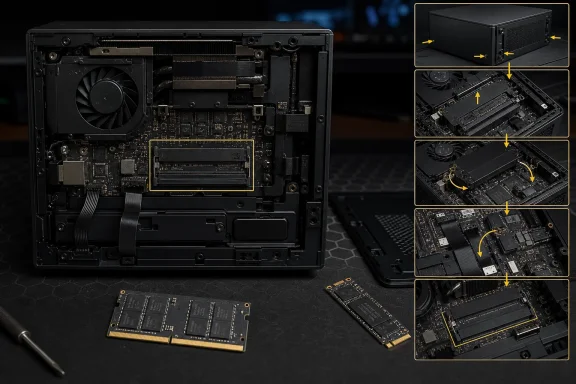
Valve says the Steam Machine’s RAM is upgradeable, but not conveniently so: reaching its SO-DIMM slots requires a substantial teardown, and the company says that is a DDR5 signal-integrity limitation rather than a temporary consequence of the current memory shortage.
In a July interview with Tom’s Hardware, Valve hardware engineer Yazan Aldehayyat said the company attempted to make the memory more accessible. It succeeded with the NVMe SSD, which is routed via a flex connection, but could not repeat that design for DDR5 memory. Longer memory routing would compromise signal integrity, while a proposed access hatch through the power-supply area was ruled out for safety reasons.
The result is an unusual split in upgradeability. Storage is intended to be readily accessible. System memory is socketed rather than soldered, but is located deep enough in the chassis that owners must remove or disconnect multiple components and ribbon cables to reach it.
Valve’s immediate RAM configuration has also been shaped by component supply. Gamers Nexus reported that the Steam Machine ships with 16GB of DDR5-5600 memory, and Valve said systems may use either one 16GB module or two 8GB modules depending on the supply it can secure. Tom’s Hardware separately reported that the first batch is limited to a single 16GB stick.
That distinction matters for buyers considering an eventual upgrade. The supply issue could ease, allowing Valve to ship future machines with two 8GB modules and dual-channel memory from the factory. The difficult physical access to the second SO-DIMM slot will not change for existing hardware simply because compatible RAM becomes cheaper or more available.
A second matched 16GB DDR5-5600 SO-DIMM would bring an affected system to 32GB and enable dual-channel operation. Valve told Gamers Nexus it found little or no measurable per-game difference in its own testing, though dual-channel memory can still matter more in CPU-limited workloads and for frame-time consistency than in GPU-bound games.
But socketed does not automatically mean easy to service. The RAM process involves navigating a compact PC around the cooling and power-delivery hardware, where cable routing and connector handling become part of the job. That raises the risk of a damaged connector or improperly seated cable compared with a typical laptop memory upgrade.
Owners who are content with 16GB should leave the machine intact; those pursuing 32GB or dual-channel operation should wait for Valve and iFixit’s official instructions and use a matched DDR5-5600 SO-DIMM.
In a July interview with Tom’s Hardware, Valve hardware engineer Yazan Aldehayyat said the company attempted to make the memory more accessible. It succeeded with the NVMe SSD, which is routed via a flex connection, but could not repeat that design for DDR5 memory. Longer memory routing would compromise signal integrity, while a proposed access hatch through the power-supply area was ruled out for safety reasons.
The result is an unusual split in upgradeability. Storage is intended to be readily accessible. System memory is socketed rather than soldered, but is located deep enough in the chassis that owners must remove or disconnect multiple components and ribbon cables to reach it.
 Supply problem, design problem
Valve’s immediate RAM configuration has also been shaped by component supply. Gamers Nexus reported that the Steam Machine ships with 16GB of DDR5-5600 memory, and Valve said systems may use either one 16GB module or two 8GB modules depending on the supply it can secure. Tom’s Hardware separately reported that the first batch is limited to a single 16GB stick.That distinction matters for buyers considering an eventual upgrade. The supply issue could ease, allowing Valve to ship future machines with two 8GB modules and dual-channel memory from the factory. The difficult physical access to the second SO-DIMM slot will not change for existing hardware simply because compatible RAM becomes cheaper or more available.
A second matched 16GB DDR5-5600 SO-DIMM would bring an affected system to 32GB and enable dual-channel operation. Valve told Gamers Nexus it found little or no measurable per-game difference in its own testing, though dual-channel memory can still matter more in CPU-limited workloads and for frame-time consistency than in GPU-bound games.
Not a casual upgrade
The Steam Machine is more serviceable than a sealed console in one important respect: Valve is using socketed system memory and says it plans to work with iFixit on replacement parts, repair manuals, and installation instructions. Aldehayyat said Valve expects items including flex cables, daughterboards, and ports to be made available as widely as possible.But socketed does not automatically mean easy to service. The RAM process involves navigating a compact PC around the cooling and power-delivery hardware, where cable routing and connector handling become part of the job. That raises the risk of a damaged connector or improperly seated cable compared with a typical laptop memory upgrade.
Owners who are content with 16GB should leave the machine intact; those pursuing 32GB or dual-channel operation should wait for Valve and iFixit’s official instructions and use a matched DDR5-5600 SO-DIMM.
References
- Primary source: Tech Times
Published: 2026-07-17T14:53:00+00:00
Steam Machine RAM Upgrade Demands Full Teardown: Valve Blames DDR5 Signal Integrity
Steam Machine RAM upgrade requires a full teardown because DDR5-5600 physics prevent a more accessible memory slot, Valve engineers confirmed. The machine ships with one 16 GB stick in single-channelwww.techtimes.com - Related coverage: tomshardware.com
Steam Machine interview full transcript: Valve engineers discuss $1,049 pricing, compact design, component shortages, and Windows support | Tom's Hardware
Valve's Pierre-Loup Griffais and Yazan Aldehayyat talked to Tom's Hardware about launching the Steam Machine in unprecedented times.www.tomshardware.com - Related coverage: gamersnexus.net
Valve Steam Machine Review: GPU & CPU Benchmarks, SteamOS Test, Thermals, Noise, and Price | GamersNexus
Pre-Built PC Valve Steam Machine Review: GPU & CPU Benchmarks, SteamOS Test, Thermals, Noise, and Price June 24, 2026 Last Updated: 2026-06-24 Our testing of the Steam Machine benchmarks gaming performance, GPU performance, framerate (FPS), CPU performance, compression and decompressiongamersnexus.net