

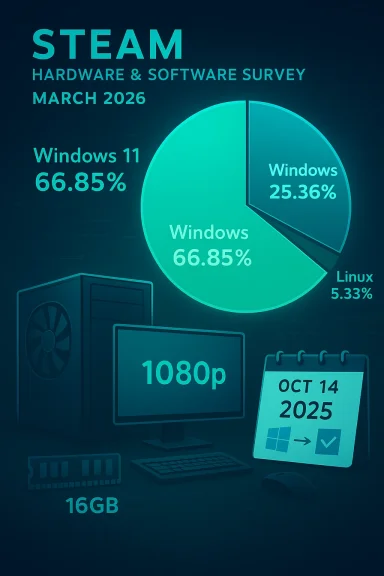
More than two-thirds of Steam users are now running Windows 11, and the latest hardware survey reinforces a bigger story that has been building for years: the PC gaming market has largely completed its migration to Microsoft’s newer platform. Valve’s March 2026 survey shows Windows 11 at 66.85% among Steam users, with Windows 10 falling to 25.36%, a steep one-month slide that reflects both normal churn and the accelerating reality of Windows 10’s end of support on October 14, 2025. At the same time, the survey keeps pointing to a familiar center of gravity for PC gaming: mid-range hardware, 16GB of RAM, and 1080p play remain the backbone of the Steam ecosystem.
The Steam Hardware & Software Survey is one of the most useful recurring snapshots in PC gaming because it captures what people actually use, not what enthusiasts say they plan to buy. Participation is optional and anonymous, which means the data is not a perfect census, but it is still a powerful barometer for platform momentum. In March 2026, the numbers show an ecosystem that is increasingly standardized around Windows 11, even as Linux grows slowly and macOS remains a distant minority.
That matters because Steam is not just a storefront; it is effectively the operating system stress test for the modern gaming PC. When the majority of players are on a single version of Windows, developers can optimize more aggressively, support overhead drops, and hardware partners get clearer signals about where consumer demand is concentrated. Windows 11’s share at 66.85% is not merely a headline number — it is a sign that the PC gaming base has crossed a threshold where Windows 11 is no longer the future. It is the default.
The pace of Windows 10 decline is especially important. Microsoft ended support for Windows 10 on October 14, 2025, and has been urging users to move to Windows 11 or adopt Extended Security Updates where available. That shift has obvious security implications, but it also has practical implications for gaming, driver support, and game launch requirements. A platform that was once held back by upgrade friction is now being pulled forward by the simple fact that support windows are closing.
At the hardware level, the survey continues to describe a market that prizes affordability and balance over brute force. The RTX 3060 remains a standout popular GPU, 16GB of RAM is still the most common memory configuration, and 6-core CPUs dominate. That combination tells a consistent story: the average Steam user is not chasing extreme 4K gaming or bleeding-edge workstation-class builds. Most players want stable, cost-conscious performance in the games they actually play.
There is also a practical reason the adoption curve keeps bending upward. Microsoft’s Windows 11 requirements are more modern than Windows 10’s, especially around TPM 2.0 and Secure Boot. Those requirements initially slowed adoption on older systems, but they also pushed the market toward newer hardware, which is exactly what many gaming users were going to buy anyway as their existing rigs aged out.
For game publishers, a larger Windows 11 base simplifies support matrices. Fewer legacy branches means fewer edge cases, fewer compatibility permutations, and fewer reasons to keep allocating engineering time to older OS behavior. That does not mean Windows 10 compatibility disappears overnight, but it does mean the strategic center of gravity has shifted decisively.
The persistence of Windows 10 is still significant, though. A quarter of Steam users is not a rounding error, and it suggests that older systems remain widely deployed. Many of those PCs are probably functioning perfectly well for the games people play today, especially if their owners are satisfied with 1080p or moderate settings and do not feel compelled to upgrade immediately.
That said, Windows 10’s share is likely to continue slipping as more users replace aging machines, encounter software compatibility pressure, or simply decide to stay on a platform that Microsoft continues to support. On the gaming side, the business case for lingering on Windows 10 gets weaker every month. Support already ended, and the market tends to move quickly once that kind of boundary is crossed.
That said, Linux’s expansion is still constrained by the same factors it has always faced: inconsistent anti-cheat support, uneven publisher support, and user familiarity. The gains are real, but they remain incremental rather than explosive. In other words, Linux is building credibility, not yet threatening Windows dominance.
macOS, meanwhile, remains stable but isolated from the broader PC gaming story. Apple’s platform is relevant to Steam, but it is not central to the hardware trends that define the PC gaming mainstream. The survey shows macOS at 2.35%, which confirms that the platform has a base, but not the scale needed to influence the direction of most PC game development.
The result is a balancing act. Valve benefits from supporting Linux and macOS because it broadens Steam’s reach and reinforces its platform independence. Yet the commercial center of gravity remains firmly in Windows land, and the March survey underlines that reality more clearly than any marketing statement could.
This is one of the most important takeaways from the survey. The biggest segment of the gaming PC market is not chasing prestige hardware; it is chasing value. That has implications for GPU vendors, game developers, and system builders alike. If the majority of users are clustered around mid-range parts, then performance targets should reflect that reality rather than the headline-grabbing end of the market.
The GPU market share breakdown also reinforces NVIDIA’s lead, with the company holding 72.83% and AMD sitting at 18.55%. That gap is large enough to shape ecosystem expectations, especially around driver tuning, feature adoption, and day-one support priorities. It also highlights the challenge AMD still faces in converting strong enthusiast goodwill into broader Steam adoption.
The CPU data tells a similar story. Six-core processors lead with 27.77%, which reflects the balance gamers want between price and performance. It is a sweet spot that accommodates modern game engines and background tasks without forcing users into expensive high-core-count territory.
This does not mean high-end display formats are irrelevant. They are increasingly important in premium segments, esports-oriented builds, and content creator rigs. But they do not define the median Steam setup, and the survey is valuable precisely because it keeps pulling the conversation back toward what the majority actually uses.
There is also a design implication here. Developers can no longer claim ignorance about the mainstream floor. If 1080p and mid-range hardware are still the norm, then optimization work for that class of machine is not optional polish — it is core product design. That matters more than ever as game budgets and expectations continue to rise.
For monitor vendors, the same pattern suggests that the mass market still values affordability and reliability over premium specs. High refresh 1440p and 4K displays have a place, but the deepest market remains anchored to displays that fit mainstream budgets and pair neatly with mid-tier GPUs.
AMD’s 18.55% share is still meaningful. It remains big enough to make AMD a relevant force in the market, especially for users who value price-to-performance ratios. But the survey suggests that AMD has not yet closed the broader adoption gap inside the Steam audience.
That matters for game studios because large market share differences affect the default assumption about installed hardware capabilities. Even well-optimized games often end up tuned around the most common vendor stack. The larger the skew, the more likely it is that the leading vendor’s architecture shapes the day-to-day reality of game development.
The more balanced CPU split also reflects a broader shift in consumer behavior. Buyers are increasingly willing to compare features, power efficiency, and multi-threaded value rather than treating one vendor as the obvious answer. That is healthy for the market, even if the lead remains modestly in Intel’s favor in the Steam sample.
The Steam Deck also acts as a strategic bridge between Linux and Windows gaming. It normalizes the idea that Steam can live comfortably outside the traditional desktop Windows experience, which strengthens Valve’s negotiating position with the rest of the PC industry. That is one reason the Steam survey matters so much: it shows how dominant Windows remains, while also revealing where Valve can keep pushing against the grain.
Valve has also addressed supply constraints and memory shortages affecting its hardware lineup, which underscores an important reality: even a company with a strong platform vision still has to live inside the component market. When memory and storage pricing move sharply, so do product plans. That is especially true in 2026, when supply chain pressures are once again shaping release schedules.
Reports also indicate Valve is preparing Android upload options ahead of the Steam Frame launch, which suggests a more interconnected hardware and content strategy. That may sound niche, but it reflects the direction of travel for the platform: more device types, more cross-compatibility, and more ways to keep users inside the Steam orbit.
That helps explain why mid-range hardware remains so persistent. Consumers upgrade when they need to, not when the enthusiast market says they should. They often choose a balanced package — a decent GPU, enough RAM, and a CPU that will age reasonably well — rather than building around speculative future needs.
The survey also suggests that software ecosystems should not underestimate the importance of default compatibility. When a platform becomes the obvious common denominator, users expect their games, drivers, and applications to work with minimal friction. That expectation influences how product teams test, ship, and support Windows applications in general.
Valve’s hardware roadmap will also be worth watching closely. The company has signaled confidence in its 2026 plans, but supply conditions, pricing, and memory availability could still force adjustments. If Steam Machine and Steam Frame ship on schedule, they could further widen the gap between Valve’s ecosystem vision and the rest of the PC market.
In the end, the most important conclusion is also the simplest: Windows 11 has won the center of Steam, but the market around it is still evolving. Consumers are settling on practical hardware, Microsoft’s legacy platform is fading, and Valve keeps building new ways to make Steam feel bigger than Windows itself. That combination suggests the PC gaming landscape is not standing still at all — it is just moving in directions that look more incremental than revolutionary, one survey at a time.
Source: Windows Report https://windowsreport.com/steam-survey-shows-windows-11-dominance-despite-slight-drop/
 Overview
The Steam Hardware & Software Survey is one of the most useful recurring snapshots in PC gaming because it captures what people actually use, not what enthusiasts say they plan to buy. Participation is optional and anonymous, which means the data is not a perfect census, but it is still a powerful barometer for platform momentum. In March 2026, the numbers show an ecosystem that is increasingly standardized around Windows 11, even as Linux grows slowly and macOS remains a distant minority.That matters because Steam is not just a storefront; it is effectively the operating system stress test for the modern gaming PC. When the majority of players are on a single version of Windows, developers can optimize more aggressively, support overhead drops, and hardware partners get clearer signals about where consumer demand is concentrated. Windows 11’s share at 66.85% is not merely a headline number — it is a sign that the PC gaming base has crossed a threshold where Windows 11 is no longer the future. It is the default.
The pace of Windows 10 decline is especially important. Microsoft ended support for Windows 10 on October 14, 2025, and has been urging users to move to Windows 11 or adopt Extended Security Updates where available. That shift has obvious security implications, but it also has practical implications for gaming, driver support, and game launch requirements. A platform that was once held back by upgrade friction is now being pulled forward by the simple fact that support windows are closing.
At the hardware level, the survey continues to describe a market that prizes affordability and balance over brute force. The RTX 3060 remains a standout popular GPU, 16GB of RAM is still the most common memory configuration, and 6-core CPUs dominate. That combination tells a consistent story: the average Steam user is not chasing extreme 4K gaming or bleeding-edge workstation-class builds. Most players want stable, cost-conscious performance in the games they actually play.
Windows 11 Becomes the New Normal
Windows 11’s 66.85% share on Steam is the clearest evidence yet that the operating system has completed its rise from cautious newcomer to platform standard. The change is not just cosmetic. It reflects years of hardware refreshes, Microsoft’s push toward stricter platform requirements, and the growing acceptance of Windows 11 as the expected environment for gaming PCs.Why the Shift Matters
Windows 11 is now the dominant target for game development and validation because that is where the users are. That creates a feedback loop: more users on Windows 11 makes it easier for developers and hardware vendors to prioritize it, which in turn makes it even more attractive as the baseline OS. In the PC market, default status is a powerful competitive moat.There is also a practical reason the adoption curve keeps bending upward. Microsoft’s Windows 11 requirements are more modern than Windows 10’s, especially around TPM 2.0 and Secure Boot. Those requirements initially slowed adoption on older systems, but they also pushed the market toward newer hardware, which is exactly what many gaming users were going to buy anyway as their existing rigs aged out.
For game publishers, a larger Windows 11 base simplifies support matrices. Fewer legacy branches means fewer edge cases, fewer compatibility permutations, and fewer reasons to keep allocating engineering time to older OS behavior. That does not mean Windows 10 compatibility disappears overnight, but it does mean the strategic center of gravity has shifted decisively.
- Windows 11 has become the primary PC gaming baseline.
- Hardware refresh cycles are accelerating the transition.
- Microsoft’s platform requirements are shaping the market.
- Developers gain simpler QA and support planning.
- Legacy OS maintenance becomes less economically attractive.
The Windows 10 Retreat
Windows 10 still commands a sizable 25.36% share on Steam, but the direction is unmistakable: the decline is now structural, not temporary. Microsoft’s end-of-support date on October 14, 2025 changed the calculus for users who had been postponing upgrades, and that deadline is now showing up in the hardware survey.The End-of-Support Effect
When Microsoft ends support, the practical consequences are immediate. Users stop receiving free security updates, feature updates, and technical assistance. For a mainstream desktop OS, that is a powerful incentive to move on, especially in households or workplaces that rely on the same machine for both gaming and general productivity.The persistence of Windows 10 is still significant, though. A quarter of Steam users is not a rounding error, and it suggests that older systems remain widely deployed. Many of those PCs are probably functioning perfectly well for the games people play today, especially if their owners are satisfied with 1080p or moderate settings and do not feel compelled to upgrade immediately.
That said, Windows 10’s share is likely to continue slipping as more users replace aging machines, encounter software compatibility pressure, or simply decide to stay on a platform that Microsoft continues to support. On the gaming side, the business case for lingering on Windows 10 gets weaker every month. Support already ended, and the market tends to move quickly once that kind of boundary is crossed.
- Windows 10 remains relevant, but the trend is clearly downward.
- The support cutoff has materially changed upgrade behavior.
- Some users will linger due to hardware constraints or inertia.
- Gaming compatibility pressure will continue to favor Windows 11.
- Enterprises and consumers face different urgency levels.
Linux and macOS Remain the Alternatives
The broader operating system picture remains overwhelmingly Windows-centric, with Windows accounting for 92.33% of Steam users in March 2026. Linux continues to rise slowly to 5.33%, while macOS sits at 2.35%. Those numbers are still small compared with Windows, but the trend lines matter because they reflect a more mature cross-platform gaming market than the one that existed just a few years ago.Why Linux Growth Still Matters
Linux’s share is small, but its growth is strategically important. SteamOS and Proton have made Linux gaming far more practical than it used to be, and Valve has spent years making the platform less hostile to mainstream players. Even a modest rise in share signals that Linux is no longer a novelty option reserved for hobbyists who enjoy debugging everything manually.That said, Linux’s expansion is still constrained by the same factors it has always faced: inconsistent anti-cheat support, uneven publisher support, and user familiarity. The gains are real, but they remain incremental rather than explosive. In other words, Linux is building credibility, not yet threatening Windows dominance.
macOS, meanwhile, remains stable but isolated from the broader PC gaming story. Apple’s platform is relevant to Steam, but it is not central to the hardware trends that define the PC gaming mainstream. The survey shows macOS at 2.35%, which confirms that the platform has a base, but not the scale needed to influence the direction of most PC game development.
Platform Diversity and Its Limits
A more diverse Steam ecosystem is healthy in principle because it reduces dependence on a single vendor stack. But diversity also raises support costs. Developers must decide where to spend their testing budget, and when Windows users remain the overwhelming majority, the answer is obvious.The result is a balancing act. Valve benefits from supporting Linux and macOS because it broadens Steam’s reach and reinforces its platform independence. Yet the commercial center of gravity remains firmly in Windows land, and the March survey underlines that reality more clearly than any marketing statement could.
- Windows remains overwhelmingly dominant on Steam.
- Linux is growing, but from a low base.
- macOS remains a niche gaming platform.
- Cross-platform support is improving, but unevenly.
- The market still rewards Windows-first development priorities.
Mid-Range Hardware Still Rules Steam
If the operating system story is about consolidation, the hardware story is about restraint. The Steam survey continues to show that the average player is not building a top-end dream machine. Instead, users overwhelmingly favor components that deliver dependable performance without pushing into the highest price brackets.The RTX 3060 Pattern
The GeForce RTX 3060 remains the most popular GPU in the survey at 3.92%, which is a strong sign that 1080p gaming still represents the platform’s sweet spot. The card is old enough to be affordable on the used market and capable enough to handle a wide range of games comfortably. That combination makes it a classic Steam component: practical, widely available, and good enough for most players.This is one of the most important takeaways from the survey. The biggest segment of the gaming PC market is not chasing prestige hardware; it is chasing value. That has implications for GPU vendors, game developers, and system builders alike. If the majority of users are clustered around mid-range parts, then performance targets should reflect that reality rather than the headline-grabbing end of the market.
The GPU market share breakdown also reinforces NVIDIA’s lead, with the company holding 72.83% and AMD sitting at 18.55%. That gap is large enough to shape ecosystem expectations, especially around driver tuning, feature adoption, and day-one support priorities. It also highlights the challenge AMD still faces in converting strong enthusiast goodwill into broader Steam adoption.
Memory and CPU Trends
16GB of RAM remains the most common configuration at 40.97%, which is exactly what many PC builders would predict for a mainstream gaming audience. It is enough to run modern games smoothly in most cases, while still staying within a reasonable budget. That makes it the natural equilibrium point for users who are upgrading in practical increments rather than chasing maximum specs.The CPU data tells a similar story. Six-core processors lead with 27.77%, which reflects the balance gamers want between price and performance. It is a sweet spot that accommodates modern game engines and background tasks without forcing users into expensive high-core-count territory.
- 16GB RAM remains the mainstream standard.
- Six-core CPUs are the most common configuration.
- The RTX 3060 still defines the value GPU tier.
- 8GB VRAM is common enough to shape game settings assumptions.
- Most users are still optimizing for cost efficiency, not extremes.
Resolution and Display Habits Show the Same Pattern
The survey’s resolution data continues to show that 1080p is the dominant practical standard across Steam. That should not surprise anyone, but it is still worth emphasizing because it defines how games are experienced at scale. The industry often talks about 4K, ultrawide, and ultra-high refresh rates, yet the most common reality remains simpler and more forgiving.What 1080p Dominance Means
1080p dominance is a reminder that game performance discussions should still begin with the mainstream. It also explains why mid-range GPUs remain so important: the card that can comfortably drive 1080p at good settings is the card that will win the broadest audience. In a market like Steam, that is the business that matters most.This does not mean high-end display formats are irrelevant. They are increasingly important in premium segments, esports-oriented builds, and content creator rigs. But they do not define the median Steam setup, and the survey is valuable precisely because it keeps pulling the conversation back toward what the majority actually uses.
There is also a design implication here. Developers can no longer claim ignorance about the mainstream floor. If 1080p and mid-range hardware are still the norm, then optimization work for that class of machine is not optional polish — it is core product design. That matters more than ever as game budgets and expectations continue to rise.
Competitive Pressure on Hardware Vendors
For GPU makers, the resolution data helps explain why value-tier cards remain strategically crucial. A product does not need to dominate benchmarks if it can dominate the real-world configuration bands most players inhabit. That is why cards like the RTX 3060 retain relevance long after faster products arrive.For monitor vendors, the same pattern suggests that the mass market still values affordability and reliability over premium specs. High refresh 1440p and 4K displays have a place, but the deepest market remains anchored to displays that fit mainstream budgets and pair neatly with mid-tier GPUs.
- 1080p remains the mainstream target.
- Mid-range GPUs map well to the average Steam user.
- Performance tuning for the average build still matters most.
- Premium display categories serve a smaller but growing audience.
- Real-world usage often differs from enthusiast conversation.
Intel, AMD, and NVIDIA: A Familiar Competitive Landscape
The component leaderboard is not especially shocking, but it is still instructive. NVIDIA leads the GPU market with 72.83%, Intel leads the CPU vendor share on Windows with 54.98%, and AMD remains competitive but second in both major categories. Those positions define the vendor battlefield for everything from game optimization to system integrator marketing.GPU Leadership Still Favors NVIDIA
NVIDIA’s GPU lead is large enough that most PC gaming software companies must treat it as the default target. The sheer size of the installed base has consequences for driver support, feature rollouts, and the practical importance of technologies such as frame generation and upscaling. Even where competitors offer compelling products, NVIDIA’s scale remains hard to ignore.AMD’s 18.55% share is still meaningful. It remains big enough to make AMD a relevant force in the market, especially for users who value price-to-performance ratios. But the survey suggests that AMD has not yet closed the broader adoption gap inside the Steam audience.
That matters for game studios because large market share differences affect the default assumption about installed hardware capabilities. Even well-optimized games often end up tuned around the most common vendor stack. The larger the skew, the more likely it is that the leading vendor’s architecture shapes the day-to-day reality of game development.
CPU Competition Is Closer
CPU competition is tighter, and that makes the market more interesting. Intel’s Windows share at 57.04% in February 2026 edged past AMD’s 42.95%, according to Valve’s processor vendor data, which is close enough to keep pressure on both companies. A near-balanced market usually creates better outcomes for consumers because it forces both sides to compete hard on performance, pricing, and platform support.The more balanced CPU split also reflects a broader shift in consumer behavior. Buyers are increasingly willing to compare features, power efficiency, and multi-threaded value rather than treating one vendor as the obvious answer. That is healthy for the market, even if the lead remains modestly in Intel’s favor in the Steam sample.
- NVIDIA retains a commanding GPU lead.
- AMD still holds a strong but secondary position.
- Intel and AMD are much closer on CPUs.
- Balanced CPU competition benefits buyers.
- GPU vendor share influences how games get optimized.
Valve’s Broader Ecosystem Strategy
The survey is only part of the story because Valve’s hardware ambitions keep expanding. The company’s broader ecosystem now includes Steam Deck, SteamOS, VR, and new living-room or device-class initiatives that aim to make Steam feel less like a storefront and more like a platform family. That strategy matters because it gives Valve leverage beyond simple software distribution.Steam Deck as a Platform Anchor
Valve has said Steam Deck players spent 330 million hours gaming in 2024, and it has continued to frame the handheld as proof that Steam hardware can succeed where earlier experiments struggled. The key lesson is not merely that a handheld can work, but that a unified ecosystem around SteamOS and compatibility layers can work at scale.The Steam Deck also acts as a strategic bridge between Linux and Windows gaming. It normalizes the idea that Steam can live comfortably outside the traditional desktop Windows experience, which strengthens Valve’s negotiating position with the rest of the PC industry. That is one reason the Steam survey matters so much: it shows how dominant Windows remains, while also revealing where Valve can keep pushing against the grain.
Valve has also addressed supply constraints and memory shortages affecting its hardware lineup, which underscores an important reality: even a company with a strong platform vision still has to live inside the component market. When memory and storage pricing move sharply, so do product plans. That is especially true in 2026, when supply chain pressures are once again shaping release schedules.
Steam Machine, Steam Frame, and the Next Layer
Valve has publicly reiterated that its Steam Machine-related hardware remains on track for a 2026 launch, despite earlier confusion around timing and component shortages. That matters because the company appears to be broadening its hardware thesis from handheld success toward a more complete living-room or hybrid PC ecosystem.Reports also indicate Valve is preparing Android upload options ahead of the Steam Frame launch, which suggests a more interconnected hardware and content strategy. That may sound niche, but it reflects the direction of travel for the platform: more device types, more cross-compatibility, and more ways to keep users inside the Steam orbit.
- Steam Deck validates Valve’s hardware ambitions.
- SteamOS reduces reliance on the Windows desktop model.
- Steam Machine extends the ecosystem to the living room.
- Steam Frame signals further platform diversification.
- Component shortages remain a real constraint on shipping plans.
Enterprise and Consumer Implications
At first glance, Steam survey data looks like pure consumer entertainment trivia. In practice, it has real implications for both consumer behavior and enterprise IT, because gaming PCs often double as work machines, family machines, or general-purpose home desktops. When Microsoft changes support policy and users upgrade hardware to keep games running, that behavior ripples into the rest of the PC market.Consumer Upgrade Cycles
For consumers, the Windows 11 lead is evidence that the upgrade wave has finally become unavoidable. Many users who deferred the move from Windows 10 may now be doing so because security support has ended and hardware replacement cycles are due anyway. In that sense, the Steam survey is not just a gaming report; it is a proxy for consumer refresh behavior across the whole PC ecosystem.That helps explain why mid-range hardware remains so persistent. Consumers upgrade when they need to, not when the enthusiast market says they should. They often choose a balanced package — a decent GPU, enough RAM, and a CPU that will age reasonably well — rather than building around speculative future needs.
Enterprise Signals
For enterprise IT, Steam data is not a procurement guide, but it is still useful context. It shows how quickly a mainstream user base can move once support deadlines and compatibility constraints become real. That same dynamic is relevant to organizations managing mixed fleets, especially when some employees use the same PC for work and play.The survey also suggests that software ecosystems should not underestimate the importance of default compatibility. When a platform becomes the obvious common denominator, users expect their games, drivers, and applications to work with minimal friction. That expectation influences how product teams test, ship, and support Windows applications in general.
- Consumer upgrades are still driven by support deadlines.
- Mainstream hardware choices favor practical balance.
- Gaming-driven refreshes can influence broader PC replacement cycles.
- Enterprise support planning must account for mixed-use systems.
- Default compatibility remains a decisive market advantage.
Strengths and Opportunities
The March survey is a strong reminder that Windows 11 has achieved the sort of momentum Microsoft wanted when it launched the OS, and that Valve’s ecosystem is still expanding in ways that could shape the next phase of PC gaming. It also shows that the market is stable enough to reward planning around mainstream configurations, which is good news for developers and hardware vendors alike.- Windows 11 now has clear platform leadership on Steam.
- Windows 10’s end of support is accelerating migration.
- 1080p and mid-range components make optimization easier.
- Valve’s hardware ecosystem is gaining strategic breadth.
- Linux gaming has room to keep growing.
- The CPU market remains competitive enough to keep pressure on vendors.
- Steam’s installed base is large enough to influence industry priorities.
Risks and Concerns
The biggest risk in reading the survey too optimistically is assuming that a dominant Windows 11 share automatically means smooth sailing. Upgrade transitions always create friction, and some users will stay on Windows 10 longer than Microsoft would like, whether for hardware, budget, or habit reasons. That lingering base can create support burdens and security exposure.- Windows 10 holdouts may become security liabilities.
- Hardware shortages could slow Valve’s ecosystem plans.
- Linux growth may stall if compatibility issues persist.
- GPU and RAM pricing pressures can distort upgrade timing.
- Market concentration can reduce incentives for cross-platform support.
- Mid-range dominance may discourage innovation at the top end.
- Survey data is optional, so it can be skewed by sampling behavior.
Looking Ahead
The next few survey cycles will be important because they will reveal whether Windows 11’s lead keeps expanding now that Windows 10 support has fully ended. If the current pattern continues, the transition will move from “migration” to “completion,” and that will reshape software support assumptions for the next several years. The key question is not whether Windows 11 stays ahead, but how quickly the remaining Windows 10 base shrinks.Valve’s hardware roadmap will also be worth watching closely. The company has signaled confidence in its 2026 plans, but supply conditions, pricing, and memory availability could still force adjustments. If Steam Machine and Steam Frame ship on schedule, they could further widen the gap between Valve’s ecosystem vision and the rest of the PC market.
What to Watch
- Whether Windows 11 pushes well past the two-thirds mark.
- How fast Windows 10 falls after support ended.
- Whether Linux’s growth rate remains steady or flattens.
- If NVIDIA’s GPU share shifts meaningfully with newer cards.
- Whether Valve’s 2026 hardware plans stay on schedule.
- How memory and storage pricing affect gaming hardware launches.
In the end, the most important conclusion is also the simplest: Windows 11 has won the center of Steam, but the market around it is still evolving. Consumers are settling on practical hardware, Microsoft’s legacy platform is fading, and Valve keeps building new ways to make Steam feel bigger than Windows itself. That combination suggests the PC gaming landscape is not standing still at all — it is just moving in directions that look more incremental than revolutionary, one survey at a time.
Source: Windows Report https://windowsreport.com/steam-survey-shows-windows-11-dominance-despite-slight-drop/
Last edited:
