

Valve’s SteamOS is becoming a realistic Windows alternative for PC gamers in 2026 because Valve has expanded its Linux-based gaming OS beyond the Steam Deck, improved AMD and Intel hardware support, and made Proton-powered Windows game compatibility good enough for many mainstream libraries. The argument is no longer that Linux gaming has caught Windows everywhere. It has not. The argument is sharper: for a growing class of living-room PCs, handhelds, and AMD-based gaming rigs, Windows is starting to look like the general-purpose tax gamers tolerate rather than the platform they actually need.
That is the thrust of a recent Geeky Gadgets piece based on Deck Ready’s SteamOS testing, and it lands at a moment when Valve’s own work makes the claim feel less like hobbyist evangelism. SteamOS 3.8.10 has brought a newer Linux base, broader hardware compatibility, and early support for upcoming Steam Machine hardware, according to Valve’s release notes as reported by outlets including Ars Technica, Phoronix, PC Gamer, and Tom’s Hardware. The catch is that “ditch Windows” still means different things depending on your games, your GPU, your tolerance for troubleshooting, and whether your multiplayer favorites depend on anti-cheat systems that remain hostile to Linux.
For years, SteamOS was easy to admire and hard to recommend outside Valve’s own hardware. The Steam Deck made Linux gaming feel consumer-ready, but it did so inside a tightly controlled AMD handheld where Valve could tune the kernel, graphics stack, compositor, power profiles, and Steam interface as one product. That success did not automatically make SteamOS a drop-in Windows replacement for the average gaming tower under a desk.
That boundary is now eroding. SteamOS 3.8 has pushed Valve’s platform closer to the broader PC market, with improved compatibility for recent AMD and Intel platforms and initial support for future Steam Machine hardware. Ars Technica described the 3.8 preview as one of Valve’s biggest steps toward third-party hardware, while Phoronix noted the stable 3.8.10 release’s updated Arch base, Linux 6.16 kernel, KDE Plasma 6.4 desktop, and Wayland-by-default desktop mode.
Those changes matter because SteamOS is not just a launcher. It is Valve’s attempt to make the entire gaming session feel console-like on PC hardware: boot into Steam, navigate with a controller, suspend and resume cleanly, keep drivers and runtime components aligned, and hide most of the desktop unless the user asks for it. Windows can be tuned for a living-room PC, but it still behaves like Windows: notifications, accounts, background services, update rituals, and a desktop metaphor that was never designed around a controller.
Geeky Gadgets frames SteamOS as “lightweight,” and that word is doing a lot of work. SteamOS is not magic; it still runs a modern kernel, a compositor, drivers, Steam, and compatibility layers. But it is lightweight in the sense that the default experience is organized around games rather than productivity, enterprise management, and decades of application compatibility. For a gaming box, that focus is not aesthetic. It is the product.
But Windows’ breadth is also why Valve has an opening. Microsoft’s operating system is the place where a gaming PC becomes an everything PC, which is useful until it is not. The same install that runs Cyberpunk 2077 also wants to handle OneDrive prompts, Teams components, telemetry settings, browser defaults, account nagging, system tray updaters, RGB utilities, printer services, and security prompts written for office workflows.
For the enthusiast with a keyboard and mouse, that mess is manageable. For the person building a couch gaming box, it is friction. The Steam Deck taught users that a PC game library can feel more like a console library if the operating system stops demanding to be the center of attention.
That is why the “ditch Windows” pitch resonates even when SteamOS still has holes. It is less about ideological Linux triumph and more about product-market fit. Windows remains the safer universal compatibility layer; SteamOS is becoming the better appliance layer for people who mostly want to boot, browse their Steam library, and play.
Deck Ready’s focus on Proton GE is understandable, though it needs a caveat. Proton GE, maintained outside Valve’s official Proton releases, often includes bleeding-edge fixes, media components, and game-specific patches that can help particular titles. It is popular with enthusiasts, but it is not the default support contract Valve provides to every SteamOS user.
The larger point still holds. Proton has made compatibility feel ordinary rather than miraculous. A user can install many Windows games from Steam and run them with little ceremony, and for a significant slice of single-player games, the experience is close enough that the operating system disappears.
That changes the Windows equation. Historically, the answer to “why not Linux?” was simple: the games are on Windows. In 2026, the answer is more conditional: some games are still effectively Windows-only, but many are not in practice. The line has moved from “Linux gaming is impractical” to “check your library first,” and that is a huge shift.
Geeky Gadgets points to Ryzen CPUs and Radeon GPUs as the preferred combination, and the broader reporting supports that instinct. Tom’s Hardware has described Valve’s current PC ambitions as easier on AMD-based systems, while also noting that Nvidia support remains a work in progress. TechRadar has reported improved Intel handheld support in SteamOS beta releases, but also noted that AMD handhelds have generally fared better under SteamOS than Intel devices in comparative experience.
That does not mean Intel is irrelevant. SteamOS 3.8’s improved compatibility with recent Intel platforms and early firmware work for upcoming Intel handhelds show Valve is trying to avoid becoming an AMD-only OS. But Intel support is still part of a moving platform story, especially for handhelds with newer Arc-based integrated graphics and hybrid CPU designs.
Nvidia is the more complicated case. Valve engineer Pierre-Loup Griffais has said, according to The Verge and Tom’s Hardware, that Valve is working closely with Nvidia on SteamOS support. That is encouraging, but not the same as saying a GeForce desktop is now a no-drama SteamOS target. For now, the most boring recommendation is also the most reliable one: if SteamOS is the plan, buy AMD unless you specifically want to test the frontier.
The context is different now. Steam Deck normalized the idea that Steam can be the shell. Proton made Windows compatibility a practical strategy rather than a wish. AMD’s Linux graphics support gave Valve a stable hardware lane. Handheld PCs from Asus, Lenovo, MSI, GPD, and others created a market where Windows often feels awkward and where SteamOS-like interfaces feel obvious.
Pre-built systems such as MetaPC’s Steamroller Next, highlighted in the Geeky Gadgets piece and covered by Tom’s Hardware, are significant because they turn SteamOS from a tinkerer’s image into a retail proposition. A prebuilt SteamOS PC is not merely another small desktop. It is a bet that some gamers want the Steam Deck experience scaled up to a TV.
That is where Windows looks most vulnerable. On a desk, Windows’ flexibility is still an advantage. On a couch, that flexibility often becomes noise. SteamOS can win there by being narrower, calmer, and more predictable.
Valve has worked for years with anti-cheat vendors and developers to improve Proton support. Easy Anti-Cheat and BattlEye can work with Proton when developers enable and validate support. But the choice ultimately sits with game makers, publishers, and security vendors who may decide that Linux support is not worth the testing burden or perceived risk.
That means SteamOS compatibility cannot be judged by averages alone. A gamer with a library of single-player RPGs, indies, racing games, emulators, and older PC titles may find SteamOS shockingly complete. A gamer whose weekly ritual is one unsupported competitive title may find the whole platform disqualified.
This is where the most breathless “Windows is dead” takes collapse. Windows is not dead when the games that define your social life still require it. SteamOS is strongest when it replaces Windows for a specific gaming role, not when it pretends every PC user has the same library.
Valve appears to know this. Tom’s Hardware has reported that Valve is working toward a more general SteamOS release and easier installation flow, though dual-boot partitioning remains an area still in progress. That distinction matters because a clean wipe is a commitment, while dual-boot is an experiment.
For enthusiasts, the sensible path is to treat SteamOS as a staged migration. Test it on a spare SSD, a second machine, or a device whose job is already gaming-first. Keep Windows around until the specific games and peripherals you care about are proven. The point is not bravery; it is avoiding an avoidable Saturday of regret.
There are also subtle platform expectations to reset. Some games may pick Steam Deck-oriented defaults, requiring manual graphics changes. Some PC niceties, such as HDMI CEC, may not be available in a given build. Some vendor utilities for RGB, fan curves, audio processing, capture hardware, or mouse configuration may be Windows-first or Windows-only.
Ray tracing support through Proton has improved substantially, though performance and compatibility vary by game and GPU. FidelityFX Super Resolution support is also part of the broader AMD and game-engine ecosystem, and recent reporting from TechSpot has described Valve and AMD activity around FSR 4 and Proton Experimental. The important point is not that every cutting-edge feature lands perfectly on day one. It is that SteamOS is now in the conversation for advanced graphics features rather than standing outside it.
That is a psychological change as much as a technical one. Gamers will tolerate a platform gap if they believe it is shrinking. They will not tolerate one that feels structural. Valve’s job is to make SteamOS feel like a fast-moving gaming platform, not a compatibility science project.
Still, the marketing claim needs discipline. A Ryzen 7 9800X3D paired with a high-end Radeon card will make many operating systems look good. If a $2,000 custom build runs beautifully under SteamOS, that is partly SteamOS and partly brute-force excellent hardware. The honest benchmark is not whether SteamOS can shine on dream builds; it is whether it can stay boring on ordinary ones.
But Microsoft should worry about losing mindshare in gaming-specific devices. The handheld PC boom exposed Windows’ awkwardness in small-screen, controller-first contexts. Even when performance is good, the experience often feels like a desktop OS squeezed into a console shell. Microsoft has tried to improve this with Xbox app changes, compact modes, and handheld-oriented interface work, but it is still fighting the architecture of Windows itself.
Valve has the opposite problem. SteamOS is elegant when it stays inside Steam’s gaming world, but becomes more complex when users need non-Steam launchers, mod managers, productivity apps, capture workflows, or Windows-only utilities. That trade-off favors Valve in dedicated gaming hardware and favors Microsoft in general-purpose PCs.
The danger for Windows is not instant displacement. It is segmentation. If gamers increasingly decide that the best handhelds and TV boxes run SteamOS while their “real PC” runs Windows, Microsoft loses the most culturally important edge of consumer PC enthusiasm. The desktop remains, but the excitement moves elsewhere.
If your library is mostly Steam, your GPU is AMD, your favorite multiplayer games are Proton-friendly, and you want a console-like interface on PC hardware, SteamOS is now worth serious testing. If your setup depends on Nvidia, unsupported anti-cheat titles, Windows-only peripherals, or non-Steam launchers that you do not want to babysit, Windows remains the pragmatic choice.
The best version of the SteamOS pitch is not “everyone should switch.” It is “more gamers now have permission to stop assuming Windows is mandatory.” That is a quieter claim, but it is the one Microsoft should take seriously.
That is the thrust of a recent Geeky Gadgets piece based on Deck Ready’s SteamOS testing, and it lands at a moment when Valve’s own work makes the claim feel less like hobbyist evangelism. SteamOS 3.8.10 has brought a newer Linux base, broader hardware compatibility, and early support for upcoming Steam Machine hardware, according to Valve’s release notes as reported by outlets including Ars Technica, Phoronix, PC Gamer, and Tom’s Hardware. The catch is that “ditch Windows” still means different things depending on your games, your GPU, your tolerance for troubleshooting, and whether your multiplayer favorites depend on anti-cheat systems that remain hostile to Linux.
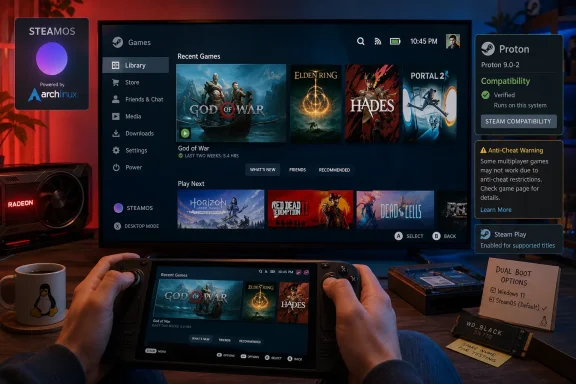 SteamOS Is No Longer Just the Deck’s Operating System
For years, SteamOS was easy to admire and hard to recommend outside Valve’s own hardware. The Steam Deck made Linux gaming feel consumer-ready, but it did so inside a tightly controlled AMD handheld where Valve could tune the kernel, graphics stack, compositor, power profiles, and Steam interface as one product. That success did not automatically make SteamOS a drop-in Windows replacement for the average gaming tower under a desk.That boundary is now eroding. SteamOS 3.8 has pushed Valve’s platform closer to the broader PC market, with improved compatibility for recent AMD and Intel platforms and initial support for future Steam Machine hardware. Ars Technica described the 3.8 preview as one of Valve’s biggest steps toward third-party hardware, while Phoronix noted the stable 3.8.10 release’s updated Arch base, Linux 6.16 kernel, KDE Plasma 6.4 desktop, and Wayland-by-default desktop mode.
Those changes matter because SteamOS is not just a launcher. It is Valve’s attempt to make the entire gaming session feel console-like on PC hardware: boot into Steam, navigate with a controller, suspend and resume cleanly, keep drivers and runtime components aligned, and hide most of the desktop unless the user asks for it. Windows can be tuned for a living-room PC, but it still behaves like Windows: notifications, accounts, background services, update rituals, and a desktop metaphor that was never designed around a controller.
Geeky Gadgets frames SteamOS as “lightweight,” and that word is doing a lot of work. SteamOS is not magic; it still runs a modern kernel, a compositor, drivers, Steam, and compatibility layers. But it is lightweight in the sense that the default experience is organized around games rather than productivity, enterprise management, and decades of application compatibility. For a gaming box, that focus is not aesthetic. It is the product.
Windows’ Greatest Strength Has Become Its Gaming Weakness
Windows dominates PC gaming because it has the libraries, the drivers, the launchers, the peripheral software, and the developer assumptions. That dominance remains real. The Steam Hardware Survey still shows Windows with overwhelming share, and even the growth of Linux gaming is starting from a small base.But Windows’ breadth is also why Valve has an opening. Microsoft’s operating system is the place where a gaming PC becomes an everything PC, which is useful until it is not. The same install that runs Cyberpunk 2077 also wants to handle OneDrive prompts, Teams components, telemetry settings, browser defaults, account nagging, system tray updaters, RGB utilities, printer services, and security prompts written for office workflows.
For the enthusiast with a keyboard and mouse, that mess is manageable. For the person building a couch gaming box, it is friction. The Steam Deck taught users that a PC game library can feel more like a console library if the operating system stops demanding to be the center of attention.
That is why the “ditch Windows” pitch resonates even when SteamOS still has holes. It is less about ideological Linux triumph and more about product-market fit. Windows remains the safer universal compatibility layer; SteamOS is becoming the better appliance layer for people who mostly want to boot, browse their Steam library, and play.
Proton Changed the Meaning of a Windows Game
The heart of SteamOS is not Linux purity. It is Proton, Valve’s compatibility technology that lets many Windows games run on Linux through Wine, DXVK, VKD3D-Proton, and a stack of related translation work. Proton is the reason SteamOS can plausibly target Windows gamers without asking developers to ship native Linux builds.Deck Ready’s focus on Proton GE is understandable, though it needs a caveat. Proton GE, maintained outside Valve’s official Proton releases, often includes bleeding-edge fixes, media components, and game-specific patches that can help particular titles. It is popular with enthusiasts, but it is not the default support contract Valve provides to every SteamOS user.
The larger point still holds. Proton has made compatibility feel ordinary rather than miraculous. A user can install many Windows games from Steam and run them with little ceremony, and for a significant slice of single-player games, the experience is close enough that the operating system disappears.
That changes the Windows equation. Historically, the answer to “why not Linux?” was simple: the games are on Windows. In 2026, the answer is more conditional: some games are still effectively Windows-only, but many are not in practice. The line has moved from “Linux gaming is impractical” to “check your library first,” and that is a huge shift.
AMD Is the Path of Least Resistance
SteamOS currently makes the most sense on AMD hardware, and that is not an accident. The Steam Deck is an AMD machine, Valve’s upcoming Steam Machine work is tied to AMD-style graphics assumptions, and Linux’s open-source AMD graphics stack has matured into the most frictionless route for gaming-focused Linux systems.Geeky Gadgets points to Ryzen CPUs and Radeon GPUs as the preferred combination, and the broader reporting supports that instinct. Tom’s Hardware has described Valve’s current PC ambitions as easier on AMD-based systems, while also noting that Nvidia support remains a work in progress. TechRadar has reported improved Intel handheld support in SteamOS beta releases, but also noted that AMD handhelds have generally fared better under SteamOS than Intel devices in comparative experience.
That does not mean Intel is irrelevant. SteamOS 3.8’s improved compatibility with recent Intel platforms and early firmware work for upcoming Intel handhelds show Valve is trying to avoid becoming an AMD-only OS. But Intel support is still part of a moving platform story, especially for handhelds with newer Arc-based integrated graphics and hybrid CPU designs.
Nvidia is the more complicated case. Valve engineer Pierre-Loup Griffais has said, according to The Verge and Tom’s Hardware, that Valve is working closely with Nvidia on SteamOS support. That is encouraging, but not the same as saying a GeForce desktop is now a no-drama SteamOS target. For now, the most boring recommendation is also the most reliable one: if SteamOS is the plan, buy AMD unless you specifically want to test the frontier.
The Living-Room PC Is Where SteamOS Makes the Most Sense First
The best case for SteamOS is not that every Windows desktop should be wiped tomorrow. It is that the living-room gaming PC has been waiting for an operating system that treats the TV and controller as first-class citizens. Steam Machines failed a decade ago partly because the Linux game library was not ready, Proton did not exist in its modern form, and the hardware ecosystem was scattered.The context is different now. Steam Deck normalized the idea that Steam can be the shell. Proton made Windows compatibility a practical strategy rather than a wish. AMD’s Linux graphics support gave Valve a stable hardware lane. Handheld PCs from Asus, Lenovo, MSI, GPD, and others created a market where Windows often feels awkward and where SteamOS-like interfaces feel obvious.
Pre-built systems such as MetaPC’s Steamroller Next, highlighted in the Geeky Gadgets piece and covered by Tom’s Hardware, are significant because they turn SteamOS from a tinkerer’s image into a retail proposition. A prebuilt SteamOS PC is not merely another small desktop. It is a bet that some gamers want the Steam Deck experience scaled up to a TV.
That is where Windows looks most vulnerable. On a desk, Windows’ flexibility is still an advantage. On a couch, that flexibility often becomes noise. SteamOS can win there by being narrower, calmer, and more predictable.
The Anti-Cheat Wall Still Defines the Border
The biggest practical reason not to ditch Windows remains multiplayer anti-cheat. Some of the world’s most important games use anti-cheat systems that either do not support Linux, are not enabled by the developer for Proton, or create inconsistent experiences for SteamOS users. This is not a niche problem if your gaming life revolves around competitive shooters, live-service titles, or esports ecosystems.Valve has worked for years with anti-cheat vendors and developers to improve Proton support. Easy Anti-Cheat and BattlEye can work with Proton when developers enable and validate support. But the choice ultimately sits with game makers, publishers, and security vendors who may decide that Linux support is not worth the testing burden or perceived risk.
That means SteamOS compatibility cannot be judged by averages alone. A gamer with a library of single-player RPGs, indies, racing games, emulators, and older PC titles may find SteamOS shockingly complete. A gamer whose weekly ritual is one unsupported competitive title may find the whole platform disqualified.
This is where the most breathless “Windows is dead” takes collapse. Windows is not dead when the games that define your social life still require it. SteamOS is strongest when it replaces Windows for a specific gaming role, not when it pretends every PC user has the same library.
Installation Is Easier Than It Used to Be, Not Yet Invisible
Geeky Gadgets correctly notes that moving to SteamOS requires preparation: bootable media, BIOS or UEFI settings, storage decisions, and some comfort with recovery images or installers. That process is not terrifying for WindowsForum readers, but it is still a filter. The average console buyer does not want to think about Secure Boot, boot order, partitioning, or whether their Wi-Fi chipset has friendly Linux support.Valve appears to know this. Tom’s Hardware has reported that Valve is working toward a more general SteamOS release and easier installation flow, though dual-boot partitioning remains an area still in progress. That distinction matters because a clean wipe is a commitment, while dual-boot is an experiment.
For enthusiasts, the sensible path is to treat SteamOS as a staged migration. Test it on a spare SSD, a second machine, or a device whose job is already gaming-first. Keep Windows around until the specific games and peripherals you care about are proven. The point is not bravery; it is avoiding an avoidable Saturday of regret.
There are also subtle platform expectations to reset. Some games may pick Steam Deck-oriented defaults, requiring manual graphics changes. Some PC niceties, such as HDMI CEC, may not be available in a given build. Some vendor utilities for RGB, fan curves, audio processing, capture hardware, or mouse configuration may be Windows-first or Windows-only.
FSR, Ray Tracing, and the Myth of the Compromise OS
The old Linux gaming stereotype was that choosing Linux meant choosing lower fidelity, fewer features, and more fiddling. SteamOS complicates that picture. Modern Proton, Vulkan translation layers, Mesa drivers, and AMD’s Linux support can deliver high-end PC gaming features that once seemed permanently tied to Windows.Ray tracing support through Proton has improved substantially, though performance and compatibility vary by game and GPU. FidelityFX Super Resolution support is also part of the broader AMD and game-engine ecosystem, and recent reporting from TechSpot has described Valve and AMD activity around FSR 4 and Proton Experimental. The important point is not that every cutting-edge feature lands perfectly on day one. It is that SteamOS is now in the conversation for advanced graphics features rather than standing outside it.
That is a psychological change as much as a technical one. Gamers will tolerate a platform gap if they believe it is shrinking. They will not tolerate one that feels structural. Valve’s job is to make SteamOS feel like a fast-moving gaming platform, not a compatibility science project.
Still, the marketing claim needs discipline. A Ryzen 7 9800X3D paired with a high-end Radeon card will make many operating systems look good. If a $2,000 custom build runs beautifully under SteamOS, that is partly SteamOS and partly brute-force excellent hardware. The honest benchmark is not whether SteamOS can shine on dream builds; it is whether it can stay boring on ordinary ones.
Microsoft Should Worry About the PCs It Does Not Control
SteamOS is not going to remove Windows from enterprise desktops, creator workstations, engineering laptops, or the average family PC. Microsoft’s ecosystem gravity remains massive. Game Pass, DirectX, OEM relationships, peripheral vendors, and decades of application compatibility all still favor Windows.But Microsoft should worry about losing mindshare in gaming-specific devices. The handheld PC boom exposed Windows’ awkwardness in small-screen, controller-first contexts. Even when performance is good, the experience often feels like a desktop OS squeezed into a console shell. Microsoft has tried to improve this with Xbox app changes, compact modes, and handheld-oriented interface work, but it is still fighting the architecture of Windows itself.
Valve has the opposite problem. SteamOS is elegant when it stays inside Steam’s gaming world, but becomes more complex when users need non-Steam launchers, mod managers, productivity apps, capture workflows, or Windows-only utilities. That trade-off favors Valve in dedicated gaming hardware and favors Microsoft in general-purpose PCs.
The danger for Windows is not instant displacement. It is segmentation. If gamers increasingly decide that the best handhelds and TV boxes run SteamOS while their “real PC” runs Windows, Microsoft loses the most culturally important edge of consumer PC enthusiasm. The desktop remains, but the excitement moves elsewhere.
The Smarter Move Is Not to Burn Windows Down
For WindowsForum readers, the most practical stance is neither Windows loyalism nor Linux triumphalism. It is workload separation. A gaming appliance does not need to be the same machine as a work PC, and an experimental SteamOS install does not need to replace a stable Windows setup on day one.If your library is mostly Steam, your GPU is AMD, your favorite multiplayer games are Proton-friendly, and you want a console-like interface on PC hardware, SteamOS is now worth serious testing. If your setup depends on Nvidia, unsupported anti-cheat titles, Windows-only peripherals, or non-Steam launchers that you do not want to babysit, Windows remains the pragmatic choice.
The best version of the SteamOS pitch is not “everyone should switch.” It is “more gamers now have permission to stop assuming Windows is mandatory.” That is a quieter claim, but it is the one Microsoft should take seriously.
Valve’s Best Argument Is a PC That Behaves Less Like a PC
The concrete case for SteamOS is strongest when it is specific rather than ideological.- SteamOS is now a credible option for AMD-based gaming systems, especially handhelds and living-room PCs built around Steam libraries.
- Proton has moved many Windows games from “unavailable on Linux” to “works well enough that the OS fades into the background.”
- Multiplayer anti-cheat remains the biggest compatibility trap, and users should verify their must-play games before wiping Windows.
- Nvidia support is improving in intent but not yet the safest path for SteamOS builders who want a low-maintenance system.
- Prebuilt SteamOS machines matter because they turn a hobbyist platform into a consumer product category.
- Dual-booting, spare-drive testing, or using a dedicated gaming box is still the safest way to evaluate SteamOS without gambling your main PC.
References
- Primary source: Geeky Gadgets
Published: 2026-07-04T08:30:31.072358
SteamOS Replaces Windows for AMD Desktop PC Gamers - Geeky Gadgets
The official release of SteamOS for desktop PCs offers a stable Windows alternative for gaming, specifically optimized for AMD Ryzen and Radeon builds.www.geeky-gadgets.com - Related coverage: tomshardware.com
Steamroller becomes first prebuilt gaming PC to ship with SteamOS — Ryzen 9600X, Radeon RX 7600, 16GB DDR5 RAM system available for preorder at $1,299 | Tom's Hardware
Controller not included.www.tomshardware.com - Related coverage: pcgamer.com
Valve says it is 'definitely' investigating an Arm-based gaming future on top of its work on FEX | PC Gamer
Flexing ahead.www.pcgamer.com - Related coverage: techspot.com
Valve confirms FSR 4 for Steam Machine, AMD releases FSR 4.1 for RDNA 3 GPUs | TechSpot
Screenshots posted on X by YouTuber and XR analyst Brad Lynch appear to show that Valve is already testing support for FSR 4.1 upscaling in the Proton...www.techspot.com - Related coverage: technobaboy.com
SteamOS adds AMD GPU support for DIY Steam Machine PC builds - Technobaboy
SteamOS now supports AMD GPUs, letting users install SteamOS 3.8 on standard PCs and build DIY Steam Machines.www.technobaboy.com - Related coverage: technave.com
Valve is officially working on Nvidia support for SteamOS | TechNave
Pierre-Loup Griffais, a Valve engineer, recently confirmed that Valve is actively working with Nvidia to bring official graphics driver supptechnave.com
- Related coverage: techradar.com
Valve's latest SteamOS beta provides better Intel hardware compatibility — and that's great news for upcoming handhelds | TechRadar
SteamOS is the way to gowww.techradar.com - Related coverage: pcworld.com
Valve's SteamOS now supports Vulkan, the cross-platform alternative to DirectX 12 | PCWorld
Nvidia leads the pack, with Intel and AMD not far behind, signalling a new dawn for Linux gaming. www.pcworld.com
- Related coverage: windowscentral.com
Valve lays the foundations for an Arm-based gaming handheld future with first Snapdragon-powered SteamOS VR headset | Windows Central
The new Steam Frame is coming next year and is Valve's first all-in-one headset running SteamOS, powered by a Snapdragon chip.www.windowscentral.com - Related coverage: vgtimes.com
Valve Expands SteamOS Support, Promises Official NVIDIA GPU Compatibility by 2026
Valve has announced that official support for NVIDIA GeForce RTX graphics cards will arrive in SteamOS by the end of 2026, marking a major step in...vgtimes.com - Related coverage: abit.ee
SteamOS 3.8 on Regular PCs — Valve Finally Remembers Intel and AMD Users Exist
SteamOS 3.8 can now be installed on any Intel and AMD PC — Valve expands desktop support. Nvidia compatibility is still in development.abit.ee
- Related coverage: techtimes.com
Valve SteamOS can now support AMD and Intel graphics
SteamOS can now support AMD and Intel graphics along with Nvidia GPUs. Valve Corporation’s Linux-based operating system, SteamOS, now supports AMD and Intel graphics processors.www.techtimes.com - Related coverage: arstechnica.com
SteamOS beta picks up built-in AMD, Intel GPU support - Ars Technica
Update follows announcement of 13 Steam Machines at CES.arstechnica.com - Related coverage: technic3d.com
SteamOS unterstützt nun auch AMD- und Intel-GPUs | News | Technic3D
VALVE hat seinem Betriebssystem ein Update spendiert, die vor allem Nutzer von Grafikchips, die nicht von Nvidia stammen, betrifft. www.technic3d.com
- Official source: github.com
Getting Started · ValveSoftware/SteamOS Wiki · GitHub
SteamOS community tracker. Contribute to ValveSoftware/SteamOS development by creating an account on GitHub. github.com
- Related coverage: phoronix.com
SteamOS 3.8.10 Stable Released With Updated Arch, Steam Machine Support & Wayland Desktop Default - Phoronix
Overnight Valve released SteamOS 3.8.10 into the stable channelwww.phoronix.com
- Related coverage: opensourcefeed.org
SteamOS 3.8.10 Released: KDE Plasma 6.4.3 and Wayland Default | OpenSourceFeed
SteamOS 3.8.10 brings KDE Plasma 6.4.3, Wayland by default, Linux kernel 6.16, HDMI VRR support, and early Steam Machine hardware support.www.opensourcefeed.org
- Related coverage: fingerlakes1.com
- Related coverage: finalboss.io
Steam Deck's SteamOS 3.8 update changes how VRR and external monitors behave | FinalBoss.io
SteamOS 3.8.10 brings Wayland defaults, improved VRR, and better external display support to Steam Deck. Verify these settings after updating to avoid...finalboss.io - Related coverage: gamingonlinux.com
SteamOS 3.8 is out with initial Steam Machine support, Desktop Mode upgrades, new Graphics Drivers | GamingOnLinux
Valve finally released the stable version of their Linux-powered SteamOS 3.8, bringing with it masses of changes making it one of the biggest upgrades yet.www.gamingonlinux.com
- Related coverage: os.watch
SteamOS 3.8.10
SteamOS 3.8.10 has just been released for all users with the following changes: updated Arch system base; initial support for upcoming Steam Machine h...os.watch - Related coverage: phys.org
Loading…
phys.org