

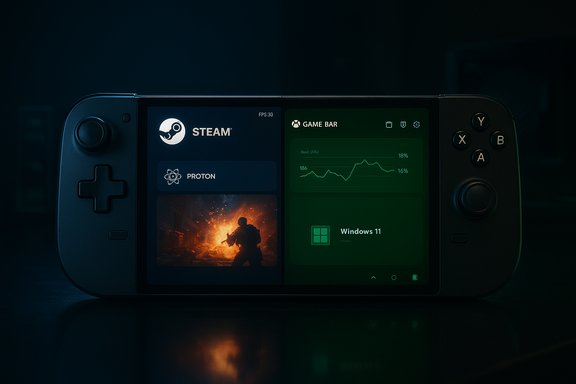
Microsoft’s late-year pledge to “make Windows the best place to play” is a tacit admission that Valve’s SteamOS has become a real competitive threat in the fast-growing handheld PC gaming market, and the performance data from side‑by‑side tests show Valve’s lean, gaming‑focused OS currently holds a measurable advantage on the portable hardware that matters most.
Handheld PC gaming moved from niche experiment to mainstream product category in 2024–2025, driven by the Steam Deck’s market success and a new generation of AMD‑powered APUs tuned for low‑power, high‑efficiency gaming. OEMs introduced a wave of Windows‑based handhelds (ROG Ally, Lenovo Legion Go, and others) while Valve expanded SteamOS beyond the Deck for the first time, offering an alternative that’s explicitly optimized for gaming on constrained hardware. Microsoft’s response—framed publicly in a Windows blog post and repeated in industry coverage—centers on what the company calls “performance fundamentals”: tighter background workload management, power and scheduling improvements, graphics stack refinements, and coordinated driver work with silicon partners. Those promises are coupled with feature rollouts such as the Xbox Full‑Screen Experience (FSE), Advanced Shader Delivery (ASD), and Auto Super Resolution (Auto SR), which together are intended to reclaim lost ground in battery efficiency, frame stability, and input latency.
For now, SteamOS enjoys momentum in the handheld niche because it aligns design, drivers, and user experience around one purpose: play. Windows’s strength—its universality—both helps and hampers it in this contest. The key question for 2026 is whether Microsoft can move beyond incremental surface optimizations to deliver the lean, predictable gaming posture that handheld users crave. If it does, Windows will remain dominant across form factors; if it doesn’t, Valve’s specialized approach may continue to redefine expectations for portable PC gaming.
Source: WebProNews Microsoft Struggles Against SteamOS in Handheld PC Gaming
 Background
Handheld PC gaming moved from niche experiment to mainstream product category in 2024–2025, driven by the Steam Deck’s market success and a new generation of AMD‑powered APUs tuned for low‑power, high‑efficiency gaming. OEMs introduced a wave of Windows‑based handhelds (ROG Ally, Lenovo Legion Go, and others) while Valve expanded SteamOS beyond the Deck for the first time, offering an alternative that’s explicitly optimized for gaming on constrained hardware. Microsoft’s response—framed publicly in a Windows blog post and repeated in industry coverage—centers on what the company calls “performance fundamentals”: tighter background workload management, power and scheduling improvements, graphics stack refinements, and coordinated driver work with silicon partners. Those promises are coupled with feature rollouts such as the Xbox Full‑Screen Experience (FSE), Advanced Shader Delivery (ASD), and Auto Super Resolution (Auto SR), which together are intended to reclaim lost ground in battery efficiency, frame stability, and input latency. The evidence: Benchmarks and real‑world tests
Lenovo Legion Go S — a pivotal data point
The Lenovo Legion Go S is the first modern handheld that shipped in two factory OS configurations with otherwise near‑identical hardware: one with Windows 11, one with SteamOS 3.7. That rare apples‑to‑apples comparison produced headlines because independent testing—Ars Technica’s benchmarks and popular hands‑on videos—found SteamOS delivering higher frame rates and substantially better battery endurance across multiple titles. Reported gains varied by game and power profile, but many mainstream titles ran measurably faster on SteamOS. TechSpot and XDA’s hands‑on coverage reinforced the pattern: Cyberpunk 2077, Doom Eternal and The Witcher 3 are frequently cited as examples where SteamOS produced a significant uplift, sometimes moving a title from barely playable to a reasonable experience at the same graphical preset. Testers and reviewers attributed the improvements to lower OS overhead, more efficient suspend/sleep handling, and the maturity of Valve’s gaming stack — including Proton and Mesa graphics drivers — on AMD handheld silicon.How big is “significant”?
Performance deltas reported in public benchmarks range from modest single‑digit uplifts to dramatic differences in particular scenarios. Ars Technica’s tests showed game‑by‑game differences commonly in the 8–36% uplift range on SteamOS over Windows on the Legion Go S under their test conditions. XDA’s deep dives found isolated examples where SteamOS posted near‑doubling percentage figures in headline terms, though those percentages can exaggerate the user‑facing difference when baseline frame rates are low. The takeaway is consistent: on integrated‑graphics handhelds or low‑TDP APUs, software overhead and driver efficiency matter a lot — and SteamOS is currently winning that battle.Where Windows still wins
Benchmarks also show context matters. On discrete GPUs and in high‑power desktop configurations, Windows generally retains the edge, particularly for titles that exploit vendor‑specific driver optimizations and DirectX‑only features. TechSpot’s wider tests confirm that Windows can outperform SteamOS in configurations with full‑fat GPUs, which helps explain why Windows remains the default for high‑end desktops and laptops. But for the mobile, thermally constrained handheld segment — the focal point of this discussion — Linux/SteamOS often provides better real‑world battery life and frame consistency.Why SteamOS is winning on handhelds
1. Lean, gaming‑first design
SteamOS is a purpose‑built environment: it boots quickly into a library‑first UI, prioritizes controller input, and minimizes desktop services. That means fewer background tasks consuming CPU cycles, less RAM pressure, and fewer interruptions from system notifications. On 15–30 watt class APUs, shaving a few percentage points of overhead can yield noticeable FPS and battery improvements. In short, SteamOS trades general‑purpose flexibility for gaming focus, and that trade pays off on handhelds.2. Graphics stack maturity for AMD handhelds
Valve’s long investment in Proton (the Windows‑compatibility layer for Linux), Mesa drivers, and tuned shader paths has matured into a robust stack that often runs modern Windows games efficiently on Linux. On AMD handheld APUs, SteamOS benefits from coordinated driver work and optimizations that reduce CPU‑side overhead and improve GPU throughput — a distinct advantage when silicon budgets are tight.3. Better suspend/resume and power management
Many testers report SteamOS has more dependable suspend and resume behavior, and more aggressive but predictable power management profiles. These traits contribute directly to longer battery life and smoother session continuity on portable devices — factors that matter more to handheld owners than raw peak FPS on desktop rigs. TechSpot and NotebookCheck flagged suspend/resume and system overhead as key differentiators.4. Ecosystem lock‑in that doubles as a strength
SteamOS is tightly integrated with the Steam ecosystem — automatic game updates, Proton compatibility tools, controller mappings and overlay features are all part of one coordinated stack. That integration reduces configuration friction for consumers and gives Valve the ability to ship platform‑level optimizations that target real usage patterns. For handheld buyers who primarily live in Steam, that integrated experience is compelling.Where Windows falls short — and why Microsoft is being challenged
Legacy baggage and background services
Windows carries decades of compatibility layers, telemetry, background services, and security hooks that are essential in enterprise and desktop contexts but are overhead on a handheld. Those background responsibilities — antivirus scans, system indexing, telemetry collection, and various platform services — can interrupt game loops or steal cycles at sensitive moments. Testers pointed at this “OS noise” as one root cause of Windows’s handheld performance gap. Microsoft’s own roadmap references the need to refine background workload management to fix exactly this problem.Driver fragmentation and timing
Windows’s driver ecosystem is broad but complex. OEM‑supplied drivers, factory images, and vendor‑specific OEM updates can lag or conflict. The Legion Go S highlighted this: one set of drivers produced worse results than updating to a different vendor’s drivers — an impractical workaround for the average user. Conversely, SteamOS’s curated driver set for AMD handhelds produced a smoother out‑of‑the‑box experience.Patch regressions and the Nvidia incident
Stability concerns aren’t hypothetical. An October 2025 Windows update caused measurable frame‑rate regressions for some Nvidia GPU users; Nvidia shipped a hotfix driver to recover lost performance, underscoring how Windows updates can accidentally degrade gaming performance across configurations. That episode amplified community frustration and fed the narrative that Windows is sometimes brittle with consumer hardware changes.Microsoft’s countermeasures: roadmap and promises
Microsoft’s public playbook is a three‑pronged program: reduce OS overhead for gaming sessions, expand platform features that benefit handhelds, and coordinate driver work with OEMs and silicon partners.- Xbox Full‑Screen Experience (FSE): a controller‑first shell that defers or suspends non‑essential background workloads to free RAM and CPU for games, available in preview on certain handhelds and slated to expand.
- Advanced Shader Delivery (ASD): precompiled shader bundles to reduce first‑run stutters and lower shader compilation overhead on low‑power devices. Microsoft claims dramatic first‑run load time reductions in controlled tests.
- Auto Super Resolution (Auto SR): an OS‑level upscaler leveraging NPUs on supported hardware to improve perceptual performance and framerates without developer changes. Early previews target specific handhelds.
- “Performance fundamentals”: systemic improvements in background workload scheduling, power profiles, graphics runtime efficiency and driver coordination slated to roll through 2026.
Critical analysis: strengths, limits, and realistic timelines
Strengths of Microsoft’s approach
- Broad compatibility: Windows still runs more software natively than any other OS, and DirectX remains the technical standard for many studios. The installed base and developer tooling are enormous advantages that won’t vanish quickly.
- Deeper ecosystem control: Microsoft can coordinate with AMD, Intel, Nvidia, and major OEMs to push driver and firmware updates at scale—something Valve can’t do as consistently outside Valve‑branded hardware.
- Feature leverage: Innovations like ASD and Auto SR are system‑level levers that, if widely adopted, can produce measurable improvements for a broad swath of titles and devices. Those are not trivial wins.
Limits and risks
- Time‑to‑impact: Many of Microsoft’s announced improvements are scheduled for 2026 rollouts or gradual preview expansions. SteamOS is already shipping on multiple handhelds and benefiting from continuous tuning. The window to change consumer perception is short.
- Architectural mismatch: Windows’ general‑purpose priorities (security, enterprise manageability) are sometimes at odds with the minimalism that benefits handheld gaming. Stripping down Windows enough to match SteamOS’s lean profile without undermining its broader role is a complex engineering and product‑policy problem.
- Trust deficit: Repeated regression incidents and the perception of “OS noise” have eroded confidence among some enthusiast communities. Restoring trust requires consistent, testable results, not only promises. The Nvidia hotfix episode was a reminder of how fragile that trust can be.
Cross‑verification and what’s still uncertain
Multiple independent outlets — Ars Technica, TechSpot, XDA, NotebookCheck and others — reported similar outcomes on Legion Go S comparisons. That cross‑section of testing reduces the likelihood that results are flukes. However, some enthusiast posts and large percentage claims (e.g., “75% faster”) amplify edge cases; percentages can mislead if baseline frame rates are very low. The most reliable interpretation is that SteamOS is consistently better on constrained, integrated‑graphics handhelds rather than universally superior across all PC hardware. Rumors and social media speculation about Microsoft’s internal hires or an upcoming Microsoft handheld should be treated as unverified unless corroborated by official announcements or multiple independent leaks; where community posts are referenced here, they are flagged as social proof rather than authoritative fact. Caution is advised when extrapolating bench results to all titles, hardware revisions, or future driver updates.Ecosystem and developer implications
For developers
Developers historically optimize first for Windows because it’s the largest single platform with direct access to the widest feature set. SteamOS’s rise matters because Proton and Valve’s tooling lower the barrier to shipping Linux‑friendly experiences. If Valve’s user base on handhelds grows, developers will have stronger incentives to test and tune for Linux/APU environments, creating a virtuous cycle that further erodes Windows’s exclusive advantage. Studios face new choices:- Continue Windows‑first optimization and accept potential performance regressions on handhelds.
- Invest in multi‑platform testing (Windows + Proton/Linux) to reach handheld users with optimized builds.
- Embrace middleware and cross‑platform graphics APIs (Vulkan, portable shader tooling) that reduce friction across OSes.
For OEMs
OEMs must weigh the tradeoffs of shipping Windows for flexibility versus SteamOS for a polished, gaming‑first experience. Early market signals show some OEMs (Lenovo) willing to ship both, letting consumers choose; others may hedge toward SteamOS for low‑margin, price‑sensitive handheld SKUs. The choice will affect driver update cadence, user support overhead, and marketing positioning.Competitive trajectories and market scenarios
Three plausible scenarios define the near future:- Microsoft executes quickly and convincingly: Windows 11’s 2026 updates deliver tangible FPS and battery improvements on handheld APUs, restoring parity in most cases. Windows remains the dominant PC gaming platform, while SteamOS becomes an important niche for enthusiasts. This relies on fast driver coordination and measurable telemetry improvements.
- Incremental progress, Valve keeps its lead on handhelds: Microsoft improves Windows on handhelds but not enough to close the gap before Valve captures hardware and mindshare. SteamOS grows in the handheld and living‑room segments; Windows stays king on desktops.
- Valve accelerates broader device support and developer tooling: If SteamOS expands rapidly beyond Valve‑approved hardware and Proton continues to mature, Linux‑based gaming could reconfigure the market, particularly for mobile handhelds and thin client experiences. This is the scenario that would force Microsoft into deeper architectural changes or a more radical product re‑positioning.
Practical implications for consumers
- If you prioritize plug‑and‑play handheld gaming and battery life, buy the OS that matches your use case: SteamOS models are currently the safer choice for pure handheld play; Windows models keep compatibility and general PC flexibility.
- If you own one of the Windows handhelds experiencing issues, keep drivers and Windows preview builds up to date, and consider using the Xbox Full‑Screen Experience preview to reduce background overhead where available. Microsoft’s upcoming features (ASD, Auto SR) may help, but timelines vary.
- Don’t treat single‑game headline percentages as universal guarantees; look for multi‑title, repeatable tests and check whether results were obtained at the power profile and resolution you expect to use.
Where Microsoft could go next — a pragmatic prescription
- Prioritize a low‑overhead gaming posture: make FSE a true, well‑documented, user‑controlled gaming mode that does one thing well — free resources for the running game and mute non‑essential system services.
- Ship a small, signed driver bundle for handheld SKUs that’s validated by OEMs and easier for end users to receive and validate — reduce the friction that made Legion Go S users hunt for “unofficial” driver packages.
- Open a cross‑platform profiling program with Valve and leading devs: share anonymized telemetry (opt‑in) that lets Microsoft target the most impactful background tasks and scheduling tweaks for handheld scenarios.
- Invest in a consumer‑facing transparency dashboard that shows what services are paused or throttled in FSE — this will reduce the trust gap by making tradeoffs visible to users.
Conclusion
The SteamOS vs Windows 11 story is not a simple technology battle; it is a marketplace test of specialization versus generalization. Valve’s SteamOS has demonstrated that a focused, gaming‑first OS can unlock surprisingly large gains on thermally constrained handheld hardware, translating into better frame rates and battery life in many real‑world tests. Microsoft’s response is credible and substantial on paper — a cross‑stack set of improvements that target the exact pain points revealed by recent benchmarks. But words and roadmaps are not the same as shipping measurable, repeatable improvements in users’ hands.For now, SteamOS enjoys momentum in the handheld niche because it aligns design, drivers, and user experience around one purpose: play. Windows’s strength—its universality—both helps and hampers it in this contest. The key question for 2026 is whether Microsoft can move beyond incremental surface optimizations to deliver the lean, predictable gaming posture that handheld users crave. If it does, Windows will remain dominant across form factors; if it doesn’t, Valve’s specialized approach may continue to redefine expectations for portable PC gaming.
Source: WebProNews Microsoft Struggles Against SteamOS in Handheld PC Gaming
