

SteamOS has done something the wider Linux-desktop conversation has long debated: it showed that Linux doesn't have to dress like Windows to attract users — it needs a clear, purpose-led identity, sensible defaultslts, and compatibility scaffolding that removes friction from everyday tasks.
For years the dominant strategy in desktop Linux was familiarity-first: mimic Windows' taskbar, menu, and layout to reduce the perceived cost of switching. That approach lowers initial cognitive friction but often backfires when the underlying ecosystem — installers, EXE files, anti‑cheat drivers, and Windows‑centric workflows — fails to match the surface-level promises. By contrast, SteamOS presents a different playbook: be obvious about what you are designed for and hide the plumbing until the user asks for it. That shift has measurable consequences. Valve’s Steam ecosystem and the Steam Deck hardware have driven an uptick in Linux usage on Steam, with Valve’s distributions (SteamOS Holo) now comprising a meaningful share of that cohort. )
This article assesses what SteamOS proves, how Valve engineered the experience to reduce friction, where the Linux desktop can learn from it, and what risks and open questions remain for users and developers alike.
Benefits:
This momentum has also encouraged OEM experiments: third‑party handhelds shipping with or supporting SteamOS, and emerging “gaming-focused” community distros that mirror SteamOS’s defaults. The result is a less fragmented Linux gaming footprint, which in turn reduces QA surface area for developers who might otherwise ignore the platform.
For the foreseeable future, SteamOS will remain the most instructive example of how a Linux desktop can scale beyond hobbyists: purpose-led, curated, and pragmatic. The Linux community’s challenge now is to take those tactics and apply them to other user needs — productivity, media creation, or enterprise — without losing the openness and flexibility that make Linux valuable in the first place.
Acknowledgements and verification notes
Source: XDA SteamOS proved the Linux desktop doesn't need to look like Windows to succeed
 Background: why this matters now
For years the dominant strategy in desktop Linux was familiarity-first: mimic Windows' taskbar, menu, and layout to reduce the perceived cost of switching. That approach lowers initial cognitive friction but often backfires when the underlying ecosystem — installers, EXE files, anti‑cheat drivers, and Windows‑centric workflows — fails to match the surface-level promises. By contrast, SteamOS presents a different playbook: be obvious about what you are designed for and hide the plumbing until the user asks for it. That shift has measurable consequences. Valve’s Steam ecosystem and the Steam Deck hardware have driven an uptick in Linux usage on Steam, with Valve’s distributions (SteamOS Holo) now comprising a meaningful share of that cohort. )This article assesses what SteamOS proves, how Valve engineered the experience to reduce friction, where the Linux desktop can learn from it, and what risks and open questions remain for users and developers alike.
Overview: SteamOS as a case study in product-first Linux
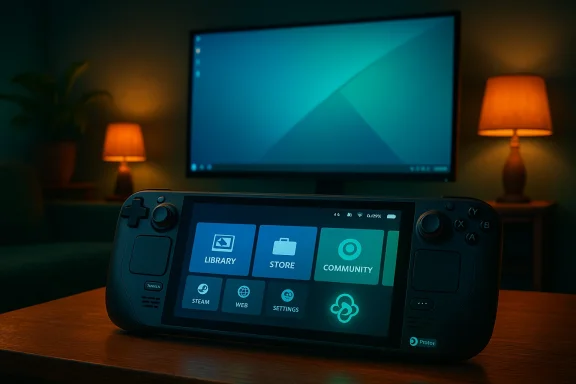
SteamOS represents a product-first approach to a Linux distribution. Instead of trying to be a drop-in replacement for Windows, it:- Starts in Gaming Mode (a console-like Big Picture interface) rather than a traditional desktop.
- Makes the desktop available as a secondary mode (KDE Plasma on SteamOS) for users who want a full Linux workstation experience.
- Bundles and maintains a compatibility layer — Proton — that runs many Windows games on Linux without native ports. Proton’s first public release arrived in August 2018 and has matured into the engine that makes the “play now” promise feasible for thousands of titles.
- Uses a curated compatibility program (Deck Verified / Steam Deck compatibility badges) so consumers can quickly tell which titles will “just work,” which will need tweaks, and which are unsupported.
Why “don’t copy Windows” is more than rhetorical
There’s a persistent myth that the fastest path to mainstream Linux adoption is to replicate Windows’ look and layout. SteamOS undermines that assumption with three practical lessons.1) Identity beats mimicry
SteamOS has a point of view: gaming-first, controller-friendly, and appliance-like when needed. That identity reduces the number of decisions a new user must make. Instead of mapping Windows metaphors onto Linux and then watching the illusion break when Windows workflows fail, SteamOS sets expectations clearly: this is a gaming platform that can morph into a desktop result is fewer “expectation collisions” where users blame Linux for an experience the distro never promised.2) Make desktop optional, not mandatory
Most Linux distributions present the desktop as the primary surface; SteamOS flips that. Boot into a console-like launcher; only venture into KDE Plasma when you choose to. That choice architecture matters: it shields non-technical users from the complexity that traditionally intimidated them while still offering power users a familiar Linux environment. The Steam Deck’s Desktop Mode uses KDE Plasma, but it’s explicitly the side door — not the front door.3) Ship compatibility and tell users clearly
Valve didn’t just ship an OS — it shipped Proton and a compatibility program (Deck Verified) that labels games as Verified, Playable, Unsupported, or Unknown. Those badges are consumer-grade signals that remove the guesswork from buying or installing titles on a new platform. The transparency of that curation is itself an onboarding tool; it reduces uncertainty in the same way a console’s store does.Technical plumbing: what actually makes SteamOS useful
The two engineering pillars under SteamOS are the compatibility stack (Proton and related libraries) and careful platform curation.Proton and runtime work
Proton is Valve’s curated fork and enhancement of Wine, integrating projects such as DXVK and VKD3D to translate Direct3D calls to Vulkan and to smooth integration with Steam runtime services. Since its initial release on 21 August 2018, Proton has steadily extended compatibility into more titles and higher API levels, enabling unmodified Windows binaries to run on Linux in many cases. That is the single most important technical enabler behind SteamOS’s claim to “just play.”Benefits:
- Immediate access to a huge portion of the Steam library without waiting for native ports.
- Simplified end-user workflow: install, press play.
- A practical alternative for hardware weight, gaming-optimized OS.
- Anti‑cheat solutions and certain low-level Windows drivers remain a blocking factor for some multiplayer titles.
- Compatibility is not guaranteed; some titles need per-game tweaks and publisher cooperation to fully work.
Deck Verified / compatibility curation
The Deck Verified program gives consumers at-a-glance compatibility information and also helps Valve prioritize engineering and QA work. The program’s four-tier labeling system is simple but effective: it codifies a combination of input support, display/UX suitability, Proton compatibility, and runtime warnings into a badge that consumers can instantly understand. That curation reduces purchase risk and lowers the support burden for hardware vendors and the Steam storefront.Measurable impact: Linux on Steam and ecosystem momentum
The combination of hardware (Steam Deck), Proton, and platform curation has delivered measurable results in the gaming segment. Steam’s Hardware & Software survey recorded Linux usage on Steam reaching record levels in late 2025 — around 3.2% of the platform in November 2025 — with Valve’s SteamOS Holo accounting for roughly 26.4% of that Linux share. Those figures are a small slice of the overall desktop market but are statistically meaningful within Steam’s hundreds of millions of users; even fractional percentage shifts translate to millions of people and influence developer priorities.This momentum has also encouraged OEM experiments: third‑party handhelds shipping with or supporting SteamOS, and emerging “gaming-focused” community distros that mirror SteamOS’s defaults. The result is a less fragmented Linux gaming footprint, which in turn reduces QA surface area for developers who might otherwise ignore the platform.
What Linux desktop projects can learn from SteamOS
SteamOS isn’t a universal solution for every desktop use case, but its design patterns offer transferable lessons for any effort that aims at mainstream adoption.- Design for a purpose: Define the platform’s central user intent (gaming, media, kiosk, productivity) and optimize the default path for that intent. Users adopt experiences, not operating-system principles.
- Hide complexity behind confidence: Provide “don’t make me think” defaults and guide users toward power features only when they want them.
- Ship compatibility pragmatically: Build or bundle compatibility layers (like Proton) and communicate where things work and where they don’t in plain language.
- Curate, don’t confuse: A few well-chosen guardrails reduce user error and disappointment. Curated Linux is not the same as locked-down Linux; it’s about helpful defau
- Invest in packaging and runtime consistency: Flatpak, containerized packaging, and standardized runtimes reduce the “it worksked on my machine” problem, helping mainstream users avoid package-manager surprises.
The strengths: what SteamOS gets right
- Consumer clarity: The Deck Verified program and an obvious gaming-first UI shorten the decision cycle for buyers.
- Practical compatibility: Proton converts a vast Windows catalog into usable content on Linux, and Valve’s integration makes it feel seamless to end users.
- Hardware and ecosystem alignment: Valve paired hardware (Steam Deck and third‑party devices) with its OS and tooling, producing a tractable vertical for developers and OEMs to target.
- Choice-preserving desktop: Desktop Mode (KDE Plasma) remains available and full-featured for those who need it, avoiding the trap of being a one-trick appliance.
The risks and remaining obstacles
No platform pivot is without trade-offs. SteamOS’s model exposes several structural limitations and open questions.1) Anti‑cheat and multiplayer parity
Anti‑cheat systems are the most persistent technical block for a full migration of mLinux. Some anti‑cheat vendors have added Proton‑compatible paths, but publisher adoption remains non-uniform and often needs active cooperation. That means major online franchises may remain Windows-centric for the foreseeable future, limiting SteamOS’s claim of “everything will work.”2) Desktop and professional app gaps
SteamOS’s focus on gaming means it does not automatically solve problems for office workflows, creative software, or enterprise-managed endpoints that rely on Windows-only applications, drivers, and certifications. While there are workarounds (Wine, Proton, containerized apps), these aren’t equivalent to native support for many professional toolchains. That keeps SteamOS comfortably inside the gaming niche rather than as a universal desktop successor.3) Driver and vendor dependency
Valve’s work benefits from strong alignment with AMD (open-source graphics stacks (Mesa). Desktop-level adoption would require robust, widely compatible driver packaging across Nvidia, AMD, and Intel on a much larger variety of hardware. Proprietary drivers and the diversity of desktop hardware remain friction points.4) Fragmentation risk if curation fails
Curated defaults are helpful — but only if maintained. If the compatibility metadata becomes stale or the curation pipeline doesn’t scale with new releases and patches, users will encounter a mixture of “verified” badges and untested reality. That mismatch could erode trust faster than an honest “it’s complicated” label. Valve’s ongoing commitment to review the catalog mitigates this risk, but it’s not eliminated.Practical takeaways for WindowsForum readers
- For gamers who want a console-like, appliance experience with access to a huge back catalog, SteamOS and Proton deliver a low‑friction alternative that is already proven on handhelds and increasingly viable on desktops. The Steam Deck experience demboarding matters as much as technical capability.
- For users who run competitive online multiplayer titles, Windows remains the safer choice today due to anti‑cheat and publisher constraints. SteamOS is closing the gap but has not reached universal parity.
- If the goal is to convert friends or family away from Windows, mimicry-style distros can create brittle expectations. A better strategy is to intrux experience that fits the task they care about — gaming, browsing, media consumption — and then show the desktop as an optional, powerful tool if needed. SteamOS exemplifies this approach by keeping Desktop Mode accessible but secondary.
- When evaluating hardware or a migration path, test key apps and drivers on the target platform. Hardware vendors and distributions increasingly ship supported images and Flatpak bundles, but variability remains; the Steam Hardware & Software survey and Valve’s compatibility badges are useful signals but not substitutes for testing your critical titles and peripherals.
A sober look at the market reality
SteamOS hasn’t made Linux the default desktop overnight, and it likely won’t. Windows continues to dominate, and Microsoft’s official documentation confirms that Windows 10 reached end-of-support on October 14, 2025 — a calendar event that has nudged some users toward alternatives, but not created a mass exodus. The reality is incremental: in late 2025 Linux’s share on Steam rose to ~3.2%, a meaningful uptick inside a platform that matters for game publishers and hardware makers, but still a small fraction of the overall desktop market. Those numbers show momentum, not victory.Conclusion: design first, ecosystem second
SteamOS’s success is a reminder that technical excellence alone doesn’t drive adoption — product design, clarity, and aligned incentives do. Valve created a coherent ecosystem (hardware + OS + Proton + clear compatibility signals) that lowered user anxiety and replaced uncertain “will it work?” questions with the much simpler “press play.” The broader Linux desktop can borrow that lesson: mainstream adoption is more likely if distributions define a clear purpose, ship excellent defaults, and provide transparent compatibility information — not by pretending to be Windows with a different icon.For the foreseeable future, SteamOS will remain the most instructive example of how a Linux desktop can scale beyond hobbyists: purpose-led, curated, and pragmatic. The Linux community’s challenge now is to take those tactics and apply them to other user needs — productivity, media creation, or enterprise — without losing the openness and flexibility that make Linux valuable in the first place.
Acknowledgements and verification notes
- Proton’s initial release date (21 August 2018) and its role as Valve’s Windows-compatibility layer are documented and cross-referenced in public project histories and reporting.
- Steam’s Hardware & Software survey figures and the SteamOS Holo share referenced above were reported in late-2025 coverage and internal survey snapshots. These numbers are time-sensitive and were verified against multiple published reports and platform snapshots.
- Microsoft’s documentation confirms Windows 10 reached end-of-support on October 14, 2025; readers planning migrations should treat that date as a hard milestone for security updates.
Source: XDA SteamOS proved the Linux desktop doesn't need to look like Windows to succeed
