

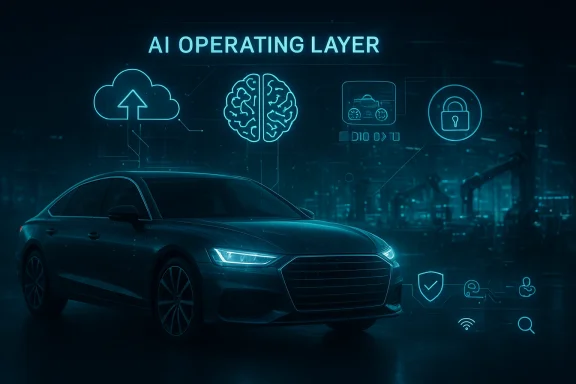
Stellantis’ reported five-year AI partnership with Microsoft lands at a moment when automakers are under unusual pressure to modernize faster, cut software costs, and prove that connected-car ambitions can produce real business value. If the agreement holds up as described, it would extend a strategy Stellantis has already been building through cloud, generative AI, and software-defined vehicle initiatives, while giving Microsoft another high-profile foothold in the automotive industry. It also reflects a broader shift in the market: carmakers are no longer treating AI as a lab experiment, but as a core operating layer for engineering, customer support, and in-car services.
The automotive industry has spent the last several years moving from hardware-first thinking to software-led product planning. That transition has not been smooth, and it has forced legacy automakers to rethink how they design vehicles, manage data, and maintain customer relationships. Stellantis, like many peers, has been investing in cloud development, AI-assisted engineering, and digital cockpit software to stay competitive in an era where the experience inside the car increasingly matters as much as the metal outside it.
For Microsoft, the automotive vertical is a natural extension of its broader enterprise AI push. The company has spent the last two years turning Copilot, Azure, and related AI services into the backbone of a partner-driven ecosystem, with industry-specific deals in consulting, telecom, manufacturing, and media. A long-term Stellantis collaboration would fit that pattern neatly, offering Microsoft recurring cloud demand and a showcase for its AI tooling in a sector where reliability, security, and scale matter far more than flashy demos.
What makes the Stellantis story especially notable is that it does not exist in a vacuum. Stellantis has already disclosed a series of AI and software partnerships, including work with Mistral AI, dSPACE, and other technology suppliers, as well as internal platform efforts around STLA Brain, STLA SmartCockpit, and STLA AutoDrive. In other words, this is not a company suddenly discovering AI. It is a company trying to knit together a fragmented digital stack into something that can be deployed across dozens of brands, markets, and vehicle programs.
That context matters because automotive AI is not just about chatbots in the dashboard. It touches vehicle development, simulation, manufacturing optimization, service workflows, data governance, and consumer-facing personalization. Any Microsoft-Stellantis deal, therefore, should be viewed as part of a much larger industrial transformation, not merely a headline about two major brands shaking hands.
One important signal came from Stellantis’ earlier cloud-development work with dSPACE, where the company said the goal was to accelerate cloud-based vehicle development and improve software quality. That collaboration also underscored the importance of simulation and software-in-the-loop workflows, which are essential in modern vehicle programs because they allow engineers to validate behavior before anything reaches a real car. In practical terms, that means Stellantis has already been trying to reduce the cost and complexity of software development long before this Microsoft news surfaced.
Another signal is Stellantis’ renewed emphasis on AI through Mistral AI. The company described that partnership as a step from pilots toward enterprise-wide deployment, which is a meaningful distinction. Many automakers test AI; fewer are willing to embed it into operations, manufacturing, and customer-facing processes at scale. Stellantis appears to be attempting the latter, and that makes any relationship with Microsoft much more strategic than transactional.
The appeal for Microsoft is not just revenue. It is also influence. Automotive AI deals can lock in enterprise platforms for years because once engineering workflows, internal copilots, data pipelines, and service tools are integrated, the switching costs become substantial. A five-year partnership, if that is indeed the term, would therefore be a classic Microsoft move: land the cloud, expand into workflows, then deepen the relationship through recurring usage.
There is also a reputational dimension. Microsoft has been pushing a message that AI is not merely for consumer chat experiences, but for serious industrial transformation. A deal with Stellantis helps reinforce that narrative. It says Microsoft’s AI stack is capable of working in one of the most regulated, asset-heavy, and complex sectors in the economy.
Stellantis has already made several moves in this direction, including AI-related acquisitions and partnerships. The company’s CloudMade acquisition, for example, signaled an intent to deepen personalization and data-driven mobility services. Meanwhile, the STLA Brain, STLA SmartCockpit, and STLA AutoDrive platforms show that Stellantis sees software as a cross-brand layer, not a boutique feature for premium models alone.
This also matters competitively because rivals are moving fast. General Motors, Ford, Volkswagen, Mercedes-Benz, and others are all trying to define what a next-generation in-car digital experience should look like. Some are emphasizing proprietary systems, while others lean on external ecosystem partners. Stellantis appears to be choosing a hybrid model: preserve platform control, but work with outside AI and cloud specialists to speed implementation.
That said, consumers often judge these initiatives on the narrowest possible metric: does the car actually become easier and better to live with? If the answer is yes, they may not care whether Microsoft, Stellantis, or another vendor provided the plumbing. If the answer is no, the partnership will be seen as expensive abstraction. That is why user experience remains the final test.
There is also an important distinction between luxury-like digital convenience and everyday utility. A slick assistant may attract attention, but a useful one saves time, reduces frustration, and feels embedded rather than bolted on. The difference between those outcomes is usually design discipline, data quality, and integration depth, not just model size.
Manufacturing is especially fertile ground. Automotive plants generate enormous streams of data from machines, quality systems, logistics, and maintenance schedules. AI can help detect deviations earlier, recommend interventions, and reduce downtime. For a company trying to protect profitability across multiple regions, even small operational efficiencies can compound quickly.
Engineering is another obvious area. If AI tools can help teams search internal knowledge bases, compare test results, summarize design changes, or simulate alternatives, the development process can become more iterative and less bureaucratic. That does not replace engineers; it makes them more productive. In a company the size of Stellantis, that distinction is crucial.
This is especially important because automotive AI systems do not operate in a vacuum. They sit at the intersection of cloud services, mobile apps, dealer networks, in-car systems, and backend maintenance platforms. Each integration point is a potential vulnerability if governance is weak. That means success depends not just on model quality, but on permissions, encryption, auditability, and lifecycle controls.
Consumer trust is equally delicate. Drivers may welcome convenience, but they are often skeptical about data collection, especially when the benefit is not obvious. Stellantis and Microsoft will need to prove that personalization is genuinely helpful and that privacy controls are understandable. Opaque AI systems are a liability in a sector where safety and confidence are paramount.
That favors companies like Microsoft because they can bundle AI with infrastructure, identity, productivity, and enterprise administration. It also favors companies like Stellantis that are willing to rethink internal processes rather than just bolt AI onto the dashboard. The combination is powerful, but only if both sides are serious about execution.
It is also worth noting that the market is becoming crowded with partnerships. Microsoft has been announcing a steady stream of strategic relationships across sectors, while automakers are signing collaborations with cloud vendors, chipmakers, startups, and design partners. The winners will not necessarily be those with the most announcements. They will be the ones that turn those announcements into operating advantage.
A second issue is timing. Automotive software programs move slowly, but AI expectations move quickly, and that mismatch often creates disappointment. The companies will need to communicate carefully about what is coming soon, what is still in pilot, and what is truly scaled. Managing expectations will be nearly as important as managing technology.
Finally, this partnership should be seen in the context of a broader strategic race. Stellantis is trying to modernize a huge, multi-brand industrial system, while Microsoft is trying to prove that its AI stack can do more than power office productivity and chat interfaces. If both sides succeed, they will validate a model that many other companies are likely to copy.
Source: qz.com https://qz.com/stellantis-microsoft-ai-cloud-partnership-041626/
 Overview
The automotive industry has spent the last several years moving from hardware-first thinking to software-led product planning. That transition has not been smooth, and it has forced legacy automakers to rethink how they design vehicles, manage data, and maintain customer relationships. Stellantis, like many peers, has been investing in cloud development, AI-assisted engineering, and digital cockpit software to stay competitive in an era where the experience inside the car increasingly matters as much as the metal outside it.For Microsoft, the automotive vertical is a natural extension of its broader enterprise AI push. The company has spent the last two years turning Copilot, Azure, and related AI services into the backbone of a partner-driven ecosystem, with industry-specific deals in consulting, telecom, manufacturing, and media. A long-term Stellantis collaboration would fit that pattern neatly, offering Microsoft recurring cloud demand and a showcase for its AI tooling in a sector where reliability, security, and scale matter far more than flashy demos.
What makes the Stellantis story especially notable is that it does not exist in a vacuum. Stellantis has already disclosed a series of AI and software partnerships, including work with Mistral AI, dSPACE, and other technology suppliers, as well as internal platform efforts around STLA Brain, STLA SmartCockpit, and STLA AutoDrive. In other words, this is not a company suddenly discovering AI. It is a company trying to knit together a fragmented digital stack into something that can be deployed across dozens of brands, markets, and vehicle programs.
That context matters because automotive AI is not just about chatbots in the dashboard. It touches vehicle development, simulation, manufacturing optimization, service workflows, data governance, and consumer-facing personalization. Any Microsoft-Stellantis deal, therefore, should be viewed as part of a much larger industrial transformation, not merely a headline about two major brands shaking hands.
What Stellantis Has Been Building
Stellantis has spent the past several years laying the groundwork for a more software-centric operating model. Its public materials show repeated emphasis on cloud-based development, AI-powered platforms, and digital engineering, which suggests that a Microsoft partnership would augment an existing strategy rather than replace it. The company’s software roadmap has consistently pointed toward smarter vehicles, faster update cycles, and better integration between engineering and customer experience.One important signal came from Stellantis’ earlier cloud-development work with dSPACE, where the company said the goal was to accelerate cloud-based vehicle development and improve software quality. That collaboration also underscored the importance of simulation and software-in-the-loop workflows, which are essential in modern vehicle programs because they allow engineers to validate behavior before anything reaches a real car. In practical terms, that means Stellantis has already been trying to reduce the cost and complexity of software development long before this Microsoft news surfaced.
Another signal is Stellantis’ renewed emphasis on AI through Mistral AI. The company described that partnership as a step from pilots toward enterprise-wide deployment, which is a meaningful distinction. Many automakers test AI; fewer are willing to embed it into operations, manufacturing, and customer-facing processes at scale. Stellantis appears to be attempting the latter, and that makes any relationship with Microsoft much more strategic than transactional.
Why the software stack matters
The modern automaker lives or dies on the coherence of its software stack. When software systems are fragmented, product launches slow down, service costs rise, and customer experiences become inconsistent. That is why Stellantis’ move toward common digital platforms is significant: it is trying to create a foundation that can support multiple brands without forcing each one to reinvent the wheel.- Cloud infrastructure supports faster development and broader data access.
- Generative AI can automate repetitive engineering and support tasks.
- Digital cockpit software creates new monetization opportunities.
- Simulation tools reduce the need for expensive physical prototyping.
- Unified data platforms help improve quality and predictive maintenance.
Why Microsoft Wants the Deal
Microsoft has been one of the most aggressive enterprise AI vendors in the market, and automotive is exactly the kind of industry where its strengths can compound. The company brings together cloud infrastructure, productivity software, AI services, and developer tooling in a way few rivals can match. For a global automaker with sprawling operations, that bundle can be more useful than any single application.The appeal for Microsoft is not just revenue. It is also influence. Automotive AI deals can lock in enterprise platforms for years because once engineering workflows, internal copilots, data pipelines, and service tools are integrated, the switching costs become substantial. A five-year partnership, if that is indeed the term, would therefore be a classic Microsoft move: land the cloud, expand into workflows, then deepen the relationship through recurring usage.
There is also a reputational dimension. Microsoft has been pushing a message that AI is not merely for consumer chat experiences, but for serious industrial transformation. A deal with Stellantis helps reinforce that narrative. It says Microsoft’s AI stack is capable of working in one of the most regulated, asset-heavy, and complex sectors in the economy.
The enterprise logic
From Microsoft’s perspective, the most valuable part of the deal may be the enterprise workflow layer rather than the car itself. Automakers have huge internal demand for software that can accelerate engineering, streamline knowledge management, and reduce time spent on repetitive support tasks. Those are ideal use cases for Microsoft’s copilots and cloud services.- Engineering teams need faster design iteration and better simulation.
- Manufacturing teams need predictive insights and quality automation.
- Customer support teams need better knowledge retrieval and response workflows.
- Sales and service teams need personalization without adding headcount.
- IT and security teams need governed AI deployment across global operations.
The Automotive AI Race Is Intensifying
The Stellantis-Microsoft story lands amid a broader race among automakers and tech vendors to own the digital experience around the vehicle. The market is no longer just about powertrains, range, or badge prestige. It is increasingly about who controls the operating environment, the assistant interface, the service relationship, and the data loop that ties them together.Stellantis has already made several moves in this direction, including AI-related acquisitions and partnerships. The company’s CloudMade acquisition, for example, signaled an intent to deepen personalization and data-driven mobility services. Meanwhile, the STLA Brain, STLA SmartCockpit, and STLA AutoDrive platforms show that Stellantis sees software as a cross-brand layer, not a boutique feature for premium models alone.
This also matters competitively because rivals are moving fast. General Motors, Ford, Volkswagen, Mercedes-Benz, and others are all trying to define what a next-generation in-car digital experience should look like. Some are emphasizing proprietary systems, while others lean on external ecosystem partners. Stellantis appears to be choosing a hybrid model: preserve platform control, but work with outside AI and cloud specialists to speed implementation.
Competitive implications
The competitive stakes extend beyond feature lists. Whoever can reduce software complexity fastest will likely ship more usable features, update vehicles more efficiently, and build better customer loyalty over time. That is especially important as vehicle hardware becomes harder to differentiate on its own.- Speed matters because software cycles now influence product relevance.
- Reliability matters because connected features must work at scale.
- Security matters because vehicles are rolling computing platforms.
- Economics matter because software must justify its own cost.
- Ecosystems matter because no automaker can own everything alone.
Consumer Impact: What Drivers Actually Feel
For consumers, the most visible effects of an AI partnership like this are likely to show up gradually and unevenly. They may arrive first as better voice assistants, more personalized infotainment, improved navigation, and more responsive customer support. Over time, they could also shape how features are updated, how problems are diagnosed, and how ownership feels after the purchase.That said, consumers often judge these initiatives on the narrowest possible metric: does the car actually become easier and better to live with? If the answer is yes, they may not care whether Microsoft, Stellantis, or another vendor provided the plumbing. If the answer is no, the partnership will be seen as expensive abstraction. That is why user experience remains the final test.
There is also an important distinction between luxury-like digital convenience and everyday utility. A slick assistant may attract attention, but a useful one saves time, reduces frustration, and feels embedded rather than bolted on. The difference between those outcomes is usually design discipline, data quality, and integration depth, not just model size.
What consumers may notice
The consumer-facing gains from AI in vehicles are likely to be practical rather than dramatic, at least initially. The strongest benefits tend to come from reducing friction rather than adding spectacle.- Smarter in-car assistance for navigation, media, and settings.
- More personalized profiles tied to drivers and households.
- Better over-the-air updates with fewer service visits.
- Faster issue diagnosis when something goes wrong.
- More relevant recommendations for charging, routes, or maintenance.
Enterprise Impact: Manufacturing, Design, and Operations
The largest near-term value likely sits outside the showroom. In enterprise settings, AI can help Stellantis improve forecasting, reduce design cycle time, assist with documentation, and surface insights across sprawling global operations. These are the kinds of use cases that do not generate viral clips, but they can materially improve margins if executed well.Manufacturing is especially fertile ground. Automotive plants generate enormous streams of data from machines, quality systems, logistics, and maintenance schedules. AI can help detect deviations earlier, recommend interventions, and reduce downtime. For a company trying to protect profitability across multiple regions, even small operational efficiencies can compound quickly.
Engineering is another obvious area. If AI tools can help teams search internal knowledge bases, compare test results, summarize design changes, or simulate alternatives, the development process can become more iterative and less bureaucratic. That does not replace engineers; it makes them more productive. In a company the size of Stellantis, that distinction is crucial.
Enterprise use cases
The enterprise layer is where a five-year partnership could become most durable. A few tightly integrated workflows can justify long contracts and sustained cloud usage far more reliably than flashy consumer features.- Document search and knowledge retrieval across engineering teams.
- Quality-control analytics in assembly and supplier operations.
- Forecasting and planning for parts, inventory, and demand.
- Employee productivity tools for internal workflows and reporting.
- Service intelligence for warranty, diagnostics, and field support.
Data, Security, and Trust
No automotive AI initiative can avoid the question of data governance. Vehicles are highly sensitive computing environments, and manufacturers must balance personalization against privacy, diagnostics against consent, and innovation against regulatory exposure. A Microsoft partnership may help Stellantis scale, but it also raises the bar for security discipline and clarity around data usage.This is especially important because automotive AI systems do not operate in a vacuum. They sit at the intersection of cloud services, mobile apps, dealer networks, in-car systems, and backend maintenance platforms. Each integration point is a potential vulnerability if governance is weak. That means success depends not just on model quality, but on permissions, encryption, auditability, and lifecycle controls.
Consumer trust is equally delicate. Drivers may welcome convenience, but they are often skeptical about data collection, especially when the benefit is not obvious. Stellantis and Microsoft will need to prove that personalization is genuinely helpful and that privacy controls are understandable. Opaque AI systems are a liability in a sector where safety and confidence are paramount.
Governance priorities
Security and trust are not side issues in automotive AI. They are the foundation on which everything else rests.- Consent management must be clear and durable.
- Data minimization should limit unnecessary collection.
- Audit trails should show how AI outputs are produced.
- Cybersecurity controls need to cover cloud and vehicle layers.
- Regional compliance must account for shifting legal regimes.
The Bigger Market Signal
The most interesting thing about this partnership may be what it says about the AI market itself. The hype cycle once revolved around consumer chatbots and general-purpose demos. Now the more durable value appears to be migrating into industry-specific deployments where AI can be tied to measurable workflows, costs, and outcomes.That favors companies like Microsoft because they can bundle AI with infrastructure, identity, productivity, and enterprise administration. It also favors companies like Stellantis that are willing to rethink internal processes rather than just bolt AI onto the dashboard. The combination is powerful, but only if both sides are serious about execution.
It is also worth noting that the market is becoming crowded with partnerships. Microsoft has been announcing a steady stream of strategic relationships across sectors, while automakers are signing collaborations with cloud vendors, chipmakers, startups, and design partners. The winners will not necessarily be those with the most announcements. They will be the ones that turn those announcements into operating advantage.
Why this matters beyond autos
This deal is part of a wider industrial pattern in which AI becomes a force multiplier for complex physical businesses. The implications go well beyond the automotive sector, because the same logic applies to manufacturing, logistics, and heavy equipment.- Legacy scale is no longer enough without software agility.
- AI vendors are becoming infrastructure providers, not just tool sellers.
- Industrial buyers want measurable ROI, not experimental pilots.
- Platform lock-in is rising as AI workflows become embedded.
- Operational excellence is turning into a software problem.
Strengths and Opportunities
A Stellantis-Microsoft partnership has several obvious strengths. The most important is that it combines scale, technical depth, and real operational pain points rather than forcing AI into a problem that does not need it. That gives the collaboration a better chance of producing tangible outcomes, especially if Stellantis is already serious about digital transformation.- Enterprise breadth across engineering, manufacturing, service, and sales.
- Strong fit with Microsoft’s cloud-and-copilot ecosystem.
- Potential for measurable ROI through workflow automation and quality gains.
- Better customer experience through personalization and support.
- Faster development cycles via simulation and cloud-native tooling.
- Industry credibility for both companies in a high-stakes sector.
- Longer planning horizon that supports deeper integration.
Risks and Concerns
The biggest risk is that the partnership becomes another well-branded but shallow enterprise AI program. Automotive companies have plenty of pilots, proofs of concept, and roadmap slides; the hard part is deployment at scale. If integration is weak or organizational buy-in is uneven, the value will remain theoretical.- Execution risk if tools do not integrate cleanly into workflows.
- Security risk from expanded cloud and vehicle attack surfaces.
- Privacy concerns if data collection feels intrusive or unclear.
- Vendor dependence if critical workflows become too tightly coupled.
- Change management friction inside a complex global organization.
- Cost overruns if AI usage expands faster than savings materialize.
- User disappointment if consumer features feel gimmicky or unreliable.
Looking Ahead
The next question is not whether Stellantis and Microsoft can announce cooperation, but whether they can make that cooperation visible in the product and the factory. The industry will be watching for evidence that AI is reducing friction, lowering costs, and improving the customer journey rather than simply adding another layer of complexity. If the partnership is real in operational terms, it could become one of the more instructive automotive AI case studies of the next few years.A second issue is timing. Automotive software programs move slowly, but AI expectations move quickly, and that mismatch often creates disappointment. The companies will need to communicate carefully about what is coming soon, what is still in pilot, and what is truly scaled. Managing expectations will be nearly as important as managing technology.
Finally, this partnership should be seen in the context of a broader strategic race. Stellantis is trying to modernize a huge, multi-brand industrial system, while Microsoft is trying to prove that its AI stack can do more than power office productivity and chat interfaces. If both sides succeed, they will validate a model that many other companies are likely to copy.
- Watch for product-level proof in cockpit software and service experiences.
- Watch for manufacturing gains tied to quality and uptime.
- Watch for deeper Azure integration across Stellantis workflows.
- Watch for security and privacy disclosures as AI usage expands.
- Watch for competing automaker deals as rivals respond.
Source: qz.com https://qz.com/stellantis-microsoft-ai-cloud-partnership-041626/
Last edited:
