

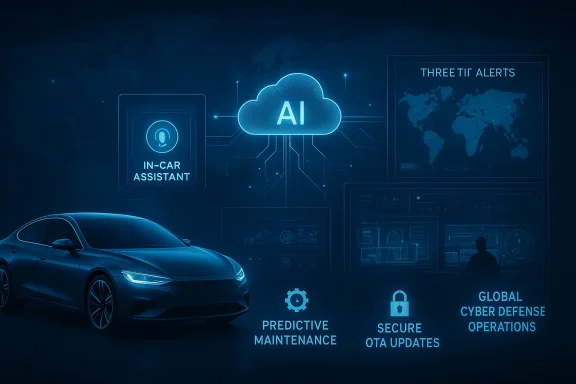
Stellantis’ new five-year collaboration with Microsoft is more than another automotive AI headline. It is a signal that software-defined vehicles, connected services, and cyber defense are now being treated as core industrial capabilities rather than nice-to-have experiments. The companies say the effort will span customer experience, engineering, operations, and security, with more than 100 AI initiatives in flight across Stellantis’ global ecosystem. In practical terms, that means the carmaker is betting that AI can improve everything from product development to in-car assistance to factory resilience.
The timing matters because the automotive sector is in the middle of a structural reset. Manufacturers are no longer just selling hardware; they are shipping rolling software platforms that must be updated, monitored, defended, and monetized over time. Microsoft’s own mobility guidance frames this shift around software-defined vehicles, connected fleets, digital engineering, and autonomous systems, all of which depend on cloud, AI, data, and security working together rather than as separate silos.
Stellantis has already been moving in this direction before the Microsoft announcement. The company deepened its relationship with Mistral AI in 2025 to explore in-car assistants and AI-driven engineering workflows, and it has been positioning STLA Brain, STLA SmartCockpit, and STLA AutoDrive as the backbone of a broader software strategy. That history matters because the Microsoft deal does not replace the earlier AI work; it extends it into a larger enterprise and platform context.
What makes this collaboration notable is that it covers both the visible and invisible layers of the car business. On the surface, it can improve driver-facing features such as intelligent recommendations, proactive vehicle-health insights, and more responsive digital services. Under the hood, it can also support product development, testing, predictive maintenance, and a global cyberdefense posture that spans IT systems, factories, connected vehicles, and digital products.
That combination is why the deal should be read as a strategic operating model decision, not a point feature announcement. Stellantis is not merely adding a chatbot to a dashboard. It is trying to unify data, security, engineering, and customer touchpoints into a single AI-enabled system, which is exactly the direction Microsoft says modern mobility should take.
The bigger competitive story is obvious: automakers that can extract speed, quality, and trust from software will have a harder-to-copy advantage than those still treating AI as a marketing layer. That makes this collaboration relevant far beyond Stellantis and Microsoft. It reflects where the entire industry is headed, and it raises the bar for rivals that must now prove AI can generate measurable product and operational value.
Stellantis sits at a particularly interesting point in that transition because it manages a large, multi-brand portfolio across regions and segments. That kind of scale can be a burden if software platforms are fragmented, but it can also be a powerful advantage if common AI and cloud tooling can be reused across brands and markets. A five-year strategic collaboration gives Stellantis the time horizon to build repeatable patterns instead of one-off pilots.
The Microsoft side is equally important. The company has been pushing AI deeper into enterprise workflows across productivity, cloud, and industry-specific solutions. In mobility, Microsoft’s published guidance emphasizes Azure services, Azure OpenAI, GitHub, security, and data platforms as the foundation for OEM transformation. That makes the Stellantis agreement look less like a surprise partnership and more like the latest expression of Microsoft’s broader industry strategy.
There is also a cybersecurity dimension that should not be overlooked. Connected vehicles and software-heavy factories increase the attack surface dramatically, and automotive cyber incidents can affect safety, operations, and brand trust all at once. Microsoft’s announcement explicitly includes an AI-driven global cyberdefense center for Stellantis, spanning IT systems, connected vehicles, manufacturing sites, and digital products. That is a strong clue that security is not being treated as a compliance box, but as a foundational layer of the architecture.
The historical context therefore points in one direction: the car company and the cloud company are both trying to convert AI from feature to infrastructure. That is the real shift. When AI becomes infrastructure, the competitive debate moves from “what can it do?” to “how reliably can it scale?” and “how well can it be governed?”
Those initiatives are not confined to consumer-facing assistants. Microsoft’s release highlights AI-powered product development and validation, predictive maintenance and testing, and faster deployment of digital features and services. That matters because the highest-value AI use cases in automotive are often the least visible ones, where small gains in cycle time, validation quality, or uptime can create substantial financial leverage.
The breadth also helps explain why Stellantis would choose Microsoft rather than a single-purpose AI vendor. A car company needs model development, cloud infrastructure, identity controls, telemetry, service tooling, and enterprise integration. Bringing those capabilities under one umbrella can reduce integration overhead, but it also increases dependence on the platform provider.
Key announced areas include:
It also suggests that this is intended to outlast a single generation of AI hype. The industry is full of announcements that never make it past the demo stage. A multi-year collaboration with explicit operational scope is more likely to survive internal budget scrutiny, provided the early use cases show tangible value.
This is important because drivers increasingly expect their vehicles to behave like connected devices, not static machines. If the car can anticipate maintenance needs, suggest more efficient driving behavior, or personalize support based on usage patterns, the ownership experience becomes more dynamic. But that same intelligence also raises privacy expectations and usability demands.
Stellantis’ previous work with Mistral AI reinforces that direction. The company had already said it was exploring an advanced in-car assistant and broader AI use cases across engineering and business workflows. Microsoft now appears to be broadening the stack underneath those ambitions rather than replacing them.
Consumer value points likely include:
There is also a trust issue. Drivers are more likely to embrace AI when it solves an immediate problem, such as explaining a warning light or reducing energy use, than when it feels like data collection dressed up as convenience. Any successful deployment will need clear controls, transparent permissions, and strong data governance.
This matters because automotive development has long been constrained by fragmented tools and slow feedback loops. If AI can help validate designs, simulate scenarios, and accelerate software testing, the company could reduce the time between concept and deployment. That is especially valuable in a market where platform competition and regional feature differences are becoming more important.
Microsoft’s own mobility documentation points to Azure AI Services, Azure OpenAI, GitHub, and high-performance compute as part of this workflow. In practical terms, that suggests a pathway where simulation, software development, and validation can be more tightly linked. The result is not just faster coding; it is potentially faster decision-making across the product lifecycle.
A useful engineering payoff could include:
That is why the Microsoft partnership should be read as a structural bet. It is not just about adding AI to a process. It is about redesigning the process so AI becomes part of the production system itself, which is a much more durable competitive move.
This is not optional. Modern cars are software-rich computing environments with remote update capability, cloud dependencies, and a broad supplier chain. A security failure can affect not only data, but functionality and customer confidence. Microsoft’s mobility guidance explicitly lists cybersecurity among the major challenges in autonomous and connected vehicle ecosystems.
That wider approach should improve incident visibility and response speed if implemented well. It can also make threat detection more contextual, since attacks on one layer may reveal risk in another. The challenge, of course, is governance: a unified defense model is only as good as the data, permissions, and processes behind it.
Security priorities likely include:
There is a second-order effect too: good security can speed adoption of richer in-car services. When customers believe the platform is protected, they are more likely to use connected features and share data that improves service quality. That is one reason the cyberdefense center is strategically important beyond compliance.
The economics here are obvious. If the automaker can use AI to deliver better service with lower support cost, it can improve both margins and satisfaction. If it can then package premium digital features, software updates, or subscription-like services, the vehicle business becomes more recurring and less purely transactional.
That does not mean customers automatically welcome every recurring charge. It does mean the opportunity exists to bundle convenience, safety, and efficiency in ways that feel more natural than older subscription experiments. The strongest offers will likely be the ones that reduce friction or solve a real problem.
Potential revenue levers include:
That distinction matters because the best monetization strategy may differ by segment. Consumer services can live inside the vehicle, while fleet tools may live in dashboards, maintenance workflows, and telematics integrations. Microsoft’s connected-fleet guidance suggests that the data foundation can support both, but the go-to-market motion will need to be tailored.
It also strengthens Microsoft’s position in automotive and industrial AI. Microsoft is already positioning itself as a platform provider for digital engineering, connected fleets, SDVs, and autonomous systems. A partnership with a global automaker like Stellantis gives that pitch more credibility and more practical reference points.
Stellantis has already shown it is willing to mix partners rather than commit to a single AI vendor. That is smart, but it also means the company is effectively assembling an AI supply chain. The competitive question becomes whether that supply chain can be integrated cleanly enough to avoid friction.
Competitors should watch:
At the same time, Stellantis is trying to avoid being trapped by any one supplier. Its earlier moves with Mistral AI show a willingness to diversify. That may prove wise if the company wants negotiating leverage, but it also increases the complexity of its AI architecture. The winners may be the companies that can partner widely without fragmenting internally.
It also creates room for both immediate and long-term wins. Some use cases can improve customer support or security quickly, while others may reshape engineering workflows and product cycles over a longer horizon. That mix is useful because it gives executives early proof points without forcing the entire transformation to succeed overnight.
The collaboration also gives Microsoft another showcase for its mobility stack. The company can point to concrete automotive use cases instead of abstract demos, which strengthens its pitch to other industrial customers. In that sense, Stellantis is both a customer and a reference architecture.
There is also the danger of strategic overdependence. If too much of the AI stack is tied to one major platform partner, Stellantis could lose flexibility later. That is not necessarily a deal-breaker, but it raises the cost of switching and can narrow future negotiating leverage.
Finally, there is the economic question. AI infrastructure, model usage, and security operations are not cheap. The collaboration will need to demonstrate that the productivity gains and service revenues outweigh the operating costs, especially if the companies want the partnership to remain strategically defensible.
It will also be important to see how this new Microsoft relationship fits with Stellantis’ other AI partnerships. The company has already been building with Mistral AI, and a multi-partner strategy can be powerful if well governed. But if the architecture becomes too fragmented, the benefits of scale may be offset by operational sprawl.
The most telling signals to watch are:
Source: The American Bazaar Stellantis, Microsoft collaborate for AI in cars
 Overview
The timing matters because the automotive sector is in the middle of a structural reset. Manufacturers are no longer just selling hardware; they are shipping rolling software platforms that must be updated, monitored, defended, and monetized over time. Microsoft’s own mobility guidance frames this shift around software-defined vehicles, connected fleets, digital engineering, and autonomous systems, all of which depend on cloud, AI, data, and security working together rather than as separate silos.Stellantis has already been moving in this direction before the Microsoft announcement. The company deepened its relationship with Mistral AI in 2025 to explore in-car assistants and AI-driven engineering workflows, and it has been positioning STLA Brain, STLA SmartCockpit, and STLA AutoDrive as the backbone of a broader software strategy. That history matters because the Microsoft deal does not replace the earlier AI work; it extends it into a larger enterprise and platform context.
What makes this collaboration notable is that it covers both the visible and invisible layers of the car business. On the surface, it can improve driver-facing features such as intelligent recommendations, proactive vehicle-health insights, and more responsive digital services. Under the hood, it can also support product development, testing, predictive maintenance, and a global cyberdefense posture that spans IT systems, factories, connected vehicles, and digital products.
That combination is why the deal should be read as a strategic operating model decision, not a point feature announcement. Stellantis is not merely adding a chatbot to a dashboard. It is trying to unify data, security, engineering, and customer touchpoints into a single AI-enabled system, which is exactly the direction Microsoft says modern mobility should take.
The bigger competitive story is obvious: automakers that can extract speed, quality, and trust from software will have a harder-to-copy advantage than those still treating AI as a marketing layer. That makes this collaboration relevant far beyond Stellantis and Microsoft. It reflects where the entire industry is headed, and it raises the bar for rivals that must now prove AI can generate measurable product and operational value.
Background
The modern car industry has spent years promising the transition to software-defined mobility, but promises are not the same as execution. In the early phase, much of the focus was on infotainment, connected apps, and over-the-air updates. Today, the ambition is broader: use cloud, AI, and data to influence design cycles, manufacturing quality, dealer service, fleet operations, and post-sale experiences. Microsoft’s mobility documentation reflects that evolution by describing digital engineering, connected fleets, SDV support, and autonomous vehicle operations as interconnected scenarios rather than isolated workloads.Stellantis sits at a particularly interesting point in that transition because it manages a large, multi-brand portfolio across regions and segments. That kind of scale can be a burden if software platforms are fragmented, but it can also be a powerful advantage if common AI and cloud tooling can be reused across brands and markets. A five-year strategic collaboration gives Stellantis the time horizon to build repeatable patterns instead of one-off pilots.
The Microsoft side is equally important. The company has been pushing AI deeper into enterprise workflows across productivity, cloud, and industry-specific solutions. In mobility, Microsoft’s published guidance emphasizes Azure services, Azure OpenAI, GitHub, security, and data platforms as the foundation for OEM transformation. That makes the Stellantis agreement look less like a surprise partnership and more like the latest expression of Microsoft’s broader industry strategy.
There is also a cybersecurity dimension that should not be overlooked. Connected vehicles and software-heavy factories increase the attack surface dramatically, and automotive cyber incidents can affect safety, operations, and brand trust all at once. Microsoft’s announcement explicitly includes an AI-driven global cyberdefense center for Stellantis, spanning IT systems, connected vehicles, manufacturing sites, and digital products. That is a strong clue that security is not being treated as a compliance box, but as a foundational layer of the architecture.
The historical context therefore points in one direction: the car company and the cloud company are both trying to convert AI from feature to infrastructure. That is the real shift. When AI becomes infrastructure, the competitive debate moves from “what can it do?” to “how reliably can it scale?” and “how well can it be governed?”
What Microsoft and Stellantis Actually Announced
The headline terms are straightforward. Stellantis and Microsoft described a five-year strategic collaboration aimed at accelerating digital transformation through advanced AI, cybersecurity, and engineering capabilities. They also said the companies will co-develop more than 100 AI initiatives across customer care, product development, and operations.Those initiatives are not confined to consumer-facing assistants. Microsoft’s release highlights AI-powered product development and validation, predictive maintenance and testing, and faster deployment of digital features and services. That matters because the highest-value AI use cases in automotive are often the least visible ones, where small gains in cycle time, validation quality, or uptime can create substantial financial leverage.
The scope is broad by design
The scale of the collaboration is what makes it stand out. A narrow pilot might prove a concept, but a program with 100-plus use cases suggests the companies want a reusable AI operating model. That is consistent with how Microsoft describes industrial transformation: start with a cloud and data foundation, then layer on AI, automation, and industry workflows.The breadth also helps explain why Stellantis would choose Microsoft rather than a single-purpose AI vendor. A car company needs model development, cloud infrastructure, identity controls, telemetry, service tooling, and enterprise integration. Bringing those capabilities under one umbrella can reduce integration overhead, but it also increases dependence on the platform provider.
Key announced areas include:
- Customer care and smarter support experiences.
- Product development and validation acceleration.
- Operations and maintenance optimization.
- Cybersecurity across cars, factories, and IT.
- Digital feature deployment across Stellantis brands.
Why the five-year term matters
A five-year horizon matters because automotive transformation is slow by software standards. Vehicle programs run on long development cycles, regulatory obligations, supplier dependencies, and validation requirements that make quick pivots difficult. A longer agreement gives the partners room to align with product launches, platform refreshes, and organizational change.It also suggests that this is intended to outlast a single generation of AI hype. The industry is full of announcements that never make it past the demo stage. A multi-year collaboration with explicit operational scope is more likely to survive internal budget scrutiny, provided the early use cases show tangible value.
AI in the Vehicle Experience
The most consumer-visible angle is the in-car experience. Microsoft said Stellantis could use AI-driven insights from secure, encrypted data to provide things like intelligent driving recommendations, proactive vehicle-health information, and feature updates designed to improve everyday usability. That turns AI from a novelty into a continuous service layer.This is important because drivers increasingly expect their vehicles to behave like connected devices, not static machines. If the car can anticipate maintenance needs, suggest more efficient driving behavior, or personalize support based on usage patterns, the ownership experience becomes more dynamic. But that same intelligence also raises privacy expectations and usability demands.
From infotainment to assistance
The industry has spent years chasing better dashboards, smarter voice assistants, and app ecosystems. Those features matter, but they are not enough on their own. The deeper opportunity is to make the car more context-aware across the entire lifecycle, from onboarding to servicing to resale.Stellantis’ previous work with Mistral AI reinforces that direction. The company had already said it was exploring an advanced in-car assistant and broader AI use cases across engineering and business workflows. Microsoft now appears to be broadening the stack underneath those ambitions rather than replacing them.
Consumer value points likely include:
- Proactive maintenance alerts before problems become costly.
- More useful voice assistance tied to real vehicle context.
- Energy-efficiency coaching for EV and hybrid drivers.
- Feature updates that improve the vehicle over time.
- Brand-specific support that feels less generic.
The risk of overpromising in the cabin
The danger is that consumers will hear “AI in cars” and expect magic. In reality, the best automotive AI often works quietly in the background, improving service and reliability rather than staging dramatic demos. The companies will need to balance ambition with restraint so the in-car experience feels helpful rather than intrusive. That distinction matters more than most marketers admit.There is also a trust issue. Drivers are more likely to embrace AI when it solves an immediate problem, such as explaining a warning light or reducing energy use, than when it feels like data collection dressed up as convenience. Any successful deployment will need clear controls, transparent permissions, and strong data governance.
Engineering and Digital Development
One of the most consequential parts of the deal is the engineering layer. Microsoft’s mobility guidance highlights digital engineering as a core use case, including product lifecycle and design, digital twins, simulations, and connected products. For Stellantis, that means AI can be applied upstream, where engineering decisions shape cost, quality, and time-to-market.This matters because automotive development has long been constrained by fragmented tools and slow feedback loops. If AI can help validate designs, simulate scenarios, and accelerate software testing, the company could reduce the time between concept and deployment. That is especially valuable in a market where platform competition and regional feature differences are becoming more important.
Faster validation, better reuse
The difference between a good engineering stack and a great one is often reuse. If Stellantis can build AI workflows that work across brands, programs, and markets, it can reduce duplicated effort and make engineering knowledge more portable. That kind of efficiency compounds over time.Microsoft’s own mobility documentation points to Azure AI Services, Azure OpenAI, GitHub, and high-performance compute as part of this workflow. In practical terms, that suggests a pathway where simulation, software development, and validation can be more tightly linked. The result is not just faster coding; it is potentially faster decision-making across the product lifecycle.
A useful engineering payoff could include:
- Shorter validation cycles for software features.
- Better simulation fidelity before hardware changes are locked in.
- Improved cross-team collaboration across design and testing.
- More consistent software quality across brands.
- Lower rework costs when issues are caught earlier.
Why digital engineering is now a board-level issue
Digital engineering used to be a specialist topic. Now it has become a board-level concern because it determines whether an automaker can compete on software velocity. If the development pipeline is too slow, the company risks falling behind rivals that can ship and iterate more quickly.That is why the Microsoft partnership should be read as a structural bet. It is not just about adding AI to a process. It is about redesigning the process so AI becomes part of the production system itself, which is a much more durable competitive move.
Cybersecurity as a Product Requirement
The cybersecurity piece may be the most underappreciated part of the announcement. Stellantis said it will deploy and operate an AI-driven global cyberdefense center covering IT systems, connected vehicles, manufacturing sites, and digital products. That implies a unified security posture across domains that used to be treated separately.This is not optional. Modern cars are software-rich computing environments with remote update capability, cloud dependencies, and a broad supplier chain. A security failure can affect not only data, but functionality and customer confidence. Microsoft’s mobility guidance explicitly lists cybersecurity among the major challenges in autonomous and connected vehicle ecosystems.
Defending the full stack
The most interesting part of the cyberdefense center is its scope. Protecting connected vehicles alone would be difficult enough. Adding factories, enterprise systems, and digital products means the security team has to think like a platform operator, not just a perimeter guardian.That wider approach should improve incident visibility and response speed if implemented well. It can also make threat detection more contextual, since attacks on one layer may reveal risk in another. The challenge, of course, is governance: a unified defense model is only as good as the data, permissions, and processes behind it.
Security priorities likely include:
- Identity and access control across environments.
- Threat detection for connected-vehicle telemetry.
- Factory resilience against operational disruptions.
- Secure software delivery for over-the-air updates.
- Incident response coordination across business units.
Security as a selling point
Consumers do not usually buy cars for cybersecurity features, but they increasingly punish brands that mishandle digital trust. For enterprises and fleet buyers, especially, security is a procurement filter. If Stellantis can demonstrate a serious AI-enabled security posture, that becomes a commercial advantage, not just an insurance policy.There is a second-order effect too: good security can speed adoption of richer in-car services. When customers believe the platform is protected, they are more likely to use connected features and share data that improves service quality. That is one reason the cyberdefense center is strategically important beyond compliance.
Customer Experience and Monetization
Stellantis and Microsoft are also framing the deal as a customer-experience story. Microsoft’s release emphasizes stronger, more agile digital processes across the ecosystem, while Stellantis has been talking for some time about AI-powered customer support and brand-specific assistance. That suggests a push to make digital services more personalized and more monetizable.The economics here are obvious. If the automaker can use AI to deliver better service with lower support cost, it can improve both margins and satisfaction. If it can then package premium digital features, software updates, or subscription-like services, the vehicle business becomes more recurring and less purely transactional.
From support to lifecycle revenue
The shift from one-time sales to lifecycle revenue is one of the defining trends in mobility. Connected products, predictive maintenance, and digital services can all create longer-term value streams. Microsoft’s mobility guidance explicitly notes that connected products can enable new business models such as product-as-a-service and continuous optimization through usage and performance insights.That does not mean customers automatically welcome every recurring charge. It does mean the opportunity exists to bundle convenience, safety, and efficiency in ways that feel more natural than older subscription experiments. The strongest offers will likely be the ones that reduce friction or solve a real problem.
Potential revenue levers include:
- Premium connected services tied to vehicle health.
- Smarter service plans for owners and fleets.
- Feature unlocks delivered over time.
- Customer support automation with fewer escalations.
- Brand-specific digital ecosystems that deepen loyalty.
Consumer versus enterprise dynamics
Consumer buyers will judge the collaboration by convenience, reliability, and privacy. Enterprise and fleet customers will look for uptime, cost control, and admin visibility. Those are related but not identical markets, and Stellantis will need to avoid assuming that a good consumer story automatically translates to fleet procurement.That distinction matters because the best monetization strategy may differ by segment. Consumer services can live inside the vehicle, while fleet tools may live in dashboards, maintenance workflows, and telematics integrations. Microsoft’s connected-fleet guidance suggests that the data foundation can support both, but the go-to-market motion will need to be tailored.
Competitive Implications
This collaboration puts pressure on several fronts at once. For one, it reinforces the idea that the auto industry’s next big competition is not just electric range or horsepower, but software competency. Brands that cannot modernize their development, service, and security stacks will find it harder to keep pace.It also strengthens Microsoft’s position in automotive and industrial AI. Microsoft is already positioning itself as a platform provider for digital engineering, connected fleets, SDVs, and autonomous systems. A partnership with a global automaker like Stellantis gives that pitch more credibility and more practical reference points.
What rivals must now answer
Rivals have three basic options. They can build a comparable AI stack themselves, which is expensive and slow. They can partner with another large cloud or AI provider, which may still leave them dependent on someone else’s platform. Or they can stay narrower and hope a specialized product edge beats the scale advantage of the big ecosystems.Stellantis has already shown it is willing to mix partners rather than commit to a single AI vendor. That is smart, but it also means the company is effectively assembling an AI supply chain. The competitive question becomes whether that supply chain can be integrated cleanly enough to avoid friction.
Competitors should watch:
- How fast Stellantis converts pilots into production use.
- Whether AI reduces engineering cycle time.
- How effectively Microsoft’s stack integrates with existing automotive tooling.
- Whether rival OEMs announce similar multi-year AI alliances.
- Whether the customer experience actually improves in measurable ways.
The platform moat is getting wider
The strategic moat here is less about a single feature and more about ecosystem gravity. If Microsoft becomes embedded in engineering, operations, security, and customer tools, it becomes harder for a rival platform to displace it later. That is the classic platform play, and it is why the deal matters beyond automotive.At the same time, Stellantis is trying to avoid being trapped by any one supplier. Its earlier moves with Mistral AI show a willingness to diversify. That may prove wise if the company wants negotiating leverage, but it also increases the complexity of its AI architecture. The winners may be the companies that can partner widely without fragmenting internally.
Strengths and Opportunities
The Stellantis-Microsoft collaboration has several clear strengths. It aligns a major automaker with one of the world’s most established cloud and enterprise AI platforms, and it does so across multiple value chains rather than a single narrow workload. That breadth gives the partnership a better chance of producing visible business results.It also creates room for both immediate and long-term wins. Some use cases can improve customer support or security quickly, while others may reshape engineering workflows and product cycles over a longer horizon. That mix is useful because it gives executives early proof points without forcing the entire transformation to succeed overnight.
- Broader AI coverage across engineering, operations, and customer care.
- Strong cloud foundation with Microsoft’s enterprise tooling.
- Potential cost savings through predictive maintenance and automation.
- Better security posture across vehicles and factory systems.
- Improved product velocity if validation and testing accelerate.
- New digital revenue streams tied to connected services.
- A clearer software-defined vehicle roadmap for brands under the Stellantis umbrella.
The collaboration also gives Microsoft another showcase for its mobility stack. The company can point to concrete automotive use cases instead of abstract demos, which strengthens its pitch to other industrial customers. In that sense, Stellantis is both a customer and a reference architecture.
Risks and Concerns
The biggest risk is execution. A large, multi-year AI collaboration can still fail if the organizations cannot integrate tools, governance, and workflows cleanly. Automotive companies tend to have long decision cycles, and AI projects can stall if they never move from pilot to production.There is also the danger of strategic overdependence. If too much of the AI stack is tied to one major platform partner, Stellantis could lose flexibility later. That is not necessarily a deal-breaker, but it raises the cost of switching and can narrow future negotiating leverage.
- Integration complexity across legacy systems and new AI tools.
- Dependence risk if Microsoft becomes too central.
- Privacy concerns around connected-vehicle data.
- Security exposure if the expanded attack surface is not tightly managed.
- Unclear monetization if consumers resist paid digital features.
- Pilot fatigue if too many AI projects stay experimental.
- Brand risk if AI features feel unreliable or intrusive.
Finally, there is the economic question. AI infrastructure, model usage, and security operations are not cheap. The collaboration will need to demonstrate that the productivity gains and service revenues outweigh the operating costs, especially if the companies want the partnership to remain strategically defensible.
Looking Ahead
The next phase will be about proof, not promise. Readers should watch for concrete deployments in vehicle support, engineering workflows, and security operations, because those are the places where the collaboration can show whether it is creating measurable value. If Stellantis can point to shorter development cycles or better service metrics, the market will take notice.It will also be important to see how this new Microsoft relationship fits with Stellantis’ other AI partnerships. The company has already been building with Mistral AI, and a multi-partner strategy can be powerful if well governed. But if the architecture becomes too fragmented, the benefits of scale may be offset by operational sprawl.
The most telling signals to watch are:
- Production rollout pace for AI features.
- Customer adoption of connected services.
- Cybersecurity outcomes in the new defense model.
- Engineering cycle-time improvements tied to AI tools.
- Any new licensing or service packaging built on the collaboration.
Source: The American Bazaar Stellantis, Microsoft collaborate for AI in cars
