

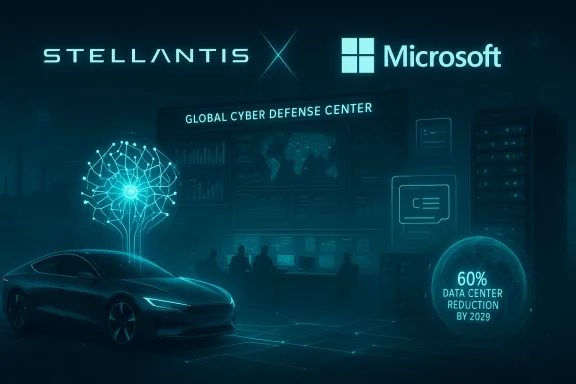
Finally, the Stellantis-Microsoft partnership is starting to look less like another glossy AI press release and more like a serious test of whether enterprise AI can reshape an automaker from the inside out. The deal spans more than 100 AI initiatives, an AI-driven global cyber defense center, broad Microsoft Copilot deployment, and a plan to cut Stellantis’ data-center footprint by 60% by 2029. That combination makes the announcement significant not just for automotive technology, but for the broader competition among cloud, AI, and industrial platforms. As the material in the field notes makes clear, the real story is execution: who can turn AI from a promise into a working operating model.
Automotive software has been moving for years from isolated features toward a much broader platform model, and that shift is what gives this partnership its weight. Earlier connected-car efforts were largely about telematics, infotainment, navigation, and limited digital conveniences. The newer phase is about touching nearly every stage of the vehicle lifecycle, from design and validation to manufacturing, service, and customer support. That evolution matters because it changes what a car company must be good at: not just engineering hardware, but managing data, cloud infrastructure, and security at scale.
Stellantis is not approaching this as a small pilot. The company and Microsoft say they will co-develop more than 100 AI initiatives across customer care, product development, and operations, while also rolling out Copilot Chat to all employees and 20,000 Microsoft 365 Copilot licenses to selected roles. The breadth is important because it signals a commitment to systems-level transformation, not a chatbot demo. In other words, the company appears to be betting that AI value will come from many small improvements that compound, rather than one dramatic breakthrough.
The Microsoft angle also reflects how the company now sells itself to enterprise customers. It is no longer just offering software licenses or cloud capacity; it is positioning Azure, Copilot, and security tooling as an integrated operating layer. That stack approach matters because large organizations increasingly want one partner to help them move data, manage employees, defend systems, and build AI workflows. The partnership with Stellantis is therefore also a showcase for Microsoft’s broader enterprise strategy.
There is also a competitive history worth noting. Stellantis has not stood still while building this relationship, and the field notes suggest it has been rebalancing its technology bets after earlier Amazon-linked in-car ambitions. That does not necessarily mean the prior effort failed, but it does imply that the company is separating different layers of its digital stack and assigning different partners to different jobs. One relationship may be about the dashboard; another may be about the full organization. That’s a subtle shift, but a strategically important one.
The most consequential part of the deal may be the least visible one: the cyber defense center. Modern vehicles are connected devices with long lifecycles, and that makes security part of the product, not just the IT department. A breach in a factory, a cloud service, or a connected-vehicle backend can quickly become a trust problem for the entire brand. The field notes repeatedly emphasize that connected-vehicle protection, manufacturing resilience, and customer-data security are now inseparable. That is the deeper industrial logic behind the announcement.
What makes this especially important is the scale. Stellantis is one of the world’s largest automakers, with global operations, complex supply chains, and a broad portfolio of brands. If a company that large can move part of its core digital estate into a more cloud-centric and AI-enabled operating model, rivals will be forced to respond. The deal is therefore not just a vendor win; it is a signal about where industrial software competition is headed.
This also raises the bar for the industry more broadly. Automakers increasingly need to behave like software companies, but they must do so without losing the discipline of safety-critical manufacturing. That means AI must work inside engineering, validation, procurement, support, and security — not just in a flashy consumer interface. In that sense, the Stellantis deal is a test case for industrial AI maturity.
The significance of that move goes beyond hosting costs. Cloud architectures can improve scalability, support AI workloads more efficiently, and make collaboration across global operations easier. They can also simplify governance if the migration is executed well. But the field notes are careful to point out the tradeoff: cloud modernization can also introduce new dependencies on uptime, identity management, and cloud economics.
This also helps explain why Microsoft is such an attractive partner. The company can offer infrastructure, productivity, and security together, which is more persuasive than a standalone tool. In enterprise strategy, bundle economics matter because they increase switching costs and deepen the relationship over time. That is especially true in a company as complex as Stellantis.
This is where many enterprise AI programs either succeed or fail. If staff only dabble with the tools, the productivity lift remains thin. If they use the tools regularly but shallowly, the business may see little more than usage metrics. The field notes stress that adoption needs training, role-based support, and measurable outcomes. In other words, seat counts are not savings.
There is also a governance issue here. Organizations need rules around sensitive data, hallucinations, approval workflows, and records retention. That is especially true in an automaker, where some decisions touch engineering quality, compliance, and customer trust. AI can reduce toil and speed work, but it cannot replace judgment in safety-sensitive contexts.
Cybersecurity in automotive is different from cybersecurity in ordinary enterprise IT. Vehicles remain in service for years, sometimes longer than their original software assumptions, and that means the security model must account for a long tail of deployed products. The result is a more persistent and more complex defense burden. A weakness in one layer can quickly become a trust issue across the whole brand.
The role of AI in this context is best understood as assistance, not replacement. AI can help detect threats faster, reduce blind spots, and prioritize what matters most, but disciplined architecture still does the heavy lifting. The strongest security programs combine automation with clear human oversight. That is especially important when the system protects products that can affect physical safety.
This is also a more credible AI story than generic personalization. Many announcements promise smarter customer experiences but fail to move the industrial machinery underneath them. Stellantis and Microsoft are instead focusing on engineering workflows, testing, and deployment. That suggests a practical understanding that better cars start with better processes.
Still, there is a major caveat: speed without rigor is not a virtue in safety-critical industries. If training data is incomplete or validation models are poorly tuned, companies can end up shipping confidence faster than quality. That is why the best model is hybrid — AI drafts, tests, and refines, while human experts approve what goes into production.
The key point is that consumer value tends to arrive later than enterprise value. A customer notices the app, the warning light, or the in-car experience. They do not see the data center migration, the detection pipeline, or the internal productivity gains. That makes the consumer side easier to market, but harder to prove.
The privacy angle is especially important. Connected vehicles generate sensitive behavioral and operational data, and consumers are becoming more aware of how that information is collected and used. The announcement’s references to secure, encrypted data are encouraging, but trust will depend on execution. A good AI feature can still fail if it feels opaque or overreaching.
Manufacturing is a natural fit for this kind of work because it produces dense operational data. If AI can improve scheduling, maintenance, quality control, or resource allocation, the payoff can be significant long before consumer-facing features change. In other words, the industrial back end may deliver the first real returns.
There is also an organizational dimension here. When AI and cloud tools reduce plumbing work, IT and operations teams can spend more time on process improvement. That can accelerate industrial AI adoption, which is likely one of the reasons Microsoft is so eager to show this partnership off. It demonstrates that AI can be woven into the enterprise fabric, not merely layered on top.
The field notes suggest this gives Microsoft a strong position against rivals such as AWS and Google Cloud, especially where enterprise productivity and industrial AI meet. In automotive, that combination is powerful because it reaches engineering, operations, and employee workflows at once. The more layers Microsoft touches, the harder it is for a competitor to displace it with a single product advantage.
There is also a reference-case effect. If Stellantis can show measurable gains, Microsoft can point to the automaker as proof that its stack works in complex industrial environments. That kind of proof is valuable in sales, in investor messaging, and in market perception. If the rollout stumbles, the lesson will not disappear, but it will be much less persuasive.
It also aligns with where the auto industry is headed. Vehicles are becoming more software-defined, customer expectations are rising, and security pressure is intensifying. If Stellantis executes well, it could move faster, improve service quality, and gain a more resilient operating model. Those are exactly the kinds of benefits that justify large-scale platform partnerships.
The security side also carries special risk. In a connected automotive environment, one incident can become a public trust problem very quickly. Cloud dependence, vendor concentration, and data-governance complexity all increase the stakes. And in a safety-sensitive industry, the tolerance for weak oversight is low.
It will also matter how well the company balances speed and control. If AI shortens development cycles but weakens rigor, the gains could evaporate quickly. If cloud migration improves resilience but creates new fragilities, the tradeoff will need to be addressed. The field notes make the central truth plain: this is a management challenge as much as a technology challenge.
Source: The Detroit Bureau The Global Implications of How to Wire in a Rear View Camera: Lessons from the Field and the Impact of Another
 Background
Automotive software has been moving for years from isolated features toward a much broader platform model, and that shift is what gives this partnership its weight. Earlier connected-car efforts were largely about telematics, infotainment, navigation, and limited digital conveniences. The newer phase is about touching nearly every stage of the vehicle lifecycle, from design and validation to manufacturing, service, and customer support. That evolution matters because it changes what a car company must be good at: not just engineering hardware, but managing data, cloud infrastructure, and security at scale.Stellantis is not approaching this as a small pilot. The company and Microsoft say they will co-develop more than 100 AI initiatives across customer care, product development, and operations, while also rolling out Copilot Chat to all employees and 20,000 Microsoft 365 Copilot licenses to selected roles. The breadth is important because it signals a commitment to systems-level transformation, not a chatbot demo. In other words, the company appears to be betting that AI value will come from many small improvements that compound, rather than one dramatic breakthrough.
The Microsoft angle also reflects how the company now sells itself to enterprise customers. It is no longer just offering software licenses or cloud capacity; it is positioning Azure, Copilot, and security tooling as an integrated operating layer. That stack approach matters because large organizations increasingly want one partner to help them move data, manage employees, defend systems, and build AI workflows. The partnership with Stellantis is therefore also a showcase for Microsoft’s broader enterprise strategy.
There is also a competitive history worth noting. Stellantis has not stood still while building this relationship, and the field notes suggest it has been rebalancing its technology bets after earlier Amazon-linked in-car ambitions. That does not necessarily mean the prior effort failed, but it does imply that the company is separating different layers of its digital stack and assigning different partners to different jobs. One relationship may be about the dashboard; another may be about the full organization. That’s a subtle shift, but a strategically important one.
The most consequential part of the deal may be the least visible one: the cyber defense center. Modern vehicles are connected devices with long lifecycles, and that makes security part of the product, not just the IT department. A breach in a factory, a cloud service, or a connected-vehicle backend can quickly become a trust problem for the entire brand. The field notes repeatedly emphasize that connected-vehicle protection, manufacturing resilience, and customer-data security are now inseparable. That is the deeper industrial logic behind the announcement.
Why This Deal Matters Beyond Automotive
The Stellantis-Microsoft partnership matters because it sits at the intersection of automotive manufacturing, cloud migration, enterprise AI, and cybersecurity. That is a more durable and more realistic combination than a standalone AI feature launch. The broader market has become skeptical of vague “AI transformation” language, so a program tied to measurable infrastructure goals and operational workflows carries more credibility.What makes this especially important is the scale. Stellantis is one of the world’s largest automakers, with global operations, complex supply chains, and a broad portfolio of brands. If a company that large can move part of its core digital estate into a more cloud-centric and AI-enabled operating model, rivals will be forced to respond. The deal is therefore not just a vendor win; it is a signal about where industrial software competition is headed.
The strategic shift
The real shift is from digital transformation as a slogan to digital transformation as a set of concrete operating tasks. The field notes point out that the partnership names specific milestones, specific technologies, and specific workforce changes. That matters because investors, customers, and competitors can now ask hard questions about adoption, productivity, resilience, and cost. The burden of proof rises when the language gets specific.This also raises the bar for the industry more broadly. Automakers increasingly need to behave like software companies, but they must do so without losing the discipline of safety-critical manufacturing. That means AI must work inside engineering, validation, procurement, support, and security — not just in a flashy consumer interface. In that sense, the Stellantis deal is a test case for industrial AI maturity.
- It connects cloud modernization to operational change.
- It treats security as part of the product stack.
- It uses AI across multiple business functions.
- It creates a public reference case for large-scale industrial adoption.
- It gives Microsoft a stronger foothold in the auto sector.
- It gives Stellantis a path to faster execution if governance holds.
Azure as the Modernization Engine
The Azure component is one of the clearest signs that this is a structural shift, not a cosmetic refresh. Stellantis says it is modernizing infrastructure using Microsoft Azure and targeting a 60% reduction in its data-center footprint by 2029. That is a substantial architectural claim, because it implies migration away from legacy infrastructure toward a more centralized cloud model.The significance of that move goes beyond hosting costs. Cloud architectures can improve scalability, support AI workloads more efficiently, and make collaboration across global operations easier. They can also simplify governance if the migration is executed well. But the field notes are careful to point out the tradeoff: cloud modernization can also introduce new dependencies on uptime, identity management, and cloud economics.
What cloud migration really changes
A cloud transition of this size changes procurement, security operations, application development, and workforce collaboration. That is why the target should be read as a strategic milestone rather than a near-term earnings catalyst. The work is unlikely to pay back instantly, especially when consulting costs, transition risk, and integration overhead are factored in. Still, if the migration reduces friction between data collection and decision-making, it could create enduring value.This also helps explain why Microsoft is such an attractive partner. The company can offer infrastructure, productivity, and security together, which is more persuasive than a standalone tool. In enterprise strategy, bundle economics matter because they increase switching costs and deepen the relationship over time. That is especially true in a company as complex as Stellantis.
- Azure provides the modernization backbone.
- Cloud migration can support elasticity and resilience.
- Centralized platforms can improve governance.
- AI readiness improves when data and apps are better aligned.
- The 2029 target suggests a long runway, not a quick fix.
- The risk is that migration complexity obscures the benefits.
Copilot and the Workforce Layer
The workforce side of the deal may look less dramatic than the cloud target, but it is strategically just as important. Stellantis says all employees currently have access to Copilot Chat, and 20,000 selected employees are receiving Microsoft 365 Copilot licenses. That tells you the company sees AI as a broad productivity layer, not just a tool for specialists.This is where many enterprise AI programs either succeed or fail. If staff only dabble with the tools, the productivity lift remains thin. If they use the tools regularly but shallowly, the business may see little more than usage metrics. The field notes stress that adoption needs training, role-based support, and measurable outcomes. In other words, seat counts are not savings.
Why adoption is the hidden differentiator
Enterprise AI becomes valuable when it changes daily habits. That means summarization, drafting, internal search, meeting prep, and workflow support have to become routine. Stellantis appears to understand this, which is why the training program is an important part of the announcement. Training is often the difference between a tool that gets used and a tool that gets absorbed into the operating culture.There is also a governance issue here. Organizations need rules around sensitive data, hallucinations, approval workflows, and records retention. That is especially true in an automaker, where some decisions touch engineering quality, compliance, and customer trust. AI can reduce toil and speed work, but it cannot replace judgment in safety-sensitive contexts.
- Copilot Chat broadens access to AI.
- Role-based licensing suggests a staged rollout.
- Training will determine whether adoption is real.
- Governance needs to move alongside usage.
- Productivity gains must be measured, not assumed.
- The biggest gains may come from many small workflow improvements.
Cybersecurity as the Hidden Core
If there is one part of the partnership that may prove most consequential over time, it is the AI-driven global cyber defense center. The field notes describe a broad perimeter spanning IT systems, connected vehicles, digital products, and manufacturing sites. That is exactly the right frame for a modern automaker, because the attack surface is no longer confined to corporate networks.Cybersecurity in automotive is different from cybersecurity in ordinary enterprise IT. Vehicles remain in service for years, sometimes longer than their original software assumptions, and that means the security model must account for a long tail of deployed products. The result is a more persistent and more complex defense burden. A weakness in one layer can quickly become a trust issue across the whole brand.
Why connected vehicles change the threat model
Connected cars broaden the attack surface in ways that make traditional perimeter thinking insufficient. Cloud APIs, dealer systems, mobile apps, embedded software, and factory networks all become part of the same ecosystem. The field notes make clear that cyber resilience is now a supply-chain issue, a brand issue, and a product-quality issue at once. That is why the defense center is not a side project; it is core infrastructure.The role of AI in this context is best understood as assistance, not replacement. AI can help detect threats faster, reduce blind spots, and prioritize what matters most, but disciplined architecture still does the heavy lifting. The strongest security programs combine automation with clear human oversight. That is especially important when the system protects products that can affect physical safety.
- Connected vehicles require continuous defense.
- Manufacturing systems cannot be treated as separate from IT.
- Customer data protection is now part of brand trust.
- AI helps with detection, but not with accountability.
- Long product lifecycles create a persistent security burden.
- A single incident can spread quickly from technical issue to public crisis.
Product Development and Validation
One of the more interesting elements in the field notes is the emphasis on product development, validation, and predictive maintenance. That is where AI can create real leverage because it reduces iteration time and helps teams surface anomalies earlier. In an industry where timing and quality are both unforgiving, even incremental improvements can matter.This is also a more credible AI story than generic personalization. Many announcements promise smarter customer experiences but fail to move the industrial machinery underneath them. Stellantis and Microsoft are instead focusing on engineering workflows, testing, and deployment. That suggests a practical understanding that better cars start with better processes.
The value of faster iteration
AI can shorten validation loops, improve simulation, and surface issues earlier in the design cycle. That can reduce rework, lower recall risk, and help teams bring products to market faster. The field notes explicitly say that faster validation can be a competitive weapon, especially when rivals are also racing to improve software-defined vehicle capabilities.Still, there is a major caveat: speed without rigor is not a virtue in safety-critical industries. If training data is incomplete or validation models are poorly tuned, companies can end up shipping confidence faster than quality. That is why the best model is hybrid — AI drafts, tests, and refines, while human experts approve what goes into production.
- Faster validation can reduce time-to-market.
- Predictive maintenance can improve reliability planning.
- AI-assisted analysis can surface engineering anomalies.
- Simulation can lower the cost of iteration.
- Human review remains essential for production decisions.
- The biggest payoff comes from process consistency, not flashy demos.
What Customers Will Notice
Consumers are not the direct audience for most of this announcement, but they are still part of the story. If Stellantis executes well, drivers may eventually see better maintenance alerts, more useful driving recommendations, and more responsive connected services. The field notes highlight these as the visible downstream effects of a deeper infrastructure change.The key point is that consumer value tends to arrive later than enterprise value. A customer notices the app, the warning light, or the in-car experience. They do not see the data center migration, the detection pipeline, or the internal productivity gains. That makes the consumer side easier to market, but harder to prove.
Utility has to outrun novelty
In the vehicle market, users are generally open to convenience but skeptical of intrusive or poorly explained automation. That means any new digital service has to feel useful, stable, and respectful of privacy. The field notes repeatedly stress that utility must outrun novelty, especially when data is involved.The privacy angle is especially important. Connected vehicles generate sensitive behavioral and operational data, and consumers are becoming more aware of how that information is collected and used. The announcement’s references to secure, encrypted data are encouraging, but trust will depend on execution. A good AI feature can still fail if it feels opaque or overreaching.
- Better vehicle-health insights could reduce inconvenience.
- Smarter recommendations may improve day-to-day usability.
- Faster feature delivery may make the ownership experience feel more current.
- Privacy safeguards will heavily influence trust.
- Customer-facing benefits are only persuasive if they are reliable.
- The consumer story depends on whether the backend actually improves.
Enterprise and Manufacturing Implications
For enterprise stakeholders, the partnership may matter even more than it does for drivers. The field notes frame this as an end-to-end operating discipline spanning operations, factories, and digital products. That means AI is being asked to help with business processes that directly affect margins, uptime, and resilience.Manufacturing is a natural fit for this kind of work because it produces dense operational data. If AI can improve scheduling, maintenance, quality control, or resource allocation, the payoff can be significant long before consumer-facing features change. In other words, the industrial back end may deliver the first real returns.
Why operational resilience matters
The cloud modernization and cyber defense pieces are closely linked. Reducing datacenter dependence may improve flexibility, but the same move also demands stronger governance and tighter monitoring. That is why the security stack cannot be separated from the infrastructure stack. In large industrial firms, the best digital programs are the ones that make systems more resilient rather than simply more modern.There is also an organizational dimension here. When AI and cloud tools reduce plumbing work, IT and operations teams can spend more time on process improvement. That can accelerate industrial AI adoption, which is likely one of the reasons Microsoft is so eager to show this partnership off. It demonstrates that AI can be woven into the enterprise fabric, not merely layered on top.
- Manufacturing data becomes more useful when it is standardized.
- Cloud support can make global operations more coherent.
- Resilience matters as much as raw efficiency.
- Predictive maintenance can reduce downtime.
- Better governance supports broader AI deployment.
- The biggest enterprise gains may be buried in process, not headlines.
Microsoft’s Competitive Position
This deal also reinforces Microsoft’s strategic posture in the race for industrial AI. The company is increasingly competing not just as a software vendor, but as the infrastructure layer for enterprise transformation. That matters because it deepens its relevance in sectors where cloud, productivity, and security are tightly interconnected.The field notes suggest this gives Microsoft a strong position against rivals such as AWS and Google Cloud, especially where enterprise productivity and industrial AI meet. In automotive, that combination is powerful because it reaches engineering, operations, and employee workflows at once. The more layers Microsoft touches, the harder it is for a competitor to displace it with a single product advantage.
Why the bundle is sticky
The bundle matters because it combines Azure, Copilot, and security into one story. Azure anchors infrastructure, Copilot brings AI into day-to-day work, and security helps justify the move to a more connected operating model. That is a more durable pitch than a narrow cloud migration. It turns Microsoft into a broader operating partner.There is also a reference-case effect. If Stellantis can show measurable gains, Microsoft can point to the automaker as proof that its stack works in complex industrial environments. That kind of proof is valuable in sales, in investor messaging, and in market perception. If the rollout stumbles, the lesson will not disappear, but it will be much less persuasive.
- Microsoft gains a high-profile industrial showcase.
- The stack strategy is more compelling than single-product selling.
- Enterprise customers want integrated workflows, not isolated tools.
- Security and cloud together create stronger switching costs.
- Success at Stellantis could influence adjacent industries.
- Failure would make the market more cautious about AI ROI claims.
Strengths and Opportunities
The partnership’s biggest strength is that it attacks genuine bottlenecks rather than inventing problems to fit a product. It addresses cloud fragmentation, operational security, employee productivity, and AI deployment in one program. That makes it a more credible industrial transformation effort than the typical AI announcement.It also aligns with where the auto industry is headed. Vehicles are becoming more software-defined, customer expectations are rising, and security pressure is intensifying. If Stellantis executes well, it could move faster, improve service quality, and gain a more resilient operating model. Those are exactly the kinds of benefits that justify large-scale platform partnerships.
- Broad scope across customer care, product development, and operations.
- Cloud modernization with a tangible footprint-reduction target.
- Security-first framing that treats vehicles and factories as connected targets.
- Workforce enablement through Copilot Chat and role-based licensing.
- Training support that improves the odds of real adoption.
- Customer-facing upside if vehicle-health insights and digital services improve.
- Scalable partner model that can bring in specialized expertise where needed.
Risks and Concerns
For all its promise, the partnership faces the classic risks of large enterprise transformation: complexity, governance, and adoption. A five-year horizon helps, but it does not eliminate the possibility that the program becomes too broad, too diffuse, or too slow to show clear value. The more than 100 initiatives sound ambitious, but ambition without prioritization can become a drag.The security side also carries special risk. In a connected automotive environment, one incident can become a public trust problem very quickly. Cloud dependence, vendor concentration, and data-governance complexity all increase the stakes. And in a safety-sensitive industry, the tolerance for weak oversight is low.
- Large AI programs often stumble on integration.
- Overpromising can dilute focus.
- Vendor dependence can deepen over time.
- Safety-critical errors carry outsized consequences.
- Privacy concerns may grow as data use expands.
- AI theater is a real risk if operational metrics do not improve.
- A fragmented partner landscape can slow execution if governance is weak.
Looking Ahead
The next phase will be about proof, not announcement. Stellantis will need to show that the program is improving measurable outcomes such as threat detection, engineering throughput, service quality, and cost structure. The most convincing evidence will be a steady stream of operational wins rather than a single headline feature.It will also matter how well the company balances speed and control. If AI shortens development cycles but weakens rigor, the gains could evaporate quickly. If cloud migration improves resilience but creates new fragilities, the tradeoff will need to be addressed. The field notes make the central truth plain: this is a management challenge as much as a technology challenge.
- Whether the cyber defense center produces faster incident response.
- Whether the 20,000 Copilot licenses drive measurable productivity gains.
- Whether the 60% datacenter reduction stays on track by 2029.
- Whether AI shortens product validation and launch cycles.
- Whether customers notice better digital services and vehicle-health insights.
- Whether Microsoft can turn Stellantis into a durable industrial reference case.
Source: The Detroit Bureau The Global Implications of How to Wire in a Rear View Camera: Lessons from the Field and the Impact of Another
