

Strategy’s Cloud Security Whitepaper stakes a clear claim: run the Intelligence Platform in your own cloud, at hyperscaler scale, with enterprise-grade controls so security teams and CISOs can confidently deliver analytics and AI without handing over custody of their data.
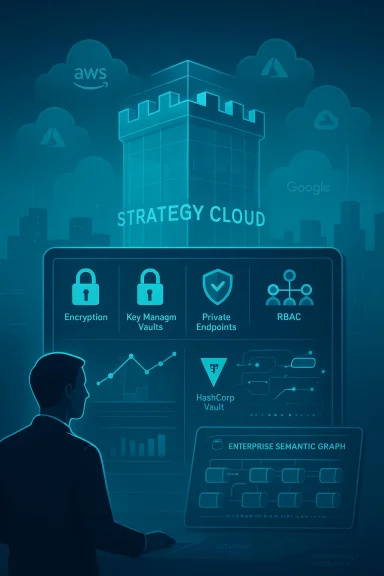
Strategy (the brand formerly known widely as MicroStrategy) has repositioned its flagship platform as a cloud-native intelligence stack—branded around the Strategy ONE architecture and delivered as Strategy Cloud, an offering that can be deployed into customer-licensed AWS, Microsoft Azure, or Google Cloud Platform environments. The vendor positions this model as a way to combine the performance and features of a modern analytics and AI platform with the security, privacy, and compliance posture that large enterprises and government customers demand.
The vendor’s cloud security whitepaper frames the service for a CISO audience: it emphasizes a single-tenant, customer-dedicated architecture; encryption and key-management options; role-based access and SSO integrations; certifications and regulated workloads support (including FedRAMP for government variants, plus references to ISO‑27001, HIPAA, and GDPR); and integrations with cloud-native vaults and identity providers. The offering is also available through cloud marketplaces and as a managed SaaS for customers who prefer a vendor-run operational model inside their cloud tenancy.
This article breaks down what the whitepaper promises, validates key technical claims against industry practice, highlights tangible strengths, unpacks material risks, and provides an operationally focused checklist CISOs can use when evaluating Strategy Cloud for multi-cloud analytics and AI.
Best practice: require short-lived service principal credentials, bind platform admin roles to break‑glass processes, and enforce just‑in‑time (JIT) elevated privileges for administrative tasks.
For commercial and healthcare use, the whitepaper references HIPAA, GDPR, and ISO‑27001. CISOs should obtain and validate the vendor’s:
However, marketing claims cannot substitute for verification. CISOs should treat the whitepaper as the starting point, not the finish line. The essential steps are to:
Adopting enterprise analytics and AI in multi‑cloud environments is now a security and governance conversation as much as a technology one. Strategy Cloud’s model—run in your cloud, with vendor operational support and vault/KMS integration—addresses the top‑line concerns. But the difference between a secure, compliant deployment and an exposed one comes down to the details: authenticated proofs, key custody, network configuration, logging, and AI governance. CISOs who insist on those artifacts and operational tests will find whether the whitepaper’s promises translate into secure reality for their organization.
Source: Strategy https://www.strategy.com/software/ecosystems/microsoft/
 Background
Strategy (the brand formerly known widely as MicroStrategy) has repositioned its flagship platform as a cloud-native intelligence stack—branded around the Strategy ONE architecture and delivered as Strategy Cloud, an offering that can be deployed into customer-licensed AWS, Microsoft Azure, or Google Cloud Platform environments. The vendor positions this model as a way to combine the performance and features of a modern analytics and AI platform with the security, privacy, and compliance posture that large enterprises and government customers demand.The vendor’s cloud security whitepaper frames the service for a CISO audience: it emphasizes a single-tenant, customer-dedicated architecture; encryption and key-management options; role-based access and SSO integrations; certifications and regulated workloads support (including FedRAMP for government variants, plus references to ISO‑27001, HIPAA, and GDPR); and integrations with cloud-native vaults and identity providers. The offering is also available through cloud marketplaces and as a managed SaaS for customers who prefer a vendor-run operational model inside their cloud tenancy.
This article breaks down what the whitepaper promises, validates key technical claims against industry practice, highlights tangible strengths, unpacks material risks, and provides an operationally focused checklist CISOs can use when evaluating Strategy Cloud for multi-cloud analytics and AI.
Overview: what Strategy Cloud claims to deliver
- A fully optimized instance of the Intelligence Platform built for customer‑owned AWS, Azure, or GCP tenants.
- Single‑tenant deployments—each customer receives a dedicated environment and metadata store to prevent noisy‑neighbor and co-tenancy concerns.
- A microservices, cloud‑native architecture designed for high performance across bulk reporting, self‑service analytics, and AI workloads.
- Integration with major cloud key management solutions and secret stores (HashiCorp Vault, Azure Key Vault, Google Secret Manager) and support for customer-managed keys where required.
- Compliance posture and certifications suitable for regulated workloads, including a FedRAMP-authorized government variant for AWS GovCloud deployments.
- Operational guarantees (SLA and availability tiers) and managed support with 24x7 monitoring, incident response, and redundancy options.
- A semantic layer (Enterprise Semantic Graph) intended to enforce consistent metric definitions, lineage, and a single version of the truth across teams and tools.
Architecture and deployment model
Customer‑owned cloud tenancy: why it matters
Strategy Cloud’s signature model is to run the platform inside the customer’s own cloud subscription. For security-conscious organizations this brings two immediate advantages:- Data custody and residency control. Logs, metadata, and analytics workloads remain inside the enterprise’s environment under their cloud account and policies, simplifying regulatory mapping and legal obligations.
- Integration with existing cloud controls. Enterprises can apply their own VPC/VNet network policies, encryption-at-rest policies, and identity controls—rather than relying on a third-party multitenant environment.
Single‑tenant, managed SaaS in your cloud
The whitepaper and supporting product documentation describe an environment per customer: dedicated metadata databases, isolated compute clusters, and per-tenant network controls. This reduces cross‑tenant blast radius versus a shared SaaS; however, it also places operational responsibility on the service model for the vendor-managed aspects (patching, upgrades, some networking tasks) and on the customer for cloud-level controls (VPC configuration, IAM policies, cloud KMS settings).Microservices and scale
The platform’s move to microservices and containerized components is standard for cloud‑native analytics. This architecture supports elastic scaling for variable query loads, but it also increases the surface area for attack if container and orchestration controls (image provenance, runtime protection, network segmentation) aren’t strictly enforced.Security controls and controls integration
Identity and access management
Strategy Cloud supports enterprise SSO and modern authentication flows (SAML/OIDC), enabling integration with Azure Entra ID and other identity providers. For CISOs this is a baseline requirement: centralizing authentication with the organization’s identity provider allows consistent enforcement of conditional access, MFA, device posture policies, and lifecycle management.Best practice: require short-lived service principal credentials, bind platform admin roles to break‑glass processes, and enforce just‑in‑time (JIT) elevated privileges for administrative tasks.
Encryption and key management
The whitepaper highlights encryption in transit and at rest, and references integration with cloud key stores and vaults:- Customer‑owned encryption keys and support for common cloud KMS solutions reduce the legal and operational risk of provider-level key access.
- Integration with HashiCorp Vault, Azure Key Vault, and Google Secret Manager enables enterprises to centralize key rotation and access controls.
- Provider‑managed keys (cloud default): easy but means the cloud provider has access to key material and can be compelled by legal process.
- Customer‑managed keys (CMEK / BYOK): better control—customer owns rotation policy and custody—but increases responsibility for key protection and recovery.
- Client‑side encryption: strongest separation but burdens application architecture.
Network isolation and connectivity
A dedicated VPC/VNet per tenant is essential. The vendor documentation describes options to restrict egress, use private endpoints, and integrate with on‑prem connectivity (VPN/Direct Connect/ExpressRoute). Ensure that:- Management planes and vendor support interfaces are restricted to IP allowlists or bastion hosts.
- Data egress policies and egress monitoring are active to spot unexpected outbound flows.
- Private link/endpoint patterns are used where supported to avoid exposing management APIs to the public internet.
Monitoring, logging, and detection
The whitepaper stresses “always‑on threat monitoring,” but CISOs must verify:- What telemetry is collected and where it is stored.
- Whether audit logs, query logs, and admin action logs are retained in customer‑controlled storage and in tamper‑evident systems.
- Integration with the enterprise SIEM and support for standard logging formats and event collections (CloudTrail, Azure Monitor, Cloud Audit Logs).
- Availability of detection rules, EDR/IDS integration, and SOC playbooks for vendor‑operated incidents.
Vulnerability management and secure software supply
Microservices increase the need for hardened images, SBOMs (software bill of materials), and transparent patching cadence. CISOs should require:- Regular container image scanning and signing.
- Published patch cycles and emergency remediation SLAs.
- SBOMs for deployed components and transparent third‑party dependency management.
- Evidence of supply chain controls and third‑party risk assessments.
Compliance posture and third‑party attestations
FedRAMP and regulated government deployments
Strategy’s government cloud variant is FedRAMP-authorized (GovCloud). That is a major signal for public-sector suitability: FedRAMP authorization indicates an independent assessment against NIST control baselines and continuous monitoring commitments.For commercial and healthcare use, the whitepaper references HIPAA, GDPR, and ISO‑27001. CISOs should obtain and validate the vendor’s:
- SOC 2 Type II (or equivalent) report covering cloud offering and managed services.
- ISO‑27001 certificate and scope statement.
- HIPAA Business Associate Agreement (BAA) template if PHI will be processed.
- Data Processing Addendum (DPA) mapping the GDPR obligations and subprocessors.
- FedRAMP ATO package or the 3PAO assessment summary for government deployments.
Data governance and lineage
The platform advertises an Enterprise Semantic Graph and lineage capabilities. For regulated contexts and AI governance, lineage and semantic consistency are non‑negotiable. CISOs and data governance owners should validate:- How metric definitions are documented, versioned, and enforced.
- Whether lineage is captured automatically across ingestion and transformation steps.
- Integration points for enterprise governance tools (for example, Microsoft Purview or other catalogs) so that business glossaries and sensitivity labels propagate into analytics access control.
AI-specific risks and mitigations
Strategy positions AI capabilities as core: from NLQ and generative assistants to embedded recommendations. AI adds a new set of operational and security concerns:- Data exposure through prompt or model logs: controls needed to mask or scrub PII in model inputs and outputs, and to prevent sensitive data from being used in model training unless explicitly authorized.
- Model integrity risks: data poisoning, adversarial inputs, or drift can cause models to produce misleading outputs. Require model governance, test suites, and drift detection.
- Explainability and audit trails: for regulated decisions, models used in decisioning must be auditable and explainable. Confirm the platform’s ability to produce contextual tracebacks for AI outputs.
- Third‑party model dependencies: when integrating cloud-provided LLMs (Azure OpenAI, Vertex AI), ensure contractual clarity about data usage, retention, and confidentiality.
Strengths: what the whitepaper gets right
- Customer‑centric custody model. Deploying inside a customer’s cloud subscription removes many legal and data‑sovereignty headaches and reduces the attack surface that comes from multitenant SaaS platforms.
- Marketplace availability and FedRAMP option. Being available through cloud marketplaces simplifies procurement, and the FedRAMP option is crucial for public sector customers.
- Enterprise semantic layer. Consistent metric governance across the enterprise reduces the operational risk of conflicting KPIs and supports auditability.
- Vault and KMS integrations. The explicit support for customer-managed keys and cloud vaults addresses a major CISO concern for subpoena and legal risk.
- Managed support with documented SLAs. For organizations that outsource operational overhead, a vendor-run model with clear service guides and availability targets simplifies operations.
Risks and gaps: what CISOs must press on
- Operational responsibilities are split. The customer‑owned tenancy model is powerful, but it requires strong cloud governance from the enterprise side. Misconfiguration in cloud IAM, VPC rules, or KMS bindings can nullify vendor-level security.
- Claims vs. attestations. Marketing claims about “military‑grade security” and “always‑on monitoring” must be backed by attestations (SOC 2 Type II, FedRAMP POA&M status, penetration test reports). Request the artifacts.
- AI data handling opacity. Ensure explicit guarantees that model telemetry and prompts are protected and will not be used to train vendor or third‑party models without consent.
- Third‑party subprocessors and supply chain. Confirm who the vendor uses (cloud provider components, managed service subcontractors) and require subprocessors lists and their security posture.
- Backup and recovery scope. Verify that backups, metadata stores, and analytics results are encrypted under customer control and that DR runbooks have been tested in the customer environment.
- Cost and complexity. Running a single‑tenant, high‑performance platform in your cloud can be costly. Expect to budget for cloud resource management, security services, and incident response readiness.
CISO checklist: what to demand before deployment
Below is a prioritized, operational checklist designed for security reviews and procurement gating. Use this during RFPs, procurement, and security assessments.- Governance & Contracts
- Obtain SOC 2 Type II, ISO‑27001 certificate and scope, and the latest FedRAMP package (if applicable).
- Get a signed BAA (if PHI is present) and a GDPR DPA that names subprocessors and transfer mechanisms.
- Require contractual SLAs for patching windows, incident response times, and for emergency hotfixes.
- Identity & Access
- Enforce SSO via Entra ID or your IdP; require MFA for all privileged accounts.
- Confirm RBAC mapping for administrative vs. analytical roles and JIT privilege elevation.
- Validate service principal and API key lifecycle policies and rotation schedules.
- Key Management & Encryption
- Require a clear statement about encryption for metadata, backups, telemetry, and whether CMEK/BYOK is supported for each artifact.
- Confirm integration with your cloud KMS or Vault and request examples of key policies and audit logs.
- Verify support for HSM-backed keys if required by policy.
- Network & Perimeter
- Confirm VPC/VNet architecture, private endpoint availability, and vendor support access controls.
- Require egress control and monitoring; insist on IP allowlists and bastion access for vendor operational tasks.
- Validate that data plane components are not exposed to the public internet.
- Monitoring & Incident Response
- Ensure logs (audit, query, admin actions) are forwarded to your SIEM and retained according to policy.
- Get a documented incident response plan that maps vendor and customer responsibilities and timelines for notification.
- Request maturity evidence of threat detection (use cases, playbooks, historic MTTR metrics where available).
- Vulnerability & Supply Chain
- Ask for image signing, SBOMs, CVE remediation SLAs, and external penetration test reports (most recent 12 months).
- Require a third‑party risk register for major subcontractors and their attestations.
- Data Governance & AI
- Verify lineage and semantic layer documentation; ensure metric contracts and reconciliation features are available and auditable.
- Request the vendor’s AI governance policy for prompt handling, logging, retention, and allowed model integrations.
- Insist on model testing artifacts and explainability mechanisms when AI outputs feed downstream decisions.
- Backup & Business Continuity
- Confirm backup encryption and key custody for snapshots and metadata backups.
- Validate RTO/RPO targets and request evidence of DR test results (or require a DR test as part of onboarding).
A practical, sequential deployment plan for CISOs
- Establish governance and procurement controls:
- Approve subprocessors, request attestations, and finalize contractual clauses (BAA, DPA, SLAs).
- Define the security architecture:
- VPC design, private endpoints, NAT/egress rules, and management-plane access model.
- Provision KMS and vault configuration:
- Create keys, define rotation policy, assign IAM roles for key access, and test decryption flows.
- Integrate identity:
- Configure SSO/OIDC or SAML, map roles, enforce MFA, and validate JIT admin workflows.
- Configure telemetry and SIEM ingestion:
- Forward audit logs, query logs, and platform metrics to enterprise monitoring.
- Run a security acceptance test:
- Penetration test, misconfiguration scan, and privilege access review inside the provisioned environment.
- Execute a DR runbook:
- Test restore of metadata, validation of encryption keys, and failover tests for availability constructs.
- Move to phased production:
- Pilot with non‑sensitive datasets, validate lineage and reconciliation, then escalate scope.
- Operationalize continuous monitoring:
- Formalize runbooks, escalate paths, and quarterly third‑party audits.
Final assessment and recommendations
Strategy Cloud—deployed inside a customer‑licensed AWS, Azure, or GCP tenancy—addresses many of the modern CISO’s core concerns: data custody, cloud-native scale, KMS/vault integration, marketplace procurement, and compliance options including FedRAMP for government workloads. Its semantic layer and single‑tenant model are strong selling points for enterprises focused on auditability and a single version of truth.However, marketing claims cannot substitute for verification. CISOs should treat the whitepaper as the starting point, not the finish line. The essential steps are to:
- Demand attestations (SOC 2, ISO 27001, FedRAMP artifacts where required).
- Verify the specifics of key management and ensure customer control of keys for any high‑risk data.
- Insist on SIEM integration, immutable logs, and demonstrable incident‑response metrics.
- Treat AI as a distinct governance domain: confirm prompt/data handling rules, model logging policies, and fallbacks for erroneous outputs.
Quick-reference: CISO one‑page scorecard (ready to use)
- Procurement essentials
- SOC 2 Type II: Provided and current? Yes / No
- ISO‑27001 certificate: Provided and in scope? Yes / No
- FedRAMP ATO (if needed): Provided? Yes / No
- BAA / DPA: Template provided? Yes / No
- Identity & Access
- SSO/OIDC or SAML integration supported: Yes / No
- MFA enforced for all privileged accounts: Yes / No
- RBAC mapping and JIT admin: Yes / No
- Encryption & Keys
- Support for CMEK/BYOK for metadata/backups: Yes / No
- HSM-backed keys available if required: Yes / No
- Key rotation policy disclosed: Yes / No
- Network & Isolation
- Dedicated VPC per tenant: Yes / No
- Private endpoints supported: Yes / No
- Vendor support access via bastion/IP allowlist: Yes / No
- Monitoring & IR
- Audit logs forwarded to customer SIEM: Yes / No
- Incident response playbook & contact SLAs: Yes / No
- Penetration test in last 12 months: Yes / No
- AI & Governance
- Model telemetry controls / retention policy: Yes / No
- Lineage and semantic metadata capture: Yes / No
- Explainability/audit trails for AI outputs: Yes / No
Adopting enterprise analytics and AI in multi‑cloud environments is now a security and governance conversation as much as a technology one. Strategy Cloud’s model—run in your cloud, with vendor operational support and vault/KMS integration—addresses the top‑line concerns. But the difference between a secure, compliant deployment and an exposed one comes down to the details: authenticated proofs, key custody, network configuration, logging, and AI governance. CISOs who insist on those artifacts and operational tests will find whether the whitepaper’s promises translate into secure reality for their organization.
Source: Strategy https://www.strategy.com/software/ecosystems/microsoft/
