

Microsoft’s newest Surface for Business PCs, announced May 19, 2026 and dissected on the Windows Central Podcast, start at $1,499 for the smaller Surface Laptop and $1,949.99 for the flagship Surface Laptop and Surface Pro configurations aimed at commercial buyers. That makes the answer to the podcast’s headline question painfully simple: yes, they are expensive. The more interesting question is whether Microsoft has built machines that justify being expensive in a Windows PC market suddenly squeezed by memory pricing, AI silicon demands, Apple comparisons, and business customers who increasingly want repairability and fleet security as much as glamour. Surface has always been a premium brand, but this generation tests whether “premium” still reads as aspiration or simply as escalation.
The oddity of this Surface launch is that Microsoft did not begin with the models most enthusiasts will buy. The company led with the commercial portfolio: Surface Laptop for Business in 13-inch, 13.8-inch, and 15-inch flavors, plus the new 13-inch Surface Pro for Business. Consumer Snapdragon X2 versions are expected later, which means the current wave is less a holiday-shopping pitch than an enterprise procurement signal.
That distinction matters because commercial pricing has always lived in a different universe from Best Buy pricing. Business machines absorb costs that consumers do not always see: longer lifecycle support, serviceability programs, enterprise security claims, reseller channels, fleet manageability, and configurations designed around IT departments rather than impulse purchases. Microsoft is not merely selling a laptop; it is selling a managed object in the Microsoft stack.
But even with that caveat, the sticker shock is real. A Surface Laptop starting just shy of $1,950 no longer feels like a halo Windows PC nudging the upper end of the market. It feels like a machine that must defend every screw, port, benchmark, and firmware decision against not only Dell, HP, and Lenovo, but also against Apple’s increasingly disciplined MacBook lineup.
The Windows Central Podcast gets to the heart of the discomfort: Surface is no longer automatically granted the benefit of the doubt. For years, enthusiasts forgave price premiums because Surface pushed Windows hardware forward. In 2026, the burden of proof has shifted. Microsoft must show not just that Surface is nice, but that it is necessary.
There is a Surface Laptop 8 in 13.8-inch and 15-inch versions, a Surface Laptop 13-inch that is a separate mid-range machine, and a Surface Pro 13-inch that some coverage frames around the “Surface Pro 12” generation. Add “for Business,” chip-family splits, Copilot+ PC eligibility, Intel-first and Snapdragon-later waves, and the naming starts to feel like an internal SKU map escaped into public view.
This is more than enthusiast nitpicking. Clear product ladders help buyers understand why one device costs more than another. Apple’s MacBook Air and MacBook Pro distinction may be imperfect, but the basic shape is legible. Lenovo ThinkPad tiers and Dell Latitude families can be labyrinthine, but they exist in a B2B context where procurement teams expect spec matrices.
Surface, by contrast, has spent more than a decade cultivating a consumer-friendly identity: elegant, simple, unmistakably Microsoft. The current naming stack blurs that identity. If a loyal Windows buyer has to pause and ask whether the 13-inch Surface Laptop is the small flagship or the mid-range entry, Microsoft has already made the sale harder than it needed to be.
That confusion becomes especially damaging when the price climbs. A $999 laptop can tolerate a little ambiguity. A $1,949.99 starting price demands precision.
The most interesting part may not be the NPU at all. The podcast spends time on the Intel Core Ultra X7 configuration and the Arc B390-class graphics, and that detail matters because Surface Laptops have rarely been bought for graphical headroom. A stronger integrated GPU changes the character of a premium ultraportable: it improves creative workloads, external display handling, light GPU-accelerated productivity, and the general feeling that the machine has room to grow.
Microsoft’s own positioning claims large gains over older Surface Laptop generations and favorable comparisons against current MacBook Air-class hardware. Vendor benchmarks should always be read with caution, but the direction of travel is credible. Intel had to respond to Apple Silicon, Qualcomm’s Windows push, and the market’s growing expectation that thin laptops should no longer feel compromised.
For IT buyers, however, raw performance is only one part of the value equation. A fleet laptop must be fast enough on day one and still manageable on day one thousand. Panther Lake gives Microsoft a modern platform story, but it does not automatically justify the premium. It gives Surface permission to compete; it does not settle the argument.
That sounds minor until you remember how much laptop quality is communicated through repeated micro-interactions. Trackpad feel, palm rejection, keyboard consistency, display reflectivity, fan behavior, and lid rigidity matter because users experience them thousands of times per week. Enterprise buyers talk about manageability, but employees judge the issued laptop by the same tactile standards as everyone else.
The podcast’s discussion of haptic feedback when snapping windows, aligning objects, or scrubbing through timelines points toward a more ambitious Windows input layer. If developers adopt these signals, Windows could gain a subtle sensory grammar that macOS has long benefited from through tight hardware-software control. That is exactly the sort of integration Surface was built to demonstrate.
The risk is that it remains a Surface-only flourish rather than a Windows ecosystem standard. Microsoft’s hardware succeeds strategically when OEMs copy its best ideas. If haptic signals become another half-supported feature that looks good in a demo and disappears in daily use, the value shrinks. If they become a standard expectation on premium Windows laptops, Surface will have done its job.
This is also where Microsoft’s commercial-first launch makes sense. A privacy screen is not a gamer feature, and it is not the kind of thing that lights up a consumer spec sheet. But for finance, healthcare, legal work, government, consulting, and frequent travel, shoulder-surfing risk is mundane and real. The most valuable security feature is often the one employees actually use because it does not interrupt them.
The key phrase is “select configurations.” Microsoft has a habit of attaching its most interesting Surface features to configuration caveats, regional caveats, or price tiers that limit their impact. If the privacy display becomes a rare option buried in expensive SKUs, it will be more talking point than transformation.
Still, this is the kind of business hardware feature that feels grounded rather than buzzword-driven. It does not require a speculative AI workflow. It does not ask IT managers to imagine a future productivity revolution. It solves a familiar problem with a cleaner implementation than the current workaround.
There are reasonable explanations. Memory prices have been under pressure, and the industry’s appetite for AI infrastructure has distorted component markets. If RAM is expensive enough, Microsoft may see an 8GB SKU as the only way to maintain an entry point that does not look completely detached from the broader laptop market.
But strategically, it is awkward. Copilot+ PC has been Microsoft’s banner for the next generation of Windows hardware. Surface was supposed to embody that transition. Offering a non-Copilot+ Surface in 2026 tells buyers that the brand promise is flexible when the bill of materials gets ugly.
That may be pragmatic, but it is not clean. It also risks confusing buyers who reasonably assume that a new Surface Laptop sold in the AI PC era should support the full AI PC feature set. If Microsoft wants Copilot+ to be meaningful, it cannot treat it as both a minimum modern standard and an optional luxury.
Surface used to answer Apple by being the Windows device that felt most like the future. The original Surface Pro was weird, compromised, and influential. Surface Book was over-engineered in ways that made enthusiasts pay attention. Surface Laptop brought a polished, disciplined Windows clamshell into a market crowded with plasticky ultrabooks and corporate rectangles.
Now the comparison is harsher because the MacBook Air has become both excellent and boring in the best possible way. It is the default recommendation for many people who do not specifically need Windows. That makes Surface’s job harder: it must justify a premium not only through design, but through Windows-specific advantages that Apple cannot copy.
For businesses, those advantages exist. Surface can be managed like a first-party Windows endpoint, repaired through Microsoft’s commercial ecosystem, secured with Pluton and Secured-core PC positioning, and integrated tightly with Windows Update and Microsoft’s device management stack. Those are not trivial. But they are also not the same as convincing an individual buyer that a nearly $2,000 Surface is the obvious choice over a MacBook.
Repairability is central to that pitch. Microsoft says major components across the Surface for Business portfolio are replaceable, with parts available through commercial channels and repairs designed for trained technicians using common tools. That is a meaningful evolution for a brand that once drew criticism for sealed designs and repair-hostile construction.
Security is another pillar. Microsoft’s messaging around Secured-core PCs, Pluton, firmware updates through Windows Update, memory-safe firmware work, Rust-based drivers, and hardware-rooted protection is not aimed at spec-sheet shoppers. It is aimed at CISOs and endpoint teams who live with the consequences of firmware vulnerabilities, inconsistent driver stacks, and unmanaged device sprawl.
The problem is that these benefits are difficult to dramatize. A privacy screen can be shown. A haptic touchpad can be felt. A firmware security architecture mostly becomes visible only when something goes wrong. Microsoft is asking buyers to pay upfront for risks avoided later, and that is always a harder story to tell.
Windows laptops have spent years fighting the perception that they are powerful in bursts and annoying under pressure. Fans ramp, chassis heat spreads unevenly, battery life falls off, and the machine that looked competitive in a benchmark starts to feel less refined in a conference room. If Surface Laptop 8 can deliver stronger Intel performance without sounding like it is constantly bargaining with thermals, that is a genuine achievement.
This is especially important for commercial users. The modern office laptop is a video-conferencing machine, a spreadsheet machine, a browser with thirty tabs, a security-agent host, and sometimes a local AI endpoint. It has to do all of that while sitting two feet from a microphone.
Performance that arrives quietly is worth more than performance that arrives theatrically. If Microsoft has improved cooling and acoustics while preserving the prior generation’s exterior design, that is an argument for refinement rather than stagnation.
That criticism is emotionally understandable, but it may misread Microsoft’s current goal. Surface no longer needs to prove that Windows hardware can be beautiful. The OEM ecosystem learned that lesson. What Microsoft now seems to want is a first-party business PC line that expresses the company’s broader platform priorities: AI acceleration, endpoint security, manageability, repairability, sustainability, and Windows integration.
That is less exciting than a wild new form factor. It is also probably more important to Microsoft’s actual business. A Fortune 500 deployment of secure, repairable Surface devices does more for the Microsoft ecosystem than a beloved niche machine that reviewers adore and few people buy.
The danger is that Surface becomes too enterprise-coded to retain its cultural role. Enthusiasts matter because they create the brand’s aura. If Surface becomes merely “the nice laptop your company overpaid for,” Microsoft loses something that specs cannot restore.
Still, cost pressure does not absolve product strategy. If components are more expensive, companies must make sharper choices about which configurations matter. Microsoft’s decision to preserve a lower starting point with an 8GB future SKU may be financially understandable, but it clashes with the Copilot+ story. The decision to start flagship business machines near $2,000 may reflect costs, but it also invites comparisons Microsoft cannot fully control.
The central issue is not whether Microsoft has reasons. It does. The issue is whether buyers will care enough about those reasons to pay. A procurement manager may accept the argument if the devices reduce support incidents, last longer, and integrate more cleanly into the Microsoft environment. A power user shopping with personal money may simply see a number that feels detached from the Windows laptop market they remember.
That split explains the podcast’s tension. The new Surfaces can be impressive and overpriced at the same time, depending on who is buying and what problem they are trying to solve.
The Snapdragon wave also matters because Qualcomm-based Copilot+ PCs were the original showcase for Microsoft’s AI PC reset. Intel has caught up in NPU terms, but the Windows-on-Arm story is still where Microsoft can claim a more Apple-like mix of efficiency, standby behavior, and integrated AI features. If the consumer devices land well, this week’s expensive business machines may look like the first half of a rational two-step rollout.
If they land poorly, the Surface brand will look trapped between two pressures. Intel models will be expensive and conventional. Arm models will be ambitious but potentially compromised. That is the old Windows hardware dilemma in modern clothing.
Microsoft needs the consumer launch to be cleaner, sharper, and easier to explain. It cannot ask buyers to decode product names, chip roadmaps, AI eligibility rules, and price hikes all at once. The next wave must feel less like a procurement catalog and more like a product story.
The concrete takeaways are less dramatic than the online sticker shock, but more useful:
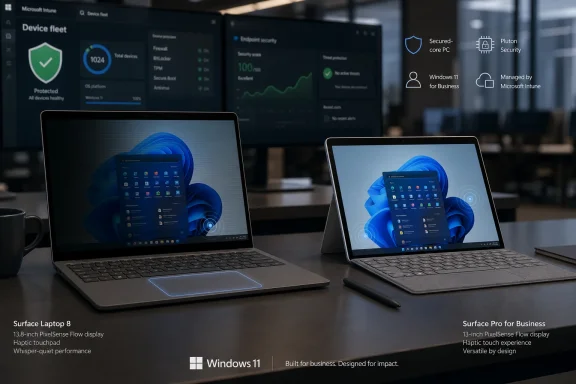 Microsoft Is Selling the Future Before the Consumer Version Arrives
The oddity of this Surface launch is that Microsoft did not begin with the models most enthusiasts will buy. The company led with the commercial portfolio: Surface Laptop for Business in 13-inch, 13.8-inch, and 15-inch flavors, plus the new 13-inch Surface Pro for Business. Consumer Snapdragon X2 versions are expected later, which means the current wave is less a holiday-shopping pitch than an enterprise procurement signal.That distinction matters because commercial pricing has always lived in a different universe from Best Buy pricing. Business machines absorb costs that consumers do not always see: longer lifecycle support, serviceability programs, enterprise security claims, reseller channels, fleet manageability, and configurations designed around IT departments rather than impulse purchases. Microsoft is not merely selling a laptop; it is selling a managed object in the Microsoft stack.
But even with that caveat, the sticker shock is real. A Surface Laptop starting just shy of $1,950 no longer feels like a halo Windows PC nudging the upper end of the market. It feels like a machine that must defend every screw, port, benchmark, and firmware decision against not only Dell, HP, and Lenovo, but also against Apple’s increasingly disciplined MacBook lineup.
The Windows Central Podcast gets to the heart of the discomfort: Surface is no longer automatically granted the benefit of the doubt. For years, enthusiasts forgave price premiums because Surface pushed Windows hardware forward. In 2026, the burden of proof has shifted. Microsoft must show not just that Surface is nice, but that it is necessary.
The Naming Scheme Is Now Part of the Problem
A product line can survive high prices if the pitch is clean. Surface does not currently have that advantage. The podcast’s joking frustration over Microsoft’s naming conventions is not a throwaway complaint; it is a symptom of a portfolio that has become needlessly hard to parse.There is a Surface Laptop 8 in 13.8-inch and 15-inch versions, a Surface Laptop 13-inch that is a separate mid-range machine, and a Surface Pro 13-inch that some coverage frames around the “Surface Pro 12” generation. Add “for Business,” chip-family splits, Copilot+ PC eligibility, Intel-first and Snapdragon-later waves, and the naming starts to feel like an internal SKU map escaped into public view.
This is more than enthusiast nitpicking. Clear product ladders help buyers understand why one device costs more than another. Apple’s MacBook Air and MacBook Pro distinction may be imperfect, but the basic shape is legible. Lenovo ThinkPad tiers and Dell Latitude families can be labyrinthine, but they exist in a B2B context where procurement teams expect spec matrices.
Surface, by contrast, has spent more than a decade cultivating a consumer-friendly identity: elegant, simple, unmistakably Microsoft. The current naming stack blurs that identity. If a loyal Windows buyer has to pause and ask whether the 13-inch Surface Laptop is the small flagship or the mid-range entry, Microsoft has already made the sale harder than it needed to be.
That confusion becomes especially damaging when the price climbs. A $999 laptop can tolerate a little ambiguity. A $1,949.99 starting price demands precision.
Panther Lake Gives Surface a Real Performance Story
Underneath the naming fog, the hardware story is more compelling than the pricing discourse allows. The new commercial Surfaces move to Intel Core Ultra Series 3 processors, the platform widely associated with Panther Lake. Microsoft is leaning on Intel’s next-generation CPU, GPU, and NPU mix to frame these machines as AI-era business PCs rather than merely annual refreshes.The most interesting part may not be the NPU at all. The podcast spends time on the Intel Core Ultra X7 configuration and the Arc B390-class graphics, and that detail matters because Surface Laptops have rarely been bought for graphical headroom. A stronger integrated GPU changes the character of a premium ultraportable: it improves creative workloads, external display handling, light GPU-accelerated productivity, and the general feeling that the machine has room to grow.
Microsoft’s own positioning claims large gains over older Surface Laptop generations and favorable comparisons against current MacBook Air-class hardware. Vendor benchmarks should always be read with caution, but the direction of travel is credible. Intel had to respond to Apple Silicon, Qualcomm’s Windows push, and the market’s growing expectation that thin laptops should no longer feel compromised.
For IT buyers, however, raw performance is only one part of the value equation. A fleet laptop must be fast enough on day one and still manageable on day one thousand. Panther Lake gives Microsoft a modern platform story, but it does not automatically justify the premium. It gives Surface permission to compete; it does not settle the argument.
The Haptic Touchpad Is the Kind of Detail Surface Used to Own
One reason Surface still matters is that Microsoft can use its own hardware to nudge Windows itself. The new haptic touchpad and Windows 11 haptic signals are a small but revealing example. Instead of treating haptics as a generic click replacement, Microsoft is trying to make physical feedback part of the operating system’s interaction model.That sounds minor until you remember how much laptop quality is communicated through repeated micro-interactions. Trackpad feel, palm rejection, keyboard consistency, display reflectivity, fan behavior, and lid rigidity matter because users experience them thousands of times per week. Enterprise buyers talk about manageability, but employees judge the issued laptop by the same tactile standards as everyone else.
The podcast’s discussion of haptic feedback when snapping windows, aligning objects, or scrubbing through timelines points toward a more ambitious Windows input layer. If developers adopt these signals, Windows could gain a subtle sensory grammar that macOS has long benefited from through tight hardware-software control. That is exactly the sort of integration Surface was built to demonstrate.
The risk is that it remains a Surface-only flourish rather than a Windows ecosystem standard. Microsoft’s hardware succeeds strategically when OEMs copy its best ideas. If haptic signals become another half-supported feature that looks good in a demo and disappears in daily use, the value shrinks. If they become a standard expectation on premium Windows laptops, Surface will have done its job.
The Privacy Screen Is a Business Feature That Actually Understands Business
The optional integrated privacy screen on select 13.8-inch Surface Laptop configurations is one of the launch’s clearest enterprise ideas. Physical privacy filters have always been inelegant: they are easy to lose, degrade the display experience, and make a premium laptop look like it is wearing office stationery. Building the function into the display and letting users toggle it from the keyboard is the sort of practical refinement business laptops rarely get credit for.This is also where Microsoft’s commercial-first launch makes sense. A privacy screen is not a gamer feature, and it is not the kind of thing that lights up a consumer spec sheet. But for finance, healthcare, legal work, government, consulting, and frequent travel, shoulder-surfing risk is mundane and real. The most valuable security feature is often the one employees actually use because it does not interrupt them.
The key phrase is “select configurations.” Microsoft has a habit of attaching its most interesting Surface features to configuration caveats, regional caveats, or price tiers that limit their impact. If the privacy display becomes a rare option buried in expensive SKUs, it will be more talking point than transformation.
Still, this is the kind of business hardware feature that feels grounded rather than buzzword-driven. It does not require a speculative AI workflow. It does not ask IT managers to imagine a future productivity revolution. It solves a familiar problem with a cleaner implementation than the current workaround.
The 8GB Model Undercuts the Copilot+ Narrative
The strangest subplot in the launch is Microsoft’s plan to offer an 8GB version of the 13-inch Surface Laptop later this year to bring the starting price down to $1,299.99. That machine reportedly will not qualify as a Copilot+ PC because Microsoft’s own requirements expect 16GB of RAM. In other words, Microsoft is creating a cheaper Surface by stepping outside the very AI PC category it has spent two years promoting.There are reasonable explanations. Memory prices have been under pressure, and the industry’s appetite for AI infrastructure has distorted component markets. If RAM is expensive enough, Microsoft may see an 8GB SKU as the only way to maintain an entry point that does not look completely detached from the broader laptop market.
But strategically, it is awkward. Copilot+ PC has been Microsoft’s banner for the next generation of Windows hardware. Surface was supposed to embody that transition. Offering a non-Copilot+ Surface in 2026 tells buyers that the brand promise is flexible when the bill of materials gets ugly.
That may be pragmatic, but it is not clean. It also risks confusing buyers who reasonably assume that a new Surface Laptop sold in the AI PC era should support the full AI PC feature set. If Microsoft wants Copilot+ to be meaningful, it cannot treat it as both a minimum modern standard and an optional luxury.
Apple Is the Comparison Microsoft Cannot Escape
Every expensive Windows laptop eventually meets the same question: why not buy a MacBook? That question is not fair in every context, especially for companies standardized on Windows, Microsoft 365, Entra ID, Intune, Windows security baselines, and legacy Win32 applications. But it is unavoidable, because Apple has trained buyers to associate high laptop prices with battery life, build quality, quiet operation, and long-term performance consistency.Surface used to answer Apple by being the Windows device that felt most like the future. The original Surface Pro was weird, compromised, and influential. Surface Book was over-engineered in ways that made enthusiasts pay attention. Surface Laptop brought a polished, disciplined Windows clamshell into a market crowded with plasticky ultrabooks and corporate rectangles.
Now the comparison is harsher because the MacBook Air has become both excellent and boring in the best possible way. It is the default recommendation for many people who do not specifically need Windows. That makes Surface’s job harder: it must justify a premium not only through design, but through Windows-specific advantages that Apple cannot copy.
For businesses, those advantages exist. Surface can be managed like a first-party Windows endpoint, repaired through Microsoft’s commercial ecosystem, secured with Pluton and Secured-core PC positioning, and integrated tightly with Windows Update and Microsoft’s device management stack. Those are not trivial. But they are also not the same as convincing an individual buyer that a nearly $2,000 Surface is the obvious choice over a MacBook.
Microsoft’s Best Argument Is Fleet Value, Not Sticker Value
The loudest online reaction to Surface pricing tends to focus on the checkout page. That is understandable, but it is not how large organizations evaluate devices. Commercial buyers care about total cost of ownership, not just MSRP, and Microsoft is trying to shift the Surface conversation into that frame.Repairability is central to that pitch. Microsoft says major components across the Surface for Business portfolio are replaceable, with parts available through commercial channels and repairs designed for trained technicians using common tools. That is a meaningful evolution for a brand that once drew criticism for sealed designs and repair-hostile construction.
Security is another pillar. Microsoft’s messaging around Secured-core PCs, Pluton, firmware updates through Windows Update, memory-safe firmware work, Rust-based drivers, and hardware-rooted protection is not aimed at spec-sheet shoppers. It is aimed at CISOs and endpoint teams who live with the consequences of firmware vulnerabilities, inconsistent driver stacks, and unmanaged device sprawl.
The problem is that these benefits are difficult to dramatize. A privacy screen can be shown. A haptic touchpad can be felt. A firmware security architecture mostly becomes visible only when something goes wrong. Microsoft is asking buyers to pay upfront for risks avoided later, and that is always a harder story to tell.
The Fan Noise Detail Matters More Than It Sounds
Daniel Rubino’s hands-on impression that the Surface Laptop 8 stays impressively quiet under load is one of those observations that can get buried beneath processor names and price arguments. It should not. Quiet sustained performance is one of the defining marks of a truly premium laptop.Windows laptops have spent years fighting the perception that they are powerful in bursts and annoying under pressure. Fans ramp, chassis heat spreads unevenly, battery life falls off, and the machine that looked competitive in a benchmark starts to feel less refined in a conference room. If Surface Laptop 8 can deliver stronger Intel performance without sounding like it is constantly bargaining with thermals, that is a genuine achievement.
This is especially important for commercial users. The modern office laptop is a video-conferencing machine, a spreadsheet machine, a browser with thirty tabs, a security-agent host, and sometimes a local AI endpoint. It has to do all of that while sitting two feet from a microphone.
Performance that arrives quietly is worth more than performance that arrives theatrically. If Microsoft has improved cooling and acoustics while preserving the prior generation’s exterior design, that is an argument for refinement rather than stagnation.
Surface’s Conservatism Is Starting to Look Deliberate
One criticism running through Surface fan communities is that Microsoft has become too cautious. The designs are polished but familiar. The big experiments are fewer. The company that once made detachable tablets feel like the obvious future now appears more interested in serving enterprise checklists than surprising enthusiasts.That criticism is emotionally understandable, but it may misread Microsoft’s current goal. Surface no longer needs to prove that Windows hardware can be beautiful. The OEM ecosystem learned that lesson. What Microsoft now seems to want is a first-party business PC line that expresses the company’s broader platform priorities: AI acceleration, endpoint security, manageability, repairability, sustainability, and Windows integration.
That is less exciting than a wild new form factor. It is also probably more important to Microsoft’s actual business. A Fortune 500 deployment of secure, repairable Surface devices does more for the Microsoft ecosystem than a beloved niche machine that reviewers adore and few people buy.
The danger is that Surface becomes too enterprise-coded to retain its cultural role. Enthusiasts matter because they create the brand’s aura. If Surface becomes merely “the nice laptop your company overpaid for,” Microsoft loses something that specs cannot restore.
The Price Hike Is Real, but So Is the Market Distortion
It would be too easy to frame Surface pricing as simple corporate greed. The reality is messier. Memory shortages, AI data center demand, tariffs, higher-end displays, newer wireless components, and premium chassis expectations all push costs upward. PC makers across the industry have been warning about price pressure, and Microsoft is not immune because it has a famous logo on the lid.Still, cost pressure does not absolve product strategy. If components are more expensive, companies must make sharper choices about which configurations matter. Microsoft’s decision to preserve a lower starting point with an 8GB future SKU may be financially understandable, but it clashes with the Copilot+ story. The decision to start flagship business machines near $2,000 may reflect costs, but it also invites comparisons Microsoft cannot fully control.
The central issue is not whether Microsoft has reasons. It does. The issue is whether buyers will care enough about those reasons to pay. A procurement manager may accept the argument if the devices reduce support incidents, last longer, and integrate more cleanly into the Microsoft environment. A power user shopping with personal money may simply see a number that feels detached from the Windows laptop market they remember.
That split explains the podcast’s tension. The new Surfaces can be impressive and overpriced at the same time, depending on who is buying and what problem they are trying to solve.
The Consumer Snapdragon Wave Now Carries the Burden
Because this launch is commercial-first, the consumer Surface story remains unfinished. Microsoft’s expected Snapdragon X2 models later this year will have to answer the questions the Intel business wave leaves open. Can Microsoft deliver better battery life without sacrificing app compatibility? Can OLED options arrive without pushing prices into absurdity? Can the company make the consumer lineup easier to understand than the business portfolio?The Snapdragon wave also matters because Qualcomm-based Copilot+ PCs were the original showcase for Microsoft’s AI PC reset. Intel has caught up in NPU terms, but the Windows-on-Arm story is still where Microsoft can claim a more Apple-like mix of efficiency, standby behavior, and integrated AI features. If the consumer devices land well, this week’s expensive business machines may look like the first half of a rational two-step rollout.
If they land poorly, the Surface brand will look trapped between two pressures. Intel models will be expensive and conventional. Arm models will be ambitious but potentially compromised. That is the old Windows hardware dilemma in modern clothing.
Microsoft needs the consumer launch to be cleaner, sharper, and easier to explain. It cannot ask buyers to decode product names, chip roadmaps, AI eligibility rules, and price hikes all at once. The next wave must feel less like a procurement catalog and more like a product story.
The Numbers Tell Only Half the Story
The useful way to read this Surface launch is not as a referendum on whether Microsoft has lost its mind. It is a test of whether Surface’s value has migrated from visible innovation to invisible infrastructure. That migration is rational for Microsoft, but it makes the devices harder to love.The concrete takeaways are less dramatic than the online sticker shock, but more useful:
- The new Surface for Business lineup starts at $1,499 for the 13-inch Surface Laptop and $1,949.99 for flagship Surface Laptop and Surface Pro configurations.
- The flagship Surface Laptop 8 gains Intel Core Ultra Series 3 silicon, stronger integrated graphics options, improved haptics, and an optional integrated privacy screen on select 13.8-inch models.
- The 13-inch Surface Laptop is positioned as the mid-range option, but its future 8GB configuration reportedly will not qualify as a Copilot+ PC.
- Microsoft is relying on business-grade arguments around security, manageability, repairability, and fleet value to justify prices that look steep in consumer terms.
- The expected Snapdragon X2 consumer models later this year will determine whether this generation feels like a coherent Surface strategy or a confusing commercial-first price reset.
References
- Primary source: Windows Central
Published: 2026-05-22T09:10:09.151077
Windows Central Podcast: Are Microsoft's new Surface PCs too expensive? | Windows Central
On this episode of the Windows Central Podcast, Daniel and Zac discuss Microsoft's new Surface for Business announcements, and their pricing.www.windowscentral.com - Related coverage: tomshardware.com
New Microsoft Surface for Business PCs pair Panther Lake chips with as little as 8GB of RAM — 13-inch Surface Laptop goes light on memory but still starts at $1,299 | Tom's Hardware
The AI gold rush crimps the local AI ambitions of the cheapest business-focused Surfacewww.tomshardware.com - Related coverage: pcgamer.com
Microsoft plans to launch a cheaper 8 GB Surface laptop later this year which won't meet the requirements of a Copilot+ PC | PC Gamer
How far we have fallen.www.pcgamer.com - Related coverage: techspot.com
Microsoft unveils thinner, lighter Surface Laptop and Surface Pro, starting at $799 | TechSpot
Microsoft has expanded its Copilot+ PC family with two new Surface devices: the 12-inch Surface Pro tablet and the 13-inch Surface Laptop. Powered by Qualcomm's Snapdragon X...www.techspot.com - Related coverage: notebookcheck.net
Microsoft releases new Surface Pro 12 with 64 GB RAM and cellular connectivity - Notebookcheck News
Microsoft has finally released the Surface Pro 12. Available globally with Intel Panther Lake processors, the 'for Business' model also comes with optional cellular connectivity, up to 64 GB RAM and a 120 Hz OLED display. www.notebookcheck.net
- Related coverage: macrumors.com
Microsoft Raises Prices for All Surface PCs, Making Them More Expensive Than Equivalent Macs
Microsoft increased prices for all of its Surface PCs this week, with most models priced hundreds of dollars higher than they were when launching. Windows Central highlighted the increases, which now see Microsoft's mid-range models priced above $1,000 and flagship models priced starting at...www.macrumors.com
- Official source: blogs.windows.com
Introducing all-new Surface Copilot+ PCs: The Surface Pro, 12-inch and Surface Laptop, 13-inch
Copilot+ PCs continue to define the next wave of personal computing — fast, long lasting, secure PCs that are purpose-built to unlock AI experiences that empower us to get more done. Today, Microsoft and Surface expand the Copilot+ PC family with tblogs.windows.com - Related coverage: hardware.slashdot.org
Microsoft Launches Surface Pro 12, Surface Laptop 8 With Intel Chips - Slashdot
Microsoft is launching three new Intel-powered Surface devices for businesses: the Surface Pro 12, Surface Laptop 8, and a smaller 13-inch Surface Laptop model. These new machines come equipped with newer Intel chips, a few business-focused upgrades, and notably higher starting prices. "The...hardware.slashdot.org - Official source: microsoft.com
Microsoft Surface Store - Buy Computers, Devices, & See Pricing | Microsoft Store
Explore Surface computers, laptops, tablets, and accessories on the Microsoft Store. Shop new and refurbished Surface devices, bundles, keyboard covers, pens, and more. See features and pricing.www.microsoft.com
- Related coverage: notebookcheck.com
Microsoft Surface Laptop 8 startet mit Privacy Display und haptischem Touchpad - Notebookcheck News
Der brandneue Surface Laptop 8 ist da, und bringt eine Reihe bedeutender Upgrades mit. Von einem Privacy Display im Stil des Samsung Galaxy S26 Ultra über ein haptisches Multitouch-Trackpad bis hin zu schnellen Intel Panther Lake Prozessoren. www.notebookcheck.com
- Related coverage: techradar.com
Microsoft unveils new Surface for Business laptops and Surface Pro for Business 2 in 1s — showing your next work device will have AI at the core | TechRadar
Microsoft unveils new Surface designed with AI in mindwww.techradar.com
