

Microsoft’s 2026 Surface Laptop 13-inch has turned an entry-level configuration into a warning label: the $949.99 model pairs a Snapdragon X Plus processor with just 8GB of non-upgradeable LPDDR5X memory, and The Verge reports that Windows 11 regularly stalls under ordinary office-style multitasking. That is a troubling result not simply because the laptop is inexpensive by Surface standards, but because this is Microsoft’s own flagship hardware running Microsoft’s own operating system.
The issue is not that the 13-inch Surface Laptop is broadly bad. The chassis, keyboard, trackpad, 1080p webcam, battery life and general fit-and-finish remain strong, according to The Verge’s testing. The issue is that Microsoft has apparently repriced last year’s value proposition in the wrong direction: a 2025 configuration with 16GB of memory and 512GB of storage sold for $900, while the new base model costs $950 with half the RAM and 256GB of storage.
For Windows buyers, the practical takeaway is unusually clear: 8GB is no longer a credible baseline for a new Windows 11 laptop at this price. It may still operate acceptably in a tightly controlled, single-task workload. It is not enough headroom for a machine expected to remain useful through several years of browser growth, Teams calls, background sync clients, security tools and feature updates.
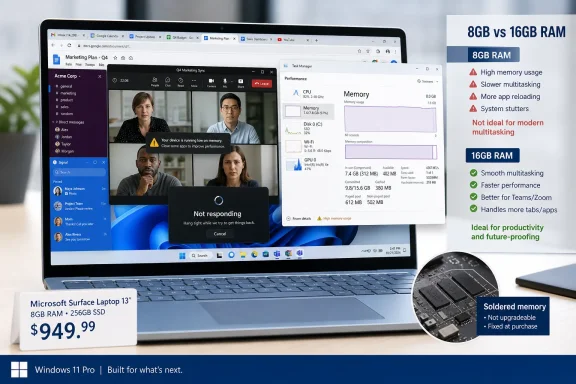
The Verge reviewer Antonio G. Di Benedetto describes several-second hangs during a Microsoft Teams call while the host streamed a short video. The machine also had roughly 10 Chrome tabs open across two virtual desktops, plus Slack and Signal—hardly a workstation load, and notably without cameras enabled.
The more concerning detail is that the pauses were not limited to that particular combination. The reviewer encountered intermittent freezes several times per day, including while working in Google Docs with no video stream or Teams call active. That distinction matters. A low-end system that slows during a render, game, or massive spreadsheet is behaving within expectations. A new $950 laptop that hesitates under ordinary knowledge-worker use is making the user manage the computer rather than the other way around.
Task Manager told the rest of the story. The review found memory consumption hovering around 6.7GB out of approximately 7.6GB usable, while a fresh boot with minimal startup software still consumed about 4.2GB. Microsoft’s published Windows 11 minimum is 4GB of RAM, but minimum requirements describe whether an operating system can install and function—not whether a modern laptop can comfortably run the applications buyers use every day.
That leaves little reserve for Chromium-based browsers, Electron apps, collaboration clients, cloud synchronization and memory spikes that occur when an app decodes video, opens a large document, updates its cache or restores a tab. Windows can rely on the paging file once physical memory becomes scarce, but moving active data to storage is an emergency tradeoff, not a substitute for RAM. Even fast storage cannot make a system feel consistently responsive when its working set no longer fits in memory.
The 8GB Surface scored 2,348 in Geekbench 6 single-core and 9,421 in multi-core testing, compared with 2,437 and 11,427 for the 2025 16GB Surface Laptop. The gap is not a clean measure of memory alone; benchmark variation, cooling, software versions and system behavior all matter. But the much sharper result in PugetBench for Photoshop—2,887 for the 8GB system against 4,773 for last year’s 16GB unit—shows how a processor that is adequate on its own can be boxed in by an undersized memory pool.
Premiere Pro and PugetBench for Premiere Pro crashed in the testing cited by The Verge, though the 16GB 2025 Surface also crashed in those particular tests. That prevents a simple claim that 8GB alone caused every failure. Still, creative applications are exactly where non-replaceable memory capacity deserves more attention, not less. Buyers cannot add a stick of RAM later to turn a barely acceptable machine into a durable one.
This configuration is also an ARM-based Windows laptop, which brings its own application-compatibility considerations depending on an organization’s software stack. That is not the central criticism here: Teams, Chrome, Slack, Signal and Google Docs are commonplace workloads, and the reported behavior occurred while using them. The Surface Laptop’s 8GB constraint is basic capacity, not a niche compatibility edge case.
That creates a poor purchasing calculation. The 8GB model has a 13-inch 1,920 x 1,280 60Hz touchscreen, 256GB UFS storage, Wi-Fi 7, a 50Wh battery, one USB-A port, two USB-C ports and a 2.7-pound chassis. It is handsome hardware, but its RAM is soldered and its storage is modest. The buyer is accepting an irreversible limitation at the exact point where Windows 11’s ordinary workload profile has become less forgiving.
For home users, this is a reason to treat 16GB as a firm filter rather than an aspirational upgrade. A machine that seems fine in a retail demo—where it has a few tabs open, no accumulated app state and no long-running sync or endpoint software—may feel markedly different after a few months of real use.
For IT buyers, the conclusion is even more straightforward. The 8GB Surface Laptop is not a sensible standard deployment for employees who use Teams, browsers with multiple business web apps, Microsoft 365, VPN clients, endpoint detection and response agents, OneDrive, line-of-business applications and perhaps a second display. Small fleets may be able to assign it to kiosk-style, frontline or highly restricted roles, but that is an exception that must be defined and tested, not a default purchasing tier.
That may explain the configuration; it does not excuse the result. There is a difference between an inexpensive laptop with transparent compromises and a premium-feeling device whose fundamental responsiveness depends on disciplined tab counts and carefully closed background apps. Microsoft’s Surface line has traditionally sold the experience as much as the hardware. The experience is undermined if the owner must keep Task Manager in mind.
Microsoft has said it is focusing on Windows 11 performance and reliability, particularly on lower-cost systems. That work is necessary, and reducing background resource use would help every PC. But software optimization cannot indefinitely offset hardware economics when the operating system itself, plus modern browsers and collaboration software, can consume most of an 8GB pool before a user begins serious work.
The immediate consequence is simple: skip the 8GB Surface Laptop 13-inch unless the workload is deliberately narrow and temporary. The more important question is whether Microsoft and its OEM partners will let 8GB become the visible entry price for Windows laptops while quietly making 16GB the price of a usable one.
The issue is not that the 13-inch Surface Laptop is broadly bad. The chassis, keyboard, trackpad, 1080p webcam, battery life and general fit-and-finish remain strong, according to The Verge’s testing. The issue is that Microsoft has apparently repriced last year’s value proposition in the wrong direction: a 2025 configuration with 16GB of memory and 512GB of storage sold for $900, while the new base model costs $950 with half the RAM and 256GB of storage.
For Windows buyers, the practical takeaway is unusually clear: 8GB is no longer a credible baseline for a new Windows 11 laptop at this price. It may still operate acceptably in a tightly controlled, single-task workload. It is not enough headroom for a machine expected to remain useful through several years of browser growth, Teams calls, background sync clients, security tools and feature updates.
 A Teams Call Exposed the Limit
The Verge reviewer Antonio G. Di Benedetto describes several-second hangs during a Microsoft Teams call while the host streamed a short video. The machine also had roughly 10 Chrome tabs open across two virtual desktops, plus Slack and Signal—hardly a workstation load, and notably without cameras enabled.The more concerning detail is that the pauses were not limited to that particular combination. The reviewer encountered intermittent freezes several times per day, including while working in Google Docs with no video stream or Teams call active. That distinction matters. A low-end system that slows during a render, game, or massive spreadsheet is behaving within expectations. A new $950 laptop that hesitates under ordinary knowledge-worker use is making the user manage the computer rather than the other way around.
Task Manager told the rest of the story. The review found memory consumption hovering around 6.7GB out of approximately 7.6GB usable, while a fresh boot with minimal startup software still consumed about 4.2GB. Microsoft’s published Windows 11 minimum is 4GB of RAM, but minimum requirements describe whether an operating system can install and function—not whether a modern laptop can comfortably run the applications buyers use every day.
That leaves little reserve for Chromium-based browsers, Electron apps, collaboration clients, cloud synchronization and memory spikes that occur when an app decodes video, opens a large document, updates its cache or restores a tab. Windows can rely on the paging file once physical memory becomes scarce, but moving active data to storage is an emergency tradeoff, not a substitute for RAM. Even fast storage cannot make a system feel consistently responsive when its working set no longer fits in memory.
The Processor Is Not the Problem
The 2026 Surface Laptop 13-inch uses Qualcomm’s eight-core Snapdragon X Plus X1P-46-100, a close relative of the chip in the 16GB 2025 model. On paper, the newer version even has a slightly higher boost clock. The Verge’s benchmark results reinforce the point: CPU and graphics figures are broadly in the same neighborhood as the earlier model, while creative workloads reveal a machine with far less room to breathe.The 8GB Surface scored 2,348 in Geekbench 6 single-core and 9,421 in multi-core testing, compared with 2,437 and 11,427 for the 2025 16GB Surface Laptop. The gap is not a clean measure of memory alone; benchmark variation, cooling, software versions and system behavior all matter. But the much sharper result in PugetBench for Photoshop—2,887 for the 8GB system against 4,773 for last year’s 16GB unit—shows how a processor that is adequate on its own can be boxed in by an undersized memory pool.
Premiere Pro and PugetBench for Premiere Pro crashed in the testing cited by The Verge, though the 16GB 2025 Surface also crashed in those particular tests. That prevents a simple claim that 8GB alone caused every failure. Still, creative applications are exactly where non-replaceable memory capacity deserves more attention, not less. Buyers cannot add a stick of RAM later to turn a barely acceptable machine into a durable one.
This configuration is also an ARM-based Windows laptop, which brings its own application-compatibility considerations depending on an organization’s software stack. That is not the central criticism here: Teams, Chrome, Slack, Signal and Google Docs are commonplace workloads, and the reported behavior occurred while using them. The Surface Laptop’s 8GB constraint is basic capacity, not a niche compatibility edge case.
Microsoft Has Made the Upgrade a $200 Requirement
Microsoft offers the same 13-inch Surface Laptop with 16GB of RAM for $1,150, according to The Verge. In other words, the capacity that should be the floor for a premium thin-and-light Windows notebook now requires a $200 step-up from the base configuration.That creates a poor purchasing calculation. The 8GB model has a 13-inch 1,920 x 1,280 60Hz touchscreen, 256GB UFS storage, Wi-Fi 7, a 50Wh battery, one USB-A port, two USB-C ports and a 2.7-pound chassis. It is handsome hardware, but its RAM is soldered and its storage is modest. The buyer is accepting an irreversible limitation at the exact point where Windows 11’s ordinary workload profile has become less forgiving.
For home users, this is a reason to treat 16GB as a firm filter rather than an aspirational upgrade. A machine that seems fine in a retail demo—where it has a few tabs open, no accumulated app state and no long-running sync or endpoint software—may feel markedly different after a few months of real use.
For IT buyers, the conclusion is even more straightforward. The 8GB Surface Laptop is not a sensible standard deployment for employees who use Teams, browsers with multiple business web apps, Microsoft 365, VPN clients, endpoint detection and response agents, OneDrive, line-of-business applications and perhaps a second display. Small fleets may be able to assign it to kiosk-style, frontline or highly restricted roles, but that is an exception that must be defined and tested, not a default purchasing tier.
“Entry Level” Is Becoming a Worse Deal
The wider context is the memory supply crunch that The Verge characterizes as “RAMageddon.” The outlet says Dell, Acer and Asus have also announced upcoming 8GB systems, and warns that constrained memory supply and higher component costs could push manufacturers to preserve low advertised prices by lowering specifications instead.That may explain the configuration; it does not excuse the result. There is a difference between an inexpensive laptop with transparent compromises and a premium-feeling device whose fundamental responsiveness depends on disciplined tab counts and carefully closed background apps. Microsoft’s Surface line has traditionally sold the experience as much as the hardware. The experience is undermined if the owner must keep Task Manager in mind.
Microsoft has said it is focusing on Windows 11 performance and reliability, particularly on lower-cost systems. That work is necessary, and reducing background resource use would help every PC. But software optimization cannot indefinitely offset hardware economics when the operating system itself, plus modern browsers and collaboration software, can consume most of an 8GB pool before a user begins serious work.
The immediate consequence is simple: skip the 8GB Surface Laptop 13-inch unless the workload is deliberately narrow and temporary. The more important question is whether Microsoft and its OEM partners will let 8GB become the visible entry price for Windows laptops while quietly making 16GB the price of a usable one.
References
- Primary source: The Verge
Published: 2026-07-17T13:30:00+00:00
Loading…
www.theverge.com