

Microsoft has announced Surface Laptop Ultra, a 15-inch Windows-on-Arm Surface laptop due this fall with an NVIDIA Blackwell RTX GPU, up to 128GB of unified memory, a mini-LED PixelSense Ultra touchscreen, and a chassis under 18mm thick and under 4.5 pounds. The useful answer for buyers and IT planners is simple: do not treat this as another Surface Laptop refresh. Treat it as Microsoft and NVIDIA’s first serious attempt to make a portable Windows workstation category feel normal, especially for creators, developers, and AI-heavy professionals who want local compute without dragging around a traditional mobile workstation.
Surface Laptop Ultra matters because it changes the premise of what a premium Surface is supposed to be. For years, Surface laptops have mostly argued for design discipline, battery life, pen-and-touch refinement, and the cleanest possible expression of Windows hardware. This announcement shifts the argument toward local acceleration: a machine that is still thin enough to be mobile, but pitched around GPU compute, unified memory, and on-device AI work.
That is why the headline specification is not the 15-inch screen, the premium chassis, or even the Surface badge. The headline is the combination of a new NVIDIA chip with an RTX GPU, up to 1 petaflop of AI compute, and up to 128GB of unified memory. Microsoft is not merely saying this laptop can run office apps quickly. It is saying the next high-end Windows laptop should be able to run meaningful AI and creator workloads locally.
The company’s timing is important. Cloud AI is still the center of gravity, but professional users increasingly care about latency, cost control, privacy, offline access, and keeping sensitive data close to the machine. Surface Laptop Ultra is Microsoft’s way of saying Windows PCs should not be thin clients for someone else’s GPU farm forever.
That does not mean every claim should be accepted at launch-day face value. The device is still a promise until independent testing can measure sustained performance, thermals, battery behavior, driver maturity, and real application compatibility. But the direction is unmistakable: Microsoft wants Windows-on-Arm to move from “efficient laptop” to portable workstation.
Inside, Microsoft says a new NVIDIA chip combines an efficient CPU with an RTX GPU and delivers up to 1 petaflop of AI compute. The platform advertises up to 128GB of unified memory, a number that immediately changes the audience. This is no longer just about opening more browser tabs or editing a batch of photos; it is about datasets, large media projects, local AI models, rendering workflows, and software development environments that strain ordinary ultraportables.
The mini-LED PixelSense Ultra touchscreen also tells us where Microsoft is aiming. A creator-first machine needs more than compute; it needs a display that can plausibly serve people working in visual timelines, design canvases, 3D previews, and color-sensitive review sessions. Microsoft has not turned Surface Laptop Ultra into a bulky workstation, but it has clearly moved beyond the conventional productivity laptop envelope.
The most revealing thermal claim is Microsoft’s comparison with the Surface Laptop 7th edition 15 inches. The company says Surface Laptop Ultra has up to 2.5 times the thermal capacity of that machine. That does not tell us sustained wattage, fan noise, or performance after 30 minutes under load, but it does show Microsoft understands the central problem: serious GPU and AI work is not won in a five-second benchmark burst.
Those questions matter because Surface Laptop Ultra is trying to collapse two buying decisions into one. Today, many professionals choose between a thin-and-light laptop that travels well and a heavier workstation that can survive real GPU workloads. Microsoft and NVIDIA are trying to make that trade-off feel outdated.
If they succeed, the implications for Windows are substantial. The PC becomes a practical local inference box, a creator workstation, and a developer environment in one machine class. If they fall short, Surface Laptop Ultra risks becoming another impressive halo device whose best claims only appear in demos and controlled workloads.
That tension is the story. The laptop is interesting because it may be fast. The platform is important because it tries to redefine what “fast enough to work locally” means on Windows.
For AI and creator workloads, that matters. Local models, large media projects, high-resolution assets, and complex development environments can become memory-bound before they become compute-bound. A machine with a powerful GPU but cramped memory can still feel like a sports car stuck in a narrow alley.
Microsoft’s decision to promote unified memory so prominently is also an answer to Apple’s influence on the workstation-laptop conversation. Apple made unified memory a mainstream talking point for creative professionals; Microsoft and NVIDIA now want Windows buyers to hear similar language attached to RTX-class acceleration and CUDA-oriented workflows.
That does not mean the implementations are identical, and it does not mean buyers should assume every workload will scale cleanly. Unified memory is a platform capability, not a magic wand. The real-world value will depend on software support, driver behavior, memory bandwidth, thermal limits, and how applications allocate resources under Windows-on-Arm.
Still, the message is clear enough: Microsoft wants high-end Windows laptops to stop looking like compromises in memory architecture. For workstation-minded buyers, that is a significant change in tone.
By pairing Windows-on-Arm with NVIDIA Blackwell RTX hardware, Microsoft is making a more aggressive claim. It is arguing that Arm can be the foundation for premium Windows performance devices, not just lightweight productivity machines. That is a much harder sell, because professional buyers bring professional software baggage with them.
Compatibility will be the pressure point. Enthusiasts may tolerate a few rough edges. IT departments and creative studios usually do not. If a plug-in, driver, capture device, rendering tool, or niche enterprise application behaves unpredictably, the theoretical platform advantage becomes a support problem.
That is why Surface Laptop Ultra should be watched less like a single Surface model and more like a compatibility referendum. If the platform can run demanding Windows creative and developer workloads reliably, Windows-on-Arm gains a new identity. If not, the device may become a beautiful proof-of-concept waiting for the software ecosystem to catch up.
This matters because NVIDIA’s PC strength has traditionally been clearest in gaming laptops, creator laptops, and workstations built around discrete GPUs. RTX Spark appears aimed at a different slot: compact systems and portable machines that can present local AI and GPU acceleration as a first-order feature, not an add-on.
For Windows users, that could be a meaningful shift. If multiple OEMs ship systems around the same general concept, software vendors have a stronger reason to optimize. Developers can target a more recognizable class of hardware. IT buyers can compare vendors instead of betting everything on one Surface design.
That ecosystem effect is the part Microsoft needs. Surface can define a category, but it rarely fills the whole market. If Dell, HP, Lenovo, Asus, Acer, MSI, Gigabyte, and others bring credible RTX Spark systems to market, Surface Laptop Ultra becomes less of a curiosity and more of a reference point.
The safest move is not to freeze every purchase. Conventional x86 workstations and RTX laptops remain known quantities, and many teams need machines now. But IT departments with scheduled refreshes later this year should start segmenting users more carefully.
The relevant question is not “Who wants the newest Surface?” It is “Which users would benefit from local GPU and AI capacity in a portable device, and which workloads are mature enough on Windows-on-Arm to justify a pilot?” That is a narrower, more useful procurement lens.
Enthusiasts face a similar calculation. If your workload is mostly browsing, Office, light coding, and media consumption, Surface Laptop Ultra is likely over-targeted. If your work involves AI experimentation, GPU-accelerated creative tools, large local projects, or constant movement between desk and travel, this is exactly the kind of machine worth waiting to benchmark.
Surface Laptop Ultra helps close that narrative gap. A Windows PC with Blackwell-class RTX hardware and 128GB unified memory gives Microsoft a more convincing local AI story than a standard thin-and-light with modest acceleration. It lets the company talk about on-device work without immediately sounding like it is hiding the real compute in the cloud.
That does not mean cloud AI goes away. For many models and enterprise workflows, the cloud will remain simpler, more scalable, and easier to govern centrally. But local AI capacity changes the balance. It makes privacy-sensitive workflows more plausible, reduces dependence on network access, and gives developers a machine that can prototype more seriously without round-tripping everything to a remote service.
For WindowsForum readers, the important distinction is between AI as a feature label and AI as a workload. Surface Laptop Ultra is aimed at the second category. That is a much more interesting market, and a much less forgiving one.
Thermal capacity is therefore not a side note. Microsoft’s claim of up to 2.5 times the thermal capacity of Surface Laptop 7th edition 15 inches is a signal that this Surface has been engineered for a different performance class. But capacity is only the start; what matters is how that system behaves after heat has saturated the chassis.
The best version of Surface Laptop Ultra is a machine that lets creators render, compile, preview, upscale, denoise, generate, and test locally without constantly asking whether they should have brought a desktop. The worst version is a laptop that posts impressive peak figures but makes professionals babysit thermals and compatibility.
That is why independent reviews should focus on workflows, not synthetic drama. The useful tests will be long renders, large project exports, local model runs, external monitor use, docking behavior, storage-heavy tasks, and mixed workloads where CPU, GPU, memory, and cooling all collide.
Apple’s advantage is platform integration. Microsoft’s opportunity is Windows software breadth, RTX acceleration, CUDA familiarity, OEM diversity, and enterprise manageability. A Surface Laptop Ultra does not need to become a MacBook Pro clone to matter; it needs to give Windows-first professionals a credible reason not to defect when they need portable performance.
The Windows advantage remains especially important in organizations tied to Windows tooling, specialized applications, device fleets, security policies, and established support models. For those buyers, the question is not whether Apple makes excellent hardware. It is whether Windows can finally offer a comparable modern workstation-laptop experience without forcing a retreat to bulky machines.
Surface Laptop Ultra is Microsoft’s answer. Whether it is a convincing answer depends on execution, but the category logic is sound.
That is the right debate for enthusiasts and IT pros. Surface has always attracted attention, but RTX Spark systems could matter well beyond Microsoft’s own hardware line. If the fall wave of systems delivers, buyers may soon have a new tier between ultraportables and full workstation laptops.
The risk is hype inflation. “AI PC” has already become a blurry label, stretched across machines with wildly different capabilities. Surface Laptop Ultra needs to avoid being swallowed by that vagueness. Its promise is not that it has an AI sticker; its promise is that local GPU-heavy work on a portable Windows machine becomes less exceptional.
That is why the most useful community coverage will track production hardware, drivers, application support, and real workloads. The launch tells us Microsoft’s ambition. The next six months will tell us whether the platform deserves the workstation label.
That said, waiting for proof is different from ignoring the signal. IT teams should start identifying roles that could benefit from local acceleration and then prepare small pilots when hardware arrives. Creative departments, AI prototyping teams, developers working with accelerated tooling, and technical users who travel frequently are the obvious early candidates.
The more conservative path is to treat Surface Laptop Ultra as a test case for the RTX Spark category rather than the automatic purchase. If the Surface design is too expensive or too specialized, other OEM systems may offer different trade-offs later in the fall. NVIDIA’s statement that laptops and compact desktops are coming from Microsoft Surface and other OEMs is the clue that this will not be a single-device market.
For individual enthusiasts, the advice is similar. Watch the benchmarks, but watch the software reports even more closely. A fast machine that does not run your tools cleanly is not a workstation; it is an expensive science project.
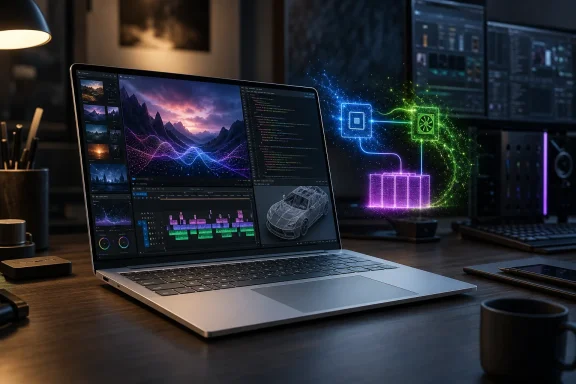 Microsoft Is Selling a Category, Not Just a Laptop
Surface Laptop Ultra matters because it changes the premise of what a premium Surface is supposed to be. For years, Surface laptops have mostly argued for design discipline, battery life, pen-and-touch refinement, and the cleanest possible expression of Windows hardware. This announcement shifts the argument toward local acceleration: a machine that is still thin enough to be mobile, but pitched around GPU compute, unified memory, and on-device AI work.That is why the headline specification is not the 15-inch screen, the premium chassis, or even the Surface badge. The headline is the combination of a new NVIDIA chip with an RTX GPU, up to 1 petaflop of AI compute, and up to 128GB of unified memory. Microsoft is not merely saying this laptop can run office apps quickly. It is saying the next high-end Windows laptop should be able to run meaningful AI and creator workloads locally.
The company’s timing is important. Cloud AI is still the center of gravity, but professional users increasingly care about latency, cost control, privacy, offline access, and keeping sensitive data close to the machine. Surface Laptop Ultra is Microsoft’s way of saying Windows PCs should not be thin clients for someone else’s GPU farm forever.
That does not mean every claim should be accepted at launch-day face value. The device is still a promise until independent testing can measure sustained performance, thermals, battery behavior, driver maturity, and real application compatibility. But the direction is unmistakable: Microsoft wants Windows-on-Arm to move from “efficient laptop” to portable workstation.
The Spec Sheet Finally Sounds Like a Workstation Conversation
The verified hardware story is unusually direct. Surface Laptop Ultra is a 15-inch Surface with a mini-LED PixelSense Ultra touchscreen, a body under 18mm thick, and a weight under 4.5 pounds. That puts it in the physical neighborhood of premium performance laptops rather than classic workstation bricks.Inside, Microsoft says a new NVIDIA chip combines an efficient CPU with an RTX GPU and delivers up to 1 petaflop of AI compute. The platform advertises up to 128GB of unified memory, a number that immediately changes the audience. This is no longer just about opening more browser tabs or editing a batch of photos; it is about datasets, large media projects, local AI models, rendering workflows, and software development environments that strain ordinary ultraportables.
The mini-LED PixelSense Ultra touchscreen also tells us where Microsoft is aiming. A creator-first machine needs more than compute; it needs a display that can plausibly serve people working in visual timelines, design canvases, 3D previews, and color-sensitive review sessions. Microsoft has not turned Surface Laptop Ultra into a bulky workstation, but it has clearly moved beyond the conventional productivity laptop envelope.
The most revealing thermal claim is Microsoft’s comparison with the Surface Laptop 7th edition 15 inches. The company says Surface Laptop Ultra has up to 2.5 times the thermal capacity of that machine. That does not tell us sustained wattage, fan noise, or performance after 30 minutes under load, but it does show Microsoft understands the central problem: serious GPU and AI work is not won in a five-second benchmark burst.
The Real Test Is Sustained Local Work, Not Launch-Day Peak Numbers
A petaflop figure is useful marketing shorthand, but professionals should care more about the boring questions. How long can the machine hold performance before clocks fall? How well does the cooling system behave on a desk, on a lap, and connected to external displays? How mature are the NVIDIA and Windows-on-Arm driver paths for the software people actually use?Those questions matter because Surface Laptop Ultra is trying to collapse two buying decisions into one. Today, many professionals choose between a thin-and-light laptop that travels well and a heavier workstation that can survive real GPU workloads. Microsoft and NVIDIA are trying to make that trade-off feel outdated.
If they succeed, the implications for Windows are substantial. The PC becomes a practical local inference box, a creator workstation, and a developer environment in one machine class. If they fall short, Surface Laptop Ultra risks becoming another impressive halo device whose best claims only appear in demos and controlled workloads.
That tension is the story. The laptop is interesting because it may be fast. The platform is important because it tries to redefine what “fast enough to work locally” means on Windows.
Unified Memory Is the Quiet Center of the Pitch
The 128GB unified memory claim may be more strategically important than the raw AI compute number. Traditional PC architecture often forces professional workloads to think about separate pools of system memory and graphics memory. Unified memory promises a more flexible model, where large workloads can draw from a shared pool rather than constantly running into hard boundaries between CPU and GPU resources.For AI and creator workloads, that matters. Local models, large media projects, high-resolution assets, and complex development environments can become memory-bound before they become compute-bound. A machine with a powerful GPU but cramped memory can still feel like a sports car stuck in a narrow alley.
Microsoft’s decision to promote unified memory so prominently is also an answer to Apple’s influence on the workstation-laptop conversation. Apple made unified memory a mainstream talking point for creative professionals; Microsoft and NVIDIA now want Windows buyers to hear similar language attached to RTX-class acceleration and CUDA-oriented workflows.
That does not mean the implementations are identical, and it does not mean buyers should assume every workload will scale cleanly. Unified memory is a platform capability, not a magic wand. The real-world value will depend on software support, driver behavior, memory bandwidth, thermal limits, and how applications allocate resources under Windows-on-Arm.
Still, the message is clear enough: Microsoft wants high-end Windows laptops to stop looking like compromises in memory architecture. For workstation-minded buyers, that is a significant change in tone.
Windows-on-Arm Is Being Asked to Grow Up Fast
Surface Laptop Ultra also raises the stakes for Windows-on-Arm. Until recently, the strongest argument for Arm-based Windows machines was efficiency: long battery life, instant-on behavior, quiet operation, and enough performance for mainstream productivity. That story is useful, but it is not enough to win creators and workstation users.By pairing Windows-on-Arm with NVIDIA Blackwell RTX hardware, Microsoft is making a more aggressive claim. It is arguing that Arm can be the foundation for premium Windows performance devices, not just lightweight productivity machines. That is a much harder sell, because professional buyers bring professional software baggage with them.
Compatibility will be the pressure point. Enthusiasts may tolerate a few rough edges. IT departments and creative studios usually do not. If a plug-in, driver, capture device, rendering tool, or niche enterprise application behaves unpredictably, the theoretical platform advantage becomes a support problem.
That is why Surface Laptop Ultra should be watched less like a single Surface model and more like a compatibility referendum. If the platform can run demanding Windows creative and developer workloads reliably, Windows-on-Arm gains a new identity. If not, the device may become a beautiful proof-of-concept waiting for the software ecosystem to catch up.
NVIDIA Gets a New Door Into the Premium Windows Laptop
NVIDIA’s role is not incidental. The company says RTX Spark laptops and compact desktops will ship this fall from Microsoft Surface and other OEMs. That means Surface Laptop Ultra is not meant to be a one-off experiment; it is the visible front edge of a broader Windows hardware push.This matters because NVIDIA’s PC strength has traditionally been clearest in gaming laptops, creator laptops, and workstations built around discrete GPUs. RTX Spark appears aimed at a different slot: compact systems and portable machines that can present local AI and GPU acceleration as a first-order feature, not an add-on.
For Windows users, that could be a meaningful shift. If multiple OEMs ship systems around the same general concept, software vendors have a stronger reason to optimize. Developers can target a more recognizable class of hardware. IT buyers can compare vendors instead of betting everything on one Surface design.
That ecosystem effect is the part Microsoft needs. Surface can define a category, but it rarely fills the whole market. If Dell, HP, Lenovo, Asus, Acer, MSI, Gigabyte, and others bring credible RTX Spark systems to market, Surface Laptop Ultra becomes less of a curiosity and more of a reference point.
The Fall Shipping Window Gives IT a Planning Problem
The announced fall shipping window is close enough to matter and vague enough to frustrate procurement planning. Organizations considering high-end laptops for creators, developers, data teams, or AI prototyping groups now have to decide whether to buy conventional workstations today or wait to see what RTX Spark systems look like in production.The safest move is not to freeze every purchase. Conventional x86 workstations and RTX laptops remain known quantities, and many teams need machines now. But IT departments with scheduled refreshes later this year should start segmenting users more carefully.
The relevant question is not “Who wants the newest Surface?” It is “Which users would benefit from local GPU and AI capacity in a portable device, and which workloads are mature enough on Windows-on-Arm to justify a pilot?” That is a narrower, more useful procurement lens.
Enthusiasts face a similar calculation. If your workload is mostly browsing, Office, light coding, and media consumption, Surface Laptop Ultra is likely over-targeted. If your work involves AI experimentation, GPU-accelerated creative tools, large local projects, or constant movement between desk and travel, this is exactly the kind of machine worth waiting to benchmark.
Microsoft’s Workstation Bet Is Also a Copilot Bet
Microsoft has spent the last several product cycles making AI central to Windows. But a gap has remained between the operating-system narrative and the hardware reality. Many PCs can run lightweight AI features; fewer can credibly handle heavier local workloads that professionals might actually care about.Surface Laptop Ultra helps close that narrative gap. A Windows PC with Blackwell-class RTX hardware and 128GB unified memory gives Microsoft a more convincing local AI story than a standard thin-and-light with modest acceleration. It lets the company talk about on-device work without immediately sounding like it is hiding the real compute in the cloud.
That does not mean cloud AI goes away. For many models and enterprise workflows, the cloud will remain simpler, more scalable, and easier to govern centrally. But local AI capacity changes the balance. It makes privacy-sensitive workflows more plausible, reduces dependence on network access, and gives developers a machine that can prototype more seriously without round-tripping everything to a remote service.
For WindowsForum readers, the important distinction is between AI as a feature label and AI as a workload. Surface Laptop Ultra is aimed at the second category. That is a much more interesting market, and a much less forgiving one.
The Laptop Has to Beat the Workstation at Its Own Game
Microsoft’s design challenge is brutal because professional users are not sentimental about form factor. They will accept weight, noise, and expense if the machine earns it. A thin workstation has to prove that it is not merely attractive, but dependable under ugly workloads.Thermal capacity is therefore not a side note. Microsoft’s claim of up to 2.5 times the thermal capacity of Surface Laptop 7th edition 15 inches is a signal that this Surface has been engineered for a different performance class. But capacity is only the start; what matters is how that system behaves after heat has saturated the chassis.
The best version of Surface Laptop Ultra is a machine that lets creators render, compile, preview, upscale, denoise, generate, and test locally without constantly asking whether they should have brought a desktop. The worst version is a laptop that posts impressive peak figures but makes professionals babysit thermals and compatibility.
That is why independent reviews should focus on workflows, not synthetic drama. The useful tests will be long renders, large project exports, local model runs, external monitor use, docking behavior, storage-heavy tasks, and mixed workloads where CPU, GPU, memory, and cooling all collide.
The MacBook Pro Comparison Is Inevitable, but Incomplete
Surface Laptop Ultra will inevitably be compared with high-end MacBook Pro systems, especially because of unified memory and creator positioning. That comparison is fair in broad market terms, but it can also obscure what Microsoft and NVIDIA are really attempting.Apple’s advantage is platform integration. Microsoft’s opportunity is Windows software breadth, RTX acceleration, CUDA familiarity, OEM diversity, and enterprise manageability. A Surface Laptop Ultra does not need to become a MacBook Pro clone to matter; it needs to give Windows-first professionals a credible reason not to defect when they need portable performance.
The Windows advantage remains especially important in organizations tied to Windows tooling, specialized applications, device fleets, security policies, and established support models. For those buyers, the question is not whether Apple makes excellent hardware. It is whether Windows can finally offer a comparable modern workstation-laptop experience without forcing a retreat to bulky machines.
Surface Laptop Ultra is Microsoft’s answer. Whether it is a convincing answer depends on execution, but the category logic is sound.
The Forum Reaction Is Already Pointing at the Right Fight
WindowsForum readers have already been circling the same core issue in related discussions: this is not just another shiny Surface, but a possible local AI workstation class for Windows. That framing is sharper than treating the device as a luxury laptop announcement because it gets to the practical question: what can users do locally that previously required a desktop, a cloud instance, or a heavier mobile workstation?That is the right debate for enthusiasts and IT pros. Surface has always attracted attention, but RTX Spark systems could matter well beyond Microsoft’s own hardware line. If the fall wave of systems delivers, buyers may soon have a new tier between ultraportables and full workstation laptops.
The risk is hype inflation. “AI PC” has already become a blurry label, stretched across machines with wildly different capabilities. Surface Laptop Ultra needs to avoid being swallowed by that vagueness. Its promise is not that it has an AI sticker; its promise is that local GPU-heavy work on a portable Windows machine becomes less exceptional.
That is why the most useful community coverage will track production hardware, drivers, application support, and real workloads. The launch tells us Microsoft’s ambition. The next six months will tell us whether the platform deserves the workstation label.
The Sensible Buyer Waits for Proof, but Starts Planning Now
No one should build a deployment plan around launch claims alone. The facts we have are promising but incomplete. Microsoft has given the broad hardware outline, the display class, the chassis targets, the memory ceiling, the AI compute claim, and the thermal-capacity comparison, but buyers still need pricing, configuration details, battery behavior, repairability information, availability by region, and independent performance data.That said, waiting for proof is different from ignoring the signal. IT teams should start identifying roles that could benefit from local acceleration and then prepare small pilots when hardware arrives. Creative departments, AI prototyping teams, developers working with accelerated tooling, and technical users who travel frequently are the obvious early candidates.
The more conservative path is to treat Surface Laptop Ultra as a test case for the RTX Spark category rather than the automatic purchase. If the Surface design is too expensive or too specialized, other OEM systems may offer different trade-offs later in the fall. NVIDIA’s statement that laptops and compact desktops are coming from Microsoft Surface and other OEMs is the clue that this will not be a single-device market.
For individual enthusiasts, the advice is similar. Watch the benchmarks, but watch the software reports even more closely. A fast machine that does not run your tools cleanly is not a workstation; it is an expensive science project.
The Practical Read Before the Fall RTX Spark Wave Arrives
Surface Laptop Ultra is worth tracking now because it could reshape the high end of the Windows laptop market, but it is not yet a machine to buy sight unseen. The practical move is to map your workloads, identify your compatibility risks, and wait for production reviews that test sustained local AI and GPU-heavy creator tasks rather than short benchmark bursts.- Surface Laptop Ultra is a 15-inch Surface laptop with a mini-LED PixelSense Ultra touchscreen, a chassis under 18mm thick, and a weight under 4.5 pounds.
- Microsoft says the new NVIDIA chip combines an efficient CPU with an RTX GPU and delivers up to 1 petaflop of AI compute.
- The platform advertises up to 128GB of unified memory, which is the specification that most clearly separates it from ordinary premium laptops.
- Microsoft says the thermal system has up to 2.5 times the thermal capacity of Surface Laptop 7th edition 15 inches, but sustained performance still needs independent testing.
- NVIDIA says RTX Spark laptops and compact desktops will ship this fall from Microsoft Surface and other OEMs, so buyers should compare the category rather than treating Surface as the only option.
- IT departments should prepare pilots for creators, developers, and AI-focused users instead of assuming every knowledge worker needs this class of machine.
References
- Primary source: microsoft.com
Surface Laptop Ultra: The new performance Surface Laptop | Microsoft Surface
Discover the new Surface Laptop Ultra. Built for world makers and creative pros who require cutting-edge AI performance, power, and portability.www.microsoft.com - Independent coverage: nvidia.com
NVIDIA RTX Spark — Slim Laptops & Small Desktops
The fusion of NVIDIA AI and RTX graphics in slim laptops and small desktops. For creators, developers, and gamers.www.nvidia.com - Independent coverage: investor.nvidia.com
NVIDIA Corporation - NVIDIA and Microsoft Reinvent Windows PCs for the Age of Personal AI
RTX Spark — a 1-Petaflop Superchip, the Full CUDA and RTX Ecosystem, and Windows-Native Agents — a New Beginning for Personal Computers News Summary: NVIDIA RTX Spark powers the world’s first Windows PCs purpose-built for personal agents, featuring 1 petaflop of AI performance, industry-leading...investor.nvidia.com - Independent coverage: news.microsoft.com
Surface Laptop Ultra :为全世界的创造者而生 - Source Asia
 news.microsoft.com
- Primary source: WindowsForum
Surface Laptop Ultra: RTX Spark Superchip Brings Real Local AI Workstations to Windows | Windows Forum
Microsoft announced the Surface Laptop Ultra at Computex 2026 in Taipei, a 15-inch professional Windows laptop built with Nvidia’s new RTX Spark superchip...windowsforum.com
