

A 15-month YouTube test of 200 PC games on Microsoft’s Surface Pro 11 with a Snapdragon X Plus shows that Windows on Arm gaming has moved from novelty demo to uneven but real capability, especially after Microsoft, Qualcomm, anti-cheat vendors, and game developers widened compatibility through 2025 and early 2026. The thin tablet is still not a gaming PC, and Snapdragon X remains a compromise platform for players who expect Steam Deck-like predictability or laptop-GPU muscle. But the experiment matters because it exposes the truth behind Qualcomm’s new confidence: Windows on Arm does not need to win gaming overnight to become credible. It only needs to stop being disqualified before the conversation begins.
The Surface Pro 11 is almost the wrong machine for this job, which is precisely why the results are interesting. It is a fan-constrained, premium 2-in-1 built around mobility, battery life, pen input, and Microsoft’s Copilot+ PC pitch — not around sustained GPU loads, high-refresh esports, or the thermal patience of a gaming notebook. If a game works tolerably there, it tells us something more useful than a cherry-picked demo on a reference platform.
That is what makes Ghobso Gaming’s 200-game test run compelling. The headline is not that Microsoft’s tablet suddenly became an Xbox handheld with a keyboard cover. The headline is that a first-generation Snapdragon X Plus device has accumulated enough working examples — from lighter indies to recognizable AAA fare — that the old “Windows on Arm cannot game” line now needs an asterisk the size of the Microsoft Store.
The top picks highlighted around the 200-game milestone are revealing because they are not all safe choices. Hades and Stardew Valley are the kinds of games people expect to behave well on modest hardware. Fortnite, Halo: Combat Evolved through The Master Chief Collection, Lies of P, South of Midnight, Resident Evil 7: Biohazard, and Alien: Rogue Incursion are more politically important wins because they touch the compatibility categories that have historically humiliated Windows on Arm: translation, anti-cheat, graphics drivers, store plumbing, and runtime assumptions.
There is a difference between “runs” and “belongs,” of course. Nobody should buy a Surface Pro 11 because it is the best way to play Lies of P. The machine’s gaming achievement is more modest and more strategically important: it proves that Snapdragon PCs are no longer confined to solitaire-class workloads when the software stack cooperates.
Gaming, however, has remained the awkward dinner guest. Qualcomm wants the credibility that comes from saying top Windows games will run on Snapdragon X2 laptops, and it has promoted large compatibility percentages and stronger Adreno X2 performance claims. Yet official chip launches still tend to frame gaming as an adjacent benefit rather than the core identity of the platform.
That hesitation tells the whole story. Qualcomm knows the PC gaming audience is unforgiving in a way office-productivity buyers are not. If Word opens slowly once, people grumble. If a game crashes at launch because an anti-cheat module refuses Arm translation, the platform gets memed into irrelevance.
The company is therefore trying to walk a narrow ridge. It wants developers, OEMs, and buyers to believe Snapdragon can handle more than browsing and Teams, but it does not yet want to invite direct comparison with AMD’s Ryzen Z-series handheld chips, Intel’s gaming-oriented mobile parts, or NVIDIA-equipped laptops. The result is a strangely coy campaign: Snapdragon X is powerful enough that gaming keeps appearing in demos and benchmarks, but not mature enough for Qualcomm to plant a flag and say, without qualification, “this is a gaming platform.”
The Snapdragon X Plus did not become a dramatically different chip after launch. What changed was the environment around it. Microsoft’s Prism emulator improved. Windows 11 on Arm gained broader support for x86 instruction extensions, including AVX and AVX2-related workloads that many modern games and creative apps expect. Anti-cheat compatibility widened. More developers began paying attention to native Arm builds or at least to not breaking emulation unnecessarily.
That is why the year-over-year narrative matters. A game that failed in mid-2024 might run in late 2025 or early 2026 without the user doing anything heroic. In the Windows world, that kind of quiet compatibility gain is often more valuable than a benchmark spike, because most buyers do not want a hobby. They want the library they already own to behave.
Prism’s AVX and AVX2 progress is especially important because it addresses a class of failures that felt arbitrary to normal users. A game could be graphically modest and still refuse to launch if it expected an instruction set the emulator did not support. Once that wall moves, the library does not merely get faster; it gets larger.
The anti-cheat story is just as consequential. Fortnite’s arrival as a viable Snapdragon X title is more than one game becoming playable. It signals that the ecosystem is willing to solve the trust and kernel-adjacent problems that surround competitive multiplayer. For years, anti-cheat was the silent veto over alternative PC architectures and compatibility layers. When that veto softens, the platform’s ceiling rises.
The reason is not raw frame rate. Fortnite can scale across a bewildering range of devices, and no one expects a Snapdragon tablet to behave like a high-wattage gaming laptop. What matters is that Fortnite historically sat in the category of games that could be blocked not by shader complexity but by the machinery around the game.
Easy Anti-Cheat support changed that equation. Once a major anti-cheat pathway works on Snapdragon X PCs, the discussion shifts from “this class of game is probably impossible” to “which games have done the work, and which vendors are still holding out?” That is a much healthier problem for Microsoft and Qualcomm to have.
It also changes buyer psychology. Compatibility charts are useful, but players think in icons. If the icon they care about launches, the platform is viable; if it does not, no percentage claim will save it. Fortnite’s movement from non-starter to playable title gives Windows on Arm one of those icons.
That middle stage is dangerous because it invites overclaiming. A “90 percent of top games” compatibility claim sounds enormous until a user discovers that their personal top ten lives disproportionately in the missing 10 percent. PC gaming is not a standardized workload. It is a chaotic archive of engines, launchers, DRM systems, anti-cheat tools, mod loaders, overlays, shader compilers, controller layers, and abandoned middleware.
Even when games launch, performance can vary in ways that make the experience feel less predictable than on x86 Windows. Emulation overhead, driver maturity, shader compilation behavior, and memory bandwidth all matter. A Snapdragon X device may run one visually ambitious title surprisingly well and stumble over another that seems easier on paper.
This is where comparisons to Valve’s Proton become uncomfortable. Proton is not magic, and Linux gaming still has its own rough edges, but Valve’s work has conditioned players to expect a visible, community-fed compatibility culture. Steam Deck users can often find a badge, a workaround, or a ProtonDB report before they buy. Windows on Arm needs an equivalent layer of expectation management, because silence is deadly when compatibility is uneven.
That is harder than it sounds. PC gaming on Windows is decentralized by design. Steam, Epic Games Store, GOG, Battle.net, Xbox, EA, Ubisoft, itch.io, and standalone launchers all bring their own assumptions. Then there are Microsoft’s own complications, including store entitlements, Xbox app behavior, Game Pass availability, and legacy dependencies that can make the official Microsoft gaming route feel less reliable than the unofficial one.
For Windows on Arm to become a serious gaming story, Microsoft needs to make the failure modes legible. If a title will not run because of anti-cheat, say so. If it requires an emulator update, say so. If native Arm support is available, surface it clearly. The average player should not have to reverse-engineer an architecture problem from a crash dialog.
The irony is that Microsoft has already learned this lesson in other parts of Windows. Driver updates, security health, and app compatibility are now mediated by layers of warnings, dashboards, and automated checks. Gaming on Arm deserves the same treatment, especially if Copilot+ PCs are going to be sold to mainstream buyers who assume “Windows PC” means “my Windows games.”
The incentive problem remains severe. Developers follow install base, and install base follows software confidence. This chicken-and-egg loop has haunted every alternative PC platform. Apple broke part of it through vertical control and a large premium user base, but even macOS gaming remains selective. Microsoft and Qualcomm do not have Apple’s control over the stack, and the Windows audience is less tolerant of curated scarcity.
Still, the shape of the market is changing in ways that help Arm. Modern engines are increasingly cross-platform by default. Developers already think about x86, Arm, consoles, handhelds, cloud streaming, and mobile GPUs. The technical distance between “possible” and “worth doing” is shrinking.
The first wave of native Arm Windows games does not need to include every major release. It needs to include enough visible examples that studios stop treating Arm as an exotic support burden. Once native builds exist for a meaningful slice of games, emulation can return to its proper role: a compatibility safety net rather than the center of the experience.
A handheld does not need 4K output at ultra settings to be considered successful. It needs good 720p or 1080p performance, consistent frame pacing, quiet-enough thermals, suspend-and-resume reliability, broad controller support, and battery life that does not collapse after 45 minutes. Those are exactly the categories where efficient Arm silicon could make a sharper argument than it can in a laptop aisle full of established x86 options.
The Steam Deck proved that the market will accept compromise if the device is honest about its target. ASUS, Lenovo, MSI, and others then showed that Windows handhelds can chase more power, even if Windows itself remains clumsy at small-screen console-like behavior. Snapdragon could enter that space with a different proposition: less brute force, more endurance, and a compatibility story that improves over time.
But Qualcomm cannot get there through flirtation. A Snapdragon gaming handheld would need first-class driver updates, storefront partnerships, anti-cheat commitments, and a public compatibility program. It would also need Microsoft to take handheld Windows seriously as an interface problem, not merely a scaling issue.
That does not make it a scientific benchmark suite. Game settings vary, updates change behavior, and user tolerance for frame rate differs. But it is precisely the kind of evidence enthusiasts use when deciding whether a device is viable outside the marketing lane.
The most important lesson is that Snapdragon X gaming is no longer a binary yes-or-no question. It is becoming a tiered question: Which games? Which launcher? Which anti-cheat? Which Windows build? Which driver? Which Snapdragon SKU? Which settings? That complexity is annoying, but it is also a sign of maturity. Dead platforms have simple answers.
The Surface Pro 11 also reminds us that “gaming PC” is not the only meaningful category. Many people want a work machine that can also play Hades on a flight, Fortnite in a hotel room, or an older AAA game on the couch. If Snapdragon X can satisfy that secondary-use case reliably, it becomes more attractive even before it challenges dedicated gaming hardware.
That reputational asymmetry is brutal. Qualcomm and Microsoft must be better than merely acceptable because they are asking users to accept a platform transition. Every failure confirms the skeptic’s prior. Every success is treated as an exception until the successes become overwhelming.
AMD’s position in handhelds is particularly strong because it combines acceptable CPU performance, mature integrated graphics, and native Windows game compatibility. Intel, despite its own ups and downs in drivers and efficiency, also benefits from being part of the expected PC baseline. Qualcomm’s efficiency advantage is real, but efficiency does not help if a favorite game will not launch.
The next competitive phase will therefore be less about whether Snapdragon X2 can post impressive numbers in selected games and more about whether it can reduce buyer anxiety. The platform has to move from “surprisingly good when it works” to “safe enough to recommend.” That is a much higher bar than a frame-rate chart.
But X2 also increases pressure on the software side. A faster chip that still runs into launcher blocks, anti-cheat gaps, or missing native builds will make the remaining failures look less like growing pains and more like ecosystem negligence. Qualcomm cannot benchmark its way out of that.
This is why the Surface Pro 11 story lands at an awkward moment. The older, weaker device is showing that persistence pays off. Now Qualcomm and Microsoft must prove that the next generation is not just faster but better supported from day one.
OEMs will also have to choose how loudly they sell the feature. A laptop vendor that markets “ultra-smooth gaming” on Snapdragon X2 is taking a risk if customers interpret that phrase like they would on an AMD or Intel Windows laptop. The words need to match the library reality, or the backlash will be predictable.
The Surface Pro 11’s 200-game journey shows that the advice now has to become more nuanced. A Snapdragon X PC can be a surprisingly capable casual and secondary gaming machine. It can run more recognizable titles than many skeptics expect. It can benefit materially from OS updates after purchase.
That last point is important. Traditional gaming laptops can improve with driver updates, but Windows on Arm devices are improving at the platform-compatibility level. The machine someone bought in 2024 may run games in 2026 that were not practical at launch. That is unusual in the Windows PC world, where software compatibility is usually assumed up front rather than earned over time.
The risk is that this improvement curve encourages premature triumphalism. Windows on Arm gaming is not “solved.” It is simply no longer absurd. For a platform that spent years being dismissed before testing began, that is a meaningful promotion.
Source: Windows Central https://www.windowscentral.com/hard...00-tested-games-tell-us-about-surface-pro-11/
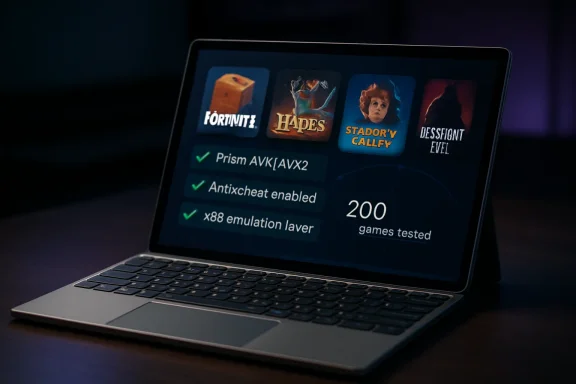 A Tablet Becomes the Most Honest Snapdragon Gaming Benchmark
The Surface Pro 11 is almost the wrong machine for this job, which is precisely why the results are interesting. It is a fan-constrained, premium 2-in-1 built around mobility, battery life, pen input, and Microsoft’s Copilot+ PC pitch — not around sustained GPU loads, high-refresh esports, or the thermal patience of a gaming notebook. If a game works tolerably there, it tells us something more useful than a cherry-picked demo on a reference platform.That is what makes Ghobso Gaming’s 200-game test run compelling. The headline is not that Microsoft’s tablet suddenly became an Xbox handheld with a keyboard cover. The headline is that a first-generation Snapdragon X Plus device has accumulated enough working examples — from lighter indies to recognizable AAA fare — that the old “Windows on Arm cannot game” line now needs an asterisk the size of the Microsoft Store.
The top picks highlighted around the 200-game milestone are revealing because they are not all safe choices. Hades and Stardew Valley are the kinds of games people expect to behave well on modest hardware. Fortnite, Halo: Combat Evolved through The Master Chief Collection, Lies of P, South of Midnight, Resident Evil 7: Biohazard, and Alien: Rogue Incursion are more politically important wins because they touch the compatibility categories that have historically humiliated Windows on Arm: translation, anti-cheat, graphics drivers, store plumbing, and runtime assumptions.
There is a difference between “runs” and “belongs,” of course. Nobody should buy a Surface Pro 11 because it is the best way to play Lies of P. The machine’s gaming achievement is more modest and more strategically important: it proves that Snapdragon PCs are no longer confined to solitaire-class workloads when the software stack cooperates.
Qualcomm’s Gaming Pitch Has Outgrown Its Marketing Nerve
Qualcomm has spent years trying to make Arm PCs sound inevitable without making promises that Windows users could immediately punish. That caution was understandable during the early Windows on Arm era, when emulation gaps, app incompatibility, and unclear developer incentives made the whole project feel like a technical preview wearing retail packaging. Snapdragon X changed the tone because the CPU performance and battery-life story finally gave Windows on Arm a mainstream reason to exist.Gaming, however, has remained the awkward dinner guest. Qualcomm wants the credibility that comes from saying top Windows games will run on Snapdragon X2 laptops, and it has promoted large compatibility percentages and stronger Adreno X2 performance claims. Yet official chip launches still tend to frame gaming as an adjacent benefit rather than the core identity of the platform.
That hesitation tells the whole story. Qualcomm knows the PC gaming audience is unforgiving in a way office-productivity buyers are not. If Word opens slowly once, people grumble. If a game crashes at launch because an anti-cheat module refuses Arm translation, the platform gets memed into irrelevance.
The company is therefore trying to walk a narrow ridge. It wants developers, OEMs, and buyers to believe Snapdragon can handle more than browsing and Teams, but it does not yet want to invite direct comparison with AMD’s Ryzen Z-series handheld chips, Intel’s gaming-oriented mobile parts, or NVIDIA-equipped laptops. The result is a strangely coy campaign: Snapdragon X is powerful enough that gaming keeps appearing in demos and benchmarks, but not mature enough for Qualcomm to plant a flag and say, without qualification, “this is a gaming platform.”
The Breakthrough Was Not One Chip, It Was the Stack
The Surface Pro 11 tests underline a fact that spec sheets usually obscure: Windows on Arm gaming is not one problem. It is a stack of problems, and every layer has to stop failing before the user sees a game instead of an error box.The Snapdragon X Plus did not become a dramatically different chip after launch. What changed was the environment around it. Microsoft’s Prism emulator improved. Windows 11 on Arm gained broader support for x86 instruction extensions, including AVX and AVX2-related workloads that many modern games and creative apps expect. Anti-cheat compatibility widened. More developers began paying attention to native Arm builds or at least to not breaking emulation unnecessarily.
That is why the year-over-year narrative matters. A game that failed in mid-2024 might run in late 2025 or early 2026 without the user doing anything heroic. In the Windows world, that kind of quiet compatibility gain is often more valuable than a benchmark spike, because most buyers do not want a hobby. They want the library they already own to behave.
Prism’s AVX and AVX2 progress is especially important because it addresses a class of failures that felt arbitrary to normal users. A game could be graphically modest and still refuse to launch if it expected an instruction set the emulator did not support. Once that wall moves, the library does not merely get faster; it gets larger.
The anti-cheat story is just as consequential. Fortnite’s arrival as a viable Snapdragon X title is more than one game becoming playable. It signals that the ecosystem is willing to solve the trust and kernel-adjacent problems that surround competitive multiplayer. For years, anti-cheat was the silent veto over alternative PC architectures and compatibility layers. When that veto softens, the platform’s ceiling rises.
Fortnite Matters Because Anti-Cheat Used to Be the Stop Sign
Fortnite is the perfect test case because it is technically, commercially, and culturally heavy. It is not just a game; it is a platform, a social space, a benchmark for whether a device belongs in the lives of younger PC users, and a stress test for the systems around game authentication and fairness. Its presence on the Surface Pro 11’s “good experience” list should make the industry pay attention.The reason is not raw frame rate. Fortnite can scale across a bewildering range of devices, and no one expects a Snapdragon tablet to behave like a high-wattage gaming laptop. What matters is that Fortnite historically sat in the category of games that could be blocked not by shader complexity but by the machinery around the game.
Easy Anti-Cheat support changed that equation. Once a major anti-cheat pathway works on Snapdragon X PCs, the discussion shifts from “this class of game is probably impossible” to “which games have done the work, and which vendors are still holding out?” That is a much healthier problem for Microsoft and Qualcomm to have.
It also changes buyer psychology. Compatibility charts are useful, but players think in icons. If the icon they care about launches, the platform is viable; if it does not, no percentage claim will save it. Fortnite’s movement from non-starter to playable title gives Windows on Arm one of those icons.
The Remaining Gaps Are Less Embarrassing but More Stubborn
The bad news for Qualcomm is that the easiest narrative wins are now behind it. Once Windows on Arm could barely run everyday apps, each compatibility improvement felt dramatic. Now the platform has entered the more frustrating middle stage, where many things work, some things work only after caveats, and a few important things still fail for reasons that are hard to explain in a product listing.That middle stage is dangerous because it invites overclaiming. A “90 percent of top games” compatibility claim sounds enormous until a user discovers that their personal top ten lives disproportionately in the missing 10 percent. PC gaming is not a standardized workload. It is a chaotic archive of engines, launchers, DRM systems, anti-cheat tools, mod loaders, overlays, shader compilers, controller layers, and abandoned middleware.
Even when games launch, performance can vary in ways that make the experience feel less predictable than on x86 Windows. Emulation overhead, driver maturity, shader compilation behavior, and memory bandwidth all matter. A Snapdragon X device may run one visually ambitious title surprisingly well and stumble over another that seems easier on paper.
This is where comparisons to Valve’s Proton become uncomfortable. Proton is not magic, and Linux gaming still has its own rough edges, but Valve’s work has conditioned players to expect a visible, community-fed compatibility culture. Steam Deck users can often find a badge, a workaround, or a ProtonDB report before they buy. Windows on Arm needs an equivalent layer of expectation management, because silence is deadly when compatibility is uneven.
Microsoft’s Role Is Bigger Than Qualcomm’s Benchmark Slide
Qualcomm can build the silicon, but Microsoft owns the platform promise. Windows on Arm gaming will rise or fall on whether Windows behaves like Windows, not like an asterisked cousin of Windows. That means Microsoft’s job is not merely to improve Prism; it must make the whole distribution and compatibility experience feel ordinary.That is harder than it sounds. PC gaming on Windows is decentralized by design. Steam, Epic Games Store, GOG, Battle.net, Xbox, EA, Ubisoft, itch.io, and standalone launchers all bring their own assumptions. Then there are Microsoft’s own complications, including store entitlements, Xbox app behavior, Game Pass availability, and legacy dependencies that can make the official Microsoft gaming route feel less reliable than the unofficial one.
For Windows on Arm to become a serious gaming story, Microsoft needs to make the failure modes legible. If a title will not run because of anti-cheat, say so. If it requires an emulator update, say so. If native Arm support is available, surface it clearly. The average player should not have to reverse-engineer an architecture problem from a crash dialog.
The irony is that Microsoft has already learned this lesson in other parts of Windows. Driver updates, security health, and app compatibility are now mediated by layers of warnings, dashboards, and automated checks. Gaming on Arm deserves the same treatment, especially if Copilot+ PCs are going to be sold to mainstream buyers who assume “Windows PC” means “my Windows games.”
Native Arm Games Are the Real Prize, but Compatibility Is the Bridge
Emulation is a bridge, not a homeland. Prism’s improvements matter because they preserve the value of existing libraries, but the long-term health of Snapdragon gaming depends on native Arm Windows support becoming boring. That will require more than Qualcomm evangelism. It will require engines, middleware, storefronts, publishers, and analytics dashboards to treat Windows on Arm as a target worth testing before launch day.The incentive problem remains severe. Developers follow install base, and install base follows software confidence. This chicken-and-egg loop has haunted every alternative PC platform. Apple broke part of it through vertical control and a large premium user base, but even macOS gaming remains selective. Microsoft and Qualcomm do not have Apple’s control over the stack, and the Windows audience is less tolerant of curated scarcity.
Still, the shape of the market is changing in ways that help Arm. Modern engines are increasingly cross-platform by default. Developers already think about x86, Arm, consoles, handhelds, cloud streaming, and mobile GPUs. The technical distance between “possible” and “worth doing” is shrinking.
The first wave of native Arm Windows games does not need to include every major release. It needs to include enough visible examples that studios stop treating Arm as an exotic support burden. Once native builds exist for a meaningful slice of games, emulation can return to its proper role: a compatibility safety net rather than the center of the experience.
The Handheld Is the Form Factor Qualcomm Cannot Keep Ignoring
If Snapdragon X gaming has an obvious future, it is not a 16-inch RGB laptop trying to dethrone GeForce machines. It is a handheld. The constraints of handheld gaming match Qualcomm’s strengths better than the expectations of traditional PC gaming notebooks.A handheld does not need 4K output at ultra settings to be considered successful. It needs good 720p or 1080p performance, consistent frame pacing, quiet-enough thermals, suspend-and-resume reliability, broad controller support, and battery life that does not collapse after 45 minutes. Those are exactly the categories where efficient Arm silicon could make a sharper argument than it can in a laptop aisle full of established x86 options.
The Steam Deck proved that the market will accept compromise if the device is honest about its target. ASUS, Lenovo, MSI, and others then showed that Windows handhelds can chase more power, even if Windows itself remains clumsy at small-screen console-like behavior. Snapdragon could enter that space with a different proposition: less brute force, more endurance, and a compatibility story that improves over time.
But Qualcomm cannot get there through flirtation. A Snapdragon gaming handheld would need first-class driver updates, storefront partnerships, anti-cheat commitments, and a public compatibility program. It would also need Microsoft to take handheld Windows seriously as an interface problem, not merely a scaling issue.
The Surface Pro 11 Test Exposes the Difference Between Possible and Productized
The 200-game Surface Pro 11 experiment is valuable because it is grassroots evidence, not a polished campaign. A YouTuber testing game after game over 15 months produces a messier but more believable picture than a staged press demo. It captures regressions, improvements, surprises, and the lived reality of a platform being built in public.That does not make it a scientific benchmark suite. Game settings vary, updates change behavior, and user tolerance for frame rate differs. But it is precisely the kind of evidence enthusiasts use when deciding whether a device is viable outside the marketing lane.
The most important lesson is that Snapdragon X gaming is no longer a binary yes-or-no question. It is becoming a tiered question: Which games? Which launcher? Which anti-cheat? Which Windows build? Which driver? Which Snapdragon SKU? Which settings? That complexity is annoying, but it is also a sign of maturity. Dead platforms have simple answers.
The Surface Pro 11 also reminds us that “gaming PC” is not the only meaningful category. Many people want a work machine that can also play Hades on a flight, Fortnite in a hotel room, or an older AAA game on the couch. If Snapdragon X can satisfy that secondary-use case reliably, it becomes more attractive even before it challenges dedicated gaming hardware.
Intel and AMD Still Own the Comfortable Default
The case for caution is straightforward: x86 still wins on certainty. Intel and AMD machines benefit from decades of assumptions baked into PC games, drivers, storefronts, peripherals, and troubleshooting culture. When a game fails on a mainstream x86 Windows laptop, users blame the game, the driver, or the laptop vendor. When it fails on Arm, they blame Arm.That reputational asymmetry is brutal. Qualcomm and Microsoft must be better than merely acceptable because they are asking users to accept a platform transition. Every failure confirms the skeptic’s prior. Every success is treated as an exception until the successes become overwhelming.
AMD’s position in handhelds is particularly strong because it combines acceptable CPU performance, mature integrated graphics, and native Windows game compatibility. Intel, despite its own ups and downs in drivers and efficiency, also benefits from being part of the expected PC baseline. Qualcomm’s efficiency advantage is real, but efficiency does not help if a favorite game will not launch.
The next competitive phase will therefore be less about whether Snapdragon X2 can post impressive numbers in selected games and more about whether it can reduce buyer anxiety. The platform has to move from “surprisingly good when it works” to “safe enough to recommend.” That is a much higher bar than a frame-rate chart.
The Snapdragon X2 Moment Is a Test of Commitment
Snapdragon X2 raises the stakes because better hardware removes one excuse. If the new Adreno GPU generation delivers the claimed leap over the first Snapdragon X chips, then more games will cross the threshold from technically playable to enjoyable. That matters because compatibility without adequate performance is only a different kind of disappointment.But X2 also increases pressure on the software side. A faster chip that still runs into launcher blocks, anti-cheat gaps, or missing native builds will make the remaining failures look less like growing pains and more like ecosystem negligence. Qualcomm cannot benchmark its way out of that.
This is why the Surface Pro 11 story lands at an awkward moment. The older, weaker device is showing that persistence pays off. Now Qualcomm and Microsoft must prove that the next generation is not just faster but better supported from day one.
OEMs will also have to choose how loudly they sell the feature. A laptop vendor that markets “ultra-smooth gaming” on Snapdragon X2 is taking a risk if customers interpret that phrase like they would on an AMD or Intel Windows laptop. The words need to match the library reality, or the backlash will be predictable.
The Real Win Is That Snapdragon Gaming Is Becoming Discussable
A few years ago, the responsible advice for Windows on Arm gaming was simple: do not count on it. That advice was not hostile; it was accurate. Too many apps were missing, too much emulation was incomplete, and too many games failed before performance even mattered.The Surface Pro 11’s 200-game journey shows that the advice now has to become more nuanced. A Snapdragon X PC can be a surprisingly capable casual and secondary gaming machine. It can run more recognizable titles than many skeptics expect. It can benefit materially from OS updates after purchase.
That last point is important. Traditional gaming laptops can improve with driver updates, but Windows on Arm devices are improving at the platform-compatibility level. The machine someone bought in 2024 may run games in 2026 that were not practical at launch. That is unusual in the Windows PC world, where software compatibility is usually assumed up front rather than earned over time.
The risk is that this improvement curve encourages premature triumphalism. Windows on Arm gaming is not “solved.” It is simply no longer absurd. For a platform that spent years being dismissed before testing began, that is a meaningful promotion.
The 200-Game Tablet Test Gives Qualcomm a Narrower, Stronger Claim
The useful takeaway from this experiment is not that every Windows gamer should run out and buy a Surface Pro 11. It is that Microsoft and Qualcomm have pushed Snapdragon X gaming far enough that the burden of proof has shifted from possibility to reliability.- A Surface Pro 11 with Snapdragon X Plus can now handle a surprisingly broad mix of indie, older, and selected modern PC games when settings and expectations are realistic.
- Fortnite’s improved viability on Snapdragon X PCs is a major signal because anti-cheat compatibility has historically blocked entire categories of multiplayer games.
- Prism’s expanded x86 instruction support, including AVX and AVX2-related improvements, is one of the most important reasons the playable library has grown.
- Snapdragon X2’s stronger GPU claims will matter only if Microsoft, Qualcomm, storefronts, and anti-cheat vendors keep reducing launch failures and compatibility ambiguity.
- A Snapdragon-powered handheld is the most natural gaming form factor for Qualcomm, but it would require a much more deliberate gaming ecosystem than today’s thin-and-light laptops provide.
- Intel and AMD remain the safer defaults for PC gaming, but Snapdragon is now credible enough to compete for users who want gaming as a serious secondary use.
Source: Windows Central https://www.windowscentral.com/hard...00-tested-games-tell-us-about-surface-pro-11/
